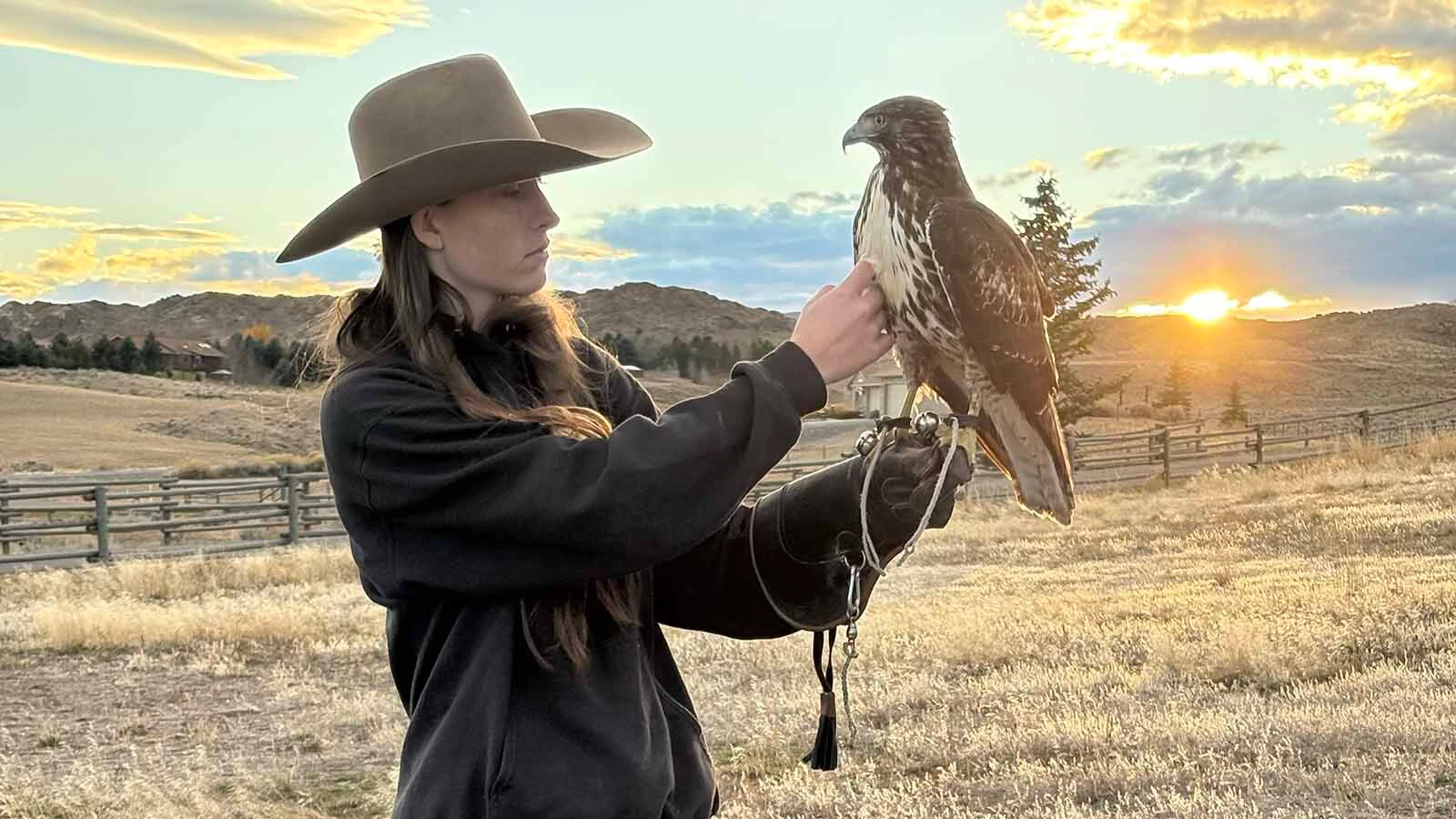
Tessa Clifton, an apprentice falconer in Park County, said she understands that her practice of dropping caged pigeons from a moving vehicle can give onlookers the wrong impression.
They don’t know Clifton is using them as bait to catch a red-tailed hawk to train for falconry. She in turn uses the trained raptors to hunt small game.
Clifton said she can’t come to a complete stop to drop the cage because that’ll scare away the hawk.
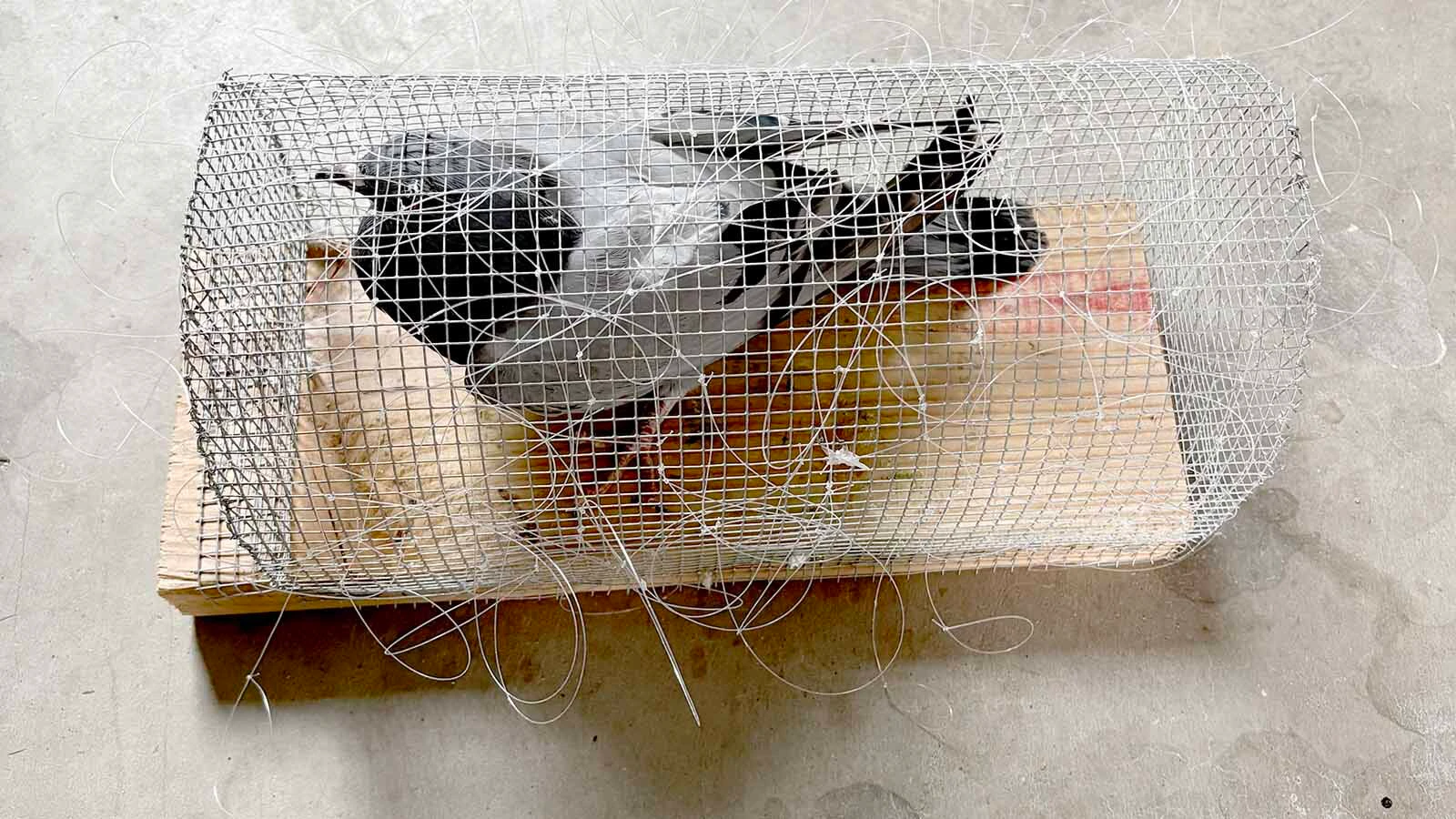
The outsides of the cages are covered in foot snares, and she plants them in hopes of snaring a hawk trying to make a meal of the pigeon.
“You’ve got to do a slow roll by, open the door, drop the cage, and keep rolling,” Clifton told Cowboy State Daily.
Sometimes, Clifton said, people will pull over to help a pigeon and end up spooking the hawk.
She takes it in stride, saying she knows it’s bound to happen. Plus, it gives her a chance to meet new people and tell them about her passion for falconry.
“I’m a total falconry nerd, and there are not that many falconers in Wyoming, or the country as a whole, and I love answering questions about it,” she said.
Childhood Dream
Falconry is regulated by the Wyoming Game and Fish Department and allows licensed falconers to hunt small game with trained raptors. It requires certification and training as an apprentice.
Clifton has about a year left as an apprentice before she can become a general falconer.
Apprentices are limited in the raptors they may take from the wild. Wyoming rules allow them to take certain wild raptors less than a year old, and Clifton said red-tailed hawks are the species she is focusing on.
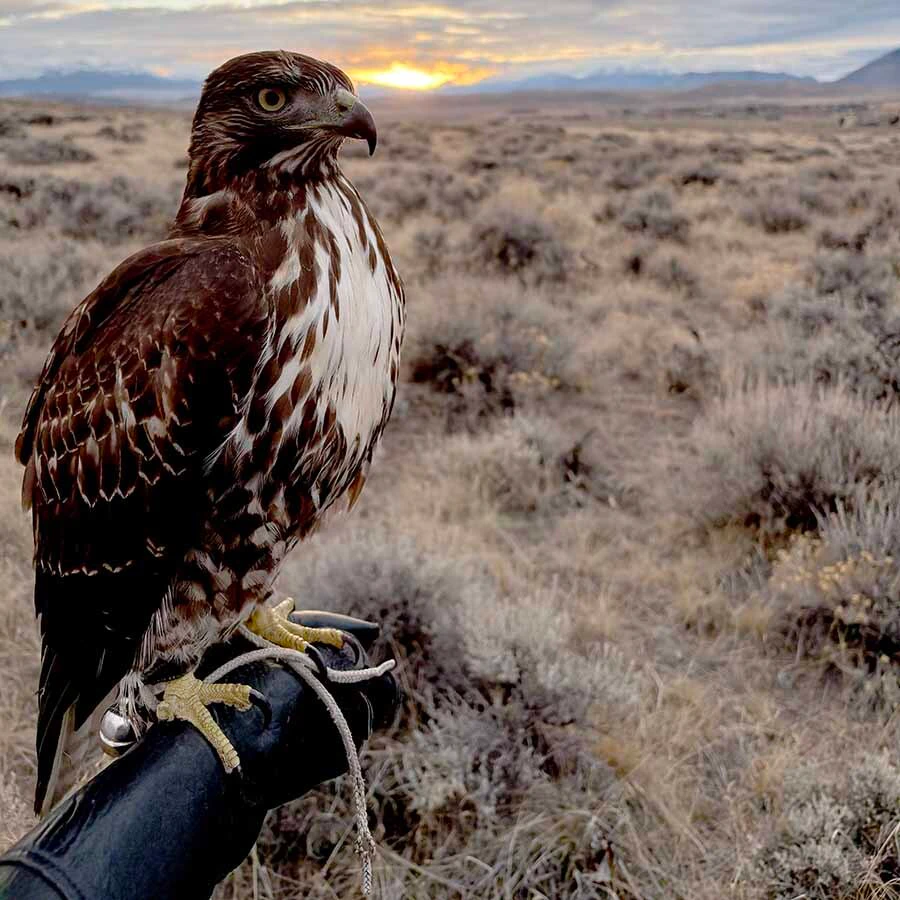
She’s allowed to trap only “passage” hawks, or juveniles. They’re identifiable through their tails, which are brown with dark brown bands.
Mature hawks have the distinctive red tails for which the species is named.
Game and Fish must also inspect and approve the mews or shelter in which a falconer’s raptor is kept.
Clifton grew up in California. She was home-schooled, and her mother was the field-trip coordinator for her homeschool group.
When Clifton was 13, her mother scheduled a field trip to visit a falconer.
She woke up sick that morning but was determined to go on the field trip anyway.
At the falconer’s, she met a Harris’s hawk called Hayduke.
“I held him once, for about 30 seconds, and from that moment on, I was obsessed with falconry,” she said.
Hawks Aren’t Sentimental
Falconry requires a big time commitment, so Clifton waited until she was finished with college and then relocated to Wyoming before taking it up.
She makes a living as a Park County 911 dispatcher. She also breeds and trains horses.
Falconry adds “about another 20 hours” to her already busy week, but she’s willing to do what it takes.
She captured and trained her first hawk last year and called the bird Trip.
That was short for “Triplet” because he came back at the bait in the cage three times before he was caught.
Red-tailed hawks can be trained to hunt in about two to three weeks and “are very forgiving” of a novice falconer’s mistakes, so they’re a good starter raptor, Clifton said.
She used Trip to hunt squirrels and rabbits and then released him back into the wild this spring.
She said she thinks she’s since spotted him in the Meeteetse area.
Training a hawk and hunting with it for a season before releasing it is common practice among falconers, Clifton said.
Raptors can learn to cooperate with falconers for a food reward, but they don’t form a sentimental bond with humans, the way such animals as horses and dogs do, Clifton said.
“It’s a cooperative relationship. And if they decide to fly away (in the middle of a hunt), they just fly away,” she said.
Releasing a hawk entails just taking it into the wild and walking away.
“It’s a little bit sad for the humans. But not the birds. They don’t form that emotional connection,” Clifton said.
'Mary Poppins Umbrella’
Some raptors hunt by “soaring” over vast swaths of territory, using their keen sight to spot prey, Clifton said.
Red-tailed hawks are often perch hunters. They’ll post themselves somewhere with a good field of view, such as atop a telephone pole.
Their usual prey consists of small mammals, animals that “never look up,” she said.
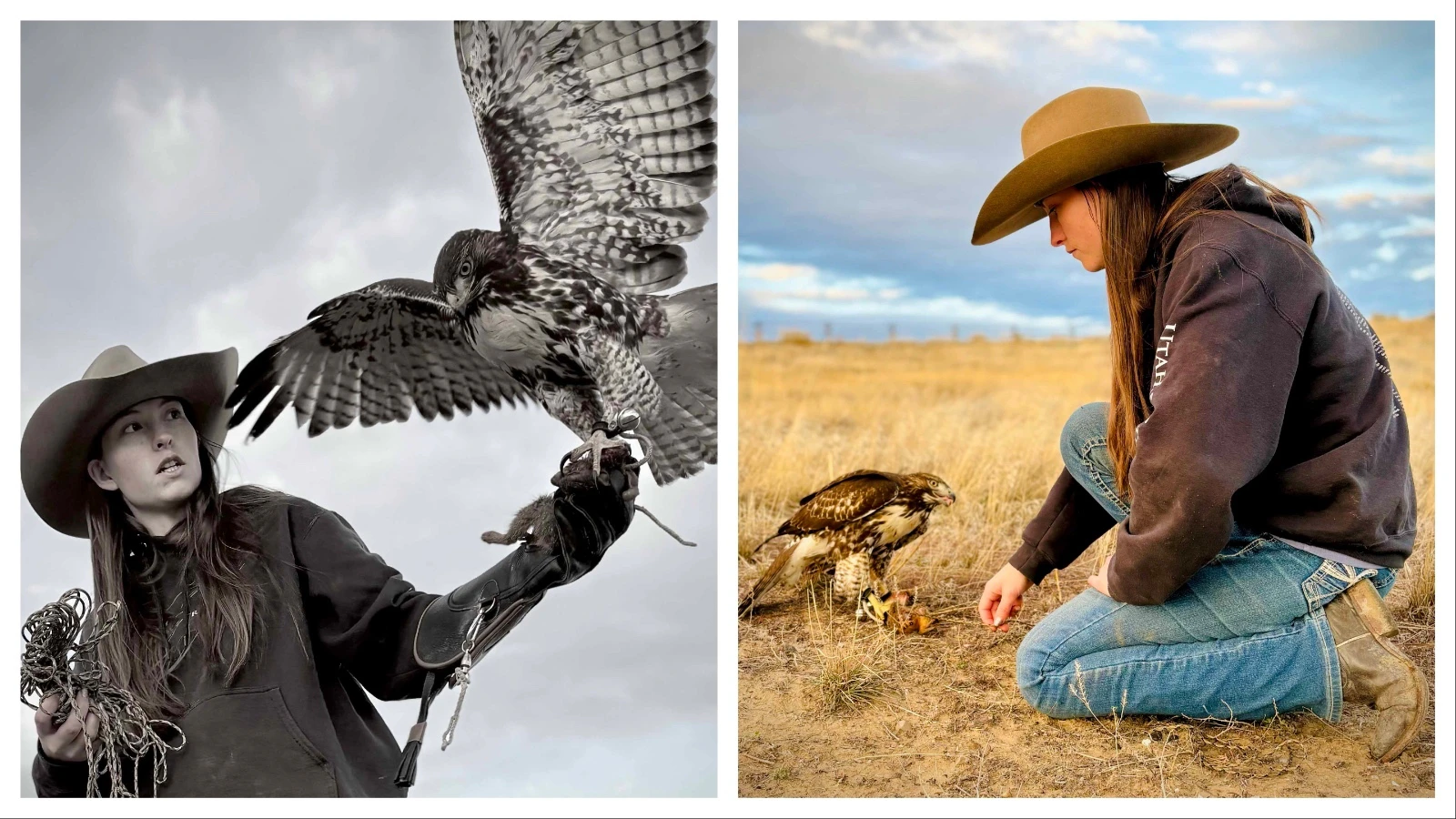
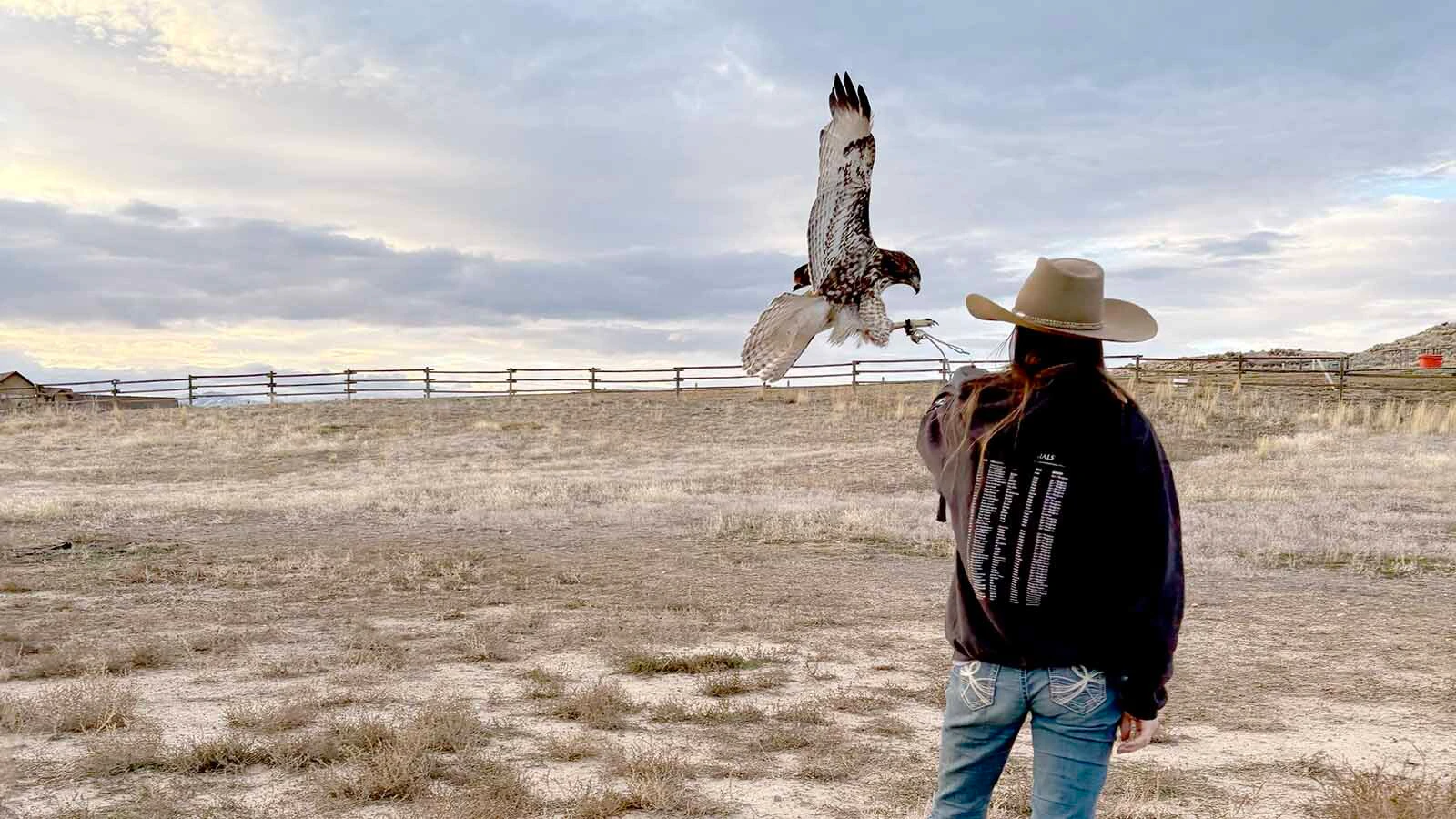
Because the noise of flapping wings can alert the prey, red-tailed hawks sometimes open their wings and essentially parachute down on their prey.
“Almost like floating down on a Mary Poppins umbrella,” Clifton said.
She usually baits her trap cages with mice but hasn’t been able to find any this year. So, she’s been using pigeons because red-tailed hawks will take ground-bound pigeons as “targets of opportunity," Clifton said.
Her preferred method is to cruise the road and look for juvenile red-tailed hawks perched on poles, fences, and the like.
“They’re smart,” Clifton said. "They learn the patterns of traffic and so get suspicious when a car pulls to a full stop in front of them. After dropping the trap cage in a slow roll-by, I'll drive down the road, flip around, and watch through binoculars to see if the hawk takes the bait."
So far this fall “I have about 40 hours in” trying to capture a new hawk, with no luck. She had one good prospect spooked away by a well-meaning motorist who pulled over to check on the pigeon.
Clifton hopes to capture a female hawk because they’re bigger than males.
Getting The Weight Right
Red-tailed hawks aren’t big enough to fly off with some of the animals they kill, such as rabbits or squirrels.
So last year when Trip made a kill, she’d walk up and over and “trade him off the prey,” Clifton said.
That means offering the hawk a tidbit of meat, and once it steps off the prey she coversit with a small towel.
“Hawks are very sight-oriented, so once their prey is covered with a towel, they just ignore it,” Clifton said.
She used the prey meat to feed Trip. And there’s a science to that.
The amount of food must be calculated against the hawk’s weight and other factors, including even the expected temperature during hunting days.
If hawks are fed too little, they become unhealthy. If they’re fed too much, "they get fat,” and lose interest in hunting, Clifton said.
‘A Little Dragon’
Getting captured and trained by a falconer might help a young red-tailed hawk get through its perilous first year of independent life, Clifton said.
“In the wild, 70% of juvenile birds don’t survive,” she said.
When a hawk with falconry hunting experience is released back into the wild, it has an edge, she said.
Raptor researcher Chuck Preston said he supports falconry “when it’s done ethically.”
He confirmed that the survival rate for juvenile red-tailed hawks is low in the wild.
Most die because they can’t quite get the hang of hunting and they starve, said Preston, the founding curator of the Draper Natural History Museum at the Buffalo Bill Center of the West in Cody.
It’s a rough life out there,” he said.
And so, a hawk trained by a falconer might have an advantage, he said.
Clifton said she’s determined to keep trying as long as it takes to capture a new hawk to start training.
“It’s so cool hunting with a hawk. It’s like having a little dragon,” she said.
Mark Heinz can be reached at mark@cowboystatedaily.com.