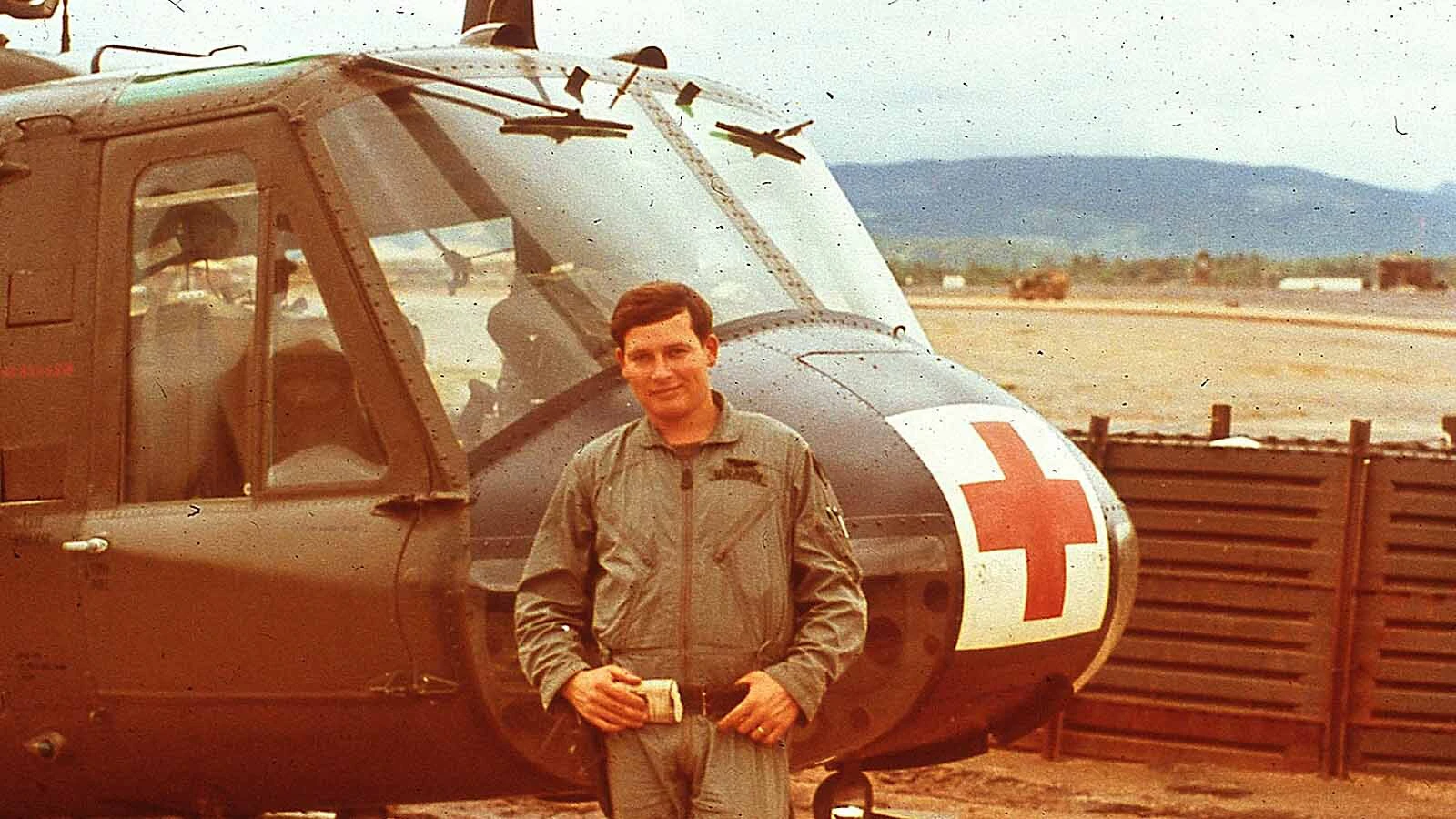
Flying unarmed U.S. medevac helicopters in Vietnam with the big red cross on a white background offered more of a target than protection from enemy fire during the nearly 497,000 missions crews flew from 1962 to 1973.
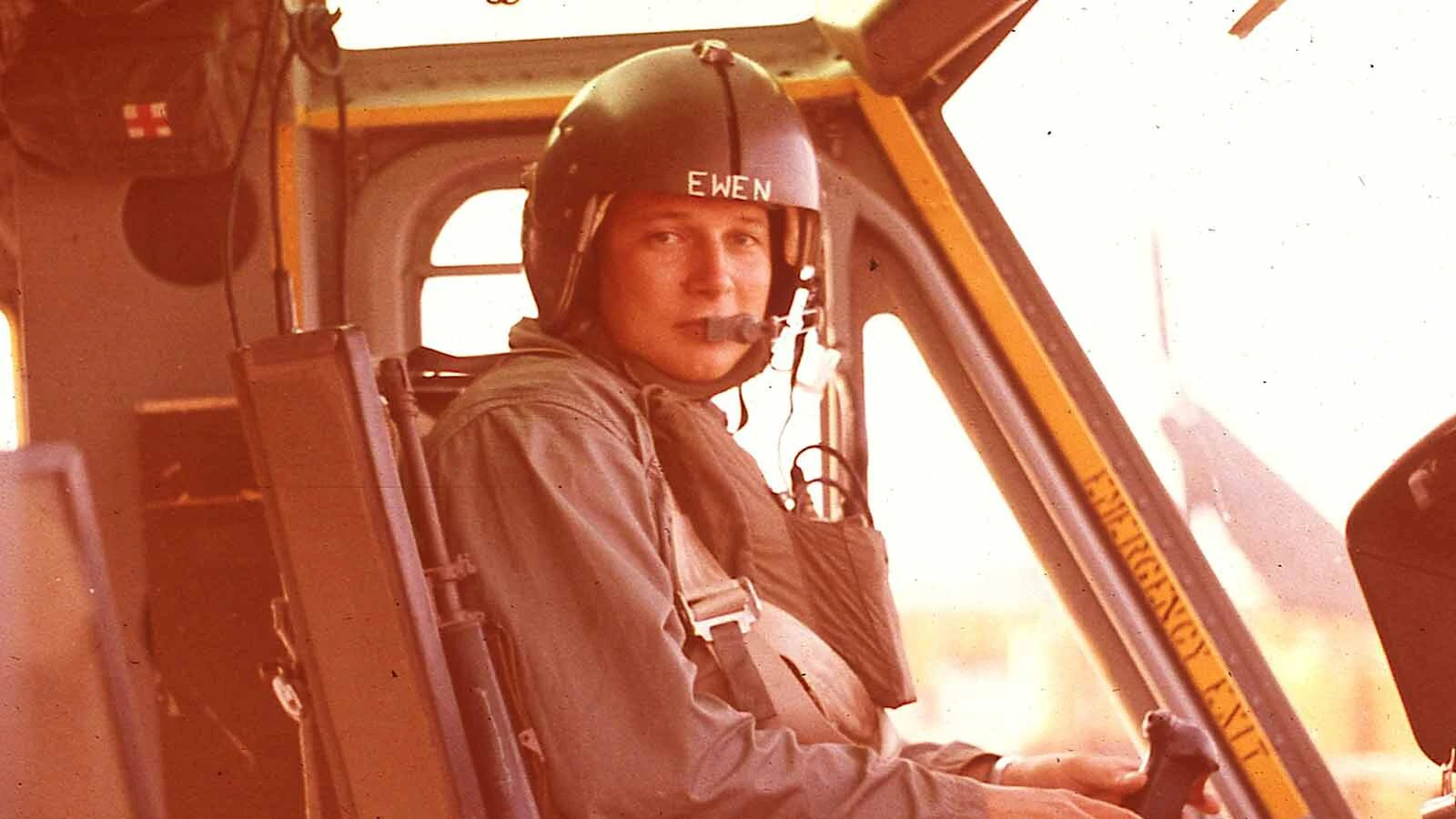
Greybull’s Jerry Ewen, 79, knows that firsthand. He launched his Huey helicopter 1,121 times between March 1968 and March 1969. Despite the red-cross markings intended to identify the aircraft as medical transports, the crews were sometimes targeted by enemy fire.
His last mission proved the point.
“We were ambushed on a night extraction and took many hits. My copilot was hit in the elbow and almost bled to death from a severed artery,” Ewen told Cowboy State Daily. “One of my guys in the back took a bullet through his shoulder.
"My wound was superficial. Some of our flight instruments were shot out, but that wonderful Huey brought us back.”
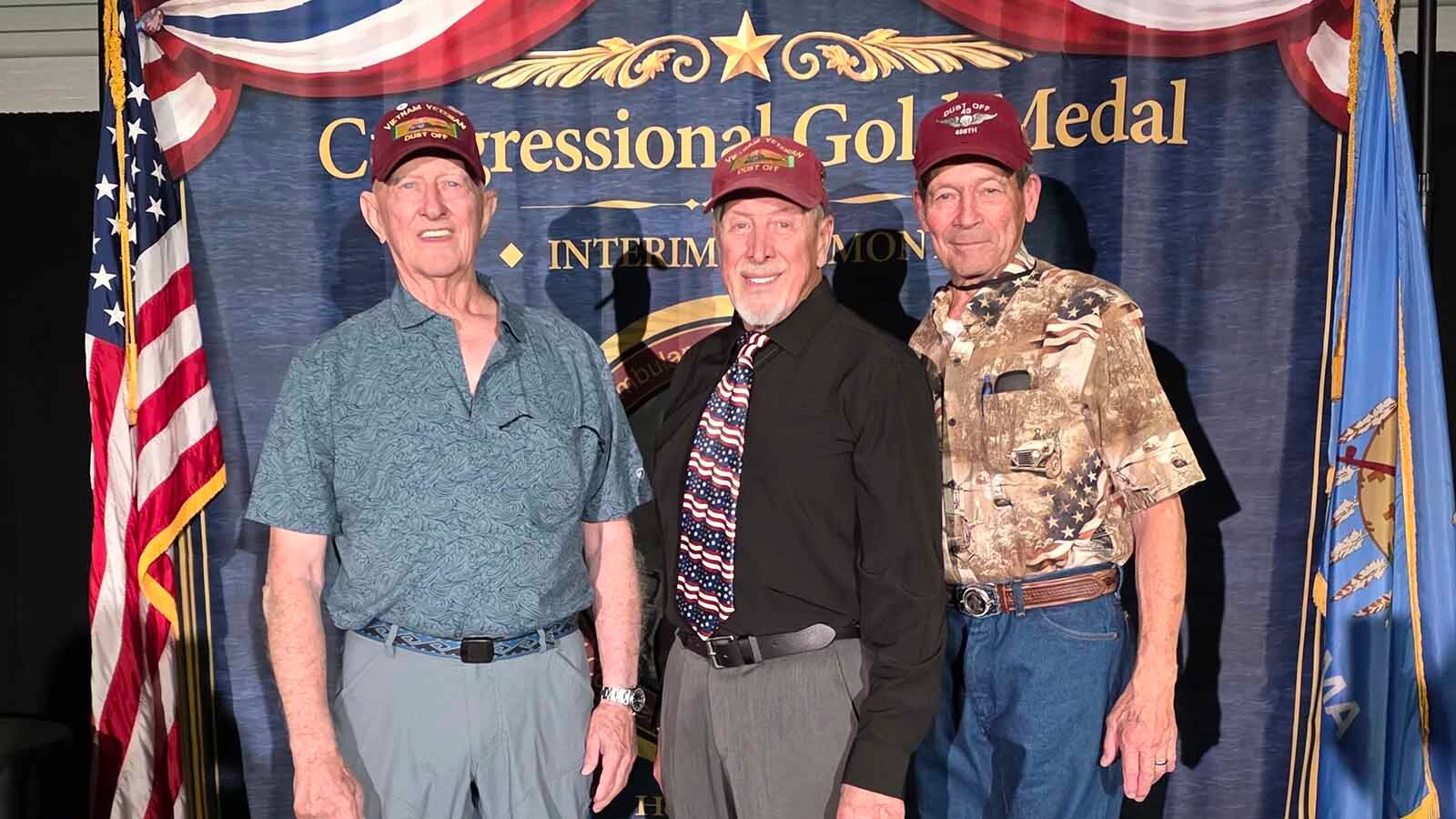
Fifty-seven years after leaving the war zone, Ewen joined other members of the U.S. medevac helicopter Dustoff Association in Oklahoma City for a few days in September to receive an interim Congressional Gold Medal for their service during the war.
Ewen, a former chief warrant officer 2, already possesses 21 Air Medals, a Bronze Star, and a Purple Heart.
The gold medal was approved by Congress in legislation signed into law by President Joe Biden on Sept. 26, 2024, but a dispute has held up production of the official medal at the U.S. Mint.
Ewen said members of the association moved ahead with an interim medal and scheduled the gathering due to the number of people dying.
“I got to see some people that I hadn’t seen since Vietnam,” he said. “We just had a really nice time and a really moving ceremony.”
900,000 Patients
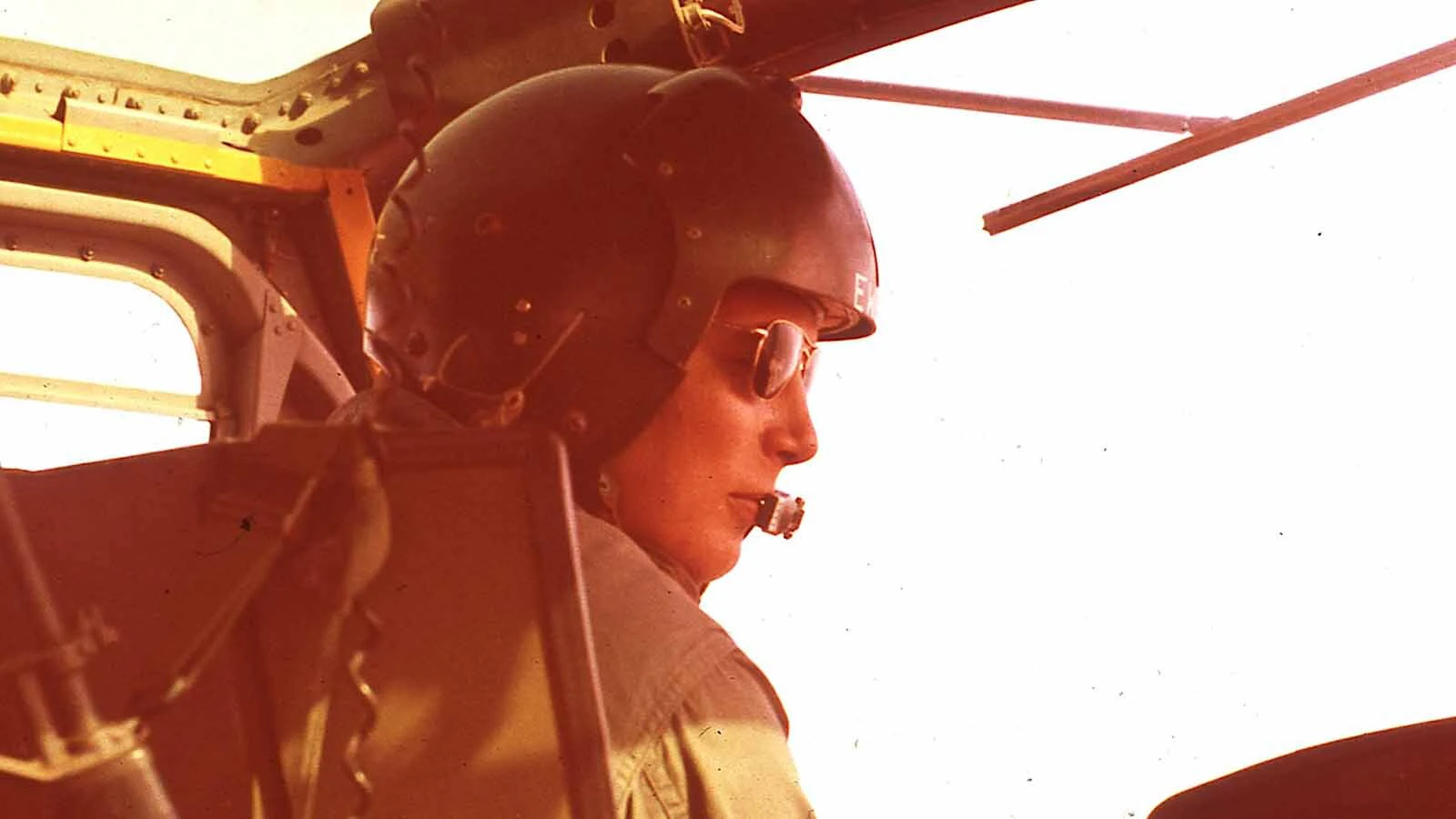
Vietnam-era pilots, crew chiefs, and medics received an interim medal and certificate that states the medevac units flew more than 900,000 patients out of the field during the war.
About one-third of Dustoff crew members were wounded or killed during the war.
Ewen’s close call on his final mission was not the only dicey encounter he experienced while helping rescue wounded soldiers. His crew sometimes sat at a field site on 24-hour call for a month at a time.
His journey to becoming a pilot was not a long-term plan.
The Greybull High School graduate said he was raised on a ranch about five miles north of Shell. After high school he spent three semesters at Northwest College in Powell as an “uninspired” student trying to avoid the draft.
He ran out of money.
Ewen went to the Army recruiter’s office to see what was possible outside of carrying a rifle and walking through a rice paddy.
“They were offering flight school and there was a battery of tests involved,” Ewen said. “I had to take a psychological profile, physical health (exam) and mental health aptitude (test).”
He passed the tests and in February 1967 was sent to basic training at Fort Polk, Louisiana, where he experienced torrential downpours unlike any in the Big Horn Basin.
He went to flight school at Fort Wolters, Texas, where he was introduced to the helicopter, soloed, and learned about weather, avionics, aerodynamics, map reading, weather, and landing in confined areas.
Then came orders to Fort Rucker, Alabama, where he flew his first Bell UH-1 “Huey” helicopter. He was trained in instrument flying and tactical flying and completed several cross-country night flights.
By the end of training, about 50% of the flight candidates failed. Ewen did not.
He was given his warrant officer rank and initially received orders for the Fourth Infantry Division in Vietnam.
Ewen was granted a 30-day leave, but just before flight-school graduation, his orders were changed to two weeks of leave and an “unassigned” status in Vietnam.
On the way to Vietnam, he turned 21.
His Welcome To War
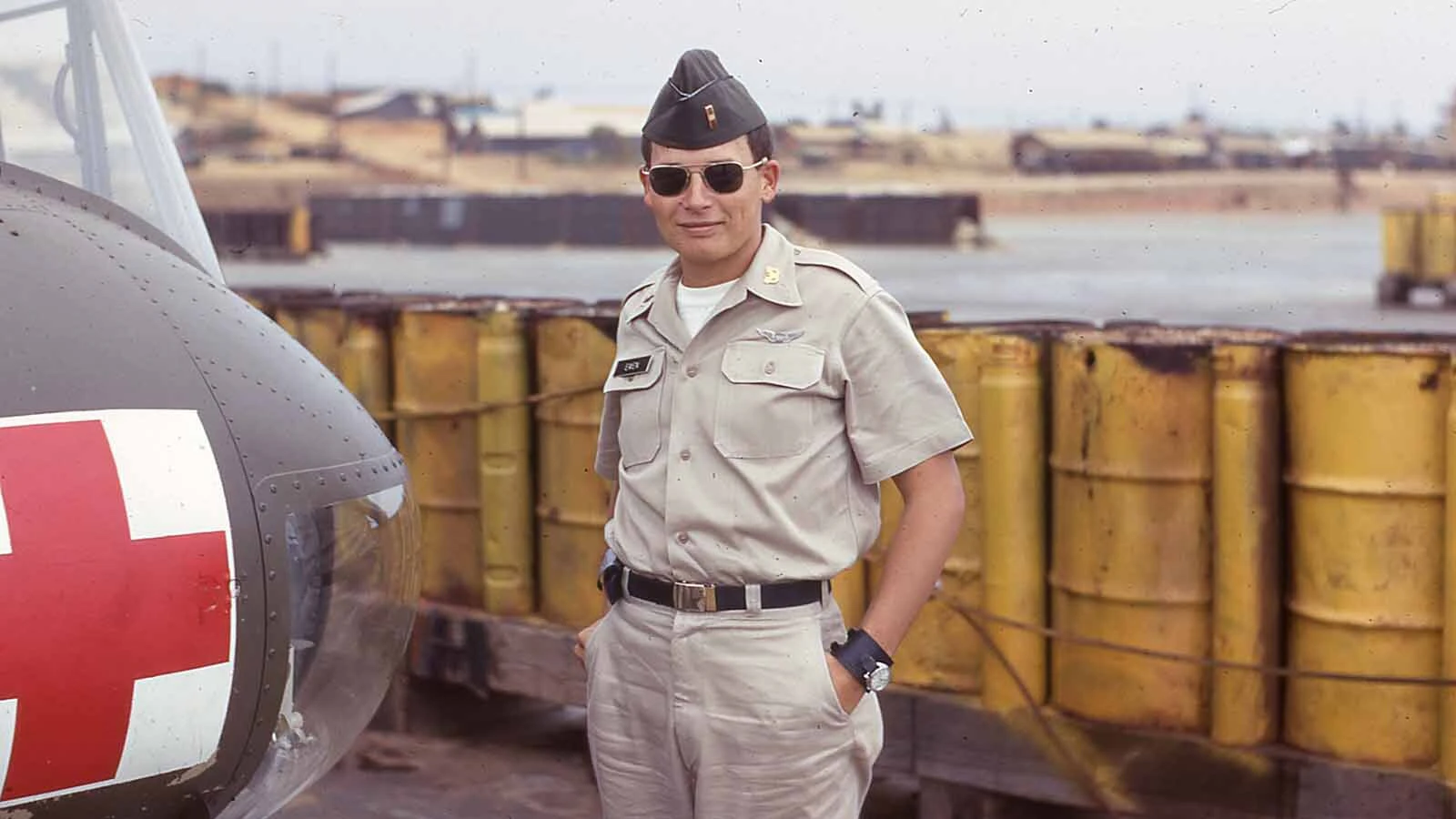
Once in the country in March 1968, just after the Tet Offensive by the North Vietnamese People’s Army and Viet Cong, he went to a replacement depot to receive his assignment. He was told to report to the 44th Medical Brigade.
“I honestly did not know what that was or what they did,” he said. “So, I asked him. He said, ‘You’ll be flying medical missions, Dustoff.'”
The term “Dustoff” was the radio call sign associated with Army medical evacuation missions. It can refer to the dust churned up by helicopter blades or to the phrase “Dedicated, Unhesitating Service To Our Fighting Forces,” Ewen said.
His first mission quickly brought him into the reality of war. He brought back the body of a soldier killed in action and another soldier experiencing a mental-health crisis after accidentally shooting his friend while cleaning his weapon.
That soldier tried to jump out of the helicopter in mid-air.
Ewen’s housing tent was next to graves registration, and he would see the bodies waiting to be registered and understand that there was “a man lying there, a boy really, and he was dead and his family didn’t know it yet.”
“Yeah, it was a shock,” he said.
After about 200 hours flying missions as a co-pilot, he was given a check ride and elevated to become pilot of his own craft. Each flight included a pilot, co-pilot, combat medic, and crew chief responsible for helicopter upkeep on the ground, and for assisting the medic and monitoring the right side of the helicopter in the air.
Flying at night to pick up the wounded in the jungle often meant using a hoist to lower seats to the jungle floor while hovering in the treetops. The helicopter was a sitting target for the enemy.
Ewen said they would point their landing searchlight into a tree ahead, and a second landing light straight down so the medic could direct the hoist that controlled the chair. He would settle the helicopter as far down into a tree as possible without causing issues.
“I think my record for time at a hover over a hoist mission was 45 minutes,” he said. “That’s an eternity.”
New Assignment
Ewen spent six months based out of Lane Army Airfield with the 498th Medical Company near Quy Nhon and then was reassigned to the 54th Medical Detachment in Chu Lai.
“They only had like 14 pilots and had lost two or three aircraft, everybody on board,” he said. “So they were short of pilots, especially experienced pilots. So I went there and spent the rest of my tour, the last six months.”
There were missions where a U.S. plane would drop a bomb in the jungle to create a landing zone and he would have to descend into a tight hole in the canopy to pick up the wounded, then take off straight up to avoid trees.
Ewen recalls a mission near the coast when a fog bank rolled in. He could only see five feet in front of the chopper. Relying on his training, he took off using instruments and contacted his base and a radar site for help.
He was guided back to base 25 minutes away via radar, totally blind outside the cockpit windows.
“I got comfortable with it, where I just felt OK,” he said.
In addition to his last mission, where his chopper was shot up, Ewen remembers another mission west of Chu Lai where he was sure they were not going to come back alive.
North Vietnamese Army forces were dug in and inflicting heavy casualties on U.S. troops and helicopters.
Ewen’s crew was launched to get the wounded.
He spoke by radio with a ground commander leading troops through a rice paddy. The commander told him not to try an approach or landing because nothing was secure.
As he watched from above, the North Vietnamese forces launched rockets into the middle of the U.S. troop position. The commander radioed Ewen that he couldn’t ask him to try and come down to help, but added “we need you really, really bad.”
Ewen said he took a vote among his crew about what to do. They all voted to attempt a landing.
“I started the approach knowing that we weren’t going to survive,” he said. “But God was with us and we flew in, got our patients, and flew out under fire all the time and never got hit by one round. … It was divine intervention is what I call it.”
After serving his year-long tour, Ewen was reassigned to Fort Wolters, where he worked as a flight instructor, an assignment he enjoyed.
Readjustment
Ewen married his Greybull High School sweetheart, Kathy, during his own flight school, and when he returned from Vietnam, they had their first child.
The Army then decided it had too many pilots and discharged him six months earlier than his initial commitment.
He took a job with Ross Perot at Electronic Data Systems in Dallas, but after three years of working in a cubicle and navigating downtown traffic, the couple decided to move back to Greybull to raise their family.
Ewen took a job flying helicopters with Hawkins & Powers Aviation. One of his first assignments in 1973 was to ferry FBI agents to various places in South Dakota as the federal government dealt with the Wounded Knee uprising.
His skills as a pilot were put to use assembling towers in the mountains, fighting fires, doing game counts and making construction runs with concrete for microwave towers in the mountains.
After several years he left the company due to all the travel involved and started his own construction business.
He returned to Hawkins & Powers again during a construction downturn and flew with them until 1991, when he left aviation for the last time, going back to his construction business.
As with many Vietnam veterans, the war changed him, Ewen said. He understands now that he returned to the States with some post-traumatic stress.
But there are no regrets.
“I learned a lot of things that served me well and some things that didn’t,” he said. “But I’ve always been glad I served because our mission as the air ambulance units was one of mercy. I never had to shoot anybody, and we saved literally thousands of lives.”
Dale Killingbeck can be reached at dale@cowboystatedaily.com.