
Before taking a heavy truck, RV or trailer down the 10% grades of Teton Pass, drivers will need a certificate starting Thursday.
The Wyoming Department of Transportation’s new WY22 Safe Pass program requires drivers of RVs, vehicles towing any trailer and vehicles weighing or rated for 10,000 pounds or more to complete an online safety course and self-certification before traveling Wyoming Highway 22 over Teton Pass.
The certification is free, good for one year, and takes about five minutes to complete.
It arrives after an especially deadly summer on the pass.
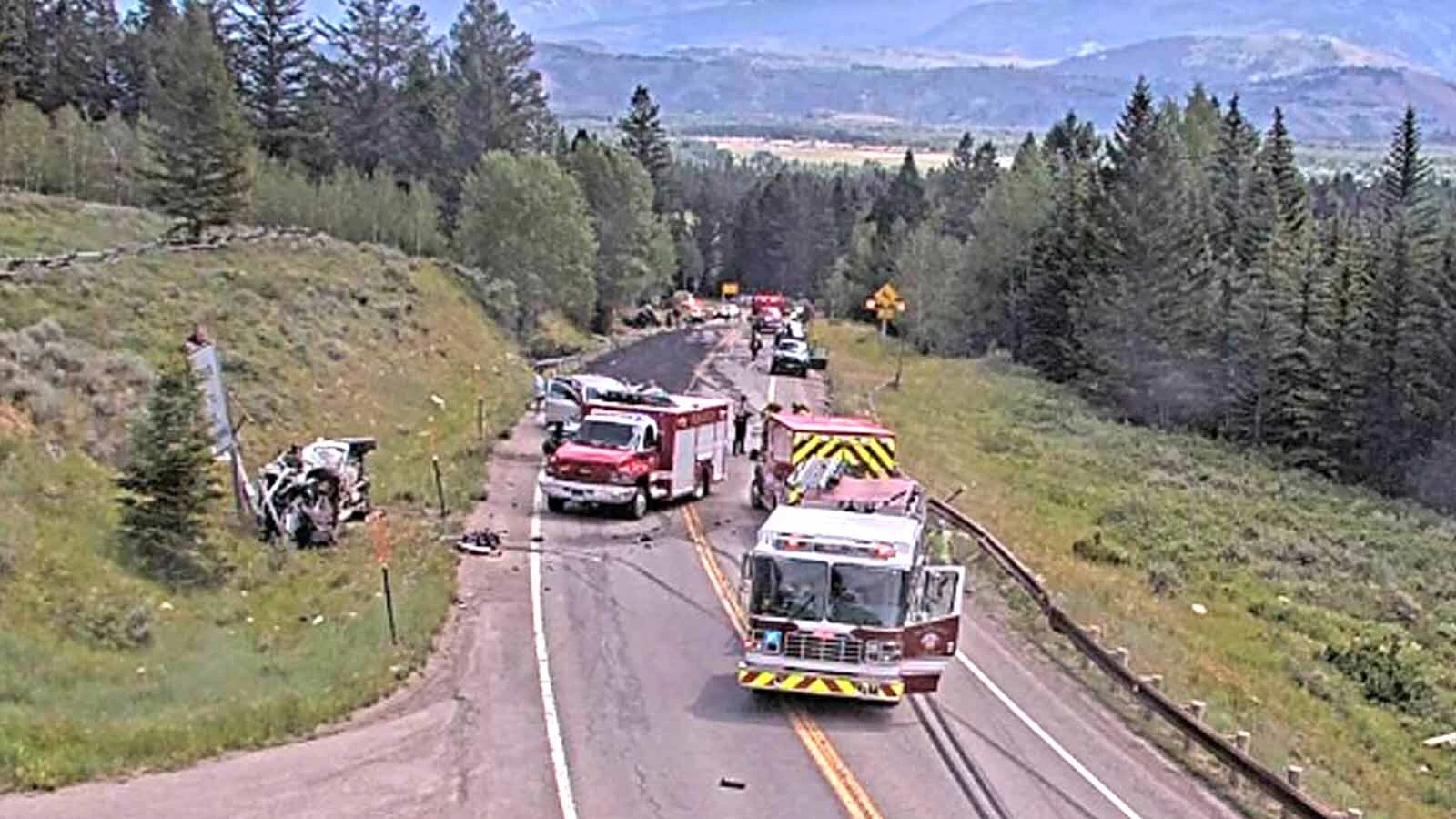
On July 7, a dump truck descending toward Jackson lost its brakes and plowed through a string of vehicles, killing two.
Investigators later determined the truck's brakes faded after its driver overused them while descending too fast. The driver also passed opportunities to stop, including a runaway vehicle escape ramp shortly before the crash. He has since been charged with two misdemeanor counts of homicide by vehicle.
Then, in September, a 41-year-old Colorado man was killed when the Ford F-250 he was riding in gained speed descending the pass, crossed the opposite lane and went off the highway. The pickup hit an uphill driveway, went airborne and rolled. The Wyoming Highway Patrol investigation into that crash remains ongoing.
For Kevin Hawley of the Wyoming Trucking Association, those dangers aren't solely a trucking problem.
“A typical mountain grade — 6%,” Hawley told Cowboy State Daily. “Sections of this pass are 10%, that is challenging for anyone.”
He supports Safe Pass and would take it even further.
“I would challenge local residents and daily commuters to participate in it as well,” he said. “I have seen and experienced unnecessary and dangerous operations from passenger vehicles, as well.”
Five Minutes
Chris Howerton has held a Class A commercial driver's license for 32 years and spent years driving trucks before becoming an RV park manager in the Jackson area.
He decided to go online and see for himself what Wyoming will require drivers to know. The entire process took about five minutes.
After creating an account, a timer requires users to spend at least three minutes on the educational portion before they can move forward.
The material includes two videos.
One explains Teton Pass' runaway-vehicle safety systems, including the CatchNET truck arrestor and escape ramp, and what drivers should do if they lose control.
The other deals with getting down the mountain in the first place: Selecting a low gear, using engine braking, avoiding riding the brakes, recognizing brake fade and what to do if the brakes stop doing their job.
Drivers also work through a pre-trip inspection list and information about the pass' weight, trailer and seasonal restrictions.
There's no final exam. Instead, drivers reach a list of boxes they must check individually.
They certify that they've reviewed the educational material and their vehicle owner's manual, understand how to use lower gears and engine braking, will make sure their brakes and trailer brakes are working, know where the escape ramp and CatchNET system are, and will conduct a walk-around inspection before traveling the pass.
Another box requires drivers to agree that at the first sign of brake trouble they'll pull over somewhere safe and allow the brakes to cool for at least 20 minutes.
Drivers also pledge to follow weight and trailer restrictions and posted speeds, use lower gears on the descent and carry or use tire chains when Wyoming's chain restrictions require them.
Finally comes a more consequential box: The driver certifies under penalty of perjury that the information provided is correct and that he or she has read and will comply with the requirements.
Hit submit and the driver can download a digital certificate.
‘I Hope So’
Brandon Guymon has spent his life around trucking and is now safety manager for ND Nursery and Landscaping in Driggs, Idaho.
“When you think about a 10% grade, a lot of the other passes that you look at — Donner Pass, Cabbage Hill over in Oregon and California — they're not 10% grade,” he said.
Teton Pass holds that 10% grade for roughly three miles, he added, without much relief along the way.
“That's what makes it tough,” Guymon said. “You don't have a break point where it smooths out. It's just straight downhill for that full three miles.”
He agrees that getting information in front of drivers can help, especially drivers coming from outside the region who may have no idea what awaits on the other side of the summit.
But a certificate can't give someone mountain-driving experience.
“You could go through this in three minutes,” he said. “Do you have to read it? No. Are people going to read it? I hope so, because that is how they're going to know about the Teton Pass and what the dangers are of it.”
Guymon thinks all drivers should make a habit of stopping at the summit before beginning the descent.
“Once you get on top of that hill, you pull over, you check your brakes before you go down,” he said.
Drivers also need to select the proper gear before starting the descent rather than trying to solve the problem after gravity has taken over.
His company takes another precaution. When it hires a semi driver unfamiliar with Teton Pass, Guymon said that person makes the trip several times with an experienced driver first.
“A mountain pass is not something that you mess with,” he said.
‘I Can Smell Your Brakes’
Chris and Elin Howerton see the other end of that learning curve.
As managers of The Virginian RV Park in the Jackson area, they spend their summers welcoming a steady stream of motorhomes, trailers and rental RVs.
“A lot of people come in; it's their very first trip in an RV,” Chris said. “Sometimes this is their very first stop.”
When they arrive after driving Teton Pass, sometimes Chris doesn't even have to ask which way they came.
“I'll come up on the golf cart next to them and say, ‘Oh, you came over the pass, didn't you?’” Elin said. “And they're like, ‘Yeah, but how do you know that?’ I said, ‘I can smell your brakes.’”
The Howertons said mountain-driving experience among RV travelers varies wildly.
A couple from London arrived Monday morning after successfully taking the pass. The husband told Elin he'd switched the vehicle into manual mode and used its lower gears on the descent.
They've also hosted people from New Zealand who were accustomed to mountain driving at home, but “most do not,” Elin said.
And the consequences aren't limited to rented RVs.
Last summer, Chris said, six or seven privately owned RVs had to be towed off Teton Pass and into their park. One needed its brakes replaced after it arrived.
When Elin takes a reservation, she asks where the guests are coming from.
If they're coming from Idaho or West Yellowstone, she recommends Alpine or going back through the park.
Experienced drivers with large coaches equipped with engine brakes are one thing, she said. For everyone else, she tries to get a feel for whether they understand what they're about to drive.
Even with decades behind the wheel of commercial trucks, Chris doesn't plan to take his own RV over Teton Pass.
“My wife would not want to, even with all my driving experience,” he said.
“Not with our RV,” Elin added.
‘Worst Feeling In The World’
Guymon doesn't have to imagine what brake fade feels like because it's happened to him.
He was descending South Pass near Lander when he experienced it and remembers the feeling distinctly.
“That is the worst feeling in the world,” he said.
“As soon as you experience brake fade, you're already behind the gate.”
Brakes convert the energy of a moving vehicle into heat. Repeatedly applying them on a long, steep descent can build enough heat that their ability to slow the vehicle deteriorates — the phenomenon known as brake fade.
That's why WYDOT tells drivers to use a low gear and engine braking to control speed rather than continuously riding the brakes. Its mountain-driving guidance also tells motorists to use pullouts to let hot brakes cool and, if the brakes fail, sound the horn and use a runaway ramp or CatchNET arrestor when available.
Guymon said motorists traveling the pass on a hot day might have smelled the warning themselves.
“You might smell like this burnt rubber almost,” he said. “That's that brake fade that you're smelling.”
By then, he said, the driver has a serious problem.
Out-Of-State Drivers
Hawley thinks a few minutes of focused review “is an extremely valuable starting point, especially for drivers who may not realize how different a 10% grade is from ordinary driving.”
He believes the information about gear selection, brake fade, inspections and alternate routes can prevent serious mistakes, particularly among RV and trailer drivers unfamiliar with mountain driving.
But he doesn't portray five minutes online as a substitute for experience.
“We view it as an additional useful layer of preparedness, not a complete substitute for skill and judgment,” Hawley said.
Guymon said the danger is especially pronounced for out-of-state drivers who might follow their navigation over Teton Pass without understanding what they're getting into.
“You have a lot of people not from Idaho or Wyoming that decide, ‘I don’t want to go through Alpine. I’d rather just go over Teton Pass in an 18-wheeler,’ or in whatever size of vehicle that they have,” he said. “If they go over that and they don’t know anything about that pass, that’s dangerous, and we see that all the time.”
And, he said, not every navigation system gives drivers the same warning.
“Google Maps doesn’t say anything about going over the pass that you shouldn’t. Waze doesn’t,” Guymon said. “Garmin GPSs that are specifically meant for truckers do, but there’s certain apps that people use that just don’t. So having more knowledge, yes, will help.”
The Wyoming Trucking Association also plans to work with WYDOT, Wyoming Highway Patrol and its Idaho counterpart to spread the word. Hawley said the group wants to reach carriers outside the region and explore early warnings through GPS and telematics systems.
“Safety on Teton Pass is a shared responsibility,” he said.
Deadly Lessons
The problem Safe Pass is trying to address predates this summer.
In August 2024, an RV pulling a Ford F-150 was coming down Teton Pass when its brakes failed. The driver tried to get off the highway, but the RV rolled onto its roof and came apart, killing a 72-year-old Nevada resident and injuring four others.
WYDOT's own analysis of crashes from 2002 through 2012 counted 17 on the stretch between the summit and Wilson, with 12 people injured and two killed. Four involved vehicles weighing more than 60,000 pounds, while one fatal crash occurred while a vehicle was using the old runaway truck ramp.
That history helped produce engineering changes, weight restrictions, warning signs, speed-detection systems and the CatchNET arrestor.
Safe Pass is the newest layer.
Hawley likes that it doesn't single out professional truckers when RVs, trailers and other heavy vehicles face the same mountain.
Guymon said education is worthwhile, but he'd like to see something more tangible: A dedicated brake-check area and greater enforcement before drivers commit to the descent.
“If you have an RV, if you have a certain amount of pounds, if you have a semi, why not have a brake-check station up there?” he said.
Because once a driver discovers halfway down a 10% grade that the brakes aren't doing what they're supposed to, Guymon said, the lesson has come much too late.
Kolby Fedore can be reached at kolby@cowboystatedaily.com.


