
A standing-room-only crowd packed Glenrock Town Hall on Tuesday night as residents from Glenrock and nearby Rolling Hills came looking for answers about four license-plate-reading cameras that have been operating around the community for roughly two years.
They wanted to know who authorized the cameras, where they are located, why Glenrock needs them and who controls the information they collect.
By the end of the special town council meeting, some residents said they are still looking for answers.
“A lot of questions were brought up,” Glenrock resident Shalyn Kovach told Cowboy State Daily. “Very few were answered.”
The meeting was organized after a group of residents appeared at a regularly scheduled Glenrock Town Council meeting earlier this month with questions about the town’s Flock cameras.
Police Chief Colter Felton, who has previously discussed the cameras with Cowboy State Daily, was absent from that meeting because of a family medical emergency.
He did not respond to calls and emails Wednesday.
Tuesday’s meeting gave residents an opportunity to ask their questions directly.
“It was a great turnout,” Glenrock resident Jack Street told Cowboy State Daily. “There were a lot of great questions.”
Kovach estimated that between 40 and 50 people attended, with some standing along the walls of the meeting room.
Operating For Two Years
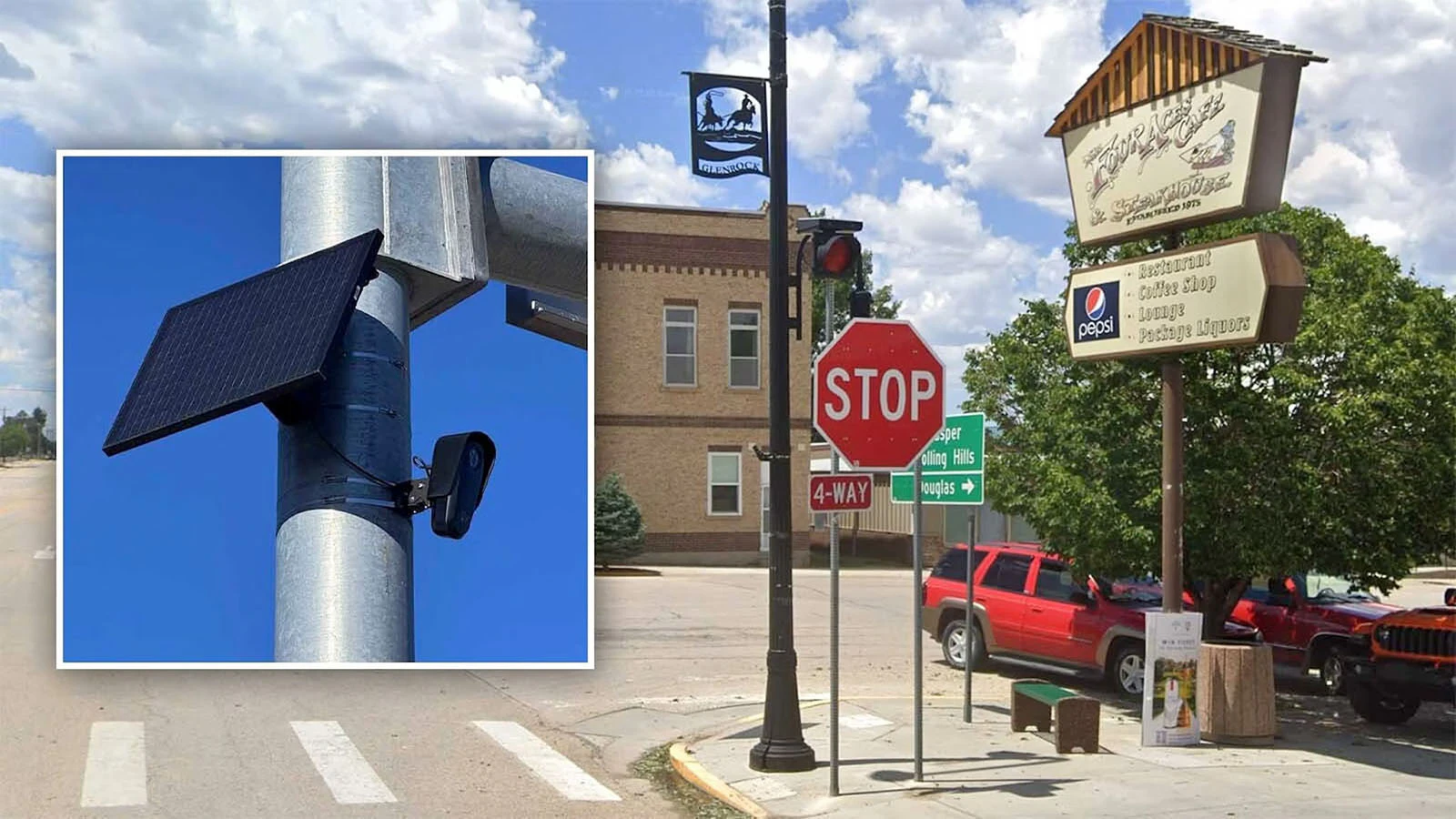
Four Flock cameras are positioned on the edges of Glenrock.
The automated license-plate recognition cameras record information about passing vehicles and can provide law enforcement with information that might help identify vehicles connected to criminal investigations.
Mayor Bruce Roumell previously told Cowboy State Daily the cameras were purchased and installed in 2024 after the police department included them in its budget and the council approved their purchase, installation and use.
Kovach said she first noticed the cameras about a year ago but did not remember hearing about a town council meeting specifically focused on whether Glenrock should have them.
At the time, she assumed the decision had already been made and that she had missed her opportunity to weigh in.
“I thought, ‘It is what it is. I missed my chance to speak. Apparently nobody cares,’” Kovach said.
Then a July 3 Cowboy State Daily article about Glenrock’s cameras stirred a broader conversation. The story revealed a public-records request showing that Felton, acting on behalf of Glenrock, secured a Wyoming Department of Transportation permit to mount license-plate readers on highway rights of way.
Kovach said she began to realize she was not the only person wondering how the cameras came to Glenrock and what they meant for privacy.
“I realized that I was not alone in being worried about our rights,” she said. “It’s a slippery slope.”
Safety Vs. Privacy
Felton has previously told Cowboy State Daily the primary purpose is public safety.
The technology can help law enforcement identify vehicles connected to crimes such as kidnappings, bank robberies and other serious offenses.
“I have nothing to hide,” Felton said. “I will tell you our cameras are strategically placed, so we’ll know simply if a vehicle comes out or into Glenrock. I couldn’t tell you anything about what a person does in the vehicle.”
He has also said he believes the cameras can be a valuable investigative tool.
But for Kovach and others, the question is whether the benefit outweighs what they see as the potential cost to privacy.
“I understand that we can save people with these systems,” Kovach said. “But I also feel we are paying the police officers.”
Flock has said its technology helps law enforcement solve crimes, but Kovach questions whether that justifies the widespread collection of vehicle information.
“Is it really enough to risk our privacy and our Fourth Amendment rights?” she asked.
Street said he also worries about where the technology could lead.
“We can all see where this is going,” he said.
Kovach said she has generally trusted the Glenrock Police Department. But when the cameras appeared, she began asking herself a question she had not previously felt the need to ask.
Should she trust police with this technology?
“I think we could do police force without it,” she said.
Glenrock has a population of roughly 2,400, and some question whether license-plate readers are necessary in a small community they see as relatively safe.
Glenrock resident Eric Farrington previously told Cowboy State Daily he questioned whether the technology was necessary in a town with comparatively little crime.
“We’re used to policing ourselves,” Farrington said.
Felton previously said he did not know why Glenrock’s cameras had generated less controversy than similar systems elsewhere.
“I like to believe it’s due to the trust they have for us, in law enforcement,” he said. “But I can’t speak on others’ behalf.”
Tuesday’s turnout, however, suggested that trust in the department does not necessarily mean residents are comfortable with the technology without more discussion.
Questions, But Few Answers
Several residents who attended Tuesday’s meeting said they appreciated the opportunity to raise questions but left frustrated by how some of those questions were handled.
“When I walked away, I still felt like a lot of questions got roundabout answers,” Street said.
He said he appreciated Councilman Roy Kincaid, who remained after the meeting to continue discussing concerns.
Kincaid did not respond to Cowboy State Daily’s request for comment. Neither did council members Judi Colling, Russ Dalgarn and Margaret Nunn.
Street and other attendees also criticized the way the meeting ended.
Alisha Hodge told Cowboy State Daily the question-and-answer session ended before everyone who wanted to speak had the opportunity.
Street said Roumell began turning off microphones and lights while people were still in the room.
“I felt that was very unacceptable for the mayor to do that,” Street said.
He also said he did not believe Roumell appeared attentive throughout portions of the meeting.
“I felt him acting like that was very uncalled for,” Street said.
Resident James Parsons expressed a similar impression in a social media post after the meeting, saying he was interested to see what the council ultimately decides about the cameras.
“With the exception of Bruce, they all seemed to be attentive and a couple actually seemed to care,” Parsons wrote.
Roumell did not respond to Cowboy State Daily’s request for comment about residents’ concerns over how Tuesday’s meeting ended.
Part Of A Larger Debate
When Glenrock’s cameras were installed in 2024, Street said, the technology was still relatively new to many residents.
“In 2022, this stuff was new,” he said. “Nobody had any idea of what we know now.”
Since then, Flock Safety and automated license-plate reader technology have become the subject of growing debate, with privacy advocates and civil liberties groups raising concerns about surveillance, data collection, information sharing and how long vehicle data is retained.
Flock has grown rapidly, deploying a large network of cameras across the country.
According to the Pacific Legal Foundation, a nonprofit public interest law firm, an estimated 120,000 cameras along American roads log data into a nationwide, searchable database accumulating billions of records every month.
The company has also faced an increasingly vocal backlash from privacy advocates and grassroots groups opposed to the technology.
There’s even a website called haveibeenflocked.com where citizens can enter their license plate number to see if they’ve been surveilled.
Flock CEO Garrett Langley acknowledged in a 2025 interview with Forbes that he regretted describing DeFlock, a group that has organized opposition to the company’s camera systems, as a “terroristic organization.”
“My comments were a mistake and I apologize,” Langley told Forbes. “There are groups today that have real valid criticisms of the business.”
He said the company is trying to find a balance between privacy and public safety.
That is much the same question now facing Glenrock residents: Whether their small Wyoming town can have both.
Kate Meadows can be reached at kate@cowboystatedaily.com.


