
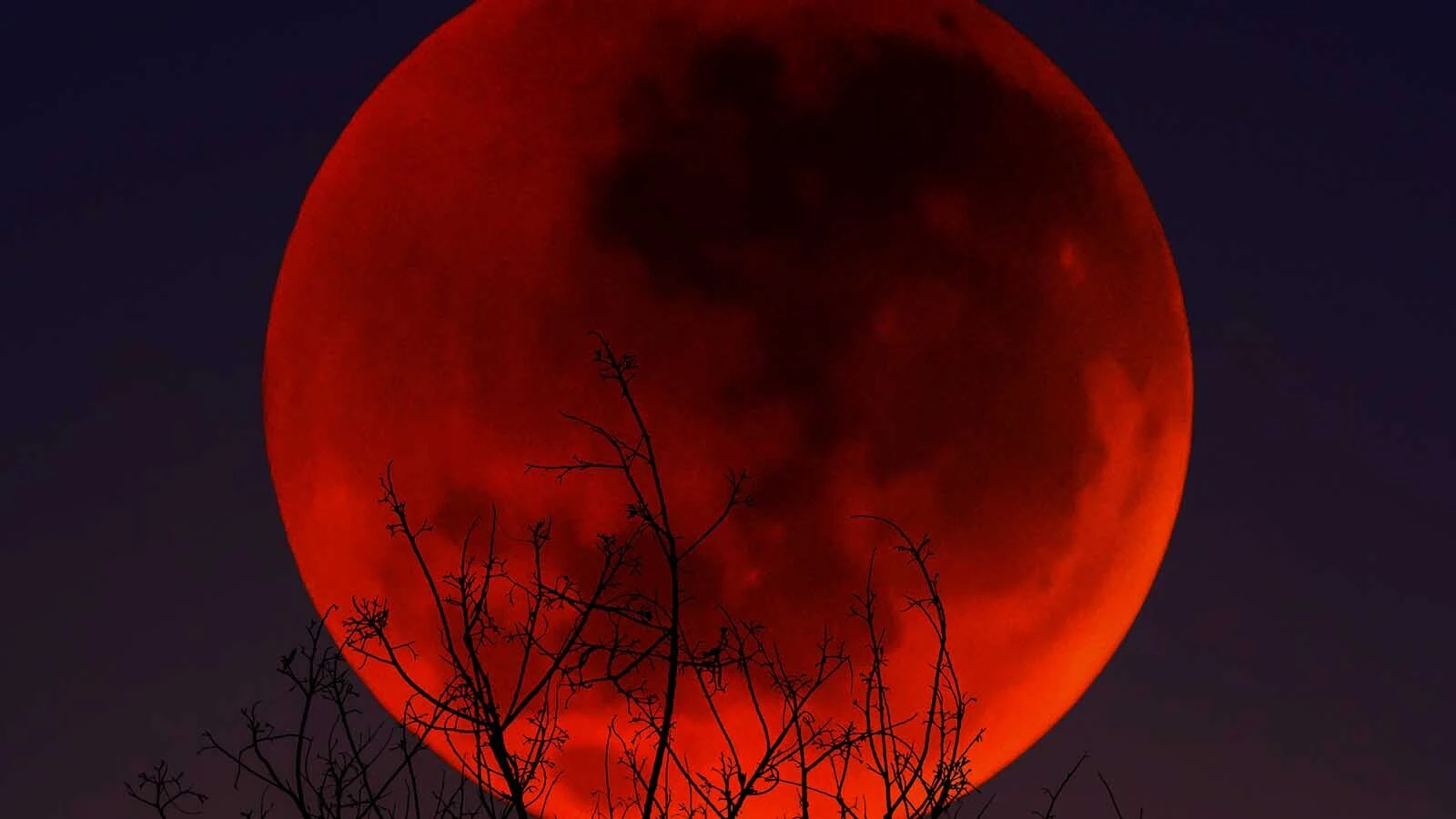
A 96.2% full lunar eclipse will be visible over Wyoming on Thursday night, and most people will get to see the best of it before bedtime.
When the Earth’s shadow covers the moon, it will appear mostly covered in blood-red light, except for a slim sliver of light at the top corner.
Provided it isn't too cloudy, this lunar eclipse should be one of the best over Wyoming in a while.
“If we have to have a partial eclipse, this is the kind I'd like to see,” said Jan Curtis, retired meteorologist, climatologist, and former Wyoming State climatologist.
When?
Lunar eclipses have multiple phases. For Wyomingites, Thursday’s will start more than 30 minutes before the moon rises at 7:52 p.m.
When the moon rises, a portion will already be covered by the Earth’s shadow.
By 8:33 p.m., the moon will be 50% covered. That’s the beginning of the partial-eclipse phase.
The eclipse will reach its climax at 10:12 p.m. over Wyoming. By then, nearly the entire moon will be covered.
Even if it isn’t a total eclipse, the moon should still appear blood-red to anyone who can see it.
“What we’ll see is a reddish moon with a slight sliver of silver at the edge,” Curtis said.
Where In Wyoming?
When the eclipse reaches its maximum, the moon will be in the southeast sky, well above the horizon near the constellation of Aquarius.
Because lunar eclipses only occur during a full moon, the moon shouldn’t be hard to spot across Wyoming. Still, it’s always best to observe celestial events from the darkest spot possible.
For anyone who wants to get photos of the eclipse, Pinedale photographer Dave Bell said lunar eclipses are “a piece of cake.”
“It’s a little like watching grass grow, but watching the whole thing unfold is a great experience,” Bell told Cowboy State Daily.
It doesn’t take an expert to see and get great photographs of a total lunar eclipse. All that’s needed is timing and clear skies, he said.
"It’s an easy shot, from a camera perspective, because it happens slowly. You have time to think about what you want to do on the fly, but you can still look at it and not worry about hurting your eyeballs,” Bell said.
Bell recommended a mirrorless camera lens with a wider aperture and a slower shutter speed to capture the most lunar detail during the lunar eclipse. Smartphones have limitations in aperture and shutter speed, but settings can be tweaked to get the most out of the technology.
Tripods, meanwhile, are a no-brainer.
What About The Weather?
The only variable that can’t be accounted for is the weather. The eclipse might be spectacular from Wyoming, but it won’t matter if it’s overcast.
“I hope it’s not cloudy,” Bell said. “I’m very hopeful it won’t be, but you don’t know what the weather’s gonna do.”
As far as weather goes, Cowboy State Daily meteorologist Don Day said Thursday night will be “a mixed bag.”
“There will be clouds, most likely in the southwest and north-central counties, but some clear spots and scattered clouds elsewhere,” he said. “Not perfect, but many should be able to see it.”
What If I Miss It?
Unlike total solar eclipses, which require conditions so precise there won’t be another anywhere over Wyoming until July 3, 2084, total lunar eclipses occur much more frequently.
Max Gilbraith, planetarium coordinator for the University of Wyoming, said anyone who can’t see Thursday night’s eclipse should have plenty of opportunities to see others.
“Lunar eclipses happen every year and a half or so,” he said in March 2025. “The moon has to be opposite the sun to get into the Earth’s shadow, and there are many opportunities for that to happen in a calendar year.”
The next lunar eclipse should be visible over Wyoming on Feb. 20, 2027. However, that will be a penumbral eclipse, where the moon passes through the lightest part of Earth’s shadow. It will be barely noticeable from the Earth’s surface.
For Curtis, this eclipse is as good as a lunar eclipse can get, unless it’s total.
“Partial eclipses are usually only 20% or 50%, but this is over 96%,” he said. “That makes this one unusual and spectacular. The prime time for this eclipse will be between 10 and 11 p.m., so with clear weather, it’ll be quite a show before everybody goes to bed."
Andrew Rossi can be reached at arossi@cowboystatedaily.com.


