
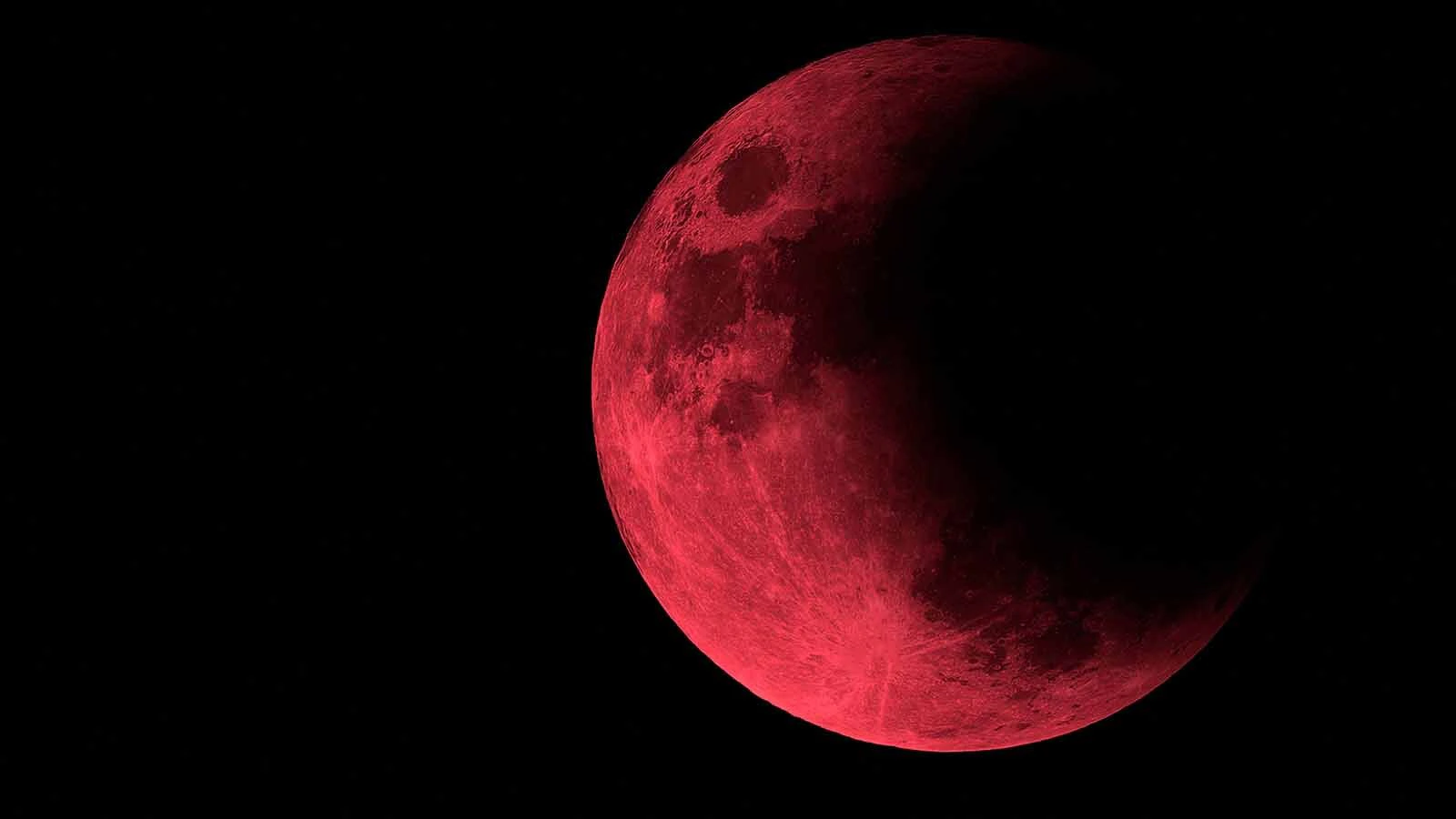
There’s a partial lunar eclipse for Wyomingites to look for on Aug. 27, but “partial” does it a disservice.
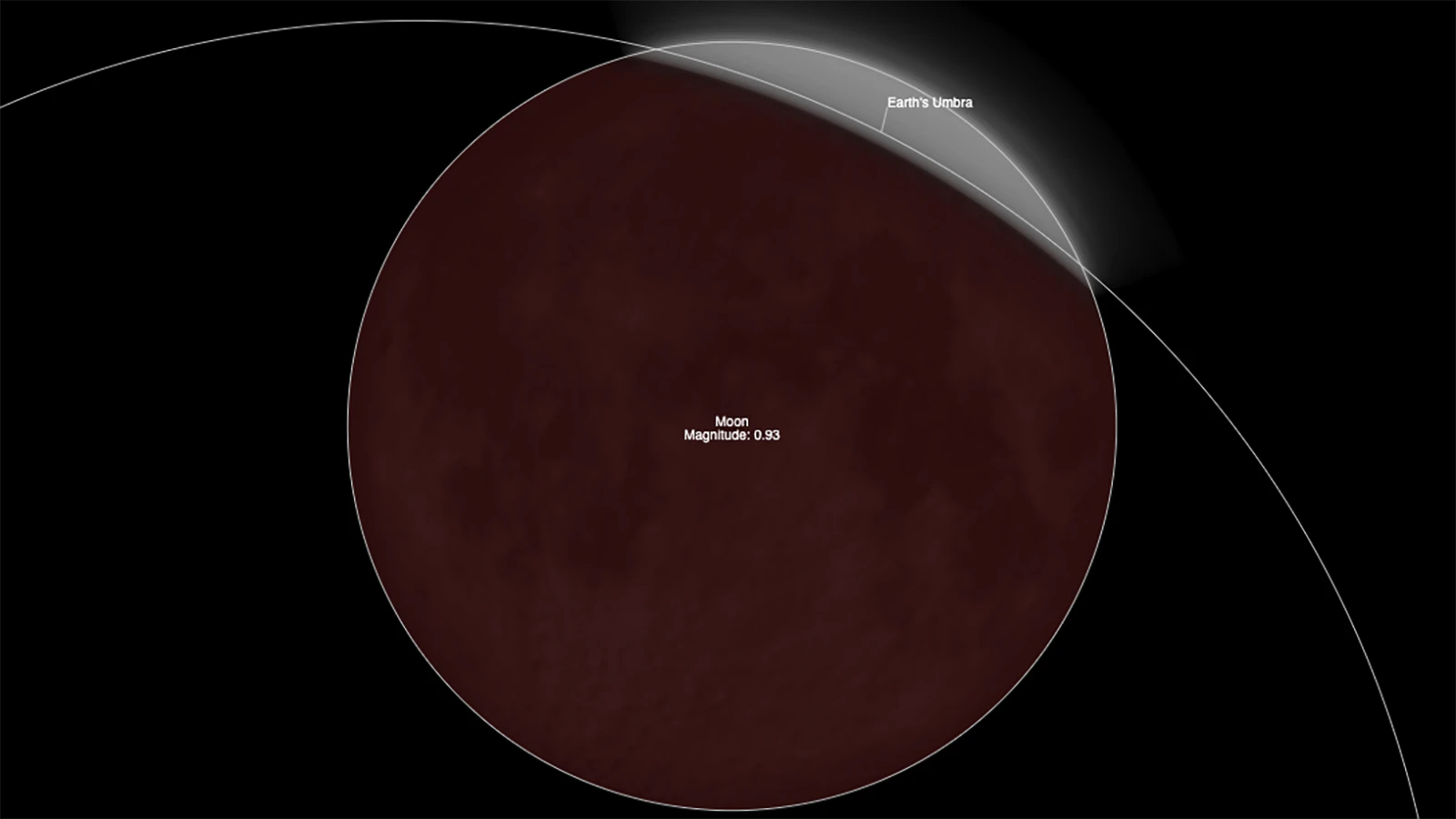
When the eclipse reaches its maximum at 10:12 p.m. Thursday, 96.2% of the moon will be covered by the Earth’s shadow. The only uncovered part of the full moon will be a tiny sliver at the top.
“If we have to have a partial eclipse, this is the kind I'd like to see,” said Jan Curtis, retired meteorologist, climatologist, and former Wyoming State Climatologist. “If you’re away from cities and it’s dark enough, it almost acts like a total eclipse. It should be very noticeable to anyone watching.”
Shadow On The Sturgeon Moon
Lunar eclipses occur when the moon’s orbit aligns with the Earth and the sun. When the Earth moves in front of the sun, it casts its shadow on the moon.
The Earth's shadow usually makes the moon appear blood-red because the wavelengths of sunlight are filtered through Earth’s atmosphere. High-wavelength colors, like blue and green, are scattered before they reach the moon’s surface, leaving only a low-wavelength deep red color to reach the moon.
The lunar eclipse will start over Wyoming at 7:23 p.m. on August 27. That’s when the first phase, the penumbral eclipse, begins and Earth’s shadow starts creeping over the moon.
Wyomingites won’t see the beginning, as the moon won’t rise until 7:52 p.m. When it rises, it'll look like a chunk of the moon is gone.
By 8:33 p.m., the moon will be 50% covered. That’s the beginning of the partial eclipse phase.
The final phase, the maximum eclipse, is when the Earth’s shadow will almost, but not quite fully, cover the moon at 10:12 p.m. For anyone on the East Coast, that'll be at 4:12 a.m. Aug. 28.
Even if it isn’t total, the moon should still appear blood-red to anyone watching it.
That’s about as good as a lunar eclipse can get if it isn't total, but Curtis said this near-total eclipse could be even more spectacular.
“What we’ll see is a reddish moon with a slight sliver of silver at the edge,” he said. “It’ll be an interesting contrast. Partial eclipses are usually only 20% or 50%, but this is over 96%. That makes it unusual and spectacular.”
It’s All Cyclical
Lunar eclipses happen with the same frequency as solar eclipses, but they’re easier to see.
Solar eclipses are rarer because the shadow cast by the moon is much smaller. It has to be in a precise position to block the sun completely from our earthly perspective.
Most Wyomingites won’t get to see the next solar eclipse visible over Wyoming. It won’t happen until July 3, 2084, and it’ll only be a partial eclipse visible from the southwestern corner of the state.
Meanwhile, there can be two to three partial or total lunar eclipses in a single year. The last total lunar eclipse occurred in March, although most people probably missed it as it reached its maximum at 4:03 a.m.
“The prime time for this eclipse will be between 10 and 11 p.m.,” Curtis said. “With clear weather, it’ll be quite a show before everybody goes to bed.”
It’s not a coincidence that a total solar eclipse occurred Aug. 12. That one was only visible from Iceland and small sections of Spain and Portugal.
The Aug. 27 partial lunar eclipse will be visible across all of North and South America, Africa, the Middle East, and western Europe. Even Antarctica will get a good view.
“It’s very common when you get a solar eclipse, then you get a lunar eclipse two weeks later,” he said. “Two weeks later, we’re still in the plane of the shadow's effect.”
Eyes On The Skies
By 1:01 a.m. Aug. 25, the eclipse will be over. The partial phase will last 3 hours and 18 minutes, peaking at the maximum 96% at 10:12 p.m.
Curtis had a simple recommendation for Wyomingites: if you can see the partial lunar eclipse, you should.
“It should be a good show, and there could be more to see,” he said. “It’s been an interesting month.”
Curtis noted that when lunar eclipses are total or near-total, it’s easier to see the Milky Way, especially if you’re in an area devoid of lights.
The annual Perseids meteor shower should be over by Aug. 24, but that doesn’t rule out the possibility of seeing a few shooting stars after sunset Aug. 27.
But if we’re especially lucky, there could be some Northern Lights to see as well.
“A fairly large solar flare came off the edge of the sun earlier this week,” Curtis said. “If the sun’s coming back to life, the maximum eclipse might prove to be the best time for the Northern Lights.”
Solar flares, or coronal mass ejections, create auroras when they reach Earth and interact with its atmosphere. If one or several of these flares hit at the right time and place, they manifest as ribbons of colorful light.
The sun is cycling out of its solar maximum, which means the chances of solar flares and auroras will be much lower for several years. Curtis is hopeful there might be a few more opportunities to see some dazzling auroras before the year's out.
"I'm hopeful that we'll get one or two more good displays before the cycle ends, so keep an eye out for that," he said.
Regardless of these exciting possibilities, the partial lunar eclipse is exciting enough to get Wyomingites away from their neighbors into the pristine night to see the blood-red moon before bedtime.
“The moon will be high in the sky by 10:12 p.m., so it’ll be easy enough to find, but keep your eye out for anything else that might be in the skies that night,” Curtis said.
We just have to hope it isn't cloudy that night.
Andrew Rossi can be reached at arossi@cowboystatedaily.com.


