
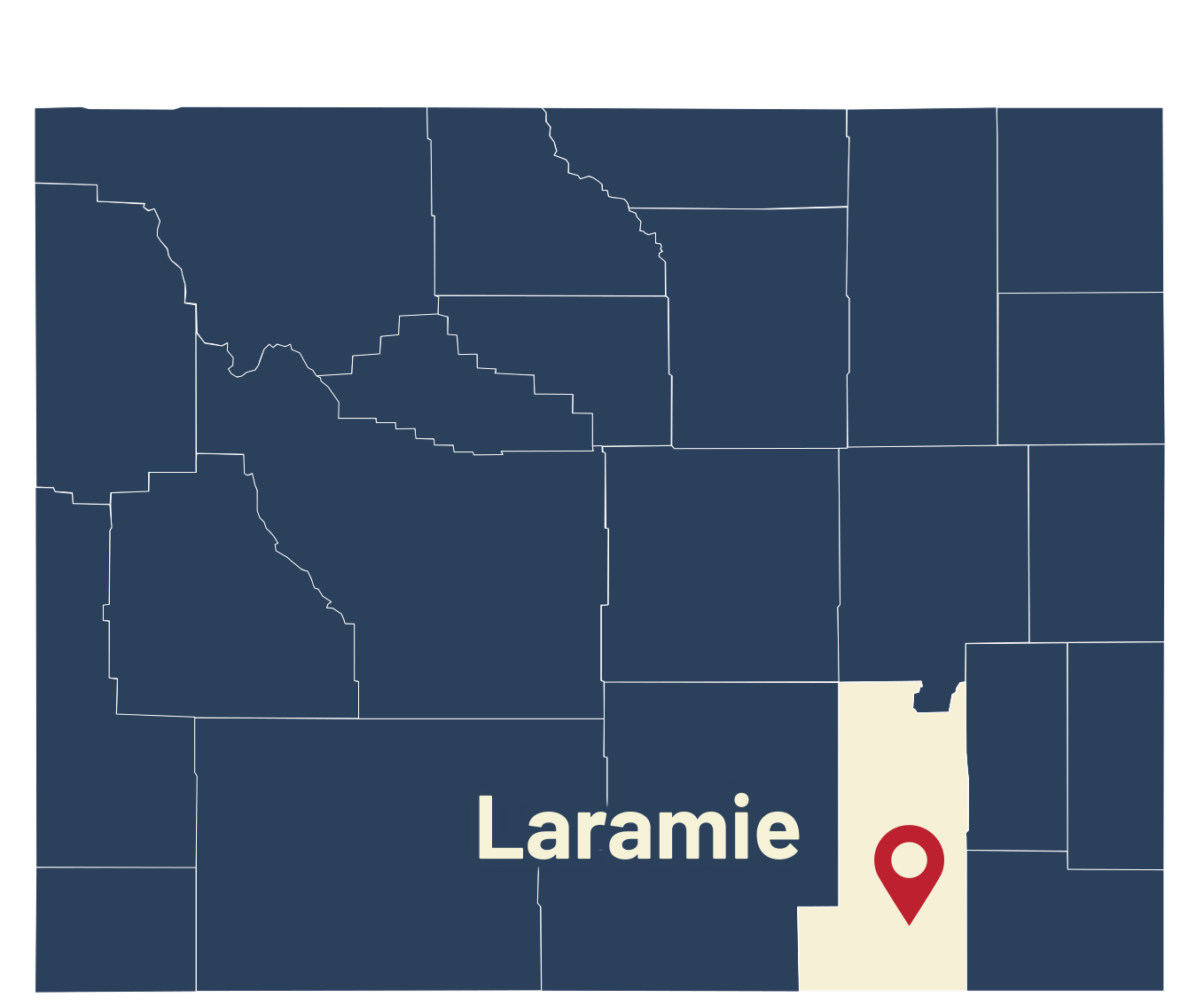

Simply by making a trip to Laramie, Wyoming, one can flip through an unpublished script from a never-produced 1970s Spider-Man movie and then watch home movies from one of the greatest comic book legends ever.
These kinds of priceless documents and more belonging to comic book legend Stan Lee are all available at the American Heritage Center, on the University of Wyoming campus, which holds the only archival collection of materials created by Lee.
The Heritage Center has maintained a relationship with Lee’s archives since 1977 and now has stacks and stacks of his papers encompassing about 125 cubic feet of space at the facility — more than 200 boxes of comic book history from his personal collection.

Stan Lee stands with his archives at the American Heritage Center in 1994. The collection takes up more than 200 boxes. (American Heritage Center) 
The University of Wyoming has had a relationship with Marvel Comics legend Stan Lee for nearly 50 years, and is home to a huge part of his personal collection of memorabilia — more than 200 boxes of it. (Stan Lee Presents, screenshot from video) 
The University of Wyoming has had a relationship with Marvel Comics legend Stan Lee for nearly 50 years, and is home to a huge part of his personal collection of memorabilia — more than 200 boxes of it. (Stan Lee Presents, screenshot from video) 
The University of Wyoming has had a relationship with Marvel Comics legend Stan Lee for nearly 50 years, and is home to a huge part of his personal collection of memorabilia — more than 200 boxes of it. (Stan Lee Presents, screenshot from video) 
Stan Lee stands with some of his work at the Heritage Center in 1994. (American Heritage Center) 
Stan Lee signs autographs for Wyoming kids during a visit in 1994. (American Heritage Center) 
Stan Lee and Spider-Man speak with students at the UW Lab School during a visit in 1994. (American Heritage Center) 
The University of Wyoming has had a relationship with Marvel Comics legend Stan Lee for nearly 50 years, and is home to a huge part of his personal collection of memorabilia — more than 200 boxes of it. (Stan Lee Presents, screenshot from video) 
The University of Wyoming has had a relationship with Marvel Comics legend Stan Lee for nearly 50 years, and is home to a huge part of his personal collection of memorabilia — more than 200 boxes of it. (Stan Lee Presents, screenshot from video) 
The University of Wyoming has had a relationship with Marvel Comics legend Stan Lee for nearly 50 years, and is home to a huge part of his personal collection of memorabilia — more than 200 boxes of it. (Stan Lee Presents, screenshot from video) 
The University of Wyoming has had a relationship with Marvel Comics legend Stan Lee for nearly 50 years, and is home to a huge part of his personal collection of memorabilia — more than 200 boxes of it. (Stan Lee Presents, screenshot from video) 
The University of Wyoming has had a relationship with Marvel Comics legend Stan Lee for nearly 50 years, and is home to a huge part of his personal collection of memorabilia — more than 200 boxes of it. (Stan Lee Presents, screenshot from video) 
The University of Wyoming has had a relationship with Marvel Comics legend Stan Lee for nearly 50 years, and is home to a huge part of his personal collection of memorabilia — more than 200 boxes of it. (Stan Lee Presents, screenshot from video)
What’s There?
Lee is considered one of the biggest names in comic book lore, helping create iconic superhero characters Spider-Man, the X-Men, Iron Man, Thor, the Hulk, Ant-Man, the Wasp, the Fantastic Four, Black Panther, Daredevil, Doctor Strange, the Scarlet Witch, and Black Widow for Marvel Comics.
Although the Marvel comic book collection at the Heritage Center totals in the hundreds, that isn’t the primary focus of the Lee collection, said Rhiannon Skye McLean, who oversees the collection and is an avowed comic book fan.
Instead, it contains many more of Lee’s personal works, such as never-before-seen scripts and personal writings.
“He lived and breathed it, and everything he lived and breathed made its way into our hands eventually,” Skye McLean said.
Skye McLean said the collection showcases the progression of Lee’s life and career, showing “the comic before the comic.”
It includes everything from Lee’s early renditions of his famous signature and earliest work to personal correspondence with fans.
They even have a copy of a rare Spider-Man comic focused on child-abuse prevention.
During the 1970s, Lee was publisher of Marvel Comics, and McLean said his work reflected this. In the 1980s, a different focus was visible through his dedication to developing Marvel’s film and television projects.
Paul Flesher, director of the Heritage Center, said dozens of Lee fans visit each year to look at the Lee archives, a number which doesn’t include the many people searching through the archives’ online troves almost daily.
His papers are so popular they keep a section of his collection permanently available to the public in the reading room.
“We can’t keep them off the shelves because when one Stan Lee patron ends, another one will come in and request it,” Skye McLean said.
How Did It Get There?
Ironically, Hollywood isn’t well known for holding onto its history, Flesher said.
He pointed to the fact that the University of Southern California School of Cinematic Arts manages the Warner Bros. Archives, yet has only one archivist on staff to look after the collection.
“In Hollywood, they’re not interested in what happened in the past,” he said. “They’re not historians. They’re more interested in creating and producing, and so they don’t really pay attention.”
Lee had become connected to the Heritage Center through the facility’s longtime former director Gene Gressley.
Flesher said Gressley became acquainted with many Hollywood figures after he began to collect the works of comedian Jack Benny.
He developed a strong relationship with Benny, which allowed him to connect other stars as well, eventually making friends with Lee around 1972. Flesher credits Gressley for significantly building up the Center’s collection and creating the facility it is today.
In 1979, Lee signed a donation contract with the Heritage Center to transfer ownership of the Stan Lee papers. Stan would joke that the AHC became his new way of “cleaning out his files,” but that he also enjoyed the process of archiving his materials.
In one letter, Lee recalled his secretary picking up a moldy memo and asking, “Can I send this to Director Gressley?”
He joked that they might be sending too much material and that the University of Wyoming might consider finding a new campus to fit it all.

The University of Wyoming has had a relationship with Marvel Comics legend Stan Lee for nearly 50 years, and is home to a huge part of his personal collection of memorabilia — more than 200 boxes of it. (Stan Lee Presents, screenshot from video) 
The University of Wyoming has had a relationship with Marvel Comics legend Stan Lee for nearly 50 years, and is home to a huge part of his personal collection of memorabilia — more than 200 boxes of it. (Stan Lee Presents, screenshot from video) 
Stan Lee of Marvel Comics on June 15, 1978, in New York, New York. (Photo by Santi Visalli, Getty Images) 
Stan Lee, American comic book writer, editor and publisher for Marvel comics, at a signing for his book 'Bring On The Bad Guys' at Words And Music in London on Oct. 14, 1976. (Photo by Ian Dickson, Redferns via Getty Images) 
Comic book legend Stan Lee poses before signing copies of "Amazing Marvel Universe" at Barnes & Noble on Dec. 7, 2006 in Santa Monica, California. (Photo by Amanda Edwards, Getty Images) 
Stan Lee seen at Columbia Pictures World Premiere of "Spider-Man: Homecoming" at TCL Chinese Theatre on Wednesday, June 28, 2017, in Hollywood. (Photo by Eric Charbonneau via Getty Images for Sony Pictures) 
The University of Wyoming is home to a huge archive of comic book legend Stan Lee's personal collection — more than 200 boxes. (Getty Images)
Fire Speeds Up Donations
A 1984 fire at Marvel Productions’ executive offices and animation studio, which included damage to some of the materials Lee intended to donate to the Heritage Center, spooked the comic book man. This prompted him to start giving his archives over to the Heritage Center more frequently, Flesher said.
“He realized, ‘Oh my God, if I don’t do something I’m actually going to lose this stuff,’” he said.
Every year for the next 30 years, Lee would send a package or two to the Heritage Center, which quickly became home to some of the superhero creator’s most prized papers and hundreds of thousands of pages of his works.
Much more than just an archive to Lee, the Heritage Center gave academic legitimacy to his work. What Skye McLean found most surprising in her work supervising the collection was learning how much Lee valued education, with a particular appreciation for storytelling.
"A lot of comic book fans have been told at one point or another that comic books are not a valuable form of literature or worthy of academic analysis, and Stan Lee spent much of his career trying to combat that," she said. "Comic books are a great way to tell stories, encourage literacy, and say a lot about culture."
Lee visited the Heritage Center a few times in the 1990s, and was one of the first major guests to speak at the building after it opened in its current location. During one of those visits in 1994, he brought Spider-Man with him and signed autographs for fans.
He wrote glowingly about his Wyoming visits afterward, writing, “Yes, as far as I’m concerned, good ol’ Wyoming U. is my alma mater. I just wish I could remember where I stored my cap and gown!”
In 2015, Lee did a telephone interview with a 13-year-old Hazel Homer-Wambeam, the future Miss Wyoming 2022. Homer-Wambeam now works for Kartoon Studios as the brand manager for the Stan Lee Universe.
“Part of her origin story … is getting to talk to Stan for five minutes,” Skye McLean said.

What Else Is There?
Although it has more documents on Wyoming and the West, the Heritage Center has also cultivated a significant collection of items from American entertainment and pop culture, a niche Flesher said few other archives have touched, as they tend to prefer more highbrow work.
Some of the other famous Hollywood artists featured in the Heritage Center collection include Jack Benny, Barbara Stanwyck and Buddy Ebsen.
They also have archives from dozens of producers, directors and composers, and an Academy Award statuette.
“People don’t expect Wyoming to have this kind of stuff, and it’s largely the prejudice of the East Coast and West Coast,” Flesher said. “Just because it isn’t a big city doesn’t mean we’re not accessible.”
The Stan Lee collection is open to the public for research, free of charge. Skye McLean recommends calling ahead before visiting so that Heritage Center staff can curate a collection personalized to specific topics of interest and verify if certain collections are available to see.
People who can’t make it to the Center in person can also access materials remotely through its Remote Research and Discovery program, which allows people to work with a staffer online and explore the collection with their help.
“In the modern age, it’s a lot easier for people to get access to these kinds of really unique collections that we house,” Skye McLean said.
The Heritage Center is one of the 10 largest nongovernmental archives in the United States, holding nearly 100,000 cubic feet of materials.


