During almost every human-bear encounter, the bear just wants to leave or, at worst, might attack because it’s startled, agitated or defending its cubs.
In the most terrifying and extremely rare cases, a bear sizes a person up as a possible meal.
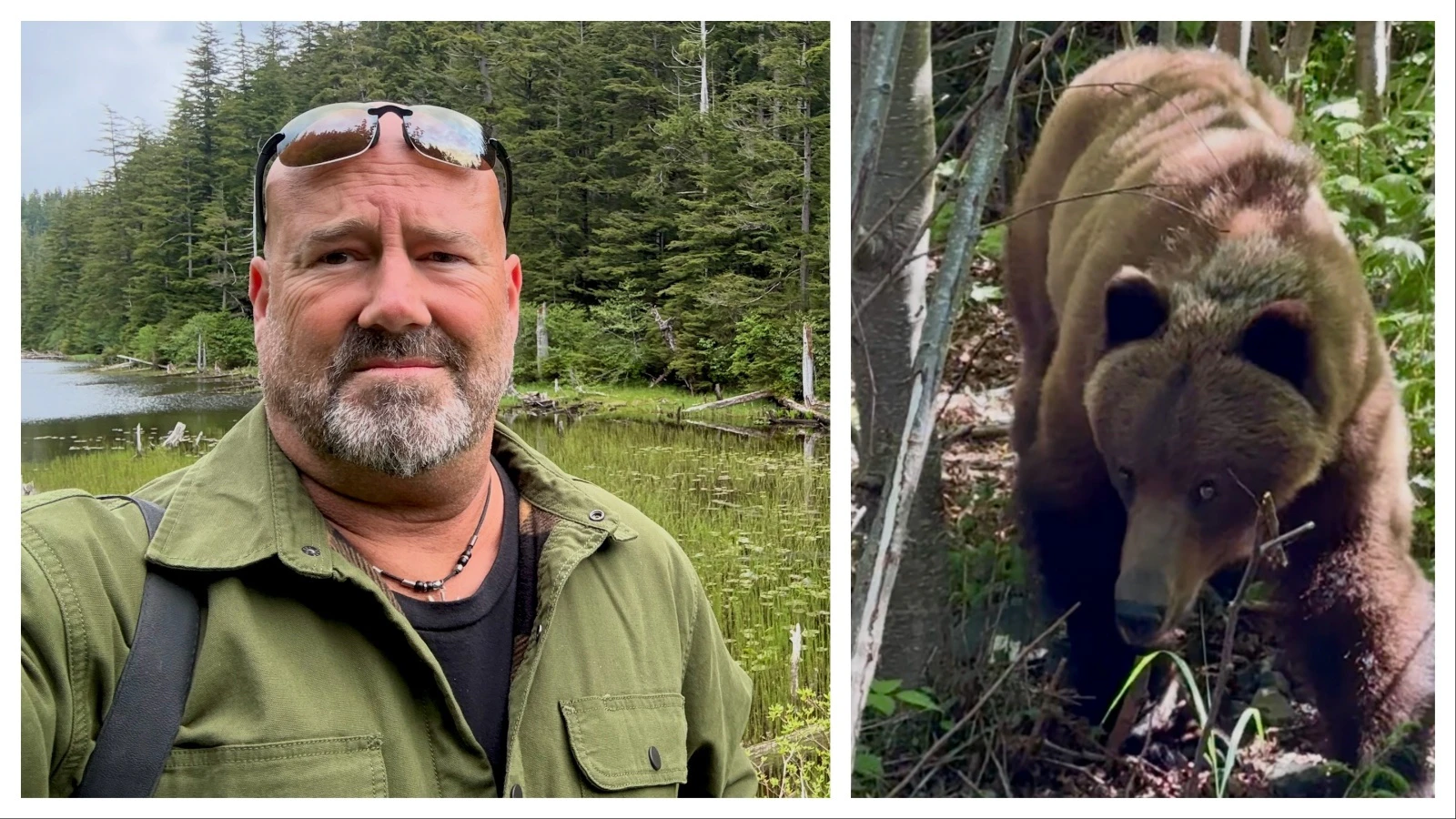
California resident Ryan Lutes believes he had a predatory encounter with a female brown bear in Sitka, Alaska, during the first week of June.
He told Cowboy State Daily that he credits confidence and bold action for coming out of the encounter unscathed.
‘I Planted My Ass’
Lutes said he encountered the bear near a raptor center along the trails.
He approached the center but discovered it was closed.
Needing to answer nature’s call, he entered some thick cover at the end of an abandoned road.
“It looked like a good place to take a leak,” he said. “I was just finishing buckling my pants back up when I heard the unmistakable crunching of leaves that I knew could come only from the weight of a bear or human.”
He said the bear almost immediately locked eyes with him.
“The second she made eye contact with me, I knew I had to plant my ass,” standing firm and not appearing weak, he said.
And he started taking video with his cellphone.
Lutes said he and the bear went through an intense back-and-forth for at least several minutes.
At one point the bear charged, and he dropped his phone. When he scared the bear back by shouting at it, he picked up his phone and started taking video again.
At another point, the bear “got down on her belly with her head away from me, like a dog,” and he thought he’d finally established dominance over it.
But then, “she popped back up like a jack-in-the-box," and the standoff began all over again.
Lutes said he was pumped full of adrenaline and not particularly proud of “some of the language I was using in those videos.”
Eventually, the bear “stuck its head in some brush” as if it had lost interest in him, and Lutes left quickly.
He said he learned later that the bear’s two juvenile cubs might have been shot while trying to kill goats with her, and so she might have been “angry” toward people.
Lutes loves traveling to Alaska, as well as Wyoming, Montana, and other wild places, and has had plenty of bear encounters.
But this one was different, he said.
The bear was alert, fixated on him, and approached boldly and quietly.
“At some point, her hair touched my arm. Then my adrenaline hit the roof, and I started screaming and going after her,” he said.
‘The Perfect Storm Of A Few Things’
It’s been a busy year for human-bear encounters. In May, two brothers were mauled by a grizzly in Yellowstone National Park. And a man was killed in a grizzly attack in Montana’s Glacier National Park.
Attacks by grizzlies and black bears have also been reported in Colorado, Canada, and elsewhere. Most recently in Wyoming, a woman was hospitalized Monday after a presumed black bear attacked her while hiking with her dogs near Teton Pass.
None of that means that bears are getting meaner, said wildlife filmmaker Casey Anderson, who lives in Emigrant, Montana, and has had thousands of bear encounters.
“There’s a perfect storm of a few things. More people going into wild spaces. There are more bears in wild spaces. Wild spaces are shrinking, and everybody’s got a camera,” Anderson told Cowboy State Daily.
That ubiquitous presence of cellphones and social media means that people can document wildlife encounters and share them like never before, Anderson noted.
So, while there might be a genuine increase in the number of human-bear encounters, the new technology might give the impression the numbers have absolutely exploded, he said.
Anderson used his own social media platform to share video of the Lutes encounter and uses it as a tutorial of highly unusual and spooky bear behavior.
Lutes said he usually carries a firearm or bear spray in the wild. But on that day he had neither. He was just trying to burn off a little time before picking up a friend from work by hiking on some Sitka municipal trails that are essentially right in town.
Having no defense mechanism, and with the bear acting the way it was, Lutes “did the right thing,” Anderson said.
“He was standing his ground and being counter-aggressive,” Anderson said. “It’s super-intense. To have that kind of encounter without protection. That’s intense.”
Focused, Determined, Deadly
A 2001 film, “Staying Safe In Bear Country,” produced by the International Bear Association (IBA), is still regarded as one of the best bear safety tutorials.
A segment of the video covers signs of predatory behavior in bears.
A defensive bear will appear “agitated and stressed,” the film’s narrator states.
Not so with a potentially predatory bear.
“With its head up and ears erect, its approach is confident and persistent,” the narrator says.
That’s the sort of behavior to watch for, regardless of species, according to the film.
The consensus among bear experts is that large, male black bears are the most likely to be predatory toward humans.
The film recommends acting aggressively toward a predatory bear to discourage it.
And, if it comes down to it, fighting back.
‘That Gives Me The Creeps’
Anderson said the behavior of the female brown bear in Lutes’ video reflects what the IBA filmmakers were pointing out.
“That video, when I watched it, provoked some reactions in me because of the bear’s body language,” he said. “The body language is focused. In those circumstances, that bear has some choices to make.
“The bear’s body language suggests, ‘I want to get a closer look at this (human). Because this might be an opportunity. And that gives me the creeps.”
Anderson said that among all the bear encounters he’s had only one that was possibly predatory, years ago in Yellowstone National Park.
An old, “emaciated” grizzly boldly approached Anderson and his cameraman, looking intensely focused.
That bear, well past its prime, was probably desperate for food, he said.
Anderson said he charged at the bear, “roaring” and holding his backpack over his head, and the bear fled.
The incident shook him.
“I didn’t sleep for three nights after that,” he said.
Be Prepared, But Not Paranoid
Anderson stressed that he wants people to be mindful in bear country, not irrationally terrified.
That means being prepared because “complacency is what gets you killed in the wild. Period,” he said.
For “a broad swath of the public” that might not be skilled with firearmskram he recommends bear spray, which he said he’s had to use on bears a few times.
And knowledge and a cool head should prevail, Anderson said.
“Time and time again, I see people getting themselves out of situations by using their brains,” he said.
As miniscule as the possibility of running into a predatory bear is, people should run through that scenario and how to handle it in their heads, Anderson said.
“You must at least have it on your mind. And you’d better have your game plan in place, because it’s life or death,” he said.
Mark Heinz can be reached at mark@cowboystatedaily.com.