
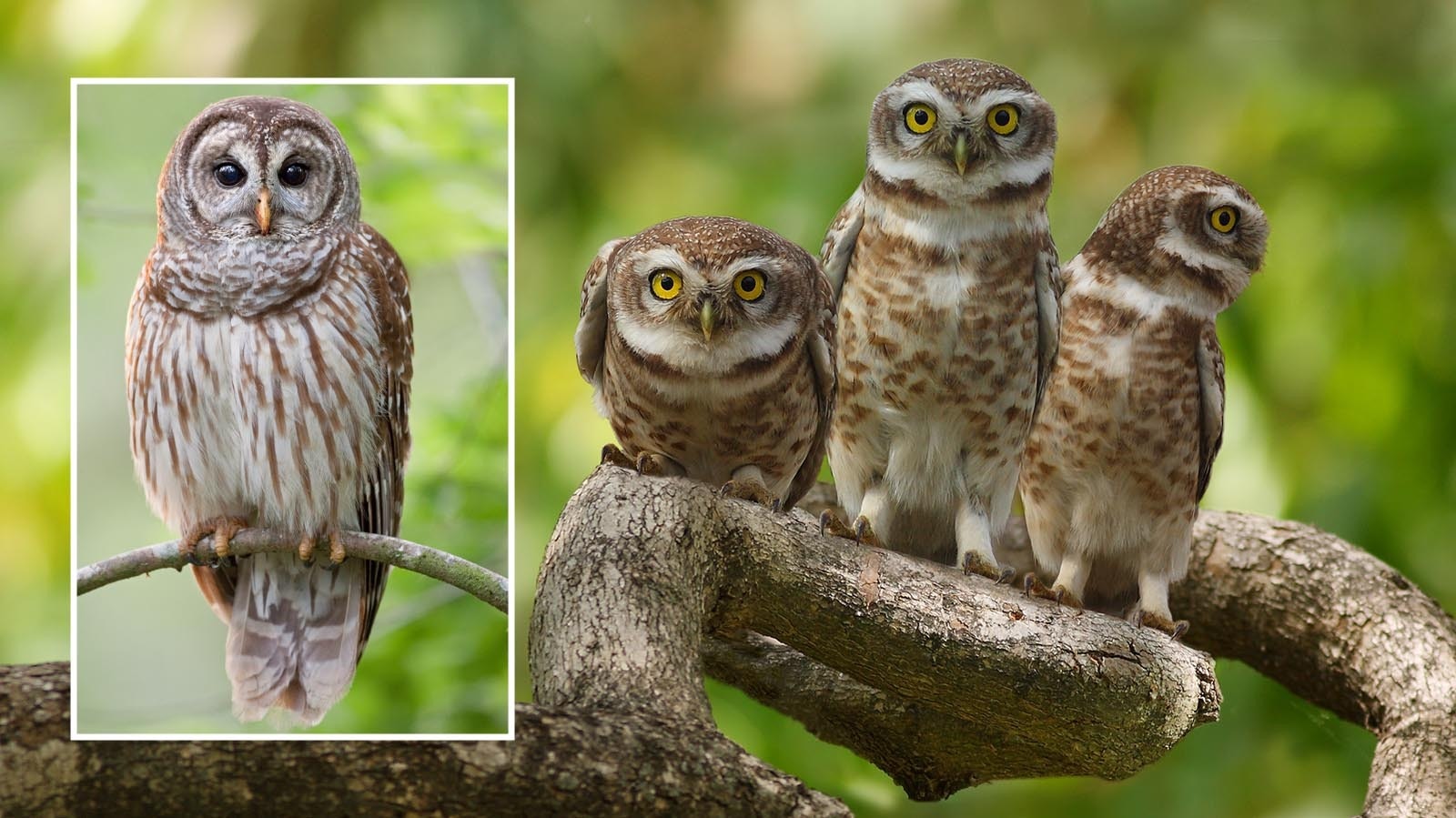
A federal campaign to kill nearly a half-million barred owls in the Pacific Northwest to save threatened spotted owls continues, even though the recent lifting of protections for spotted owl habitat defeats the entire purpose, an animal welfare advocate says.
It’s costing the government roughly $3,000 per bird to have barred owls shot, Wayne Pacelle, president of Animal Wellness Action and the Centre for a Humane Economy, told Cowboy State Daily.
And with a recent move to weaken the habitat protection element of the Endangered Species Act, it could be all for nothing if spotted owls’ old-growth forest habitat gets logged, he added.
Meanwhile, Wyoming’s barred owl population appears to be growing and might include four pairs in the Grand Teton area, Bryan Bedrosian, conservation director at the Teton Raptor Centre, told Cowboy State Daily.
There’s virtually no chance spotted owls will ever come to Wyoming, he added.
That means that Wyoming’s barred owls are safe from getting shotgunned to protect spotted owls.
What’s the Point Now?
The U.S. Fish and Wildlife Service (FWS) sparked controversy in early 2025 by rolling out a plan for permitted shooters into Pacific Northwest coastal forests to kill up to 470,000 barred owls. They’re larger than spotted owls and reportedly have been hogging their food.
A new wrinkle was added in July, when FWS finalized a scaling back of habitat protections under the ESA.
Effective Sept. 14, the change rescinds the regulatory definition of "harm", eliminating blanket protections for threatened species, and streamlines critical habitat exclusions.
Pacelle said rescinding “harm” from the ESA could throw spotted owl habitat open for logging.
In essence, barred owls are being “framed” for damage spotted owls are suffering from habitat loss, he said.
What’s more, he argues that the killing program is expensive.
The Hoppa Valley Tribe received a $4.5 million grant to kill 1,500 barred owls, Pacelle said.
That’s about $3,000 for each owl shot, he said.
A request for comment from FWS wasn’t answered by publication time.
‘Biologically Ignorant Statement’
Barred owls are originally from the eastern United States, but they’ve been moving west, claiming new territory.
In the Pacific Northwest, they’ve been dubbed an “invasive species", which has been used to justify killing them, Pacelle said.
However, he says it’s more a case of the species naturally expanding its territory.
Bedrosian said little is known about the history of barred owls in Wyoming. Another species, the great grey owl, is native to the state.
Great grey owls, barred owls and spotted owls all belong to the same family, he said.
Barred owls are smaller than great grey owls but they’re also more aggressive, he said.
Hearty Eaters
Two known nesting pairs of barred owls in Wyoming are known. One produced offspring two years ago, Bedrosian said.
Researchers recently discovered evidence of barred owl activity in two additional territories, which might indicate two more pairs have moved in, he added.
Researchers have captured four barred owls and placed radio transmitters on them to track their movements.
They’ve also set up recording devices in the barred owl's territories.
Recordings help researchers determine “species richness” or the number of different species in an area, he said.
And it will also help determine if “there are any species of songbirds, or other birds, that are avoiding the barred owls,” he said.
Barred owls are voracious opportunists, Bedrosian said.
“They eat reptiles, amphibians, reptiles, birds, and small rodents,” he said.
Mark Heinz can be reached at mark@cowboystatedaily.com.


