
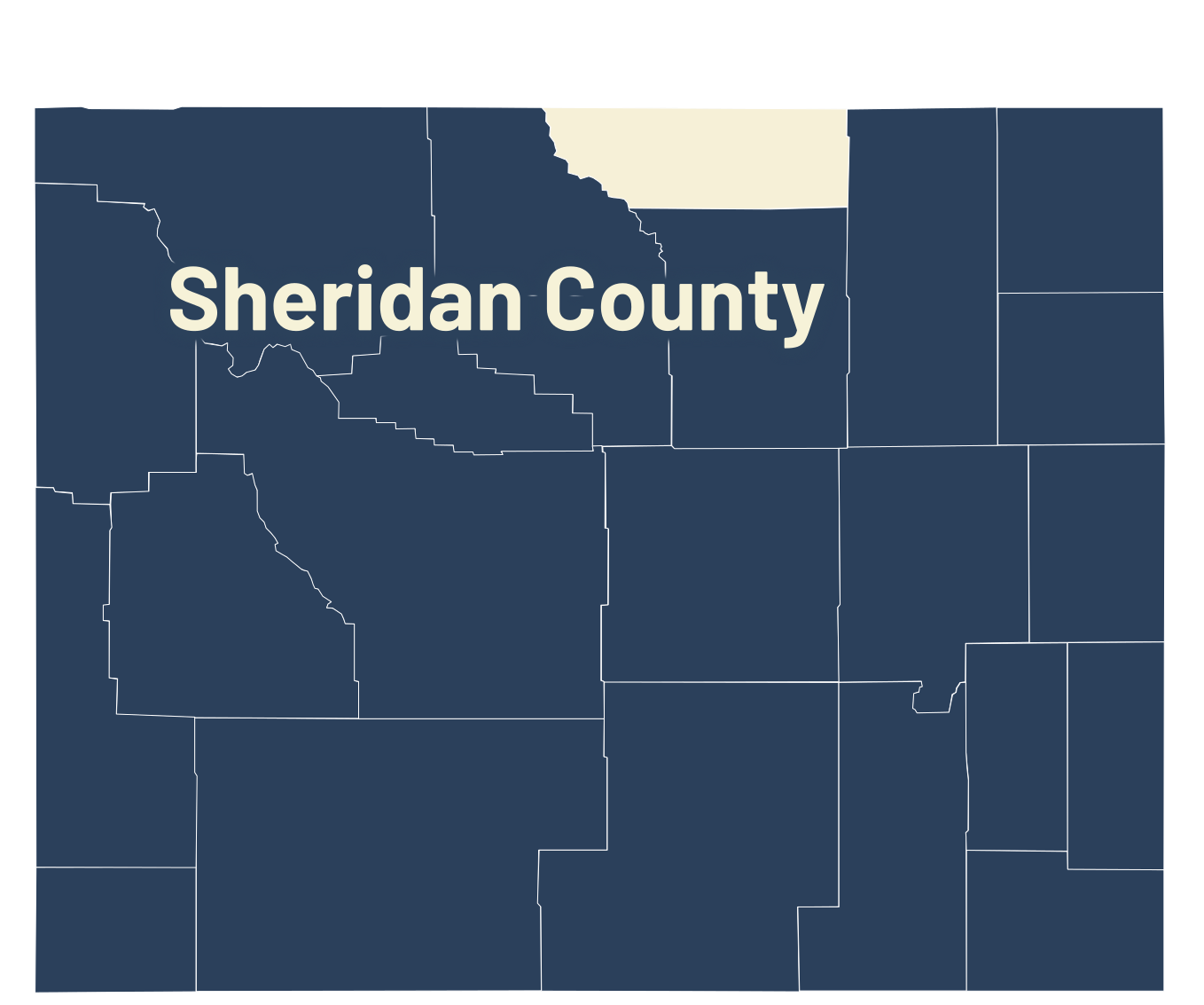
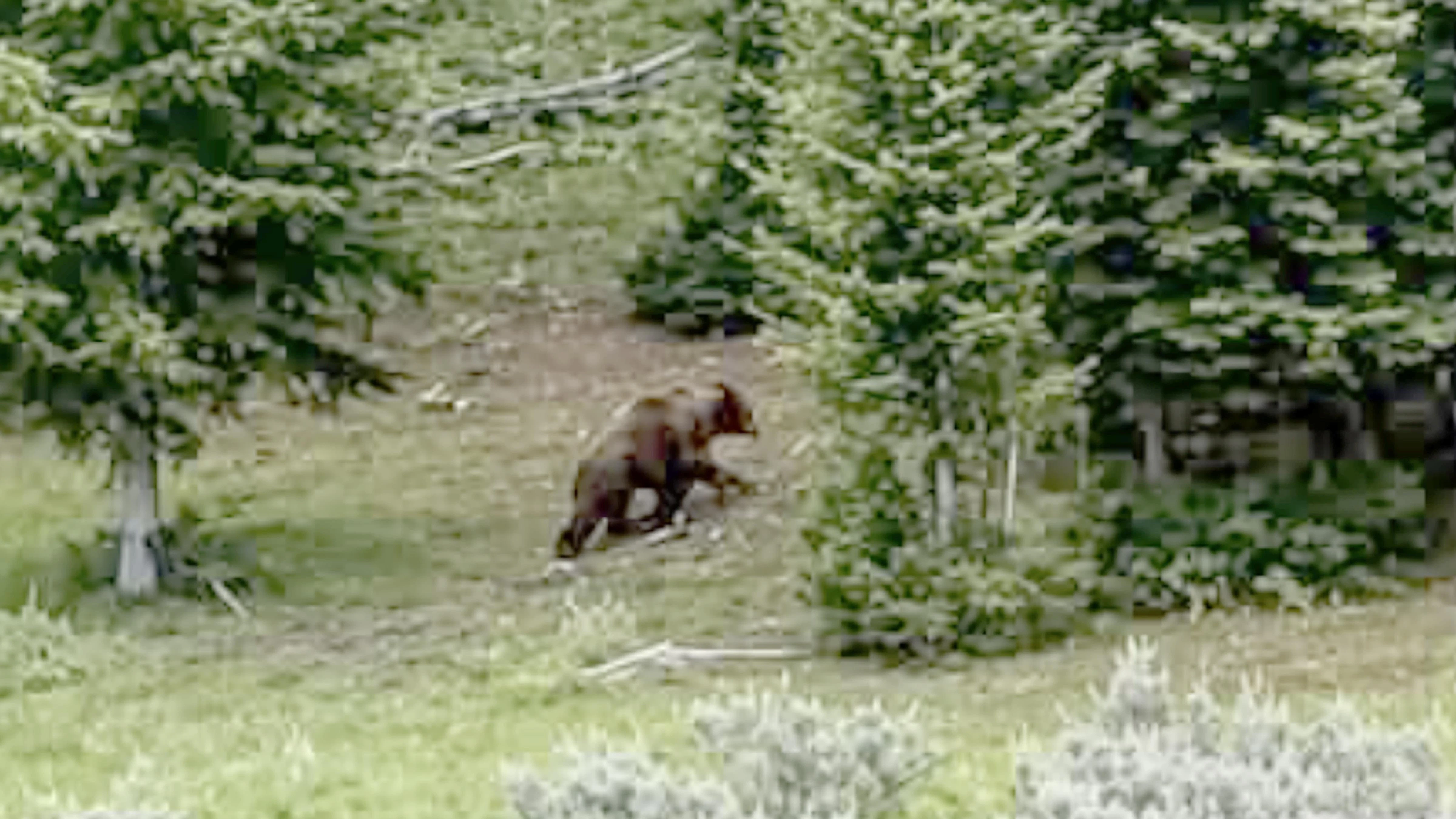
A Lovell man says he’s reasonably sure a bear he briefly spotted off Dayton Gulch Road in the Bighorn Mountains last week was a grizzly.
Casey Jones told Cowboy State Daily he saw the bear at about 3:30 or 4 p.m. July 2, and caught a video of it.
“The hump between the shoulders, that’s what got me to thinking it’s a grizzly,” he said during a telephone interview Thursday when he had brief service from the Bighorns.
His father, Levi Jones of Lovell, posted the video on social media, igniting a debate over whether the bear is in fact a grizzly or a member of the Bighorns’ significant population of black bears.
Retired Wyoming Game and Fish Department biologist Mark Bruscino viewed the video and told Cowboy State Daily that “I can’t tell for sure” whether the bear is a grizzly from the brief, distant clip.
Casey Jones said the bear is the first he’s ever seen in the Bighorns that he suspects is a grizzly, although he’s seen what he thought were grizzly tracks.
He added that he hasn’t seen the bear since he took the video or heard of anybody else in the Bighorns spotting it.
Reports Over The Years
Rumors of grizzlies in the Bighorns have abounded for years.
Bruscino recalled getting reports as far back as the early 1990s.
“We had regular reports of them (grizzlies) in the Bighorns. And those that we followed up for we had no evidence or we confirmed that they were black bears,” he said.
Bruscino worked for Game and Fish for 29 years before retiring in 2013. He served as game warden, a trophy-game conflict officer and the large carnivore services supervisor.
The only officially verified grizzly in the Bighorns in recent memory was a sub-adult male found near Ten Sleep in April 2024. Wildlife agents killed that bear for preying on livestock.
John Baughman served as Game and Fish director from 1996-2002 and told Cowboy State Daily he recalled the department getting reports of grizzlies in unusual places during his tenure, but never a confirmed sighting in the Bighorns.
“There was one (grizzly) over by Cowley” in Big Horn County, he said.
And there were also frequent sightings of grizzlies near Ralston, in eastern Park County, Baughman said.
Grizzlies would also frequently show up in the fall east of Clark, also in Park County, drawn by ripening Russian olive trees.
“Those bears are crazy for Russian olives,” he said.
How Could They Get There?
Bruscino said if the bear in Jones’ video is a grizzly it will likely show up somewhere else in the area and be confirmed.
There’s no evidence of an established population of grizzlies in the Bighorns, he said.
For one thing, numerous domestic sheep flocks are in the Bighorns. Grizzlies are known to prey on sheep, so there would be numerous reports of attacks if grizzlies frequented the mountains, he said.
However, it’s “not inconceivable” for an “occasional disperser" to wander into the Bighorns, Bruscino said.
Dispersers, or lone bears roaming great distances, tend to be young males, he said.
And grizzlies are expanding their territory across the Greater Yellowstone Ecosystem, Bruscino noted.
“Expansion is happening. It’s happened over the decades, that’s obvious and documented,” he said.
As to how a grizzly might reach the Bighorns, there are a few paths that could take.
A grizzly could follow the Clark’s Fork of the Yellowstone River toward the Pryor Mountains and then keep moving into the Bighorns, Bruscino said.
“They could also possibly come across the Bighorn Basin undetected by following the Greybull or Shoshone rivers,” he added.
A grizzly might also traverse the Meeteetse rim to reach the Bighorns. Or one could also make a long circle around the Owl Creek Mountains, he said.
Difficult To Tell
Distinguishing a grizzly from a black bear can be difficult, even for professionals, Bruscino said.
He recalled that members of the Interagency Grizzly Bear Study Team would sometimes “send pictures of bears back and forth,” challenging each other to identify them as black bears or grizzlies. And sometimes, biologists would get the wrong answer.
Grizzlies can be mistaken for black bears when they’re wet because that can push down the fur around their telltale humps, he said. And a wet coat will also make a grizzly’s ears look larger.
Larger ears in proportion to the head are one telltale sign of a black bear.
He recalled an incident when he and another biologist were arguing over whether a bear caught in a snare was a grizzly or a black bear.
After they moved in to tranquilize and examine the bear, it turned out to be a female grizzly with a wet coat, Bruscino said.
Game and Fish has an online quiz challenging viewers to determine whether bears in a series of photographs are grizzlies or black bears.
Always Be Bear Safe
Casey Jones noted that the area where he spotted the alleged grizzly isn’t far from where two campers, Shonna Kaye Dehl of Lovell and Maggie Bassett of Powell, were driven from their camp by an aggressive black bear on Sunday.
In an email to Cowboy State Daily, Game and Fish large-carnivore specialist Dan Thompson said the agency can’t offer comment on any particular video shared to social media.
He added that bear safety protocols, such as securing food around campsites, should be observed, regardless of which bear species is in the area.
Mark Heinz can be reached at mark@cowboystatedaily.com.


