
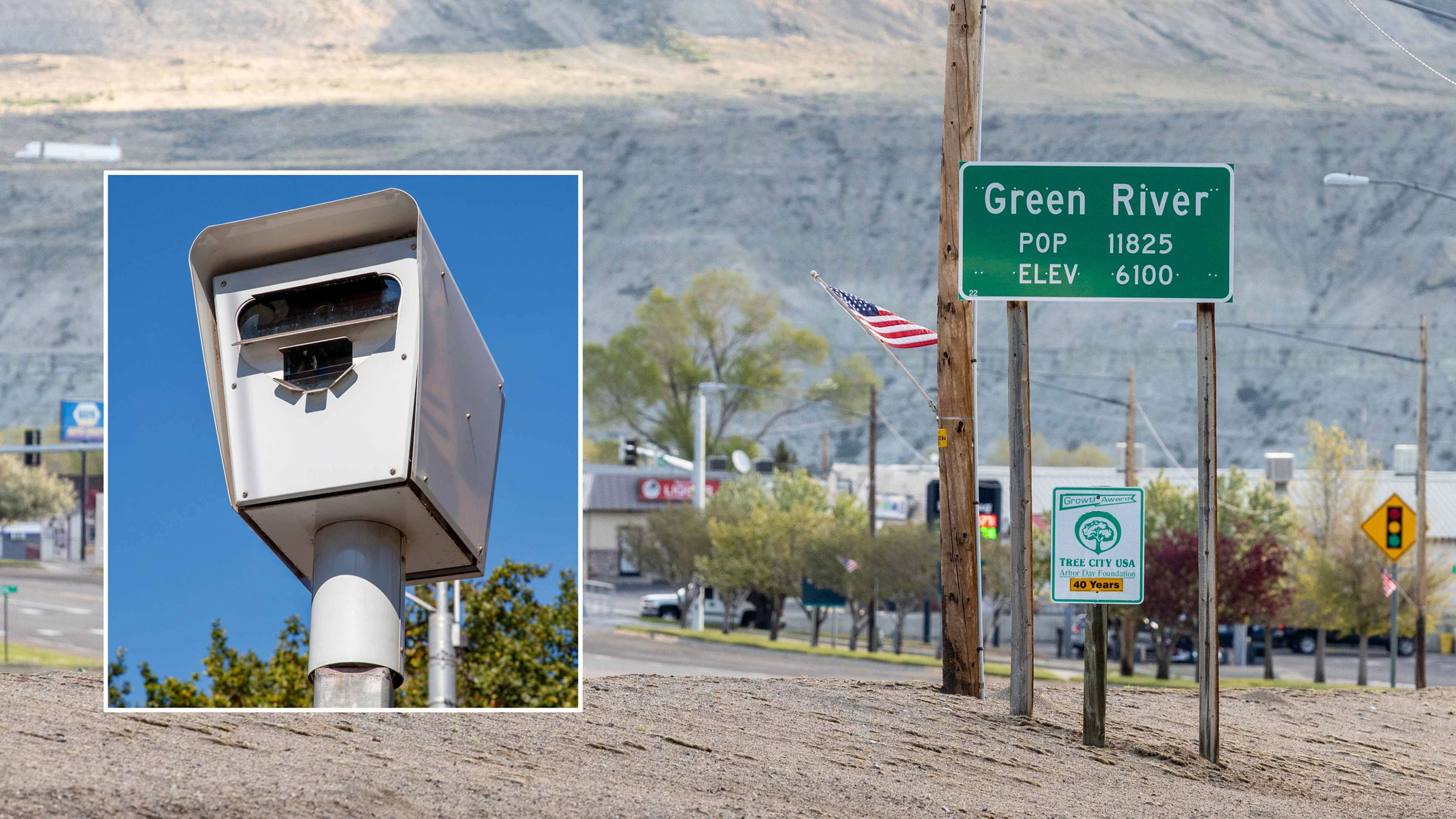
The Green River City Council is considering whether to approve a nearly $112,000 grant it’s been awarded to install license-plate readers around the city.
Green River applied last year for two Wyoming Office of Homeland Security grants and in January was awarded one for $111,956 to buy and install license plate readers for the police department, says the agenda item description.
As of this writing, the Green River City Council was set to consider approving the grant at its regular meeting Tuesday night.
Mayor Pete Rust told Cowboy State Daily on Tuesday the police department spearheaded the grant application.
The grant consists of federal funds from the U.S. Department of Homeland Security (DHS), the description says. Its goal is to enhance “the ability of governments and nonprofits to prevent, protect against, respond to, and recover from terrorist attacks.”
Green River Police Chief Shawn Sturlaugson told Cowboy State Daily in a Tuesday phone interview that the license-plate readers could curb terrorism. He said he anticipates that their commoner use, however, will be expanding law enforcement’s ability to find vehicles implicated in criminal getaway situations or missing-or-vulnerable person cases.
“They’re another tool for us,” Sturlaugson said.
Currently, officers are far less likely to find a vehicle flagged in the National Criminal Information Center unless they know about it, are looking for it specifically, and happen to cross paths with it, added the chief.
If the city mounts license-plate readers, “As soon as that vehicle rolls into town, my officers will immediately get an alert, start looking for it and hopefully find the vehicle.”
Sturlaugson said runaway Amber and Ashanti alerts and missing or vulnerable persons cases are just as vital a use as responding to criminal incidents.
He said he’s been surprised that, after the City Council agenda went public, people have been voicing criticism of the plan. He said the grant award, in January, was public information.
“We haven’t kept it a secret, I can tell you that,” Sturlaugson said. He said the readers will be Motorola brand, not Flock. He expects the grant to fund the installation and other costs for about four readers, to be placed generally at town entrances.
Sturlaugson said he heard complaints Tuesday morning “that we’ll use this as some type of proactive, crime-stopping tool,” but that’s not the department’s intention. Nor does the department plan to use the system to stop people for expired registration “or anything like that,” the chief added.
“It’s strictly to identify vehicles or people that are already of some concern, in some way, for law enforcement,” Sturlaugson said.
‘It’s Some Bull –“
Marshall Burt, the former lawmaker whom Green River elected in 2020 as the state’s first Libertarian legislator, bristled in a Tuesday interview with Cowboy State Daily.
“It’s some bullshit,” Burt said.
He cast the agreement’s stated goal of curbing terrorism as dubious.
“I mean, if we have that big a case of terrorism in Green River, I imagine we would have heard about it by now,” he said.
Burt, who served nine years in the Marine Corps and was deployed to the Anbar Province during the Iraq War, said the grant’s terrorism-related mission poses a false dichotomy.
“This is the argument you’re going to hear: you’re either for the cameras to be against terrorism or you’re against the cameras and you want to promote terrorism,” he said. “Because that’s how stupid politics arguments go all the time.”
Burt said the argument, rather, is about the slippery slope toward pervasive government tracking he says the cameras exacerbate.
“I don’t have an expectation for privacy on a public road. I don’t. My license plate is out there for anybody and everybody to see. I don’t care about that, I understand that when I drive,” he said.
But the growth of data centers, the increased capacity for data storage and transfer, coupled with the camera systems’ own abilities to compile and aggregate data over time, lend concerns about tracking, profiling and behavioral patterning, he added.
Burt is not alone in that fear.
A number of lawsuits have surfaced nationally, including an April 15 filing in which the Institute for Justice derided the surveillance system in San Jose, California.
“Unlike a police officer posted at an intersection, the cameras see and remember everything,” says the complaint. “Day or night, they photograph every passing car and use AI to analyze the images … Officers can run searches based on a hunch, idle curiosity, or even personal animus.”
Sturlaugson told Cowboy State Daily he’s inclined toward crafting a policy, conversely, that deletes the data after 30 days. He said the policy is in progress.
The Institute for Justice offers draft legislation that would cement Fourth Amendment constraints into laws specifically pertaining to the cameras.
Burt said that’s not enough.
“It’s a straight no,” he said of welcoming the cameras, with guardrails or without. “The problem with putting in guardrails like everybody talks about is, nothing ever becomes permanent. The next City Council or whoever decides (can) change policy.”
Burt said good intentions rarely hold the line. He referenced the post-9/11 Patriot Act, an anti-terrorism law he called “the most abused surveillance system ever put in place against the American people.”
A Little Surprised
Rust told Cowboy State Daily he was surprised at the pushback ahead of Tuesday’s meeting.
“We’re very proud of the fact that we’re one of the safest cities in the nation,” he said. "Surveillance is a tool the police department uses. This is just another tool.”
He said he doesn’t know of any terrorism concerns in Green River.
But on the other hand, the city falls along an interstate, a railroad, and a river. One of the main regional power plants sits in the area.
“We’re in a strategic location because of all those things. So who knows?” Rust said. “Cameras are something that exist all over the place. Everywhere. It’s to help people observe things that could be a concern, so they can have information to take care of it, if it is – keep the community safe.”
Katie Roascio, the Wyoming Department of Homeland Security's public information officer, said in a Tuesday email that the Green River Police Department was the only Wyoming agency that applied for the grants made available last year for license-plate readers.
That was part of a larger, 167-grant application pool from the 2025 grant window, she said.
Elsewhere
Other Wyoming towns and communities have license-plate readers. Those are the cities of Jackson and Cheyenne, the entrances to the town of Glenrock, and the entrances to the Wind River Indian Reservation.
The reservation cameras came about through an agreement between the 12-person Wind River Intertribal Council and the U.S. Drug Enforcement Administration (DEA).
It remains unclear whether any public meetings were held on the reservation cameras prior to their installation. The tribal governments of Wyoming don't fall under the state's public meeting or public record laws.
Clair McFarland can be reached at clair@cowboystatedaily.com.


