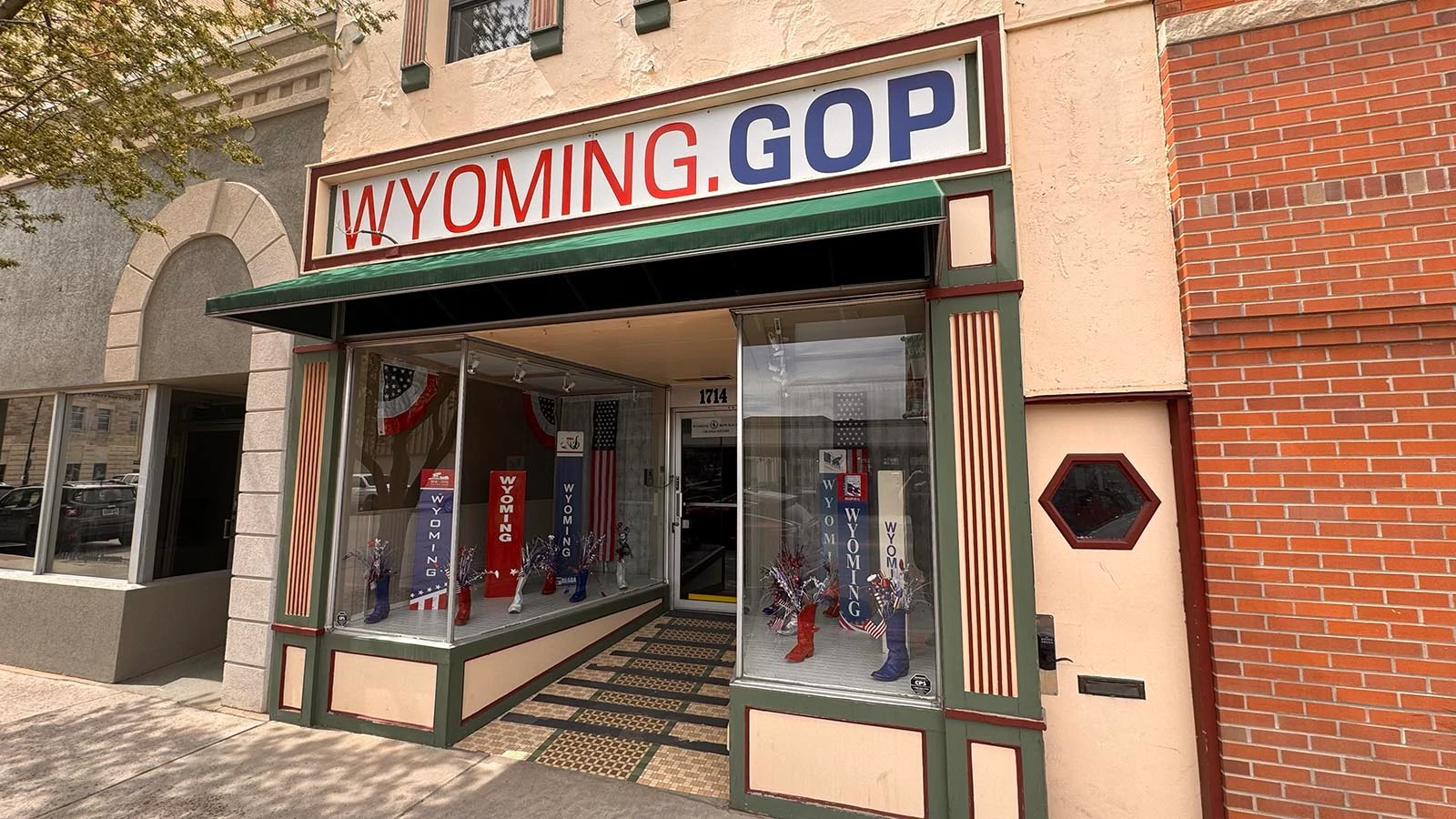
The Wyoming Republican Party is appealing a judge’s ruling that state laws governing major party leadership elections apply to it.
Uinta County District Court Judge James Kaste ruled May 29 that the Hot Springs County Republican Party’s 2025 leadership election in which non-precinct committee people were allowed to vote was not legal.
The Wyoming Republican Party’s Dispute Resolution Committee had insisted that the election was legal and upheld it. While the election didn’t square with state law, it squared with the party’s bylaws.
The judge ordered the state party to follow state law over its bylaws.
The Wyoming Republican Party informed Kaste’s court Friday that it’s asking a higher tribunal, the Wyoming Supreme Court, to review his order.
“Through undersigned counsel, notice is hereby given that Defendants Wyoming Republican Party, Wyoming Republican Party State Central Committee, and Wyoming Republican Party Dispute Resolution Committee appeal the Court’s Order,” says the Friday motion by the party’s attorney, Thomas Szott of The Bernhoft Law Firm.
Now the party is waging multiple legal challenges in which it argues that it may follow its bylaws over Wyoming law.
Earlier this month, the Wyoming GOP challenged the Secretary of State’s Office in federal court in an effort to overturn a law barring major parties from financially backing one of their affiliated candidates over another in the primary election cycle.
Each party can bankroll the nominees its registrants choose at the primary election in the three months between the primary and general election — but not before.
That law has been interpreted over the years to equate to a ban on the party endorsing specific candidates in the primary cycle, GOP Chair Bryan Miller told convention attendees in April.
Well That Depends
Whether political parties’ associational and free-speech rights rise above the state laws that govern them is a recurring judicial topic nationwide.
The answer is sometimes, according to Kaste’s May 29 order.
Kaste noted that Wyoming election law doesn’t dictate the state party’s membership directly.
Freedom of association is a right, and it gives political parties some protection from state infringement, noted Kaste from a 1986 case called Tashjian v. Republican Party of Connecticut.
But courts also use a balancing test called the Anderson-Burdick test when parties assert this right, and they consider how burdensome the state’s laws are on that right.
If the burden is severe, the court judges the state’s infringement under a rigorous constitutional standard that most laws do not survive, called strict scrutiny.
But if the state is only imposing a “lesser burden” on the party, then the state’s important regulatory interests are usually enough to justify “reasonable, nondiscriminatory restrictions,” Kaste noted from an earlier case.
State party leaders who were sued in this case claimed Wyoming violated the party’s rights.
“Defendants are incorrect,” wrote Kaste.
The state laws impose minimal burdens on the party’s associational rights, and the state’s important regulatory interests justify them “amply,” said the judge.
He added that the party relied on oblique cases while ignoring cases “that are more squarely on point.”
Wyoming law lays some tasks and formational requirements on the party, but the party’s role in filling vacancies is a privilege in which the state has an important interest, he added.
The Wyoming laws challenged in this case impose only a minimal burden on the party, says Kaste’s order.
The state has a legitimate interest in how office vacancies are filled, he wrote.
“It would be a real problem if a vacancy occurred in a public office and the State had no one to call,” Kaste said, adding that the biennial election also ensures orderly election tasks, like nominating presidential electors before general elections.
But Kaste’s order doesn’t address the endorsement and financial backing issue the party has raised in federal, not state court. That case is ongoing.
Clair McFarland can be reached at clair@cowboystatedaily.com.