
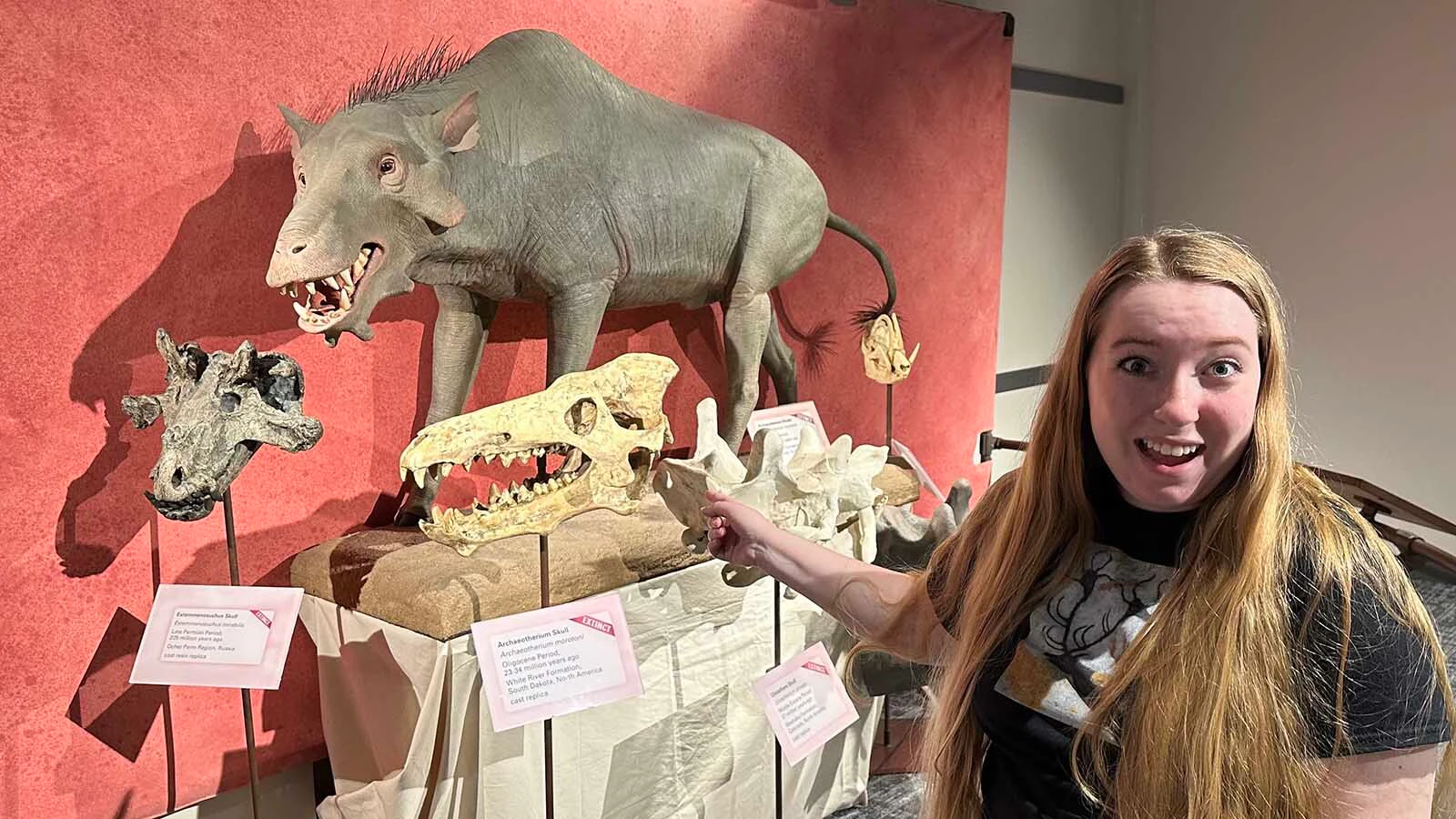
New research indicates that Wyoming’s prehistoric hell pigs had different diets based on their size. The bigger they were, the wider the menu.
Brynn Wooten, a Ph.D. candidate at Vanderbilt University in Nashville, Tennessee, published a study of size-driven diet partitioning in Archaeotherium, a prehistoric mammal that’s better known as “the North American Hell Pig.”
“They look similar to pigs, but they’re actually more closely related to whales and hippos,” Wooten told Cowboy State Daily. “They were one of the largest things capable of eating meat in their ecosystem.”
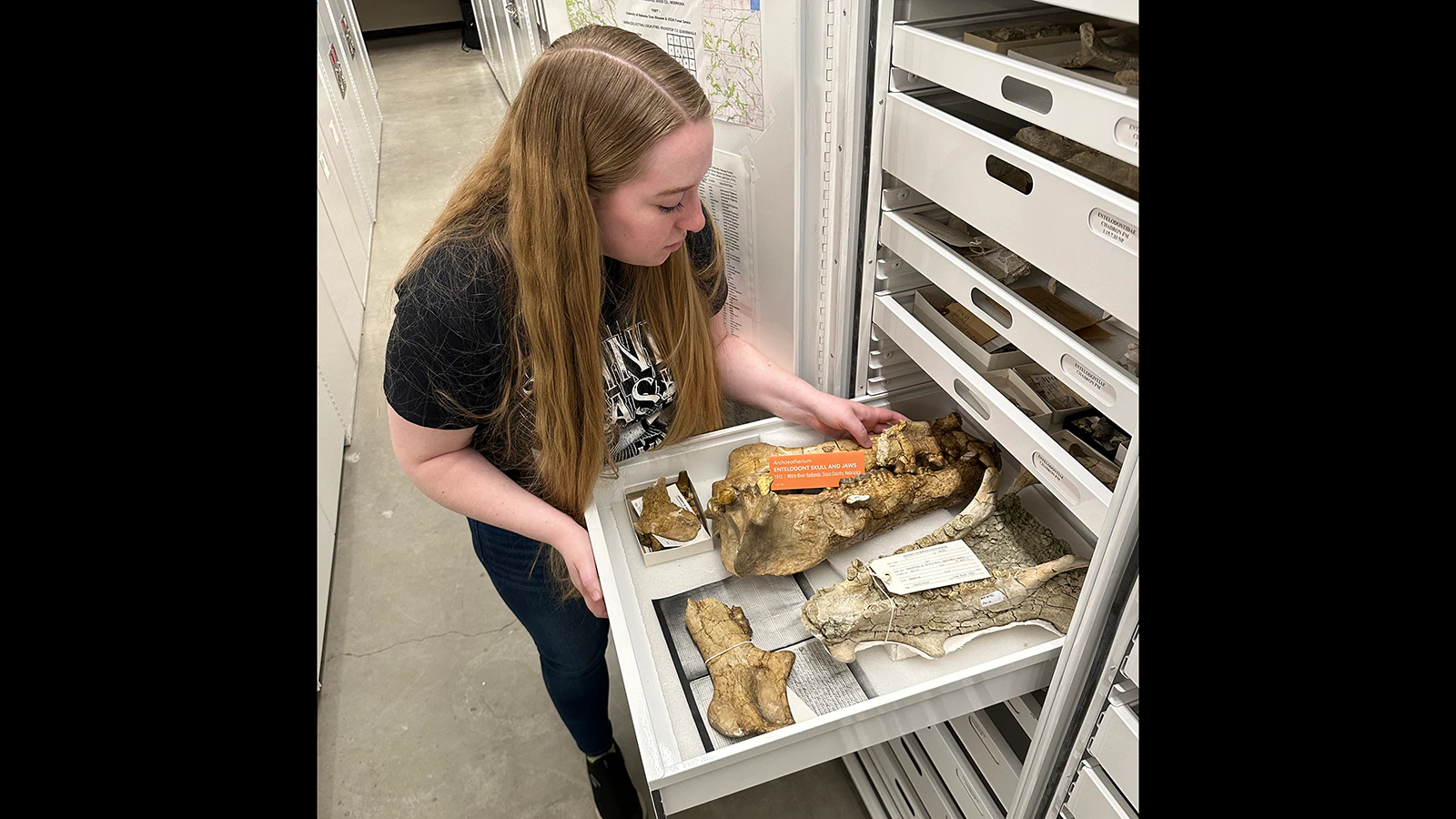
Wooten’s study focused on the teeth of hell pigs, including specimens in the collections of the University of Wyoming’s Geological Museum. She studied the microwear on the tooth surfaces of multiple species to get an idea of what they were biting and crunching.
Even she was surprised by the results.
“I was shocked,” she said. “We found a really interesting phenomenon that is uncommon in modern mammals. In fact, we actually see the exact opposite. It’s surprising and really interesting.”

The Hell Pig Person
Hell pigs are an extinct group of large mammals that were widespread in North America, Europe and Asia from 36 to 19 million years ago. The first fossils were found near Fort Laramie in 1850. A food cache fossil is on display at the Wyoming Dinosaur Center in Thermopolis.
These had enormous heads with thick jaws and powerful teeth. If that wasn’t frightening enough, the largest entelodonts could grow to the size of a horse.
Hell pigs weren't quite that big, but it was one of the largest and most successful mammals in North America during the Eocene and Oligocene periods. Its fossils are common in the White River Formation, which stretches across the western U.S.
Wooten became enamored with “hell pigs” when she saw their massive skeletons at the Denver Museum of Nature and Science as a child. Her latest research is the first chapter of her Ph.D. dissertation on hell pigs.
“When I go to conferences, I’ll tell people when and what I’m presenting, and they’ll say, ‘Oh, you’re the hell-pig person,’ and get really excited.”
That excitement stems from the fact that while hell pits and other like creatures are legendary in paleontology, there’s been little research done on them. Wooten’s focus on the paleoecology of hell pigs is, in many ways, the first of its kind.
“Everything else has been inferred by looking at and measuring bones,” she said. “I'm taking a more quantitative approach, and that’s excited a lot of people because we’ll get to learn a little bit more about a truly lost lineage.”
You’ll Wreck Your Teeth
Modern pigs aren’t picky. They’ll eat anything, making them true omnivores.
Hell pigs aren’t really pigs, but it’s always been assumed that they were similarly omnivorous. The first step in Wooten’s research was to see whether she could support or refute that idea by becoming a prehistoric dentist.
“Dental microwear texture analysis can't tell us what an animal was eating, but it can tell us the texture of what the animal was eating,” she said. “Since the diet of entelodonts has been contested, we thought it’d be interesting to see if we could figure that out.”
Wooten scanned and studied 53 hell pig teeth from 13 co-existing species in the collections of the UW Geological Museum, the Yale Peabody Museum in New Haven, Connecticut, and the Florida Museum of Natural History in Gainesville.
The fossilized teeth Wooten used for her study came from South Dakota, Colorado, Nebraska, and Oregon, with a handful from Wyoming.
Teeth wear differently depending on diet. But studying the distinct patterns of microwear on the hell pig teeth, Wooten could determine whether each individual was primarily eating brittle items, like bones, browses, and seeds, or tough items like flesh and grass.
“That's why it's important that we compare the microwear on the fossilized teeth to modern animals,” she said. “We know what modern animals are eating. If we can see similarities in microwear texture, you can infer what the prehistoric animals were eating.”
Wooten had an idea of what she’d see on the teeth. What she exactly saw subverted her scientific expectations.
Who’s Eating What
After examining the dental microwear texture on the teeth of hell pigs and comparing that with that of modern animals, clear patterns emerged. They weren’t the patterns Wooten was expecting.
“I was really expecting to scan these and come out with everything that was eating super hard things,” she said. “When the results came back, I was shocked.”
Several teeth showed the telltale textures of a bony diet, comparable to the teeth of modern hyenas. Others showed little to no evidence of anything hard in their diet, with microwear comparable to that of modern cheetahs.
Wooten decided to explore these differences until she found an explanation.
“As I was exploring these differences, I discovered a body-size difference,” she said. “I ran all the statistics with the body size separated into smaller and larger, and that's when I found that there was this significant difference in diet.”
Wooten’s conclusion was that the smaller hell pigs were eating tougher food while the bigger ones were eating whatever they could. That’s an anomaly in modern ecosystems.
“Larger animals actually eat softer foods because they have the liberty of eating softer foods,” she said. “Smaller animals eat whatever they can get because they're not as advantaged as the larger animals. That’s what we expect to see in nature. The opposite is fairly uncommon.”
Wooten also noted that this size-diet split was tied to species, not age. Smaller species of hell pig had softer diets, while larger species had harder diets.
“The larger-bodied individuals ate like hyenas, but the small-bodied individuals ate like cheetahs,” she said. “Cheetahs are exclusively flesh eaters, so it’s possible the smaller Archaeotherium were exclusive flesh eaters, too.”
Gimme, Gimme!
With this intriguing diet disparity determined by body size, it’s only natural to speculate what that could reveal about the biology and behavior of hell pigs.
Wooten doesn’t want to jump to conclusions, but she did say the differences in the diet could have been partially caused by a common behavior scientists see in many modern ecosystems: kleptoparasitism.
That’s a big word for big animals stealing food from small animals. Wyomingites can see it happen all the time in places like Yellowstone National Park.
“Bears will scare wolves, lynxes, or pumas from their kills and eat the remains,” Wooten said. “When you’re scavenging, you eat bone even if you don’t really mean to.”
Wooten referenced a fossil from the White River Formation that suggests the same behavior. It’s believed to be a hell pig food cache, containing several partial skeletons of Poebrotherium, a small prehistoric camel.
“The camels were killed by a bite to the head and neck,” she said. “The meatier portion of their bodies — the butt — was eaten, while front portions, the head and arms, were dragged back to a meat cache.”
This fossil has been cited as evidence of active hunting by hell pig mortoni, which Wooten called “the smallest of the smaller-bodied Archaeotherium species.”
The butt-less Poebrotherium food cache might give more credence to kleptoparasitism among hell pig species. If the camels were killed by a smaller-bodied species, it would align with what Wooten discovered from her dental microwear analysis.
“Maybe the smaller ones would run and actively hunt their food, and the larger ones could have scared them off and consumed their kills,” Wooten said. “It's really hard to have two different kinds of animals that are living at the same place at the same time, because then they're constantly going to be fighting for resources.”
A Closer Look
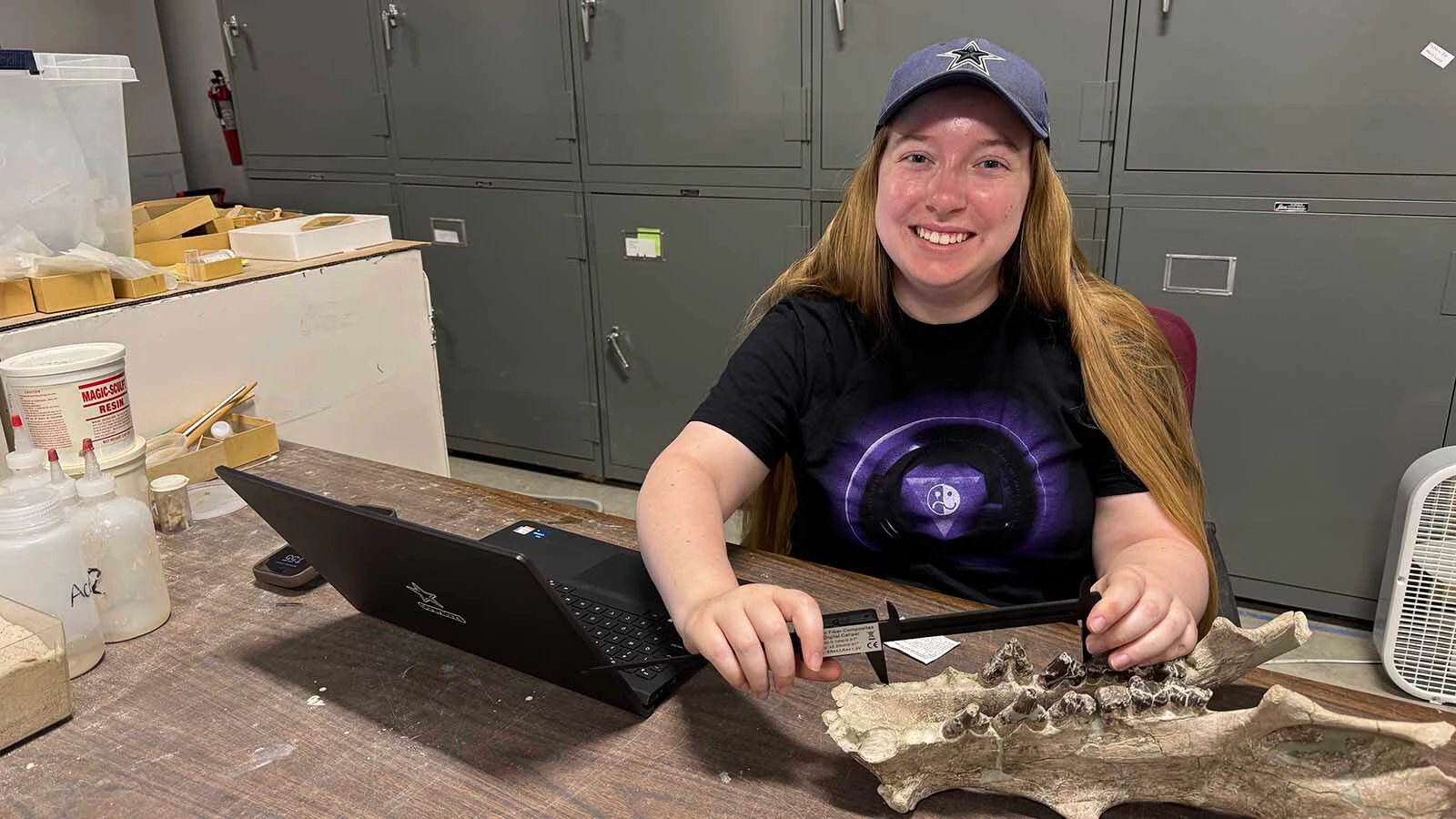
Wooten has learned a lot from the dental microwear analysis of hell pig teeth. The next step in her research is more in-depth dentistry.
“The next step is using stable isotope analysis to put more of the puzzle pieces together,” she said. “That’ll give me a better picture of what was going on.”
Stable isotope analysis is an increasingly powerful tool in paleontology. A 2025 study determined the diets of Jurassic dinosaurs, down to the specific salads Brontosaurus ate, using the calcium isotopes preserved in their tooth enamel.
Using stable isotope analysis on hell pig teeth, coupled with the microwear textures, would help Wooten narrow down the dietary preferences of the different-sized species.
It will also shed insight on whether hell pigs were primarily carnivorous or had a more generalist diet of meat and plants.
“Unless we have a time machine, I don't think I'm ever going to know exactly what they were eating day-to-day,” she said. “Stable isotope analysis will help clarify the textures of foods being eaten and potentially lead to a path to infer what actual foods were being eaten.”
Wooten has already done some stable isotope analysis, but she’s not at liberty to share what she’s learned. That’s for the next paper.
“It’s embargoed, but it’s very fascinating,” she said.
Archaic And Unknown
Wooten’s ultimate goal is to use her ongoing dental analysis to build “a broader picture” of the many species of hell pig in their ancient environment.
“Going forward, I’ll focus more heavily on general paleoecology,” she said. “Where were they living? How might they have adapted to the changing environment? How do they utilize the resources in their habitats?”
Wooten believes there’s a lot to learn from hell pigs. It was a long-lived and diverse genus that served as a top predator in its ecosystem for 17 million years.
“That’s a really long time for any genus, let alone one with over a dozen different species, to survive,” she said. “They’re all related to reach others, but distinctly different, which is another really interesting factor in all this.”
That means she’s more than content to be “the hell-pig person” for the rest of her career.
“I fell in love with these creatures,” she said. “They’re so archaic and unknown. They’re different from anything else we have today, and it’s always going to be exciting to learn a little bit more about them.”
Andrew Rossi can be reached at arossi@cowboystatedaily.com.


