
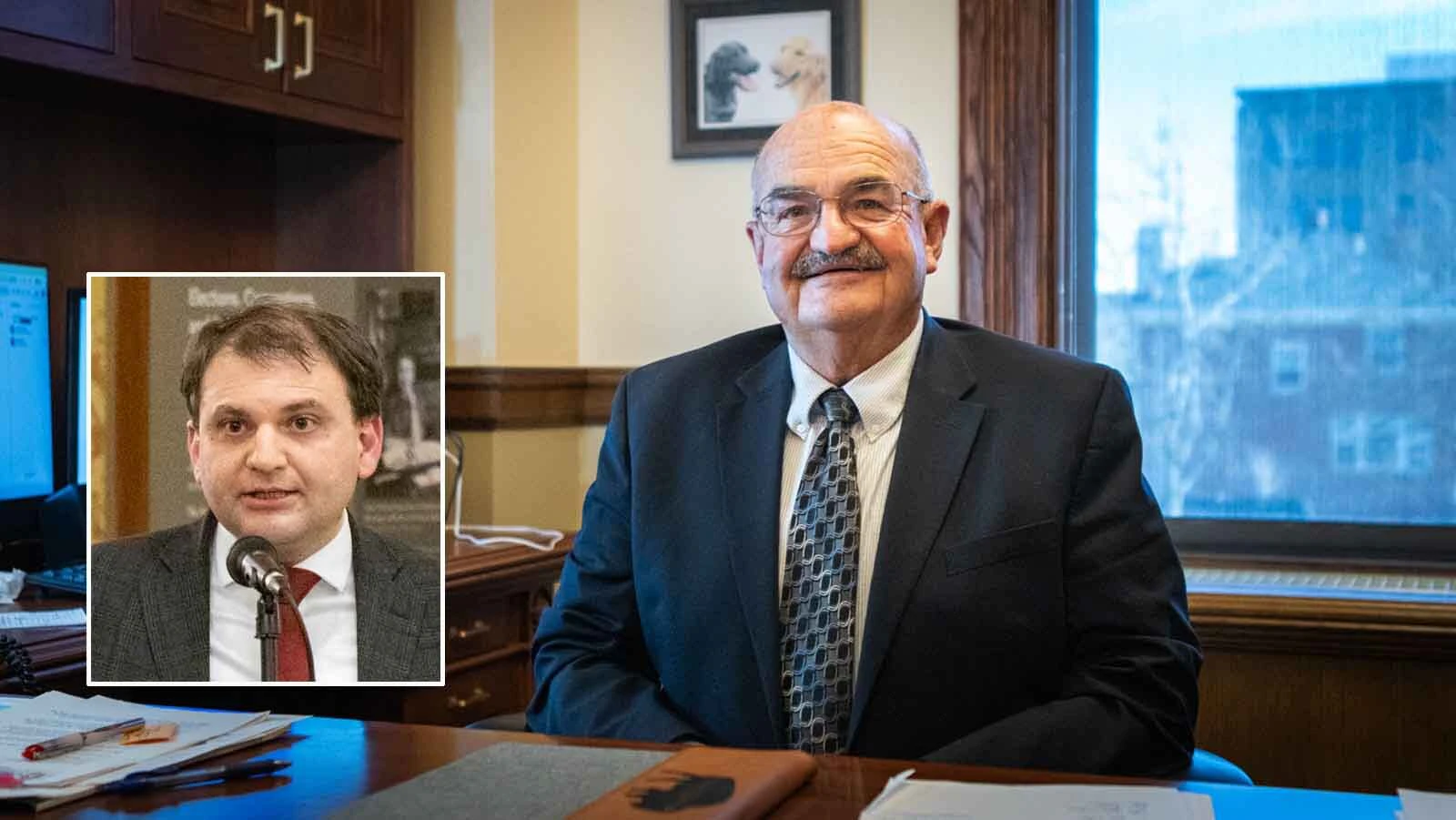
In response to a Cheyenne-based attorney’s claims that the Wyoming attorney general must appoint special prosecutors to decide whether Secretary of State Chuck Gray violated any laws, the AG countered Tuesday that he has already appointed two special prosecutors, and neither wanted to charge Gray with a crime.
Upon a request by President Donald Trump’s administration, Gray sent sensitive voter data to the federal U.S. Department of Justice last year, public records show.
George Powers, a semi-retired attorney based in Cheyenne, who won a past public records case, started filing requests to learn about Gray’s actions.
In April, Powers filed an official complaint with the AG’s office accusing Gray of violating a state election law that makes data like the kind Gray reportedly released – voters’ partial Social Security numbers or driver’s license numbers – confidential.
Wyoming also has an umbrella statute that allows prosecutors to charge election officials who violate election law with a felony, if merited.
But Gray told the public that the AG’s office approved the release of voter data to the federal government.
So Powers, in his complaint, urged Attorney General Keith Kautz to offload the investigation onto a special prosecutor, because the AG’s office reportedly counseled Gray in this controversy. Powers suggested having a judge appoint the special prosecutor.
Kautz answered in a May 4 letter that Powers’ complaint would be handled in accordance with the AG’s office rules and state professional conduct rules for attorneys.
Four weeks passed.
Powers filed a petition June 2 with the Wyoming Supreme Court, accusing Kautz of neglecting a clear duty and asking the court to appoint a special prosecutor to investigate Gray.
Kautz parried with a Tuesday filing, which says Powers doesn’t have standing to wage that battle, and it’s irrelevant anyway, because the AG’s office has arranged two different, independent evaluations. And neither special prosecutor wanted to charge Gray with a crime, says the filing.
“One of those independent evaluations was conducted by a division of the Attorney General’s office – separate from the civil division – by the construction of a ‘Chinese wall',” says the AG’s Tuesday answer. “The other independent evaluation was conducted by a private Wyoming law firm in conjunction with a Wyoming county and prosecuting attorney.”
A Chinese wall is an informational barrier with an entity designed to prevent ethical conflicts.
The independent attorneys submitted reports – one before Powers asked the high court to intervene and one after – and “each independent counsel declined to bring criminal charges,” says the AG’s response.
“Mr. Powers filed his petition in this matter before the Attorney General could announce that no prosecution would be forthcoming,” says the filing.
As to the AG’s reticence toward Powers, the filing says the person reporting a crime doesn’t have a right to hear the prosecutor’s decision on it, and that Powers hasn’t shown he’s a “victim” of a crime to enjoy some rights under the state Victims’ Bill of Rights.
The AG’s filing emphasizes that Kautz didn’t involve Powers in the investigation, “but told him that investigations and charging decisions were not conducted in the public square.”
In Wyoming, prosecutors generally do not discuss their thinking publicly while they’re deciding whether to charge a crime. Often, especially in matters of high public interest, a prosecutor who decides not to charge a crime will issue a decision letter on why he made that choice.
Kautz’s office defended the reticence he displayed while the special prosecutors’ investigations were reportedly ongoing as standard practice, pointing to DOJ guidelines for keeping ongoing investigations quiet to avoid infringing the rights of the accused.
“Mr. Powers assumes the Attorney General’s lack of comment means that he is doing nothing, at best, and violating the Rules of Professional Responsibility, at worst,” says the AG’s filing. “Mr. Powers invites this Court to make the same assumptions, what is sometimes referred to as an appeal to ignorance.”
Prosecutors are required to address complaints in a “timely” manner, the AG’s filing acknowledges. But there’s no concrete deadline associated with that adjective, it adds.
As to announcing his decision to the public at the end of an investigation, the AG’s filing calls that a discretionary decision, not a requirement.
“It is obvious that Mr. Powers wants to be informed of how the Attorney General has addressed his complaint, (yet) a prosecutor has no duty to communicate with a complainant,” the filing says. “Instead, a prosecutor has discretion in deciding on whether to communicate about an investigation with the complainant or the public.”
That decision hinges on ethical considerations, such as if talking about a case publicly or with the person who reported it would botch some “eventual prosecution, should the prosecutor decide to proceed.”
Team Powers Says
Powers’ attorneys Ryan Semerad and Rob Shively issued a Tuesday statement saying that with his filing the AG “admitted for the first time that the complaint against Secretary of State Chuck Gray was reviewed in secret and that no charges will be brought against the Secretary for disclosing every Wyoming voter’s confidential information in response to a federal demand eight federal courts have found unlawful.”
“The Attorney General’s own filing proves our point,” says the statement. “He admits one review was done inside his own office — the office that represented Secretary Gray and claimed privilege on his behalf — behind what he himself calls a ‘Chinese wall.’ The other was done by lawyers he picked and deputized.”
The lawyers’ statement says, “That is not independence. The office that advised Secretary Gray has now cleared Secretary Gray. No one may judge his own cause.”
The lawyers demand that the special evaluators’ names and reports be made public.
They contend the case is not moot, and question why Kautz did not air the special prosecutors’ work.
“He cannot keep a citizen in the dark, force him to sue, and then call the lawsuit unnecessary,” the statement says. “Justice requires a truly independent review — by someone the Attorney General did not choose.”
The statement concludes: “Elected officials are not above the law, and they deserve no special treatment when they are accused of misusing the power the people gave them.”
Gray Says
In a Tuesday text message, Gray said Powers' claims and filings have been "nothing more than lawfare and weaponization of the legal system by leftists and the insider media."
Gray claimed the media have ignored the states that have complied with the DOJ's request.
Cowboy State Daily has reported on states that granted the DOJ's request and states that are fighting it in court.
Multiple courts have ruled that the DOJ's requests for sensitive voter data unsupported by federal law.
"Powers (sic) false claims are an effort to undermine our work on election integrity," wrote Gray. "I have and will continue to stand for the truth, and I will continue to comply with the law and advance election integrity and voter list maintenance, which is pivotal to our elections."
This story has been updated to include a post-publication comment by George Powers’ attorneys.
Clair McFarland can be reached at clair@cowboystatedaily.com.


