
Republicans on both sides of the pro-and anti-Freedom Caucus divide voiced critiques Monday on a New York Times story that dissects one of the Cowboy State’s fiercest legislative races.
“In the shadow of Devils Tower,” begins the story, “an election-year fight has erupted between Wyoming’s right and its far right, with serious implications for the state’s political future.”
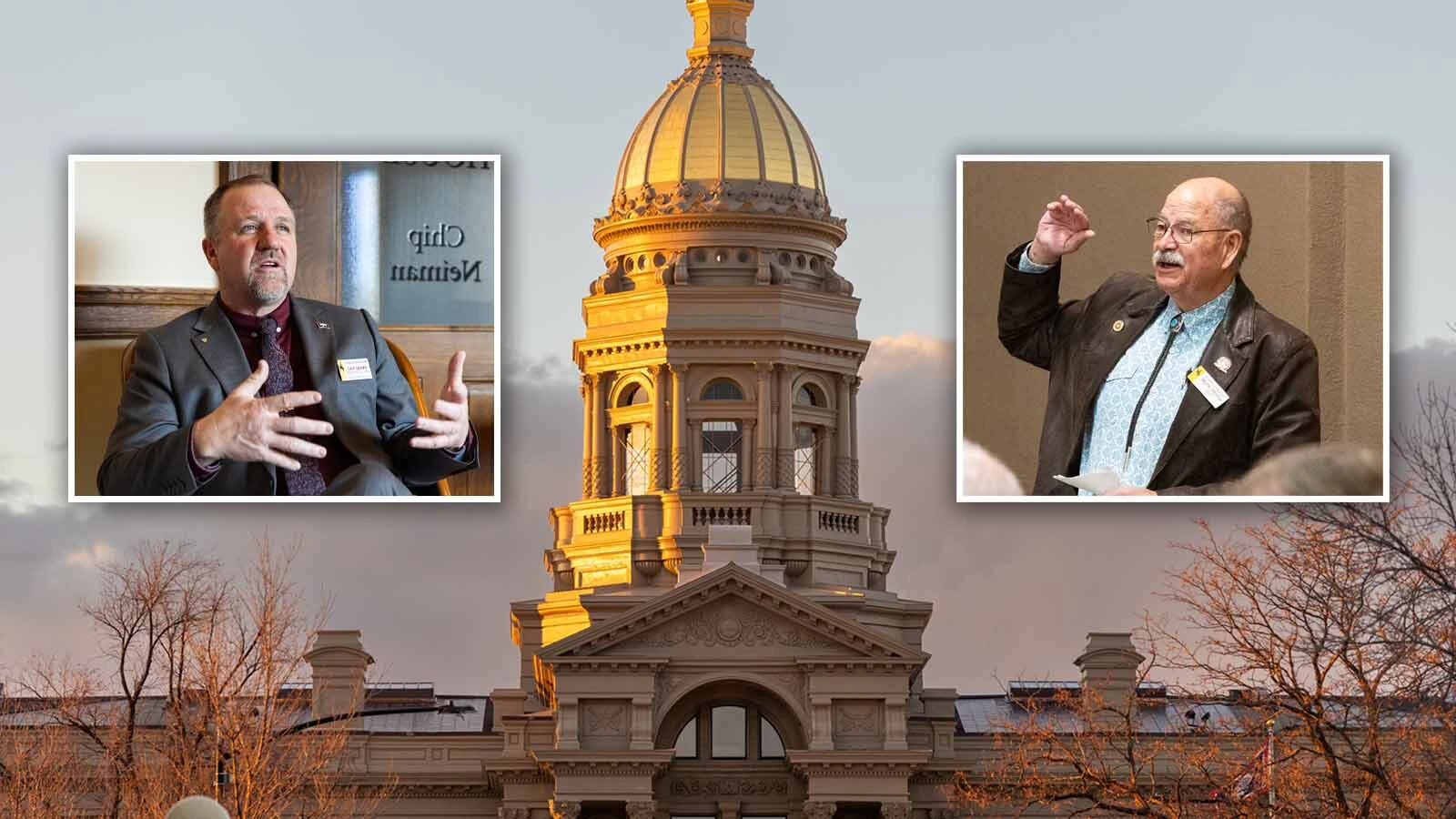
The story covers the state Senate race between two Republicans: Wyoming Freedom Caucus (WFC) member and House Speaker Chip Neiman, and the upper chamber’s incumbent, Sen. Ogden Driskill.
That race is anthemic of the divide between the Wyoming Freedom Caucus and its intra-party foes, multiple news outlets and the NYT have agreed.
But it’s difficult to capture the nuance of it.
The story casts non-Freedom Caucus lawmakers as institutionalists, caucus members as insurgents. It touches on the caucus-led passage of a 25% residential property tax cut, and it airs both ideals of caucus leaders and grievances of their critics.
The caucus’ priorities, WFC chair Rep. Rachel Williams told the outlet, include shrinking government, tightening voting rules, and curtailing “activist” judges.
The NYT covered Neiman’s long battle for pro-life legislation and Driskill’s efforts this year to shield the University of Wyoming from a $40 million cut and the Wyoming Business Council from complete repeal.
But Who Owns The Right?
Former state Rep. Ember Oakley, who’s a career prosecutor and a detractor of the caucus, said the story repeats a fallacy that the Freedom Caucus is more conservative than its Republican foes.
Neiman had the inverse critique, saying though the story labels him as “far-right” he’s the normal right, and Driskill is, he asserted, a “Democrat.”
Oakley responded to that barb hours before Neiman said it.
“This race actually does exemplify the division sowed by the Freedom Caucus, because classifying Ogden Driskill as anything but a solid conservative is ridiculous,” she said. “You can find this out by the policies he supports, his voting in the Senate, or any time you speak with the man.”
Driskill also bristled at being called a Democrat. He called it an instance of juvenile and disheartening name-calling, and described himself as a Reagan Republican.
He noted that he’s fought against both fuel and cigarette taxes throughout his 16-year legislative career.
Wyoming has produced no universal agreement about what it means to embody the political “right.”
“I take umbrage with the continued classification (of) the Freedom Caucus being more conservative than the traditional, long-term Republican Wyomingites,” said Oakley.
She gave an example.
While the Freedom Caucus passed the 25% property tax cut, its ally, gubernatorial candidate Brent Bien, led the effort to put another 50% residential property tax cut on the ballot this November.
Oakley stressed that because property taxes fund local governments – such as ambulance, firefighting, law enforcement, and schools – the locals of each county are funding their own services through them.
Offloading the tax burden onto another revenue structure, like the energy industry or sales taxes, shifts each local services bill from the people who are receiving the services, Oakley noted. She added that it would also shift communities’ autonomy to the bigger state government.
“Local control, instead of the bigger government – yes, even state – has always been a central tenet to Republicanism,” she said.
She called the WFC’s battle cry against “activist judges” a red herring, and said “Republicans in this state have traditionally had a respect for the rule of law and the Constitution that mandates separation of powers.”
WFC state director Jessie Rubino did not respond by publication to a Sunday text message and Monday voicemail request for comment on the NYT story.
‘Ol Kitty Dog’
Neiman was pleased to find his dog named for the Gunsmoke character Miss Kitty Russell in the NYT’s profile photograph of him.
“That is a cool picture of me with Ol’ Kitty Dog,” he said.
His delight ended there.
Neiman disagreed with the outlet calling him far-right. He said he follows the Wyoming Republican Party platform, and doesn’t believe the state party’s current candidate vetting process calling for 80% or higher agreement is a tall ask.
“Then he calls Ogden a ‘merely conservative.’ I don’t even know what that is,” said Neiman.
Of being called an “insurgent,” Neiman said with a laugh, “Jeez-oh-Pete … Sounds like we’re creating an insurrection.”
Neiman said Freedom Caucus members are “just taxpayers wanting to be involved in the conversation.”
Driskill had called the Wyoming GOP’s new platform-based vetting rule a “purity test.”
He’s not alone. Other Republicans have pointed to broad strokes and inconsistencies in the platform.
For example, it says people have a right to life from conception to natural death – wording that could alienate Republicans who support the death penalty.
The story references the Common Sense Republicans, a new PAC that warns of caucus-led deep cuts to services and education.
Neiman countered this, noting that the Freedom Caucus joined nearly the entire Legislature in passing a new school-funding bill that increased K-12 spending and teacher pay.
When the Legislature passed the 25% property tax cut, he noted, property taxes had just soared.
Neiman said Wyoming would have clearer ideas about politics if it had a strong Democratic Party.
“We fight inside the Republican Party because the Democratic Party has moved into the Republican Party,” he said.
What Is A Democrat?
Driskill countered, “I wish (Neiman) understood what a Democrat is, because he obviously does not.”
“I was going to Republican state conventions when he was in diapers,” added Driskill.
Driskill said he has encountered people on the campaign trail who’ve been told that he’s a leftist, and he’s spent time going over his record with people to undo what he calls trickery from his foes.
Driskill noted that the Wyoming Freedom Caucus and its members often tout as victories bills that passed with broader support by other Republicans, and even Democrats.
While the NYT story didn’t capture “the whole drift of what we’re like in northeast Wyoming,” said Driskill, the authors tried to be fair and did a reasonable job.
Oakley lodged a technical note: the story calls Neiman’s decision to leave the House and run for Senate an “unusual gamble.”
Actually, it’s tradition in Wyoming for the Speaker to serve just one term in that role, Oakley observed.
The chamber elects a House speaker every two years. Its two most recent speakers before Neiman, Albert Sommers and Eric Barlow, both ran for Senate after their terms.
Nah, Says Lindholm
Tyler Lindholm, Wyoming-based director of Americans For Prosperity and a side character in the NYT story, didn’t have any real gripes about it Monday.
“I don’t really think it said much at all,” said Lindholm. “For once I wasn’t very exciting, I guess.”
Clair McFarland can be reached at clair@cowboystatedaily.com.


