
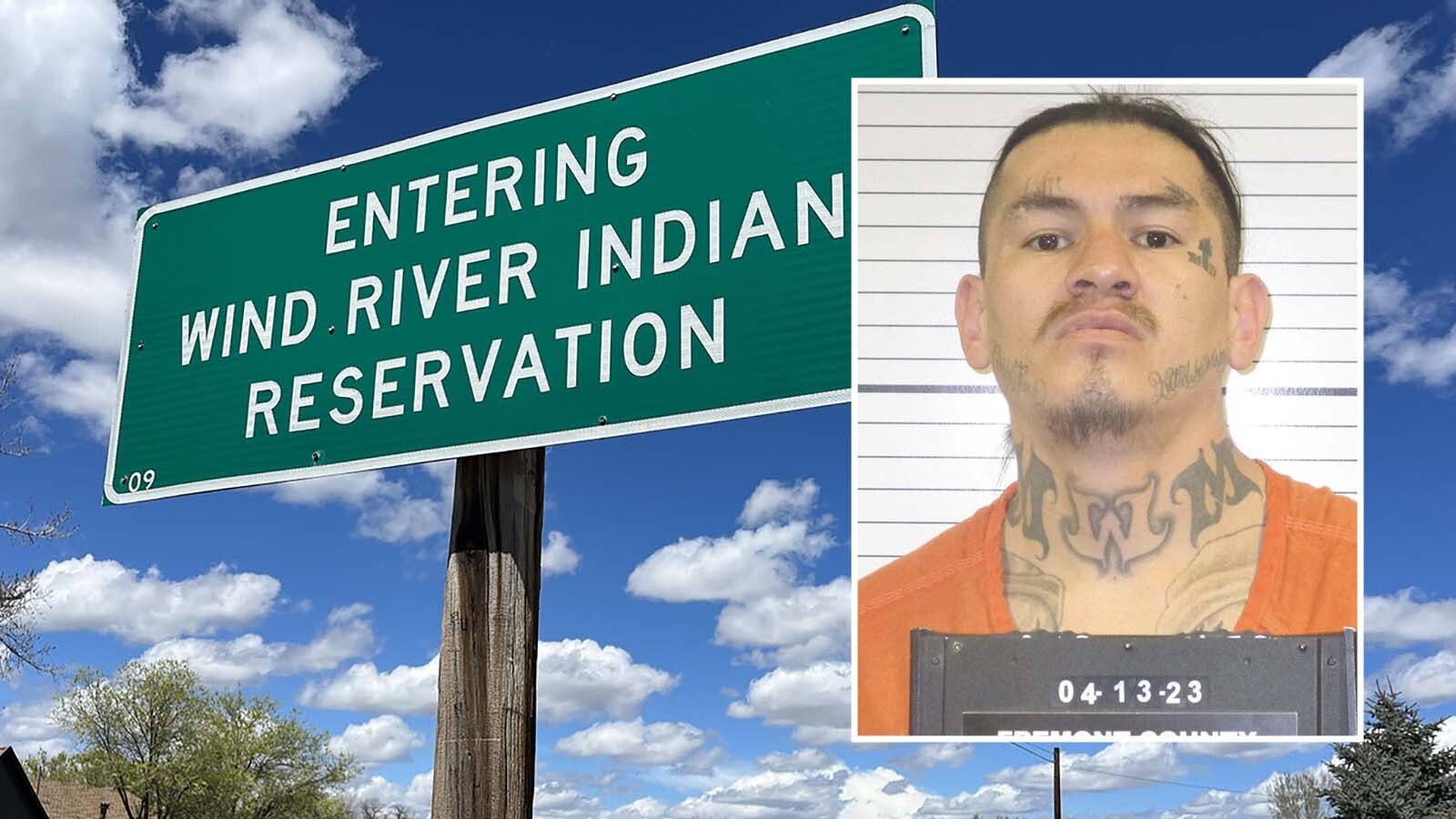
A Riverton man who admitted to slitting the throat of a Wind River Reservation man, binding his hands and feet, wrapping his body in hotel bedding and dumping it in the snow was sentenced Thursday to life in prison with the possibility of parole.
Fremont County District Judge Jason Conder imposed the sentence on John William Goodman, describing the case as a "brutal killing of a human being" and one "replete with an overwhelming abundance of aggravating factors."
The sentence comes more than three years after 37-year-old Gustave Elmer Yellowhair's body was discovered by "little kids," partially buried in snow on the Wind River Reservation, Conder said during Thursday's hearing.
Fremont County Attorney Micah Wyatt urged the court to impose the maximum sentence available, arguing Goodman had already received "substantial mercy" through a plea agreement that reduced the charge from first-degree murder to second-degree murder and dismissed a separate kidnapping charge.
"This is not a normal second-degree murder," Wyatt told the court.
'Even After The Victim Was Dead'
Wyatt argued Yellowhair was not killed in self-defense or during a drunken fight.
"Even after the victim was dead, the violence did not stop," Wyatt said.
Goodman attempted to decapitate Yellowhair after killing him, Wyatt argued, a fact he said demonstrated an "extreme de-valuing of human life."
"That fact matters," Wyatt told the judge.
Wyatt argued Goodman then treated Yellowhair's body as "disposable," abandoning it in a remote area before later bringing two underage girls to view the remains.
"This is not an isolated event from an otherwise peaceful person," Wyatt said before walking the court through a lengthy and violent criminal history that included multiple assault and battery convictions.
Defense Argued For Lesser Sentence
Assistant Federal Public Defender Valerie Schoneberger acknowledged the gravity of the crime but argued for a lesser sentence.
"This case involves the death of a human being and it's tragic," Schoneberger said. "We don't dispute a serious sentence."
Goodman endured a lifetime of instability and hardship, Schoneberger said, noting he was arrested when he was only 14 years old.
"He has a history of being mistreated by the system," she said.
She also pointed to a family history of alcohol abuse and described a life shaped by dysfunction and trauma.
Then Schoneberger reviewed five homicide cases she considered similar to Goodman's, including one she characterized as more egregious, involving a father who killed his premature infant and attempted to conceal the child's remains.
Schoneberger argued those cases demonstrated that a lengthy prison sentence could be imposed without condemning Goodman to spend the remainder of his life behind bars.
Goodman declined to address the court before sentencing.
Judge Rejects Comparison To Other Cases
Judge Conder said Schoneberger was "spot on" when describing the many hardships Goodman had faced throughout his life, and that he had endured "innumerable tragedies."
At the same time, Conder noted that Goodman had inflicted tragedies on others.
Conder rejected the defense's invitation to compare Goodman's sentence to punishments imposed in unrelated cases.
"That's illogical,” the judge said, adding that what happens in "some other court" does not dictate what sentence should be imposed in a case with a different set of facts.
In addition to the life sentence, Conder ordered Goodman to pay $6,355 in restitution to victim services.
Jailhouse Boasting
Yellowhair's body was discovered in March 2023 after the U.S. Bureau of Indian Affairs was alerted that Goodman had shown two underage girls a dead body on the reservation.
When FBI Special Agent Scott Jensen arrived at the scene, he found Yellowhair partially buried in snow, according to an affidavit filed in his case. His feet protruded from the snowpack, and investigators discovered the body wrapped in bedding with the feet bound by a cord.
Despite the gruesome discovery, it would take more than two years before prosecutors formally charged Goodman with murder.
During that time, investigators with the Wyoming Division of Criminal Investigation and Riverton Police Department continued working the case while Goodman sat in jail on unrelated charges.
They reviewed recorded jail calls, interviewed associates and cultivated multiple confidential informants, the affidavit says.
According to court records, several witnesses told investigators Goodman had spoken openly about killing a man at a Riverton motel, cutting his throat, wrapping the body in motel bedding and dumping it on the reservation.
Investigators also reviewed calls in which Goodman discussed a gang he called the "Maniacs" and made statements they interpreted as admissions connected to the killing.
A Single Hair Becomes Critical Evidence
While witness statements helped investigators piece together the timeline, forensic evidence ultimately provided one of the strongest links to Goodman.
When Yellowhair's body was discovered, investigators recovered a hair clutched in the victim's hand. During the investigation, Goodman reportedly told an associate he had learned his hair had been found with the remains and said that was why he cut his own hair short.
The breakthrough came when FBI laboratory testing analyzed the hair.
Initial testing found a possible DNA association with Goodman. Investigators later collected cheek swabs from Goodman and submitted them for comparison.
Results returned in April 2025 showed it was 13 sextillion times more likely that Goodman contributed the DNA found in the hair than an unknown person, according to court records.
Investigators also found DNA on motel room keys and USB cords recovered from the crime scene that showed strong support for a mixture containing DNA from both Goodman and Yellowhair, according to the affidavit.
Combined with witness statements, jail calls and other evidence gathered during the two-year investigation, prosecutors said the forensic findings helped solidify the case that ultimately led to Goodman's murder conviction.
Kolby Fedore can be reached at kolby@cowboystatedaily.com.


