
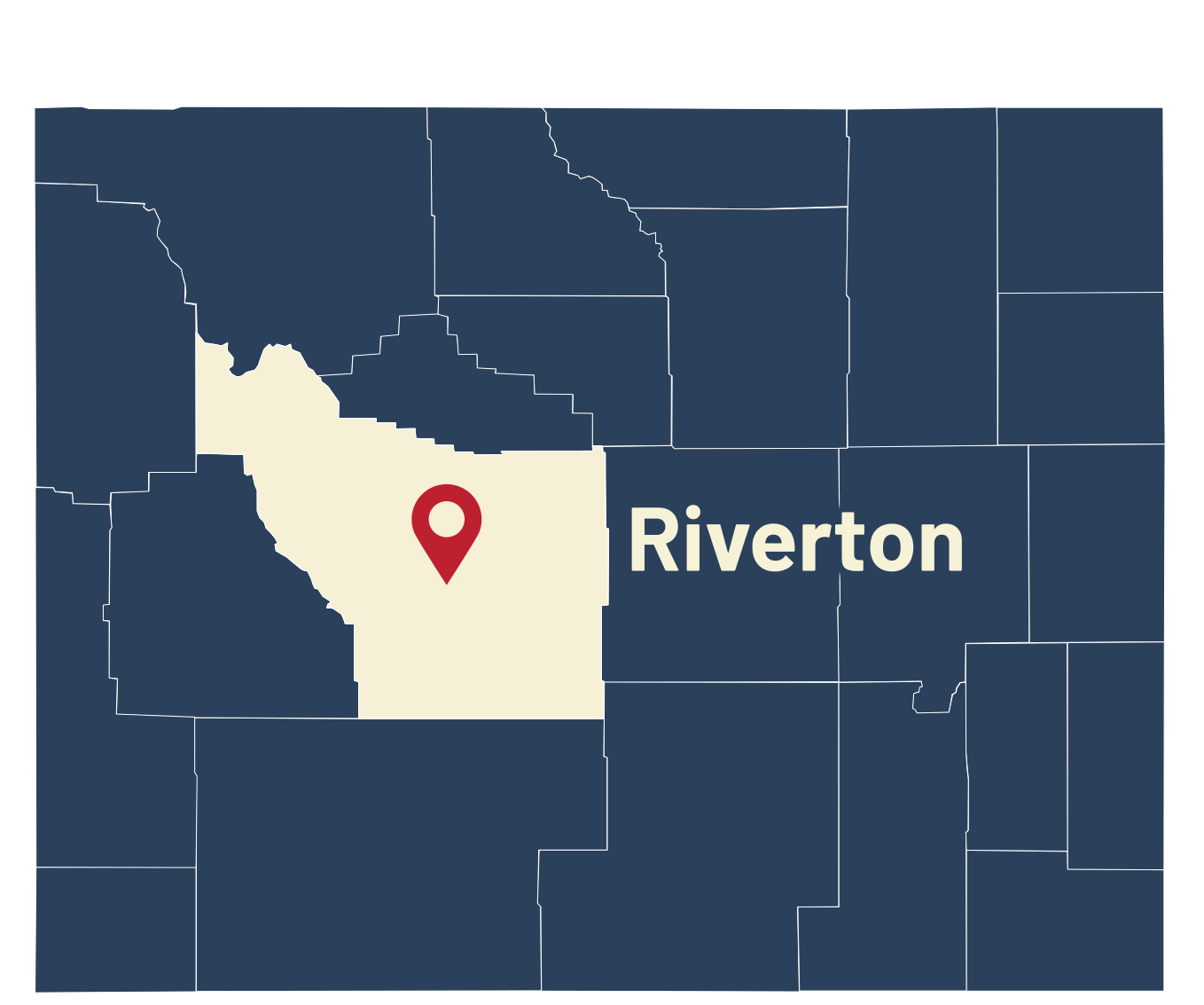
RIVERTON — Steve Friess said he wants to turn the Environmental Protection Agency (EPA) into an advisory board that gives advice to state environmental quality agencies.
He’s one of nine candidates running for the Republican nomination for Wyoming’s lone U.S. House seat.
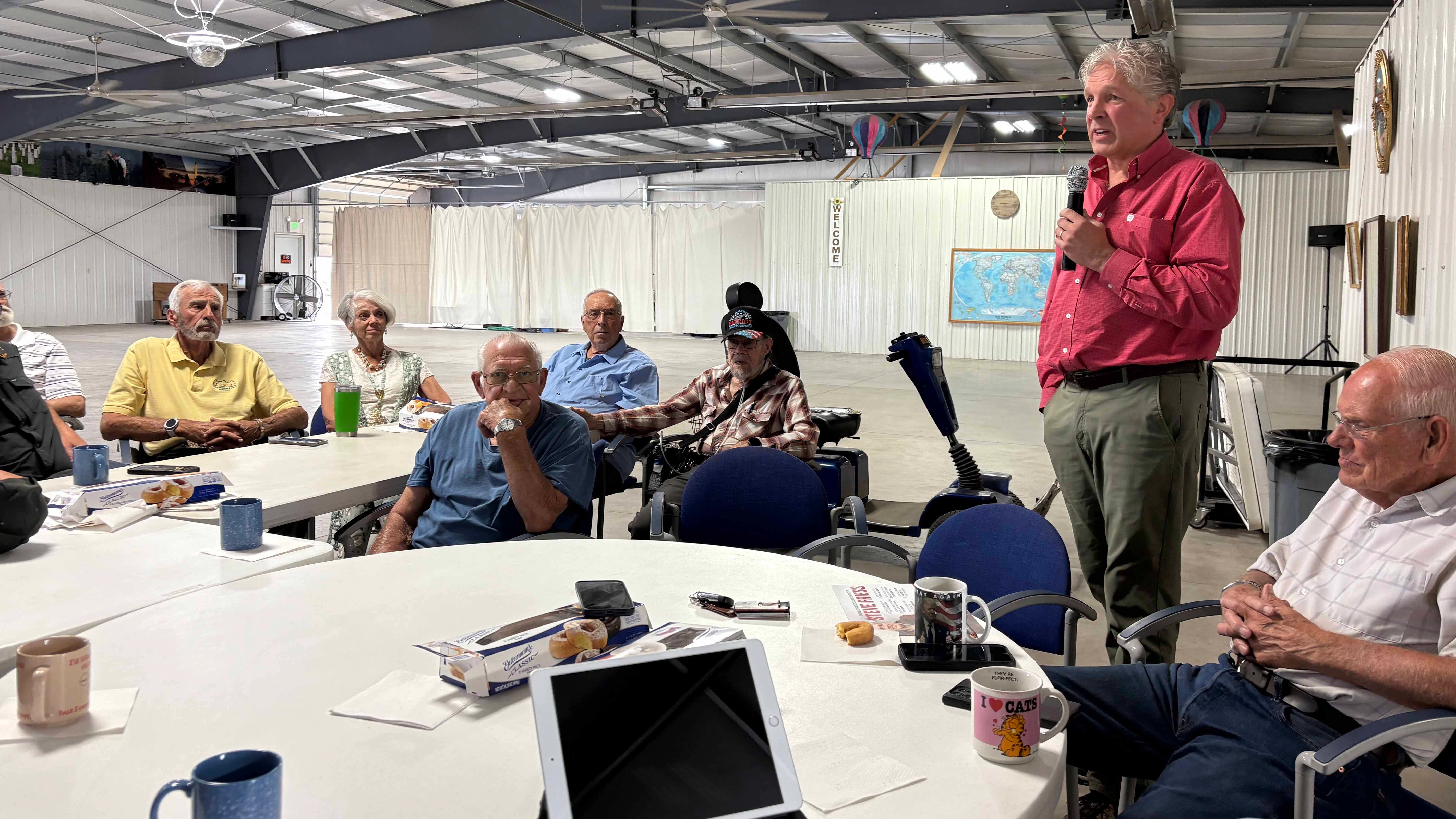
Visiting an old-guard political coffee group known as “The Gentry” on Riverton’s airport hill Wednesday, Friess said, “I think the EPA should be a panel of experts that make recommendations to state DEQs (departments of environmental quality).”
“I don’t think we need redundant enforcement,” he added. “I think our state knows how to do things in a clean, reasonable, cost-effective fashion, and I think the EPA is a nightmare.”
Friess said hadn’t intended the EPA comment as an announcement. He said big “green” groups would be after him if it aired.
Cowboy State Daily pressed Friess to put the comment on the record and, with a hand gesture of surrender he said, “Take it.”
The Sierra Club of Wyoming is not impressed with the plan.
In a Wednesday email, the environmental group’s climate and energy organizer Emma Jones called the proposal “ridiculous and harmful to hardworking Wyoming communities.”
“Given the recent explosion in data center development that threatens our communities with air and water pollution, we need more oversight and transparency from our state decisionmakers, not less,” wrote Jones.
She emphasized that states already have the power to make their own rules and regulations.
“The EPA simply exists to ensure the states are meeting standards that will enable communities to have access to clean air and drinking water for generations to come,” said Jones. “If Steve Friess doesn’t understand the value of having strong protections for our local environment, why would we trust him to represent us?"
‘We Can Take Care Of Ourselves'
Friess countered in a later phone interview.
He said he agrees “entirely” with the Sierra Club’s point that Wyoming is in charge and should exercise leadership regarding data centers. He said state leaders “should negotiate fiercely to ensure that electricity rates should not go up.”
Friess said state leaders should negotiate, rather, to drive power bills down, “because data centers should provide their own power sources and sell excess into the local market.”
At the coffee gathering, Friess had said those power sources should use Wyoming gas, and data centers should at a minimum use coolants other than water or “closed loop” water cooling.
He noted in his phone interview that the “Republican Party” created the EPA and called clean air and clean water longstanding priorities of Republicans.
“However, at this stage, the state departments of environmental quality are ably equipped to manage these issues,” he said, adding that the EPA’s regulations are “duplicative and redundant,” as well as unhelpful to Wyoming.
“We can take care of ourselves,” said Friess.
Origin Story And Arc
President Richard Nixon proposed the EPA’s creation to Congress in early 1970 due to the public’s concerns about poor city air quality, debris and contaminated urban water.
His plan created the EPA. Congress ratified that plan as law in 1984, when Democrats controlled the House of Representatives and Republicans controlled the Senate.
Congress also established much of the Clean Air Act’s structure in 1970, and revised it in 1977 and 1990.
EPA investigators and federal prosecutors in about 2020-2021 started interpreting a provision of the Clean Air Act as authorization to charge diesel delete mechanics with felonies. That led to the well-known case of Wyoming delete mechanic Troy Lake, whom Trump pardoned last November.
Trump pardoned nine more delete mechanics this month.
Not The First Rodeo
U.S. Rep. Clay Higgins, R-Louisiana, proposed a bill in 2024 to abolish the EPA and send roughly half of its $8.8 billion budget to the environmental quality agencies of states and U.S. territories for no more than four years.
Higgins asserted in a statement at the time that the EPA has "unjustly penalized our farmers, petrochemical industry, energy producers, and American families."
He said his bill would restore environmental protection authority to the sovereign states “and (save) tens of billions in taxpayer dollars.”
The bill stalled after introduction.
Meanwhile, In Riverton
"The Gentry" Wednesday coffee group consisted mostly of post-retirement age men who generally describe themselves as energy sector professionals, retirees, and semi-retired farmers.
Former mayor Ron Warpness hosted the gathering.
Riverton-based Republican legislators Rep. Pepper Ottman and Sen. Tim Salazar attended, as did former lawmakers Eli Bebout and David Miller — also Riverton Republicans.
The Gentry's gatherings are a stopping point for many serious statewide candidates. Friess’s opponents David Giralt, Jillian Balow and Bo Biteman paid visits this summer, as did gubernatorial candidates Eric Barlow and Brent Bien.
Bebout asked Friess how he’d help hardworking Wyomingites, particularly in the energy business.
“Because they’re working hard. But we’ve been through the busts, see, and they’re not good,” said Bebout. “We’ve all suffered in this room, whether it’s uranium, oil, gas, whatever.”
Friess’s message was pro-oil, coal, gas, uranium and rare earths.
He said temporary uranium storage worries could be addressed through innovation.
He emphasized that Congress doesn’t run data center policy for states but urged Wyoming state and county leaders to craft policies that are Wyoming-people-first, but acknowledge data centers’ place in the tech race against foreign adversaries.
Friess theorized that by “unlocking” energy production through deregulation and innovation, the nation could also address people’s other worries, like the high cost of living.
“The jobs that will provide, the salaries that will provide — that will support the whole ecosystem all the way down,” said Friess.
Besides Friess, Biteman, Balow and Giralt, five more candidates are running for the Republican nomination to U.S. House. Those are Secretary of State Chuck Gray, former legislator Keith Goodenough, combat veteran Kevin Christensen, Casper businessman Reid Rasner, and actor/singer Richard Dodson.
The primary election is Aug. 18.
Clair McFarland can be reached at clair@cowboystatedaily.com.


