
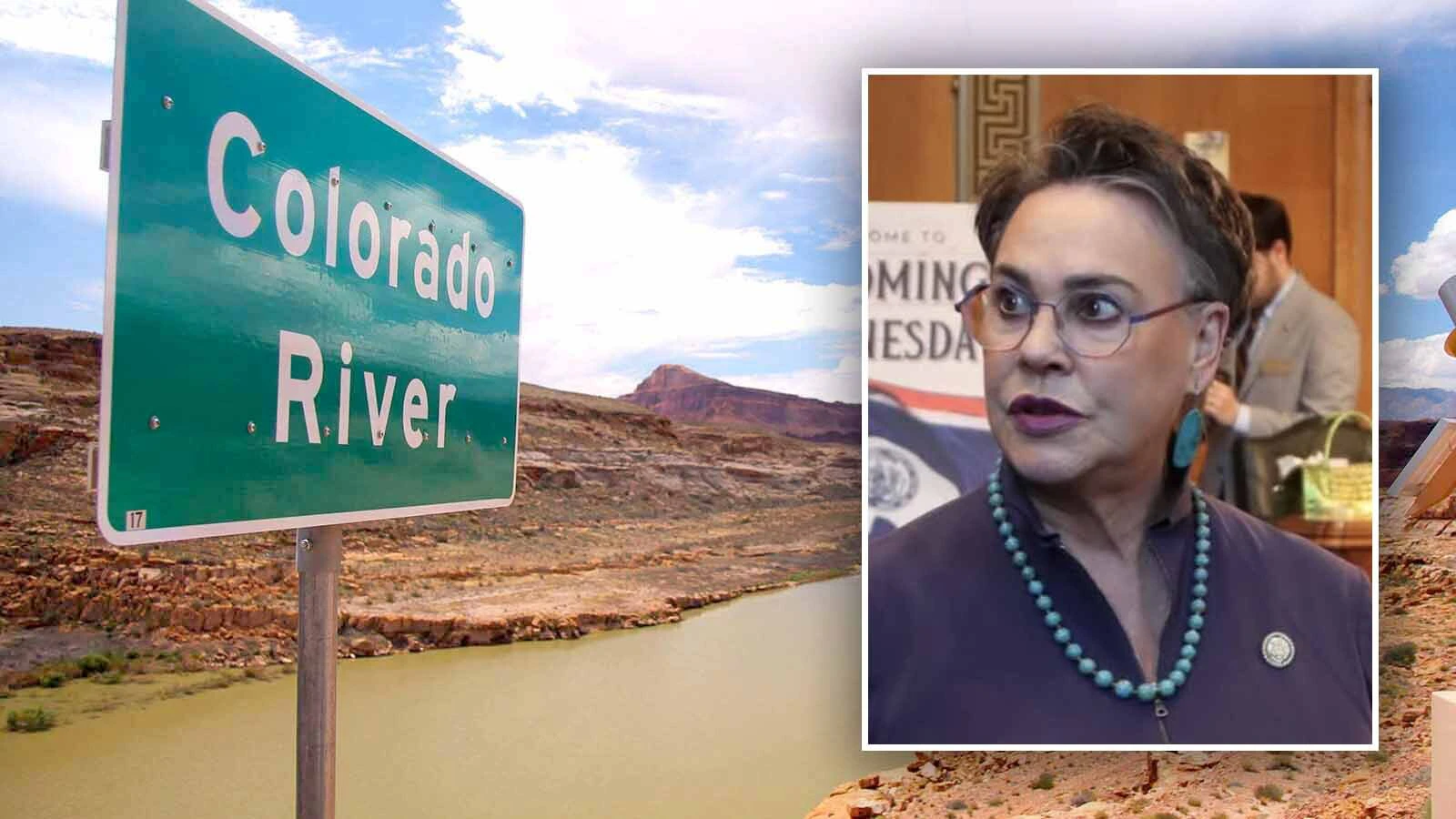
California isn’t doing its part to avert the Colorado River crisis by upgrading its aging water infrastructure and is instead spending billions on pet projects, Wyoming Republican Rep. Harriet Hageman said Monday.
“It’s because they do stupid things like spending money on high-speed rail and don’t meet the basic needs of their citizens,” Hageman told Cowboy State Daily.
She added that California Gov. Gavin Newsom is one of the “top five worst governors in the United States.”
“How many billions have been wasted on healthcare for illegal aliens (in California)?” she asked.
During a recent appearance on News Nation, Hageman said California, with a population of 40 million, still relies on water infrastructure dating to the 1960s, when about 16 million lived in the state.
That could saddle Wyoming and other Colorado River basin states with meeting an increasing demand for water against a dwindling supply, she said.
If the issue escalates into a legal battle, probably before the U.S. Supreme Court, California and other downstream states might try going after Wyoming’s irrigation water, Hageman added.
Hageman was previously a water and natural resources attorney. She worked on cases related to the 1922 Colorado River Compact, the North Platte Decree limiting Colorado’s use of the river’s water, and other interstate water agreements.
Red Lights Flashing
Alarm over the condition of the river reached new levels Saturday, when Lake Powell, on the Utah-Arizona state line, reached its lowest level on record, CNN reported.
Nine days earlier, Lake Mead, on the Arizona-Nevada state line, also reached its lowest level.
Lake Powell and Lake Mead are the largest reservoirs on the Colorado River and supply hydroelectric power and other water needs to the Lower Basin states of California, Arizona, and Nevada.
The Upper Basin states are Wyoming, Colorado, Utah, and New Mexico.
There’s concern that Lake Powell and Lake Mead could reach “dead pool,” or levels so low their dams can no longer generate hydroelectric power.
California should have seen trouble coming and acted accordingly, Hageman said.
“The red lights have been flashing for years, if not decades,” she said.
Wyoming Irrigation Would Prevail In Court
Wyoming Gov. Mark Gordon recently stated that he’s "encouraged” that the Department of the Interior's new 10-year plan for the Colorado looks out for Upper Basin states.
However, Arizona Gov. Katie Hobbs said it calls for “draconian water cutbacks" for her state.
Hageman said Arizona’s water woes stem from the same problems California has: Poor planning and misallocation of funds that should have gone toward water infrastructure.
“I think it might very well be Arizona that will try to drag the other states into court over this (Colorado River) compact,” she said.
Attorneys for Arizona or other Lower Basin states would likely try arguing that meeting industrial or municipal demands would be a “higher and better use” for water than irrigation in Wyoming, she said.
However, Hageman said she’s confident that’s an argument attorneys for Wyoming and the Upper Basin would win.
“The solution to their long-term water needs isn’t shutting Wyoming off from being able to irrigate,” she said.
Moreover, irrigation is good for the environment, she added.
The 1922 Compact Stands
Tensions over the Colorado River have led some to question whether the 1922 Colorado River Compact should be replaced.
Hageman said that might sound appealing at first, but drawing up a new compact could take years or possibly even “decades” in court.
And there’s no guarantee a new compact would be better for Wyoming and the Upper Basin, she added.
“It is what it is. And the reality is, we keep coming back to this compact,” Hageman said.
The best hope is for the Upper Basin states to argue for the existing compact to work in their favor, Hageman said. And she said she thinks that case can be made.
The compact calls for the Upper Basin to supply an annual flow of 7.5 million acre-feet at Lees Ferry in Arizona.
It is viewed by some as a “delivery obligation” on the Upper Basin’s part, Hageman said.
“I would argue that it’s a non-depletion compact,” she said.
Wyoming has never used its allotted 14% of the Upper Basin’s allocation, she added. And until it does, there shouldn’t be a call for Wyoming’s supply to be depleted.
‘They Failed All Of Us’
Some have suggested California wean itself from the Colorado by desalinizing Pacific Ocean water along its extensive coastline.
Hageman said she favors that option and thinks California is obligated to pursue it far more aggressively than it has.
“Israel is at almost 100% desalinization” of seawater to meet its freshwater demands, Hageman said. “It can be done.”
However, California’s policy has been directed by short-sighted politicians who want to spend the state’s revenue on flashy projects, such as “Los Angeles-to-San Fransico high-speed rail,” rather than investing in desalinization plants and the like, she said.
“They failed all of us,” Hageman said. “They failed everybody on the (Colorado River) system.”
Mark Heinz can be reached at mark@cowboystatedaily.com.


