
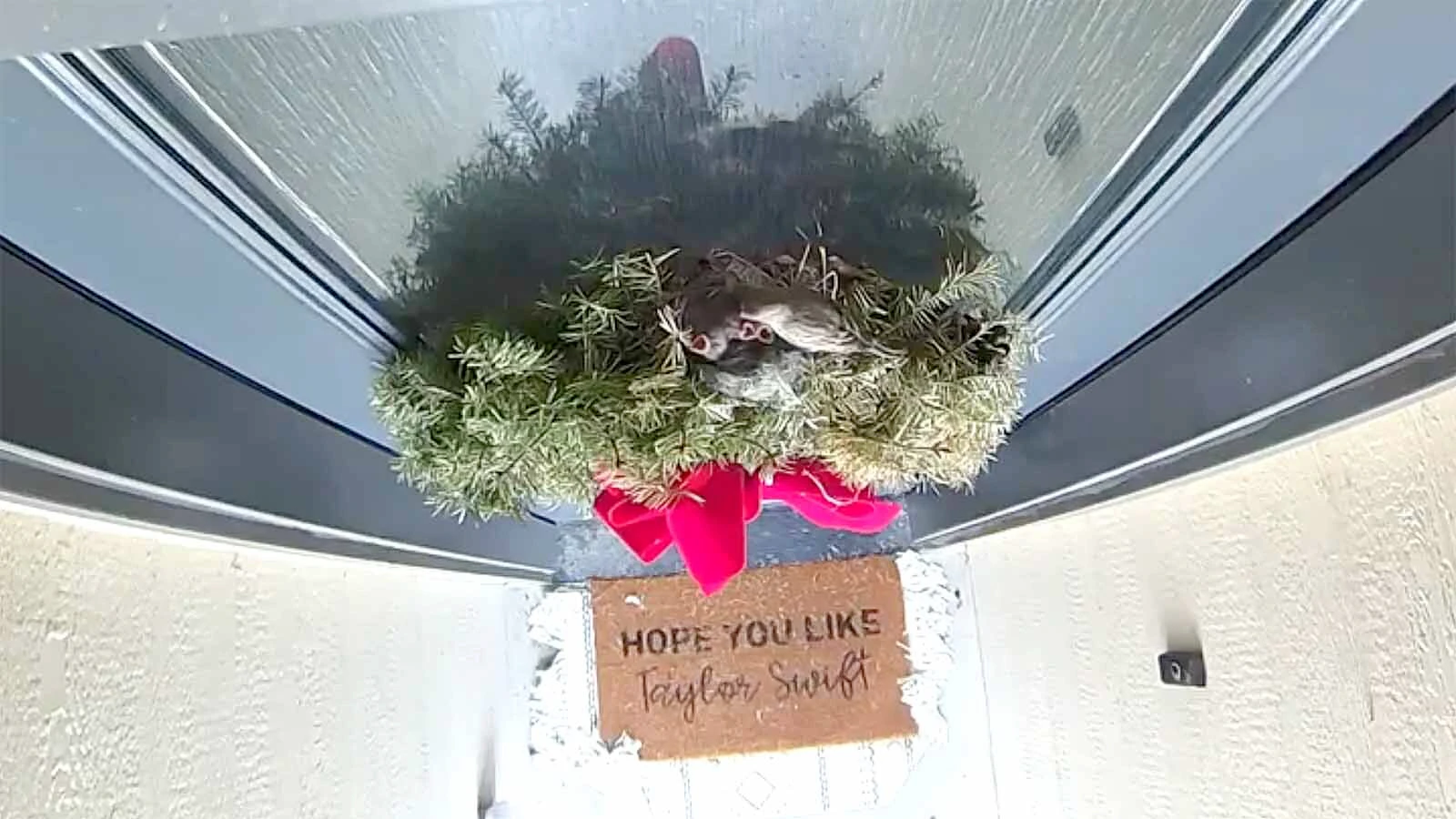
CASPER — Nearly five months after Christmas, the Petrino family still won’t take the wreath off their front door. They won’t even use the door.
That’s because they procrastinated taking down their holiday decorations so long that a pair of finches built a nest in it, laid eggs and are now raising a brood of babies in their Christmas wreath.
The Petrinos discovered the nest about a month ago, and their front door remains off-limits. A Ring camera is trained on the nest — now full of hatchlings — and the family is watching in real time as the chicks grow bigger by the day.
By mid-April, the Christmas wreath had already overstayed its welcome, but the Petrinos are a busy family with two boys, so it was easy to ignore, until it wasn’t.
“I got home from Ohio and opened the front door to grab a package, and I was like, ‘There are pine needles everywhere. I need to take this wreath down,’” said the mom, Alex Petrino.
The next morning, her husband paused near the door because he could hear chirping.
That didn’t make much sense until they cracked the door open and a bird flew out from somewhere in the vestibule, revealing a nest of twigs tucked into the boughs of the wreath, partially hidden and already established enough to make them hesitate.
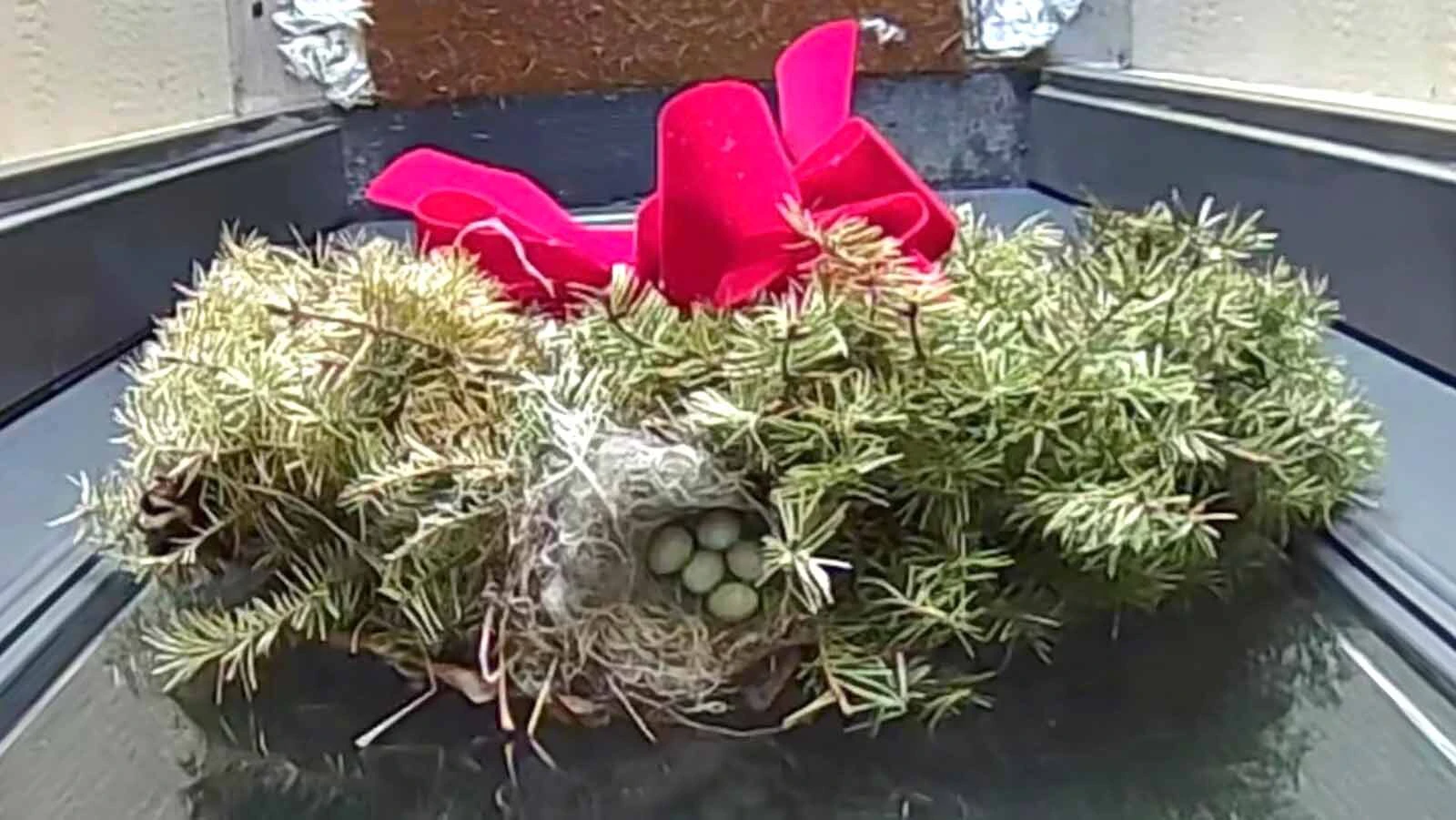
They closed the door. By the following morning, the situation had escalated from curiosity to commitment to what was a fully formed nest holding five eggs.
Off Limits
Alex said her maternal instincts took over.
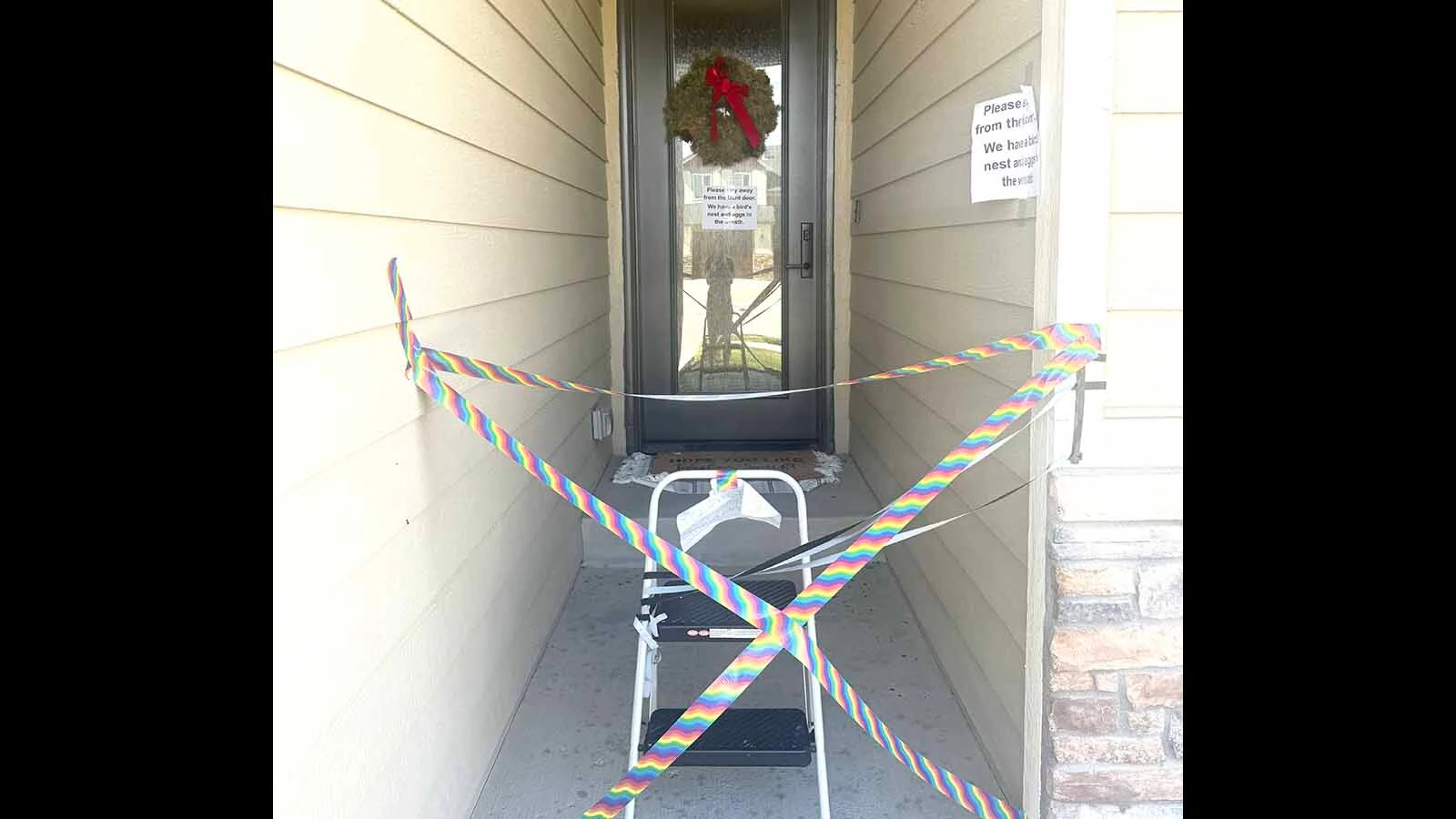
“We were like, ‘Oh no, we can’t do anything,’” she said, and within a day, the front entrance to their home was effectively decommissioned.
Tape went across the patio, a stool was positioned as a barrier, and handwritten signs now warn anyone approaching that there arebirds nesting in the wreath and that the suburban entryway was a restricted zone.
Now that it’s May, the chicks have hatched. Still, the zone remains off limits.
“I’ve opened it a couple times when I knew the mom wasn’t there, just a little bit, standing on a stool to take a quick picture,” she said. “But we haven’t used it.”
Everything else is rerouted.
Packages, visitors, neighborhood traffic — all of it now moves through the garage, which stays open most of the time as a workaround that is functional but messy, especially with kids in the neighborhood who are used to coming to the front and don’t always read or understand the signs.
“That’s probably been the biggest change,” said Alex.
Watching Closely
A few days into their bird nest watching on April 18, the Petrinos decided to get a better look at the developing situation.
Seizing a moment when the parent birds were away, they installed a Ring camera above the door, angled down toward the nest so they could keep a close eye on it.
Alex said she checks in on the video feed “probably once an hour, if not more.”
The camera feed is shared with her family, including her parents, and her husband checks it regularly as well, creating a fun departure from their everyday routines.
“It’s been a nice distraction from work and everything else,” she said.
Petrino guesses the birds are finches, based on coloring and size, noticing the bright red head of the male and the more muted brown of the female.
That suspicion lines up with what Wyoming Game and Fish wildlife staff say.
Casper-region agency spokesperson Janet Milek said, “This sounds exactly like a House Finch."
She added that their behavior makes perfect sense for the setting.
“House finches are synanthropic, meaning they have evolved to thrive in human-altered environments,” she said. "They often prefer human structures because they provide flat ledges and protection from some natural predators.
“House Finches naturally nest in conifers. So, a front-door wreath is a top-tier nesting site in their world.”
Eggs, Then Movement
“We’ve got a baby!” said Alex on April 26. Then, in a series of cracks and movement, four baby birds emerged.
At one point, the family believed all five eggs had hatched, though more recently they can only make out three or four babies, leaving some ambiguity about whether one didn’t make it or simply isn’t visible from the camera’s angle.
“They’ve grown really fast,” she said. “Every day they look different.”
From a wildlife standpoint, that rapid progression is expected.
Milek said the full nesting cycle is typically just four to five weeks from egg to fledging, with clear signs when departure nears.
“The nest will look far too small, and you’ll see chicks standing on the edge, flapping and ‘branching’ before they leave,” she said.
One of the Petrinos’ favorite moments has been catching the mother flying back to the nest with food.
Like synchronized swimmers, the chicks open their tiny beaks wide for a feeding. You can hear the chirping on the camera recording.
Notorious BIRDs
At some point, the Petrinos named the birds.
The parents became “the Notorious BIRDs,” and the chicks were assigned names pulled from musicians: Freddie Birdcury, Chick Jagger, Egg Sheeran, and Stevie Chix.
The names aren’t used in any formal way, but they stick, a shorthand that turns a cluster of indistinct movement into something easier to track and talk about, especially when multiple people are watching the same camera.
The biggest practical impact is still the door.
While the workaround through the garage is manageable, Alex said that, “I’d like to use my front door again.”
It won’t be long before that can happen.
The chicks are already changing quickly and the Petrinos are ready for the next phase when the chicks leave the nest.
“I think I’ll be a little sad, but also kind of proud,” she said. “And then off they go.”

The Wreath Stays
A situation that started with procrastination has evolved into a unique story the Casper family won’t forget. It also may motivate more timely removal of decorations in the future.
“This is the consequence of me not taking my Christmas decorations down,” Alex said.
Wildlife officials say the family handled it exactly as they should have.
“From a wildlife management perspective, they did the right thing,” Milek said.
House finches are protected under federal law, meaning active nests with eggs or chicks generally can’t be disturbed.
The wreath itself came from the Casper Oilers Hockey Club, one the Petrinos buy every year, and they'll continue to do so.
And if it stays up too long again, which Alex admits is likely — and if another pair of nesting birds decides to use it — the Petrinos will happily let them.
Kolby Fedore can be reached at kolby@cowboystatedaily.com.