
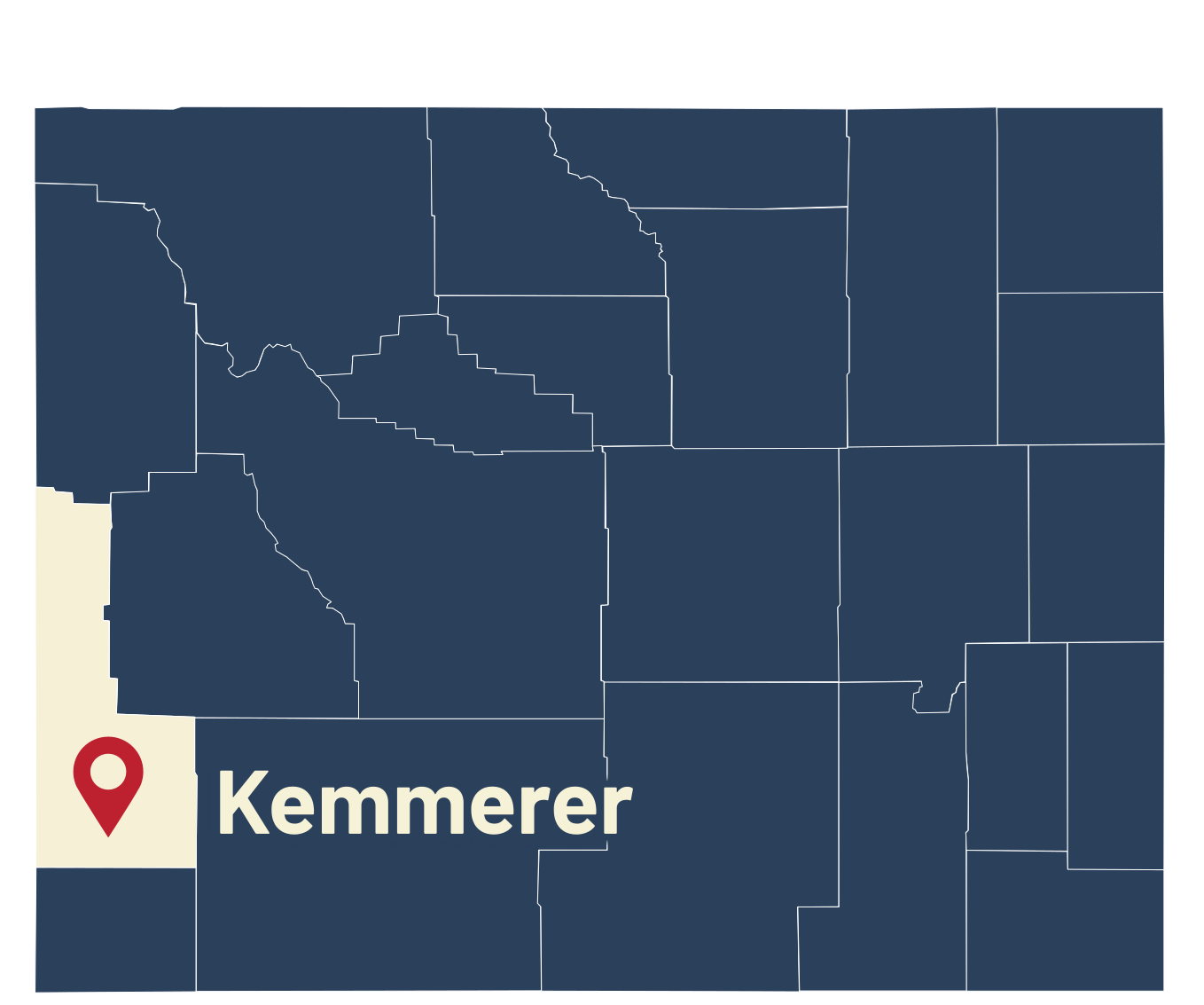
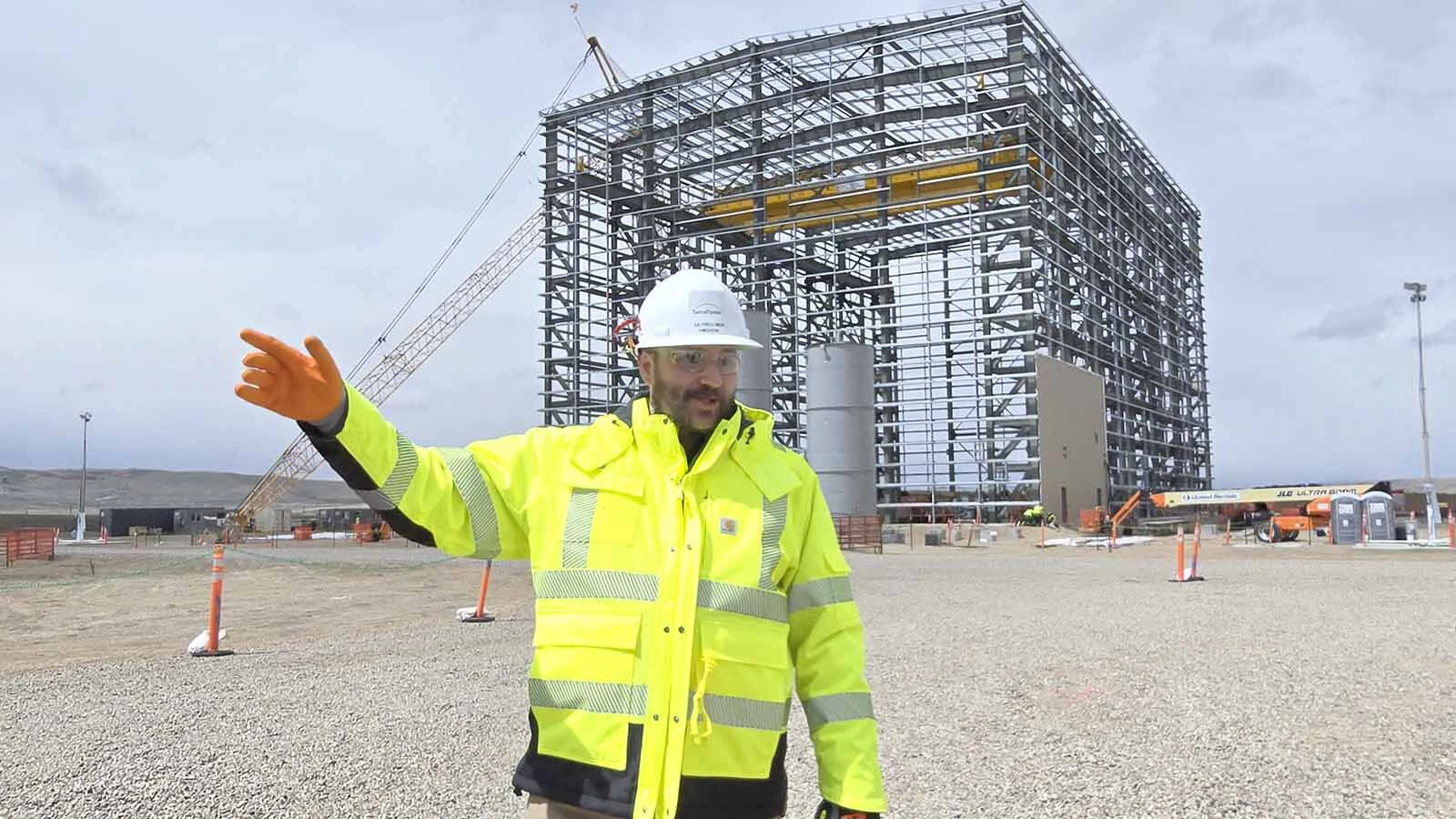
Wyoming’s notorious winds stole the show Wednesday in Kemmerer, as TerraPower opened its gates to the media for its nuclear plant’s first day of construction.
Once built, the Natrium plant in Kemmerer will become the nation’s first utility-scale advanced nuclear power plant and the first commercial-scale sodium-cooled reactor in America.
The plant will bring about 1,600 workers to town at peak construction, and roughly 250 permanent jobs when it comes online sometime around 2030.
TerraPower has been working on a non-nuclear facility that will be used to test all the components of its Natrium reactor over the past year, which it calls the Test and Fill Facility.
Wednesday marked the first day of construction for the nuclear part of the project, which company officials say will be one of the first its kind in size and scale in both America and the world.
Gusts were strong enough to sideline cranes at the site, shifting work to less wind-sensitive tasks. The wind also snarled up flights into Wyoming for TerraPower president and CEO Chris Levesque.
The show — and the construction — went on in spite of the difficulties, with TerraPower Director of Construction Andy Churusciel noting that he and his crews are used to the harsh weather and have learned to work around it.
“The team together has made this a very safe site,” he said. “I’m very proud of it. The weather doesn’t bother us.”
TerraPower tracks wind speeds at the construction site on a daily basis, TerraPower’s lead engineer for the Test and Fill Facility told Cowboy State Daily.
Cranes come down around 25 mph, one TerraPower official noted, while elevated work platforms and siding crews stand down when gusts top about 30 mph, to prevent steel sheets from turning into a “sail that carries you away.”
“It’s not ideal,” Stockett said. “But it’s something that we can work around, and we have been working around consistently.”
Work crews come in around 6 a.m. each day to begin work before wind picks up. Then they switch to prep work or interior systems, if winds climb into the 20 to 30 mph range.
“So, as soon as the wind dies down, they’ll be back up and back to siding this thing,” he said, gesturing toward the Test and Fill facility. “It’s a challenge, but we enjoy the challenge here. We don’t do this because it’s easy.
"We do it because it’s something worth doing, and it’s hard to do.”
The Cruelest Month
Cowboy State Daily Meteorologist Don Day has always called April the cruelest month.
“You can have just spectacular weather one day, and really bad weather the next,” he said.
The wind was carried in by a sharp cold front that barreled into western Wyoming on Wednesday, bringing 40 to 60 mph gusts, along with rain, snow showers, and even a little lightning in some places in southwestern Wyoming, like Evanston.
“Between 10 a.m. and 1 p.m., it was getting what we like to call ‘sporty,’” Day said, chuckling a little bit. “It was getting windy. And there was rain and snow showers. I did see some lightning strikes over there too, so not a great day to put up a crane or to fly.”
Weather records reviewed by Day showed wind in Kemmerer ramping up dramatically over the morning. From 7 mph at 7 a.m. to sustained wind gusts nearing 40 mph by noon — just ahead of the time TerraPower had scheduled media activities and site tours.
First Cut
Despite the wind-related difficulties, TerraPower pressed ahead with both construction activities and media tours.
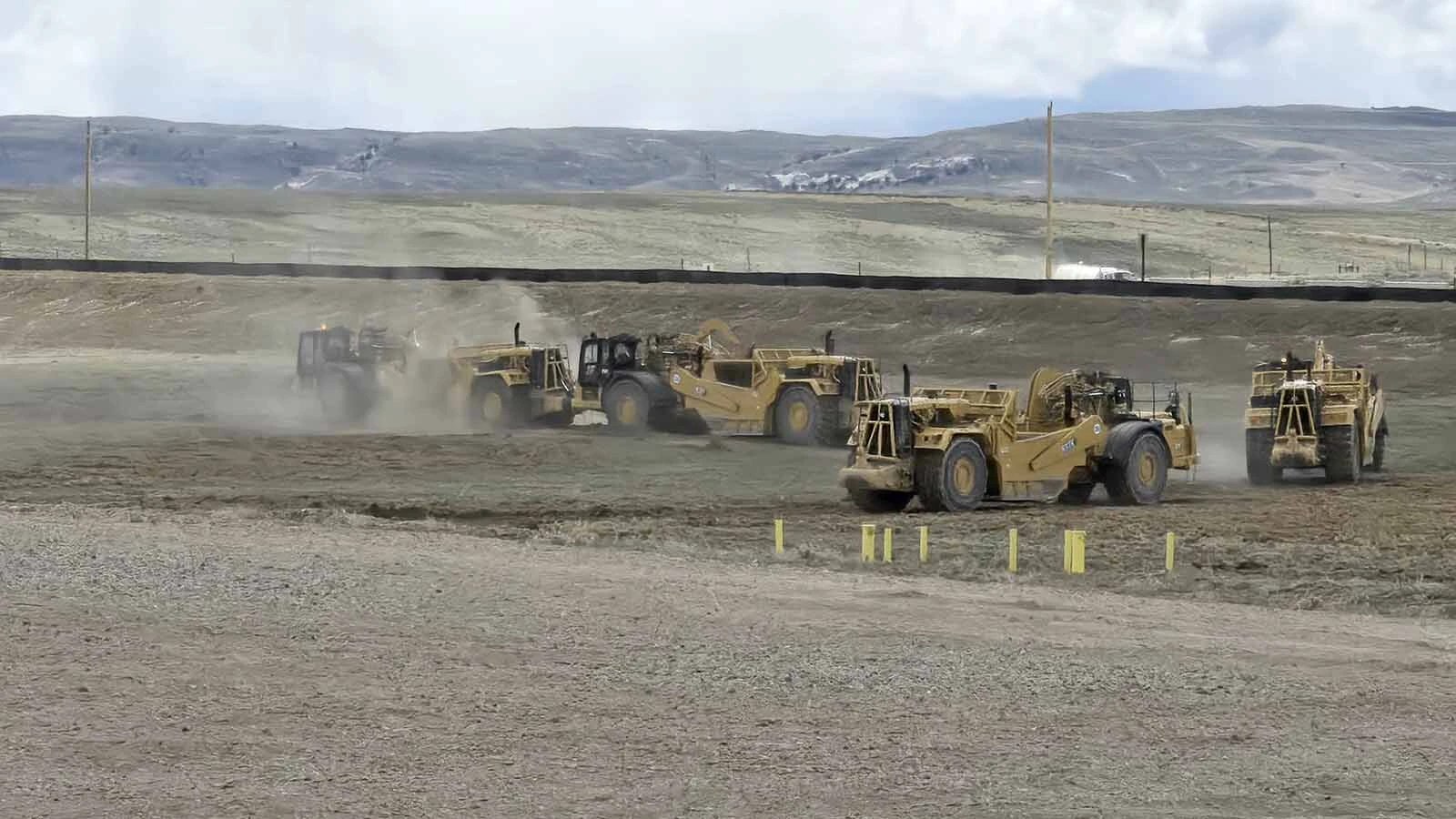
In the background, a set of scrapers, working in teams of two, cut away soil in the nuclear island area. Sprayers followed, helping to keep the dust down as the wind continued to blow.
“This is the initial cut of the ground,” Stockett said. “They’ll actually take the top 6 inches or so of soil and just basically scrape the entire ground.”
The scrapers work in teams of two, pushing each other along during the work. That helps ensure neither gets bogged down or stuck.
They will dig as much as 80 feet down in some places on the site, before other crews will come in to blast bedrock for the reactor’s foundations.
“We are actually standing inside the nuclear island now,” Stockett added. “So, in not too long, we will be producing power right here on this site.”
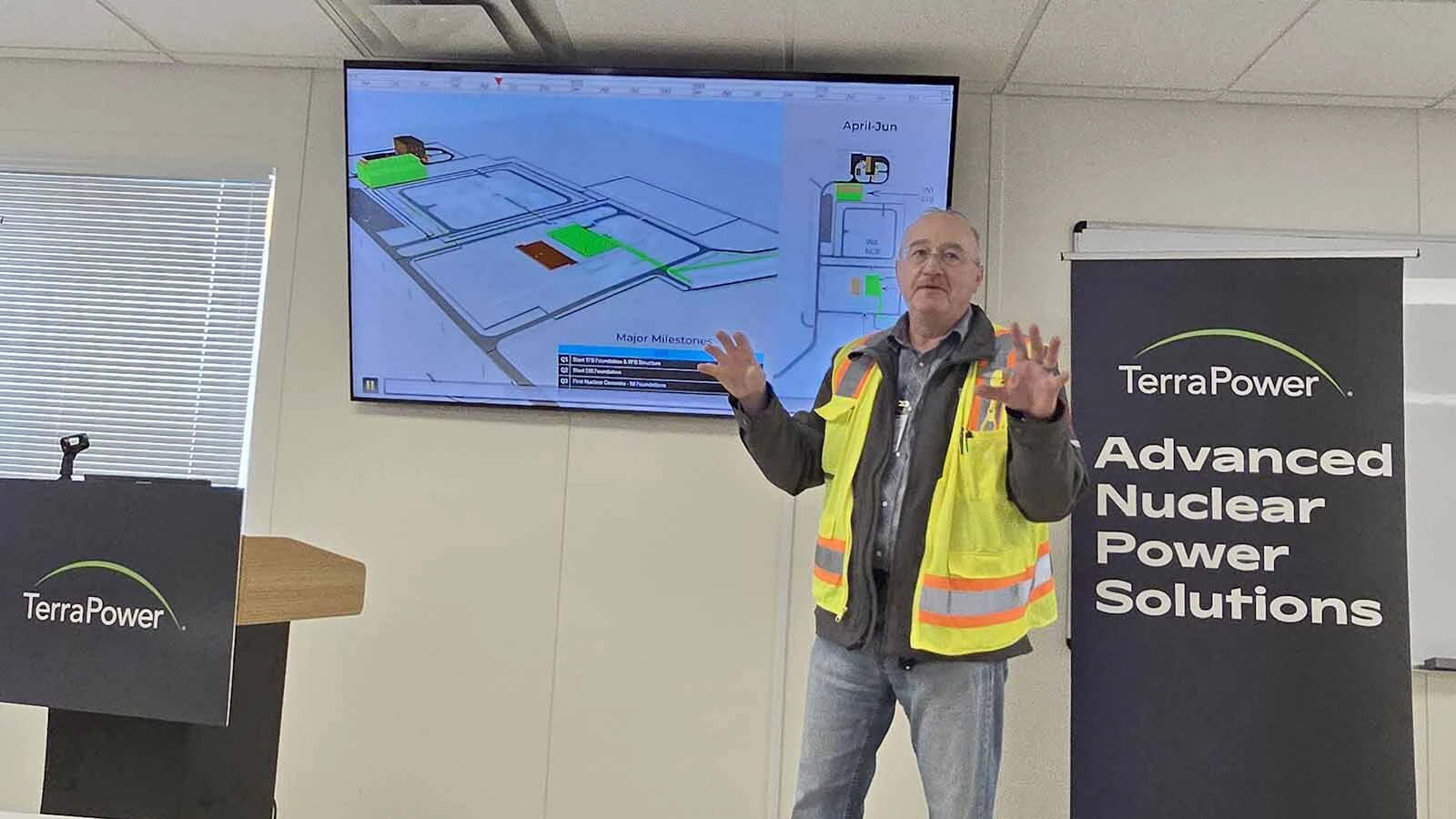
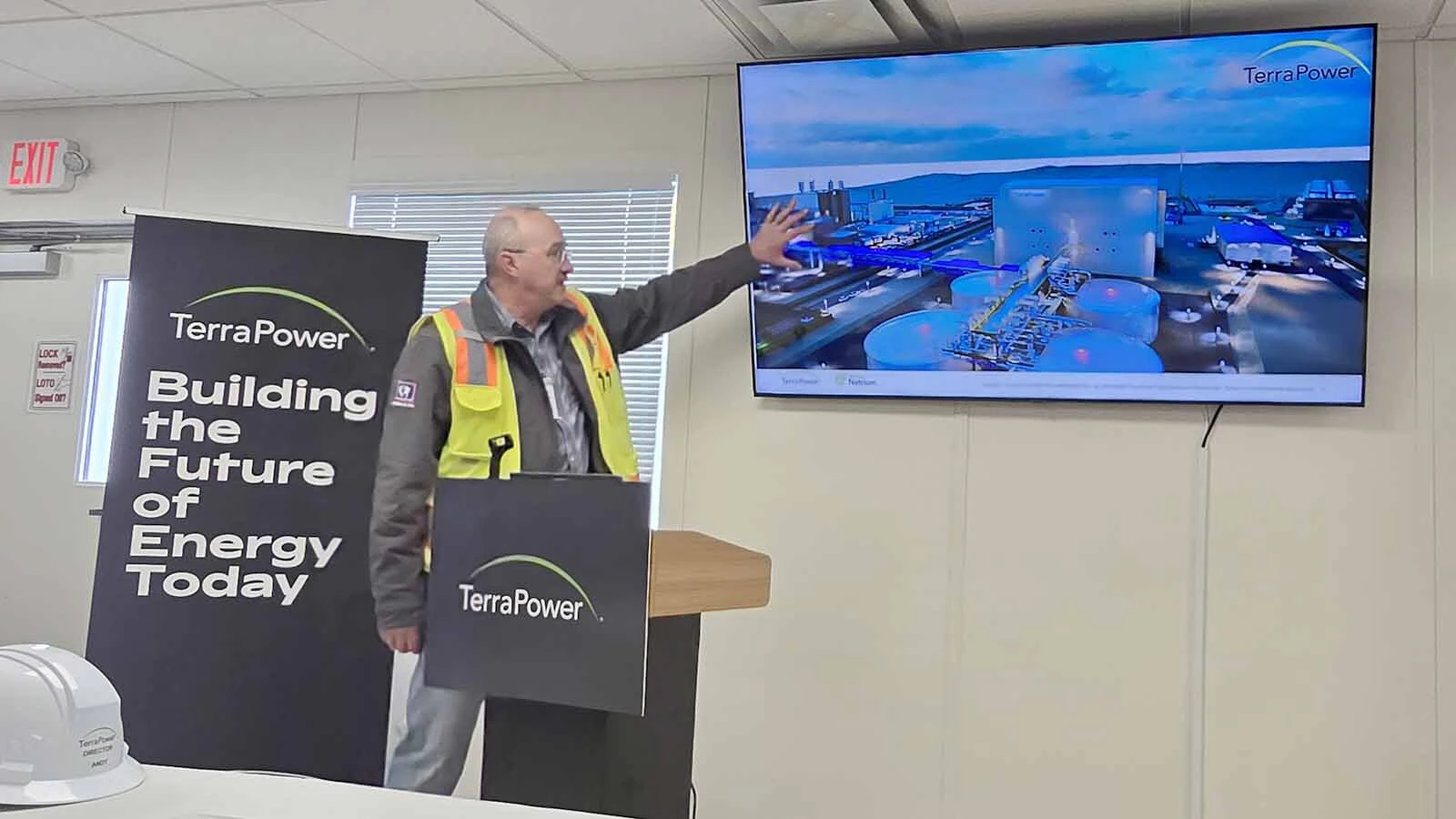
A digital modeling program trained with a 90,000-line construction schedule illustrated how the Natrium plant’s various pieces will be put together, a virtual three-dimensional jigsaw puzzle in neon colors.
There will be 30 acres for the company’s “energy island,” which has the non-nuclear components common to most power generation plants — turbines and storage — while the Natrium portion will have 60 acres.
That will be where the molten salt storage tanks and switchyard sit.
Based on the digital model, most of the construction activity will start at the south end of the property, where the energy island will be. It will steadily advance northward, toward the Test and Fill facility.
The nuclear plant, meanwhile, is one of the smallest of all the puzzle pieces, and it will be among the last buildings to go up.
Economic Powerup
The day marked the start not just of construction activities on the nuclear portion of the site. It also marks the start of a swift ramp-up in economic power from the site.
TerraPower will mobilize a workforce of roughly 1,600 workers at peak construction, who will all be present in Kemmerer at once, working to bring the Natrium reactor and energy storage system online sometime in 2030.
Once operational, the 345-megawatt, sodium cooled fast reactor will employ about 250 full-time staff at what will be the first utility-scale advanced nuclear power plant in the United States, as well as Wyoming’s first-ever commercial nuclear generating station.
TerraPower has already begun commercializing its Natrium technology. That includes an agreement with Meta for up to eight Natrium plants by 2035.
It’s not known if one of those plants will be in Cheyenne for certain, but a TerraPower official has told Cowboy State Daily previously that the city is a natural candidate.
What Makes Natrium Different
One of the things that makes TerraPower different from all others is its plan to use molten sodium to cool its reactor.
It’s a concept that has been tested here and there, and some countries have smaller, sodium-cooled plants working. Kemmerer’s plant, though, will be on a much larger scale, making it a commercial first in America if realized.
The traditional approach to nuclear power has been to pump water into a reactor core heated by atomic fission, then use the steam to create electricity.
Because it’s water, that’s meant highly pressurized systems, which require heavy pipes and thick containment. That adds to the high cost of building traditional nuclear facilities.
But molten sodium does not require such thick shielding because it’s not a pressurized system. It can also absorb a lot more heat than water, without reaching dangerous temperatures, widening safety margins.
Air vents, meanwhile, rather than water pumps, will cool the facility in an emergency instead of water, an approach that won’t require emergency electricity or pumps to work.
These are all factors that help lower the building costs of the Natrium reactors, and will help lower the cost of producing electricity.
TerraPower has estimated its system will produce electricity at half the cost of a traditional nuclear plant, all while boosting safety, in a system that’s been designed with interruptible power sources like wind and solar in mind.
Proof In Progress
Display boards set up for the event included a lot of slogans. There was one that was particularly telling though: The proof is in the progress.
Cowboy State Daily asked an employee about the meaning of that, and was told that for a long time advanced nuclear reactors had been all talk and no show.
“Now it’s time to show,” the employee said with an ear-to-ear grin.
“This is the moment our industry has been working toward for a generation,” Levesque said in a prepared media statement. “We’re not just breaking new ground on a first-of-a-kind nuclear plant in Wyoming. We’re building the next generation of America’s energy infrastructure.
“The Natrium plant will deliver reliable and dispatchable power to the grid, and Kemmerer Unit 1 will serve as a commercial blueprint to mobilize a fleet of Natrium plants across the country and around the world.”
It’s a major milestone for Wyoming, Gov. Mark Gordon said.
“Wyoming has long powered this country,” he said. “And today we are leading again, this time in next-generation nuclear technology. This project reflects our commitment to reliable energy, good-paying jobs, and a future built on innovation and Wyoming values.”
City Administrator Brian Muir told Cowboy State Daily it was a great day for the city’s economic future.
“We congratulate TerraPower for reaching this major milestone of beginning construction on the nuclear island portion of the power plant,” he said. “We are working closely with our mayor, city council staff, developers and other agencies to prepare the permanent and temporary workforce housing needed to serve these workers.
"We want to make the TerraPower employees, who have and will come to our community, and the Bechtel employees and construction workers who are building the plant, feel welcome.”
Wyoming’s Congressional delegation all sent statements noting that Wyoming is the perfect place to build a plant that uses nuclear fuel, and touting the economic development and jobs that will be created.
“Starting construction on this groundbreaking project will create more jobs in Kemmerer and help expand Wyoming’s already strong energy economy,” Sen. John Barrasso, R-Wyoming said. “It’s a win-win for Wyoming and America’s energy security.”
“Wyoming has always powered America, and today that proud tradition reaches an exciting new milestone,” Sen. Cynthia Lummis, R-Wyoming, said.
“The start of construction on TerraPower’s energy island in Kemmerer is a defining moment for our state, our nation, and the future of American energy,” she added. "This project delivers what Wyoming communities deserve: good-paying jobs, lasting economic strength and reliable, affordable, baseload power.”
“As the nation’s top producer of uranium, Wyoming is a natural launch pad for America’s nuclear renaissance,” Rep. Harriet Hageman, R-Wyoming, said. “This construction of the first new state-of-the-art advanced nuclear power plant demonstrates Wyoming’s leadership pioneering a new frontier in American energy.”
Renée Jean can be reached at renee@cowboystatedaily.com.


