
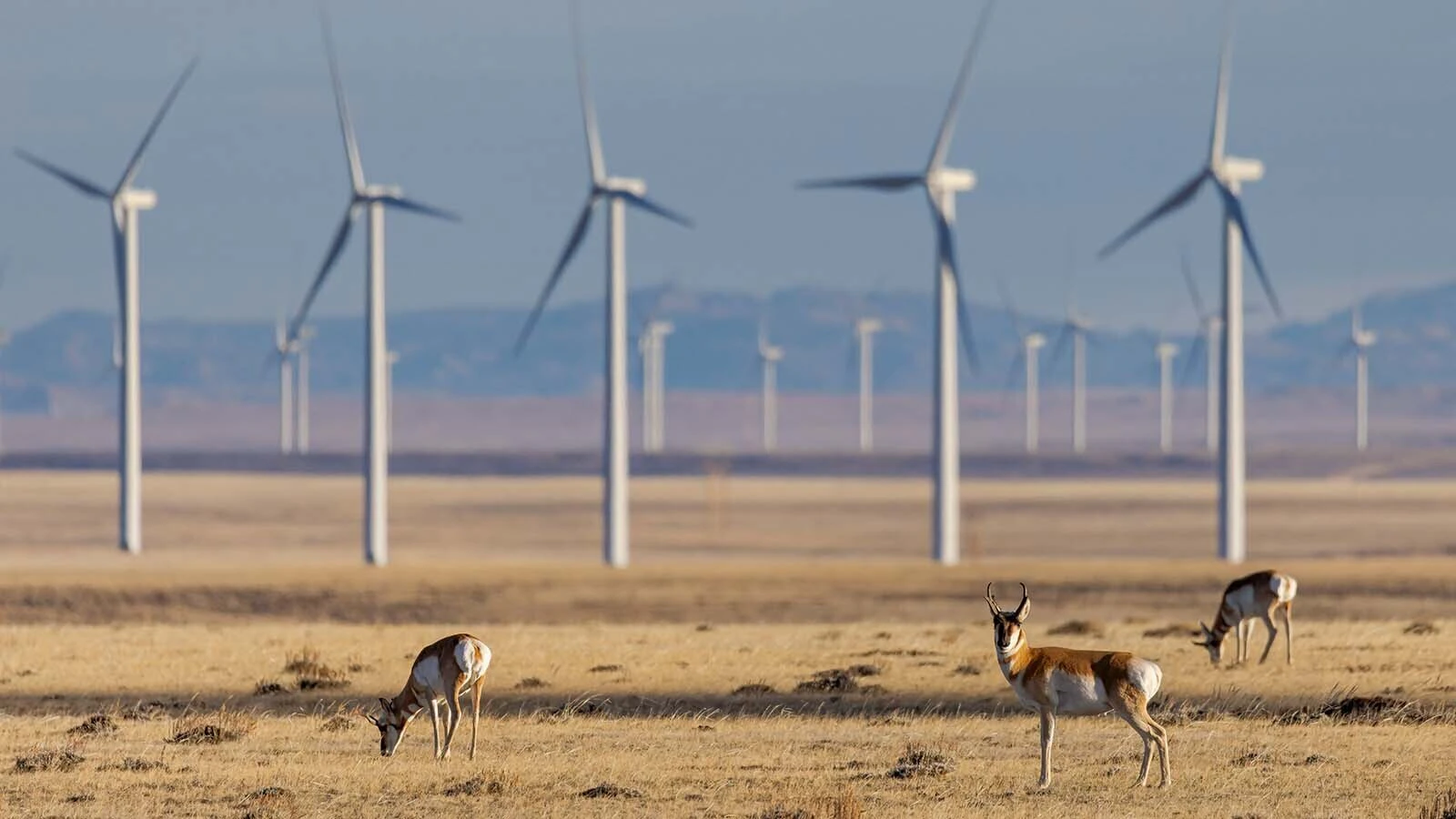
As wind and solar energy projects continue to expand across southeastern Wyoming, some landowners say they’re concerned about whether that growth will lead to a “Wyoming wind wall” of turbines across the Laramie Range.
Wyoming has long had a reputation as being an energy-friendly state that makes it attractive to companies for all-of-the-above development.
Supporters say the economic benefits that energy development brings to local communities are huge and projects bring jobs.
Developers often cite limited environmental impact that allows livestock to continue to graze and the removal of infrastructure once projects meet their decades-long energy generation objectives.
Wendy Volk, a Cheyenne Realtor, ranchland owner and vocal critic of large-scale wind development said she's been trying to understand the overall scale of the green energy projects in southeast Wyoming by putting pink sticky notes on a map.
Individually, they may appear as blips on a map, but together paint another picture with a lot of pink, she said.
“I think what’s happening in southeast Wyoming is no longer a series of individual wind projects,” Volk told Cowboy State Daily. “No one at a state level is looking at the cumulative development of a landscape corridor.”
Mapping The Projects
Wind energy is the second-largest electricity producer in the state of Wyoming, according to Wyoming Energy Authority, and southeast Wyoming has one of the densest concentrations of high-class wind energy potential in the country.
By 2023, wind power accounted for 21% of the electricity generated in the state, making it Wyoming’s leading renewable energy source. Wind-generated electricity accounts for nearly 90% of Wyoming’s renewable energy, the WEA reports.
Along with operational wind farms, there are a number of large-scale projects in various stages of development across the state.
The Chokecherry and Sierra Madre Wind Energy Project, a utility-scale wind farm outside of Rawlins, is scheduled to be completed in 2029.
It will be the largest single power plant in Wyoming and the largest single wind power project in North America when it is completed, according to the WEA.
It is estimated to generate more than 3,000 megawatts of electricity, enough to power more than 1 million homes.
A wind project that would cover an area nearly three times the size of Cheyenne is moving forward, although Laramie County Commissioners denied the project’s initial permit last fall.
Commissioners denied the Laramie Range Wind Project’s permit, citing too many unanswered questions and incomplete responses from the project’s developer, Spanish energy giant Repsol.
Following the permit denial, ConnectGen Laramie County, an affiliate of Repsol, revised the project’s initial footprint from 170 wind turbines to 139 and tightened its proposed acreage to 41,220 from the original 56,000.
It informed property owners it intended to submit an application to the Wyoming Department of Environmental Quality’s Industrial Siting Council to permit the wind farm on state and private lands.
Gunnar Malm, Laramie County Commissioner chairman, told Cowboy State Daily in a text message that the county permit is one of two items necessary for a wind project to proceed.
Repsol is proceeding with the second part of the industrial siting now, he said.
“They are free to amend their initial application and reapply to go through the county process,” he added.
Malm said he had “no anticipated time for when a new application may come through.”
According to the project’s website, “Given the minimal footprint associated with wind energy projects, grazing and ranching is a compatible land use that may continue throughout project operations.”
Repsol is the same company behind the controversial Rail Tie wind project outside of Laramie. The Rail Tie project involves 120 wind turbines across 26,000 acres.
In Converse County, NextEra’s Cedar Springs Wind Farm is in its early years of generating electricity from wind on about 2,400 acres of state trust land.
The Chugwater Energy Project, another NextEra project, could install up to 106 wind turbines, solar panels and battery storage systems on about 47,000 acres in Platte County.
In January, a special meeting of the Wyoming Board of Land Commissioners in Douglas drew dozens of residents opposed to the Pronghorn H2 wind project, a 267-turbine development partially on state trust lands along the northern Laramie Range.
Petition, Opposition
A petition calling for a full review of energy projects impacting the Laramie Range corridor is circulating, with 321 signatures collected as of Friday morning.
“This is not one project. It is a corridor,” the petition reads. “Wyoming’s ‘Wind Wall’ isn’t a proposal; it’s already happening.”
Volk previously told Cowboy State Daily that “industrialization on this scale must be weighed carefully against long-term community identity and land stewardship.”
“We need to ask our local representatives some good questions,” Volk said. “Once the infrastructure is in place, there’s no going back.”
Last October, Volk attended the groundbreaking of a $1.2 billion data center in Cheyenne, marking a major milestone on land her father and uncle had developed through their Campstool Land Company.
The Campstool Land Co. put together several developments along Cheyenne’s Venture Drive, including commercial projects that now house Caterpillar, FedEx, Best Western, Camping World and other businesses, Cowboy State Daily previously reported.
That land, Volk told Cowboy State Daily, was part of an industrial business park that has existed for 35 years.
Renewable energy companies, by contrast, are converting agricultural land into utility-scale energy development.
“These large utility-scale wind and solar project are changing land use,” she said, adding that, “it’s happening at a much faster and monstrous scale.”
Not So Fast
Chris Brown, executive director of Powering Up Wyoming, said the petition that’s circulating “contains misinformation about how wind projects are reviewed in Wyoming.”
Every project, whether in southeast Wyoming or elsewhere in the state, undergoes a thorough industrial siting process, he said. The process is among the most rigorous in the country.
“Developers must complete extensive social, economic, and environmental studies, often resulting in applications that run thousands of pages,” Brown told Cowboy State Daily.
They must coordinate with 19 state agencies, including the Wyoming Game and Fish Department, before a project is considered by the Industrial Siting Council, he said.
“These are not rushed or lightly reviewed projects,” Brown said. “They are carefully evaluated with input from multiple experts and agencies before being permitted.”
Brad Enzi, president and CEO at the Laramie Chamber Business Alliance, said Wyoming is in a new gold rush.
“People want to use our resources,” he told Cowboy State Daily. “If these energy resources are responsibly developed, we get a threefold economic benefit.”
Those benefits are tax revenue, job growth and money from a finished product.
“Are we going to take advantage of the opportunities that are there or are we not?” he said.
Landowners’ Rights
A clash over landowners’ rights played out last fall during debate over the proposed 47,000-private-acre wind and solar farm near Chugwater.
Kathryn Stevens, a self-proclaimed “modern homesteader” who owns 15 acres with chickens, horses, rabbits and bees, argued that the project threatens her independent way of life.
Raising her children in the state’s wide-open spaces was a key factor in her family’s decision to move to Wyoming from Washington, she said.
Rancher Paul Norfleet is a partner in the Chugwater Energy Project. As a partner, he will receive regular payments from the project’s developer, NextEra. That income, he said, could go toward buying him a new farm truck.
He told Cowboy State Daily last fall that, as the property owner, he can make decisions about what to do with his land and what to allow on it. He also said he doesn’t think wind and solar impact the land any more than cell towers and oil rigs.
Norfleet sometimes brings his sheep to Colorado where they graze beneath solar panels. These structures, he said, provide shelter for the animals and can help accelerate the growth of some grasses.
Norfleet’s sheep also enjoy the extra shade of wind turbines, he said.
Stevens countered that the scope of 106 wind turbines goes beyond a private citizen doing a private thing on his private land.
“I mean, these things are 500 feet tall,” Stevens said. “That’s almost twice as tall as the Statue of Liberty.”
Brown with Powering Up Wyoming said renewable energy development is one tool that helps keep ranchers’ operations intact.
More than $40 million in annual lease payments go directly to Wyoming landowners, he said, helping families stay on their land and supporting the next generation of producers.
“That income does not sit idle,” he said. “It moves through local communities, supporting equipment purchases, feed, vehicles, and other local businesses.”
For Enzi, the question of large-scale renewable energy development comes down to being good stewards of God-given resources.
“The way I look at it is, God made all of these things,” he said. "What God told us to do is be good stewards of the resource.”
Kate Meadows can be reached at kate@cowboystatedaily.com.


