
This past week I attended a nuclear energy forum at the University of Wyoming, hosted by the Ruckelshaus Institute, the School of Energy Resources, and the Wyoming Energy Authority. It was one of the first major statewide efforts to give the public a clear, unvarnished look at the nuclear industry: its history, its risks, its opportunities, and its relevance to Wyoming. What I appreciated most was that it wasn’t a pep rally and it wasn’t a protest. It was an attempt to lay out the facts so communities can make informed decisions.
Wyoming needs that clarity, because we are standing at an inflection point. And we’ve been here before.
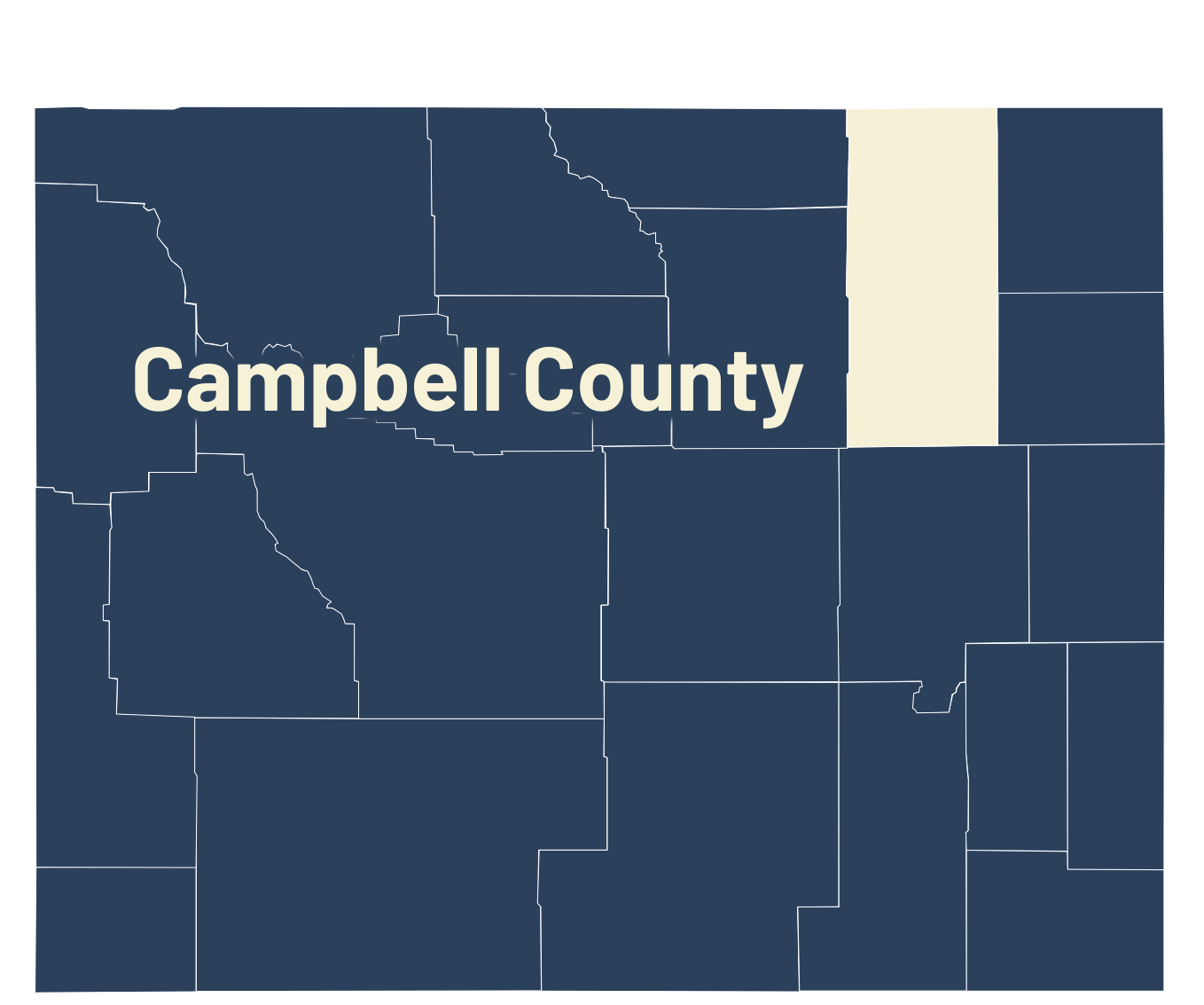
In the 1970s, when the Powder River Basin coal seams first drew national attention, the reaction in Campbell County was not celebration. It was fear. People worried about water, air quality, property values, environmental damage, and the character of their communities. Some predicted that coal development would ruin the region. But as history shows, coal became the economic backbone of Wyoming for half a century. It funded our schools, our infrastructure, our parks, and the quality of life we enjoy today. Gillette transformed from a dusty outpost into a thriving community; a transient community to one where people chose to raise their families.
None of that happened because coal was risk‑free. It happened because Wyoming learned how to manage those risks responsibly. We built regulations, improved technology, and held companies accountable. Over time, the unknown became the understood.
Today, nuclear energy is generating the same mix of promise, risk, misunderstanding, and political distortion that coal once did. Companies are expressing interest in everything from TRISO fuel fabrication to conversion facilities. TerraPower’s Natrium project is underway in Kemmerer. Uranium mining in the Shirley and Powder River Basins, something Wyoming has done since the 1950s, is seeing renewed activity. Whether we feel ready or not, the nuclear industry is arriving at our doorstep.
To navigate this moment, we have to start with honesty about the past. The early history of nuclear development in the United States is complicated and, in many cases, painful. Much of it grew out of the Manhattan Project and the race to develop nuclear weapons. The science was new, the risks were poorly understood, and environmental safeguards were almost nonexistent. Communities across the country, including the Wind River Reservation here in Wyoming, are still dealing with the consequences of that era. Those harms were real, and they should never be minimized.
But it is equally true that the nuclear industry of today is not the nuclear industry of the 1940s, 50s, or even the 1970s. Our scientific understanding has grown. Our regulatory framework has matured. The Nuclear Regulatory Commission is one of the most stringent regulatory bodies in the world. And Wyoming’s own Department of Environmental Quality has developed a robust system for monitoring land, water, and air across all forms of industrial activity. We have learned from the past, and we have built guardrails to prevent repeating it.
That is why fear‑based rhetoric does not serve Wyoming well. Some people are responding to nuclear proposals with the same kind of assumptions and predictions that once surrounded coal: catastrophe, contamination, and the belief that any new industry is a threat rather than an opportunity. Others are calling for local government to decide which private businesses should be allowed to operate at all. That approach doesn’t align with the long‑standing conservative principle that government should regulate responsibly but not arbitrarily block lawful enterprise. Regulation is necessary. Oversight is necessary. But using government power to shut down a business simply because it is unfamiliar or politically unpopular is not consistent with the values many Wyomingites hold.
One of the most helpful parts of the nuclear forum was hearing how Wyoming has responded to the federal government’s recent request for information about “nuclear innovation campuses.” Wyoming made its position clear: our interest is in the front end of the fuel cycle: mining, milling, conversion, enrichment, and fuel fabrication. The state is not volunteering to take on long‑term nuclear waste storage. At the same time, Wyoming is part of a three‑state partnership with Utah and Idaho, where each state focuses on different parts of the industry. Utah, for example, has expressed interest in waste management and reprocessing. This regional approach allows Wyoming to participate in the economic opportunity without taking on responsibilities we do not want.
The question before us is not whether nuclear energy is perfect or risk free. It isn’t. No industry is. The question is whether Wyoming will approach this moment with the same clear‑eyed seriousness that allowed us to harness coal responsibly and build decades of prosperity.
We can acknowledge historical harms without being paralyzed by them. We can recognize modern safeguards without pretending risks don’t exist. And we can reaffirm the principle that government’s role is to protect public health and the environment, not to pick winners and losers in the private sector.
Wyoming has a chance to shape the next 50 years of its energy economy. But only if we resist the temptation to let fear, misinformation, or political distortion drive the conversation. We’ve been at an inflection point like this before. We chose responsibility over panic, and the state prospered because of it.
We can do that again.