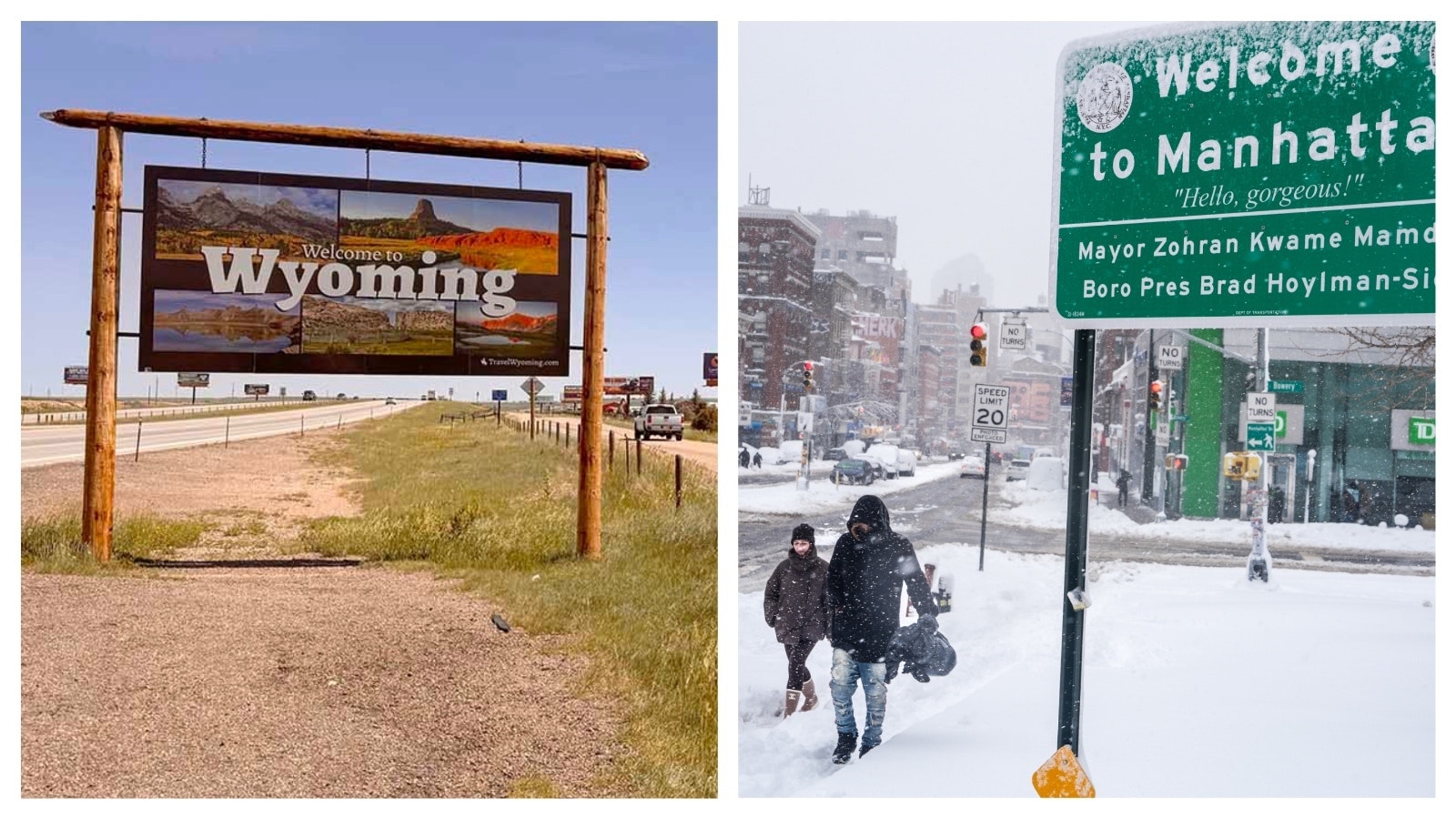
Lander has received 8.2 inches of snow this winter season. By Feb. 26, it usually has seen an average of 51 inches of snow, making this the lowest seasonal snowfall in 135 years.
Syracuse, New York, usually receives 102.8 inches of snow. By Feb. 26, it already had more than 130 inches with more on the way.
Salt Lake City has received 2.5 inches of its average 42.3 inches of snow. But in Marquette, Michigan, residents have dealt with 207. 3 inches over the same period.
Those are the statistics presented by the National Weather Service (NWS) office in Riverton that show the 2025-2026 winter season has been a tale of two winters.
What’s the cause of this East/West disparity?
Cowboy State Daily meteorlogist Don Day said it can be chalked up to a weak La Niña, a prolonged block, and an underwater volcanic eruption that most people never heard about.
“I would call this a generational winter,” he said about how extreme it’s been both ways at either end of the U.S. “We should only witness a winter like this every 30 or 40 years, but we have never seen anything of this magnitude in modern times.”
The Numbers
Meteorological winter ended on Feb. 28. According to historical records from many Wyoming communities, some dating back to 1891, this was the warmest winter on record in Wyoming.
Lander’s average temperature was 12.1 degrees above normal and had 11 days of record-breaking high temperatures between Dec. 1 and Feb. 26.
Buffalo, Casper, Cody, Jackson, Riverton, Rock Springs, and Lake Yellowstone in Yellowstone National Park also experienced their warmest winters on record.
That trend has been seen across the Western U.S. Between December and March, Salt Lake City received less snow than Augusta, Georgia (3.5 inches).
New York City has received three times as much snow, 42 inches, as Denver, Colorado’s 13.4 inches.
“The Colorado Climate Center measured snowpack on Feb. 7, then compared it to every Feb. 7 since they've been keeping snowpack data,” Day said. “It’s the worst snowpack since 1981.”
Meanwhile, many European nations have experienced their coldest winters in recent memory.
“There have been big contrasts across the Northern Hemisphere,” Day said. “There were parts of Europe that had a lot of snow and really cold conditions, but you also had other parts of the globe that were like us in the Western U.S. It all depends on where you are.”
The Three Horseman Of The Snowpocalypse
Day has been trying to understand this winter all winter.
After reviewing all the models and historical data he can, he’s identified “the three horsemen of the apocalypse.”
“There were three things that worked together,” he said. “We got triple sevens on the slot machine that lined up to set this winter in stone.”
Those three factors are a weak La Niña over the Pacific Ocean, the quasi-biennial oscillation in the stratosphere, and the Hunga Tonga volcanic eruption in 2022.
Let’s break those down.
Weak La Niña
Day said the weak La Niña was “the least impactful” of these factors on the generationally warm winter. La Niña generally means a warmer, drier climate over Wyoming,
The NWS’s Climate Prediction Center (CPC) issued a La Niña Watch in August 2025. That threw a wrench into winter forecasts, as many anticipated the Pacific Ocean to stay “neutral” for most of the season, partly because the 2024-2025 winter was a full-fledged La Niña winter.
“It was a factor, but the least impactful factor,” Day said. “My thoughts were that La Niña was going to weaken as we went into winter, which it has.”
Oscillation Switch
The quasi-biennial oscillation (QBO) is a cyclical pattern of wind directions in the troposphere, the lowest layer of Earth’s atmosphere.
According to the World Climate Service, the troposphere contains virtually all of the world’s water vapor, which determines everyday and seasonal weather.
Why does that matter? Day said it explains the multiple “logjams” that walled the western U.S. off from winter weather and sent it eastward.
“The QBO switched from a positive to negative phase in November and early December,” he said. “Historically, these QBO patterns have led to some pretty cold, snowy winters, but with the addition that there’s a propensity for stronger blocking patterns in the jet stream that happen more frequently.”
A negative QBO coupled with a weak La Niña would already make the western U.S. drier than normal.
Then there’s Hunga Tonga.
Volatile Volcano
In January 2022, the eruption of Hunga Tonga–Hunga Haʻapai, a submarine volcano in the South Pacific, reached its climax.
At least four people were killed by the 66-foot tsunamis the eruption created, which NASA categorized as the largest volcanic eruption on Earth since the 1991 eruption of Mount Pinatubo.
“This is, in my opinion, the most unreported climate story of the decade,” Day said. “This volcanic eruption was so intense it (sent) a shockwave around the globe twice.”
Day said the Hunga Tonga eruption sent 150 trillion gallons of water into the stratosphere. That’s the equivalent of two Lake Eries.
“The stratosphere isn't a normally very wet place,” he said. “It’s very dry up there normally, but when that much water was transported into the stratosphere and spread out over the globe, it had impacts that we didn't really know to expect.”
A 2025 study by the University of California-Los Angeles determined that the Hunga Tonga eruption released far less sulfur dioxide and much more water vapor into the stratosphere than expected.
Water vapor is a greenhouse gas that cools the stratosphere but warms the Earth’s surface. The study actually determined that the eruption cooled the Southern Hemisphere slightly in 2022 and 2023.
Four years later, Day said the amount of water vapor thrust into the atmosphere by Hunga Tonga is still impacting global weather.
Day said the enormous amount of snow Wyoming received during the 2022-2023 winter season, which prompted Gov. Mark Gordon to declare a state of emergency, can be partially attributed to Hunga Tonga.
“It’s hard for meteorologists to really understand the volcanic impacts over the last three or four years because we’ve never experienced something like it before in the satellite era of weather,” he said. “Now, as the stratosphere is working through all this extra water, those impacts have matured.”
Tale Of Two Winters
The triple-whammy of a weak La Niña, a negative QBO, and the ongoing impact of the 2022 Hunga Tonga created what Day called “blocking patterns on steroids.”
“We had a winter when we were going to have blocks anyway,” he said. “It appears that the impacts of the volcanic eruption, mainly because of the gigantic amount of water being transported into the stratosphere, caused those blocks to be more robust.”
When the first block of high pressure set up over the Bering Strait in November, it set the precedent for the rest of the season.
The block was too strong for cold Arctic air and warm Pacific moisture to penetrate into the Rocky Mountain Region, so everything was funneled eastward.
“We would have these blocks set up for weeks, then something would sneak through, and we thought that things were finally going to change,” Day said. “But then the blocks would come right back.
Day noted that the few cold snaps Wyoming experienced rarely lasted for more than a few days. That’s because there was only a brief opening between the strong, stubborn blocks.
In a sense, the Eastern U.S. got the winter weather that the Western U.S. was supposed to receive. Instead, Wyoming experienced its warmest winter on record while many Eastern states were crippled by record-breaking snow and cold.
“You could really take North America and slice it in half,” he said. “There's a large part of Central and Eastern Canada that has been just like the Central and Eastern U.S. in terms of the cold and the snow. The same thing is true for Western Canada and the Western U.S.”
Not To Freak Anybody Out
Day said the 2025-2026 winter season has been unprecedented, mainly because of the immensity of the impact from the 2022 Hunga Tonga eruption.
“We don’t really understand what that volume of water does to the stratosphere and how it’s impacting our models,” he said.
Unfortunately, some of these factors aren’t going to change anytime soon.
While La Niña episodes usually last between nine and 12 months, the negative QBO is more enduring. Day said the switch that occurred in November could last for another two years.
“I don't want to freak anybody out, but the QBO phase we're in usually lasts 24 to 30 months, and that’s inherently a blocking pattern,” he said.
Then there’s the ongoing impacts of the Hunga Tonga eruption.
Four years might seem like a long time for anything to impact global weather to any extent, but Day believes we are not even halfway there.
“It could be up to 10 years before the stratosphere gets back to the levels of water vapor before the eruption,” he said. “Therefore, we may see varying amounts of impact on a global scale, climatologically, for another six years.”
What Does That Mean For Wyoming?
Wyoming and the Western U.S. had the worst of times during this tale of two winters. Now that meteorological winter is over, what’s the prognosis going forward?
Day sees some reason for optimism as Wyoming enters spring. The negative QBO will remain in place, but it will weaken as days get longer and warmer.
“Blocking patterns have a harder time maintaining themselves as you change seasons,” he said. “They tend to be strongest in winter. Now that we're going into meteorological spring, we're seeing it getting warmer in the low latitudes.
"There's still a lot of cold air in the high latitudes, so the blocking situation should be less of a factor.”
Over in the Pacific Ocean, the weak La Niña is already transitioning into a neutral phase. That, according to Day, should lead to “more active spring weather” across the Western U.S.
That’s crucial, as March, April, May, and June are the wettest months of the year for Wyoming. That means we should only be dealing with two of the three horsemen of the 2025-2026 winter apocalypse going forward.
But that’s not a guarantee, and Day certainly isn’t promising anything.
“Changing sea surfaces in the Pacific means the likelihood of a strong blocking pattern in spring into early summer is less,” he said. “But I have seen blocks in the summer, partly due to the QBO. That’s a real concern, so we do have to be careful.”
History Says
Even after a generational winter, Day sees some encouragement in historic data. He cited the records of Colorado’s snowpack as particularly noteworthy after this once-in-a-generation winter.
“Colorado’s snowpack is the worst it’s been since 1981, but it was actually worse that year,” he said. “The second-worst snowpack that occurred was in 1977, so two of the worst snowpacks in the West happened within a five-year period.
"In between those years, they had two of the best snowpacks ever. 1978 was one of the top 10. It’s like feast or famine.”
Day categorized the winters of 1977 and 1981 as “generational winters,” which happened more than 40 years ago. It’s an imperfect assessment, but it would suggest a generational pattern.
March is already off to “a better start,” Day said. Southern Wyoming could receive up to an inch of water before the end of the week.
“That would be the most precipitation that part of the state has seen for months,” he said. “As we go into the next three months, we still have the effects of Tonga, we still have the QBO, but the changing sea surface temperatures in the Pacific are setting us off to a good start.”
The 2025-2026 winter season is going to go down in history as one of the worst in a generation, and ongoing factors could cause some upheaval in the years to come.
However, Day said that in his experience, Wyoming doesn’t have “successive winters,” as conditions typically vary, sometimes drastically, from year to year.
There’s no reason to believe that next winter will rival this one as one of the warmest in history. The question now is how, and if, Wyoming can recover from the warmest, driest winter in 135 years of recordkeeping.
“There’s no precedent for what happened this winter,” he said. “We have never seen anything of this magnitude before in modern times. That’s not to say that what we experienced this year is going to be the next several years in terms of winter weather, but it's possible.”
Andrew Rossi can be reached at arossi@cowboystatedaily.com.