Joe Stone has a name for the handcycle he uses for long endurance rides.
He calls it his “suffer” machine.
It has no electric motor to help him along. He cranks it with his arms instead, challenging himself mile after muscle-burning mile.
Other days, the C7 quadriplegic is mountain biking, cross-country skiing with his service dog George, or even taking to the sky in a specially equipped paragliding chair.
It’s not a bad collection of hobbies for someone who is paralyzed from the chest down.
“It’s a lot of hobbies to juggle,” Stone said with a chuckle. “But it’s allowed me to maintain that smile on my face that I need to not only feel like I’m living a high-quality life, but also be productive in other areas of my life that aren’t as much fun, like spending time on the computer working.”
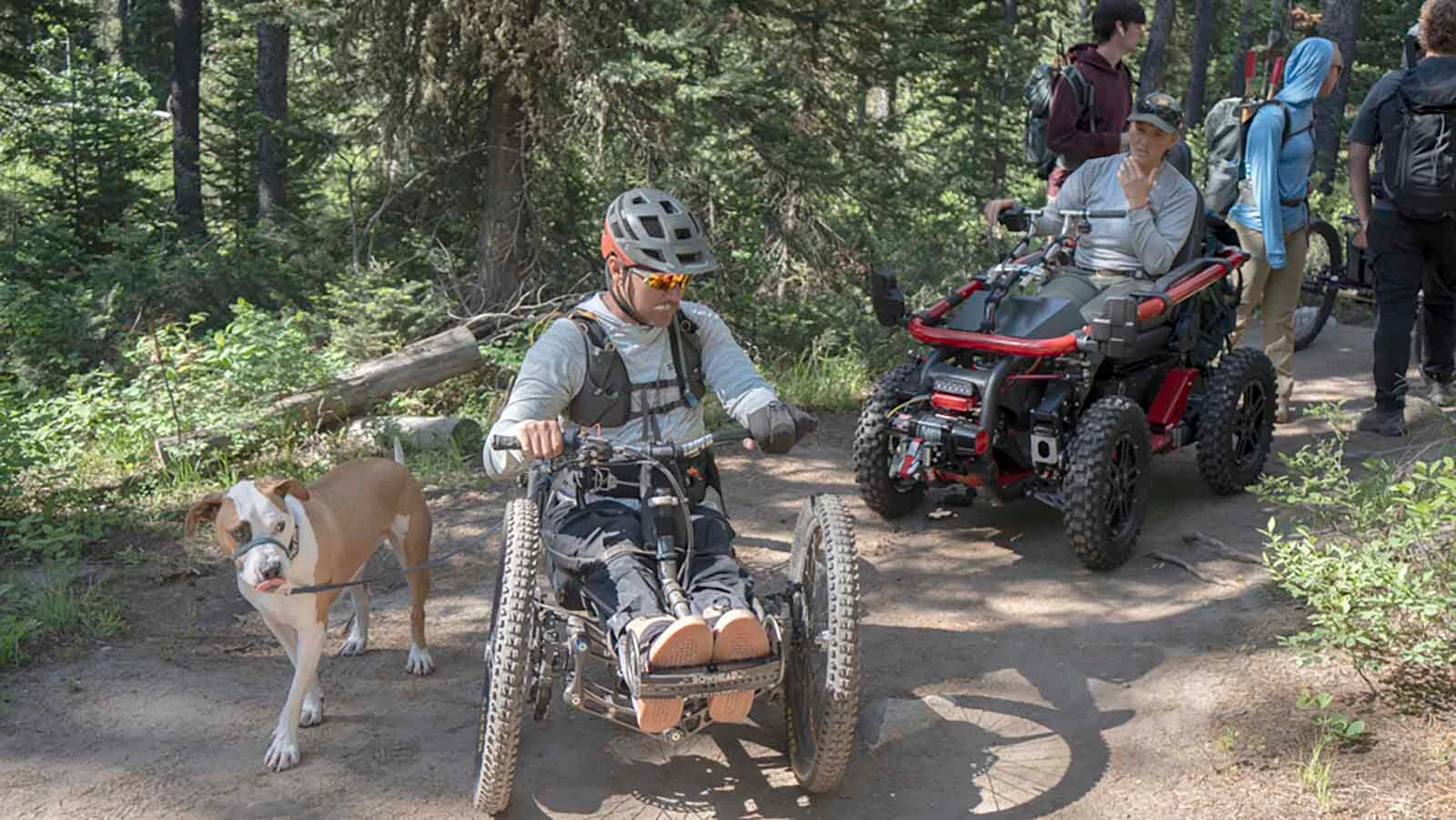
Joe Stone and his dog George demonstrate use of adaptive equipment. (Joe Stone and Melody Rupple) 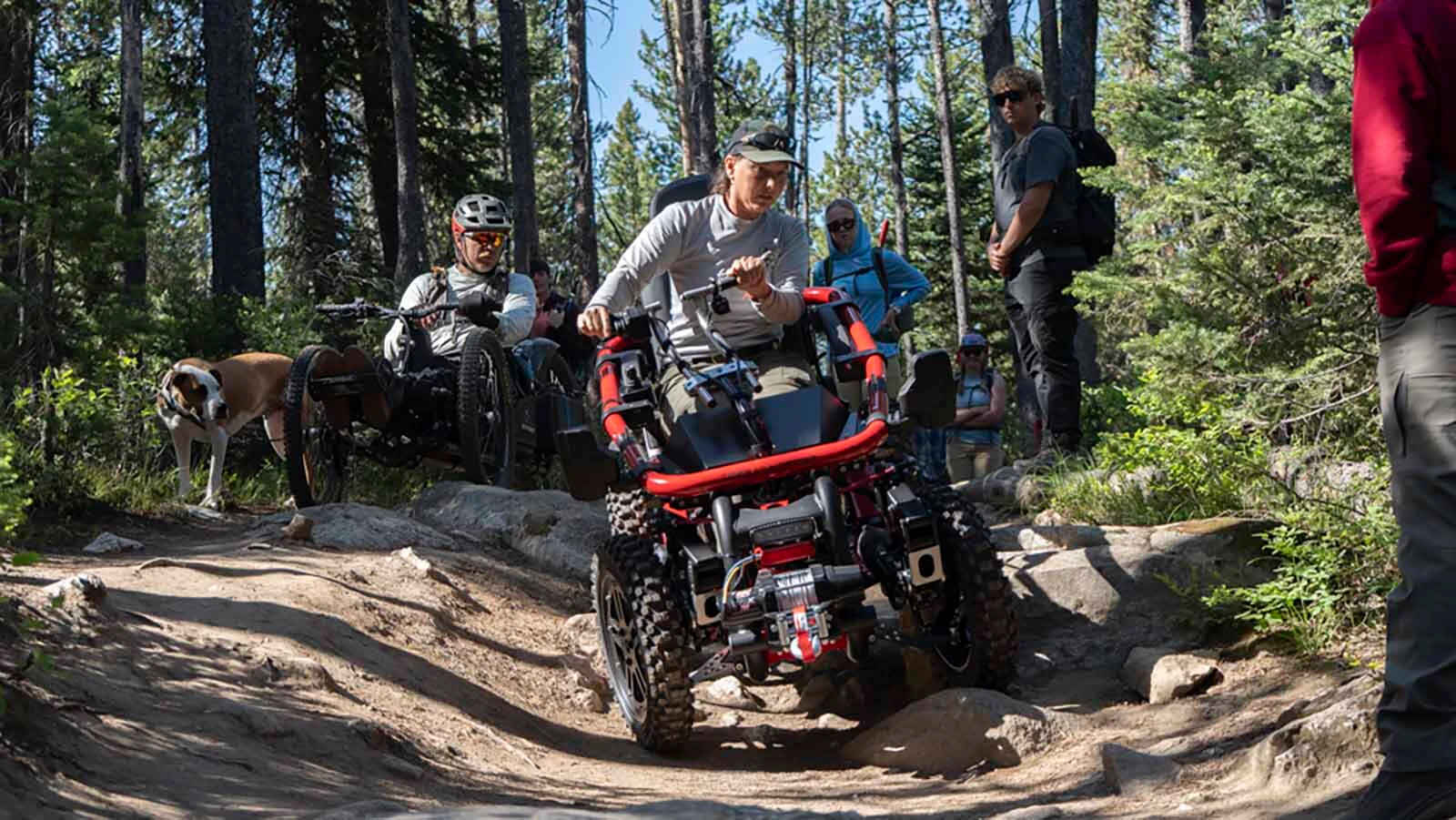
Technology is helping more people enjoy outdoor activities. (Joe Stone and Melody Rupple)
Reclaiming the Wilderness
There was a time when Stone couldn’t imagine any of that.
After a speed-flying accident in Montana in 2010, he remembers lying in a hospital bed, trying to learn to breathe and swallow again. He thought the rest of his life would be spent in a nursing home.
“I thought my whole life was over,” he said.
The outdoor adventures he has reclaimed offer a glimpse of what adaptive technology can make possible.
Through his consulting business, Unified Dirt, Stone works to make trails more accessible and usable. He’s also forming the Unified Dirt Foundation, a nonprofit that would put adaptive equipment into the hands of people who might otherwise never get to try it.
Stone isn't alone. Melody Rupple, in Lander, has already started an adaptive-equipment lending library called TrekAbility, helping people with mobility challenges get outside without first buying thousands of dollars worth of specialized gear.
The equipment is free to borrow.
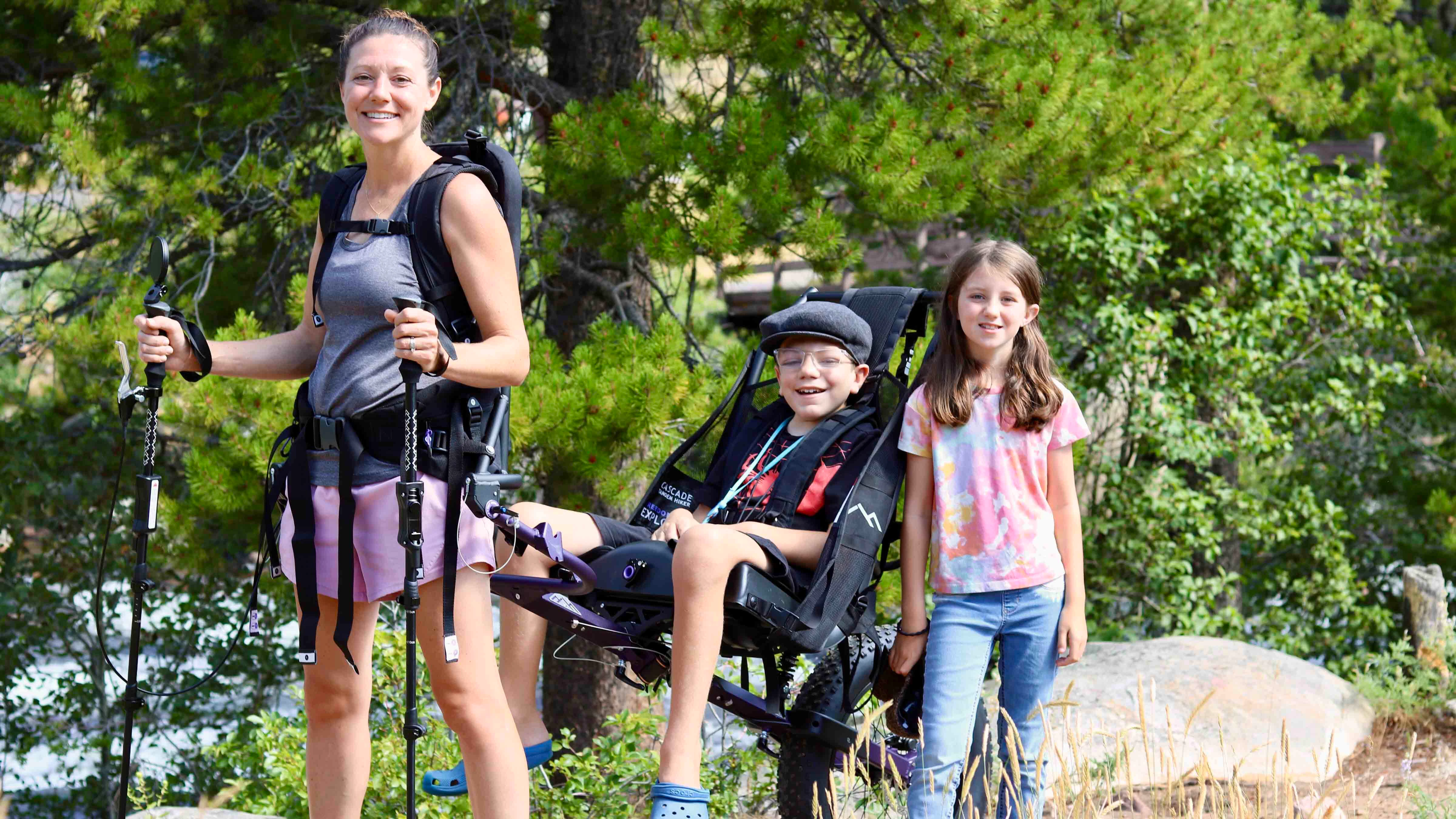
For her, the mission started with her 12-year-old son, Ezra, who has Hurler syndrome.
“He is a pretty independent kid,” Rupple told Cowboy State Daily. “But he has complications in all of his joints, and so his stamina is pretty low.”
When he was younger, such limitations weren’t a huge problem for the family. They could just give him piggyback rides whenever they needed to, or help him over obstacles in the way.
But as he grew older and heavier, those solutions were no longer enough. That prompted the family to start scouring the internet, hoping for a solution.
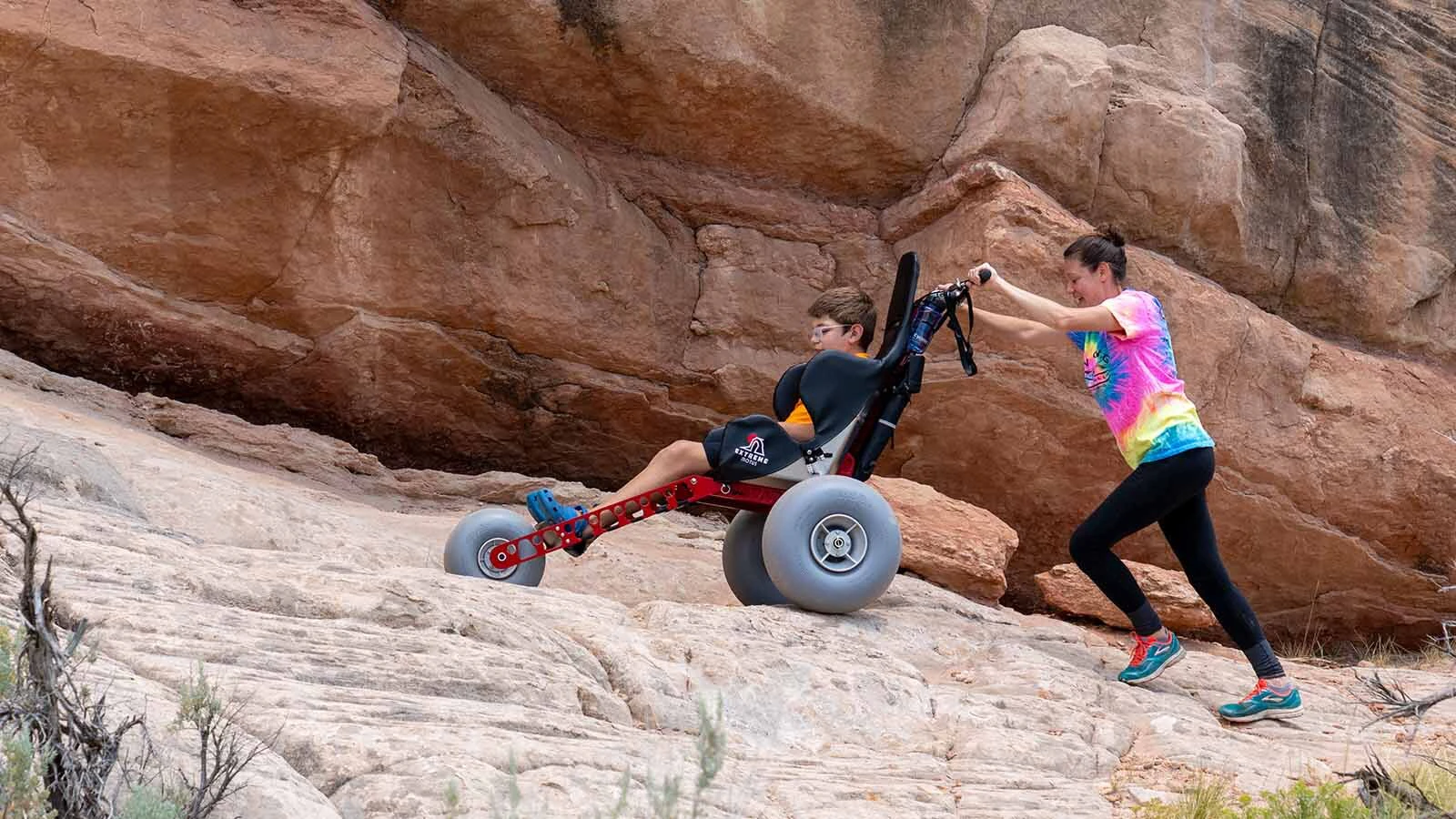
What they found was an all-terrain wheelchair called the Extreme Motus.
At $6,000-plus, though, they couldn’t afford it.
“The reality is, a lot of this gear that could help in outdoor spaces are not part of daily needs, so they’re not covered by things like insurance,” Rupple said. “And anytime you have a piece of equipment that has ‘adaptive’ in the title or made for people with medical needs, they’re just always very expensive.”
A Library On Wheels
Eventually, Rupple’s church surprised the family with a donation to help them buy the machine so they could continue hiking as a family.
That started a thought process for Rupple, though.
“I kept thinking about these other families who could use something like this,” she said. “So I reached out to a handful of moms saying, ‘If you had access to something like this, do you think that you would use it?’”
Their “yeses” led her to start the library of adaptive equipment.
“We have five pieces of equipment so far,” she said. “And the big picture hope is that we’re able to provide equipment that supports all ages, all terrain, and all seasons.”
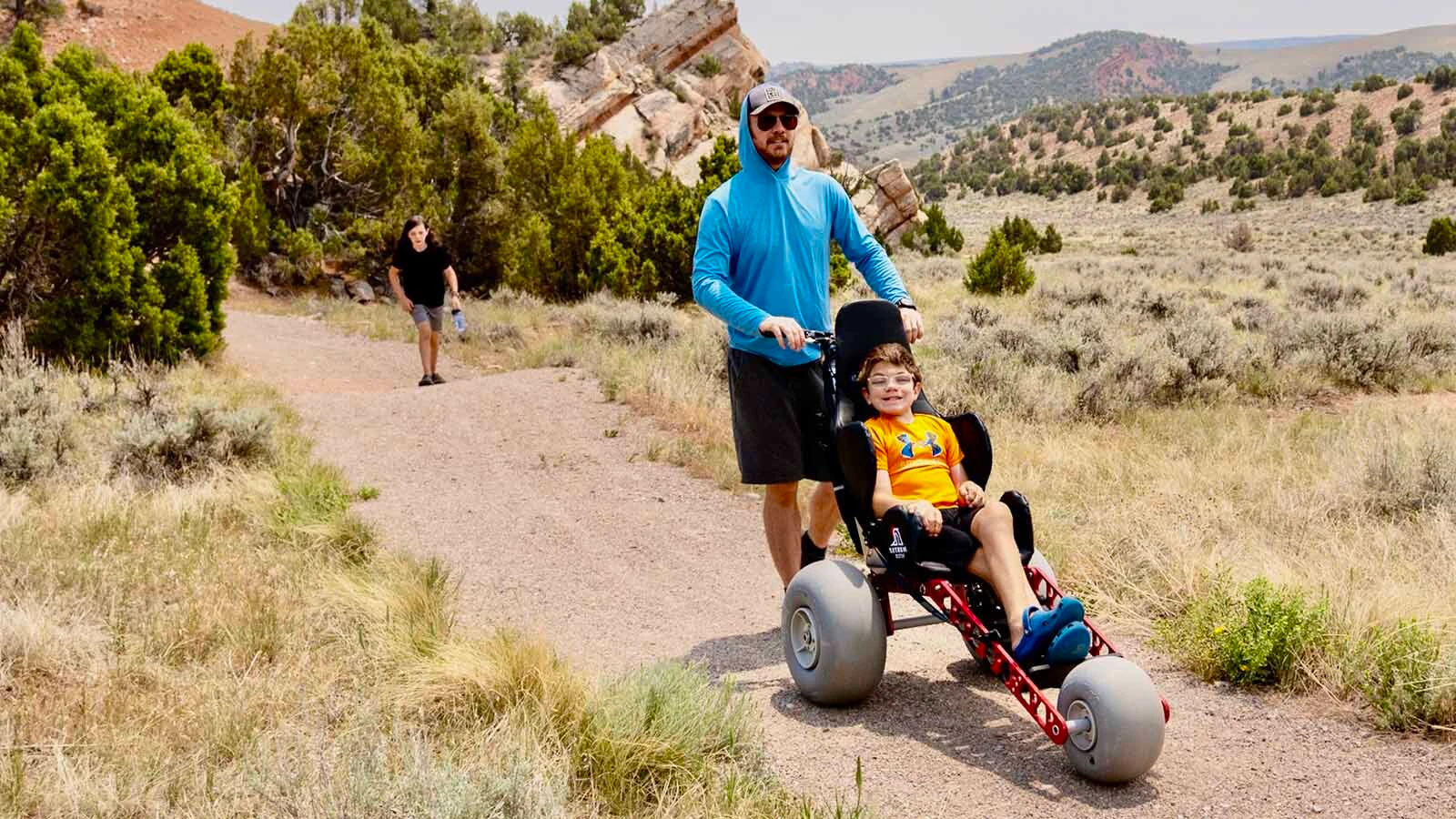
The equipment ranges from simple adaptive packs that carry a smaller child on someone’s back to single-wheel hiking carts that pull a rider along. There’s also a large Extreme Motus all-terrain wheelchair that can accommodate an adult weighing up to 250 pounds.
Its big, inflated tires handle ground that makes a conventional wheelchair difficult to push.
“This thing just floats over gravel,” Rupple said. “All of these pieces of equipment can be used in all seasons. They can roll on snow. People could snowshoe with them and be able to take their loved one along on adventures.”
A Joystick For Trails
For now, TrekAbility’s equipment requires someone else to carry, pull or push the rider. Rupple hopes eventually to add a motorized option that would let some users take the controls themselves.
“He wouldn’t have to just sit there and be pushed or pulled,” Rupple said of Ezra. “He could control something and be part of it and be an active participant.”
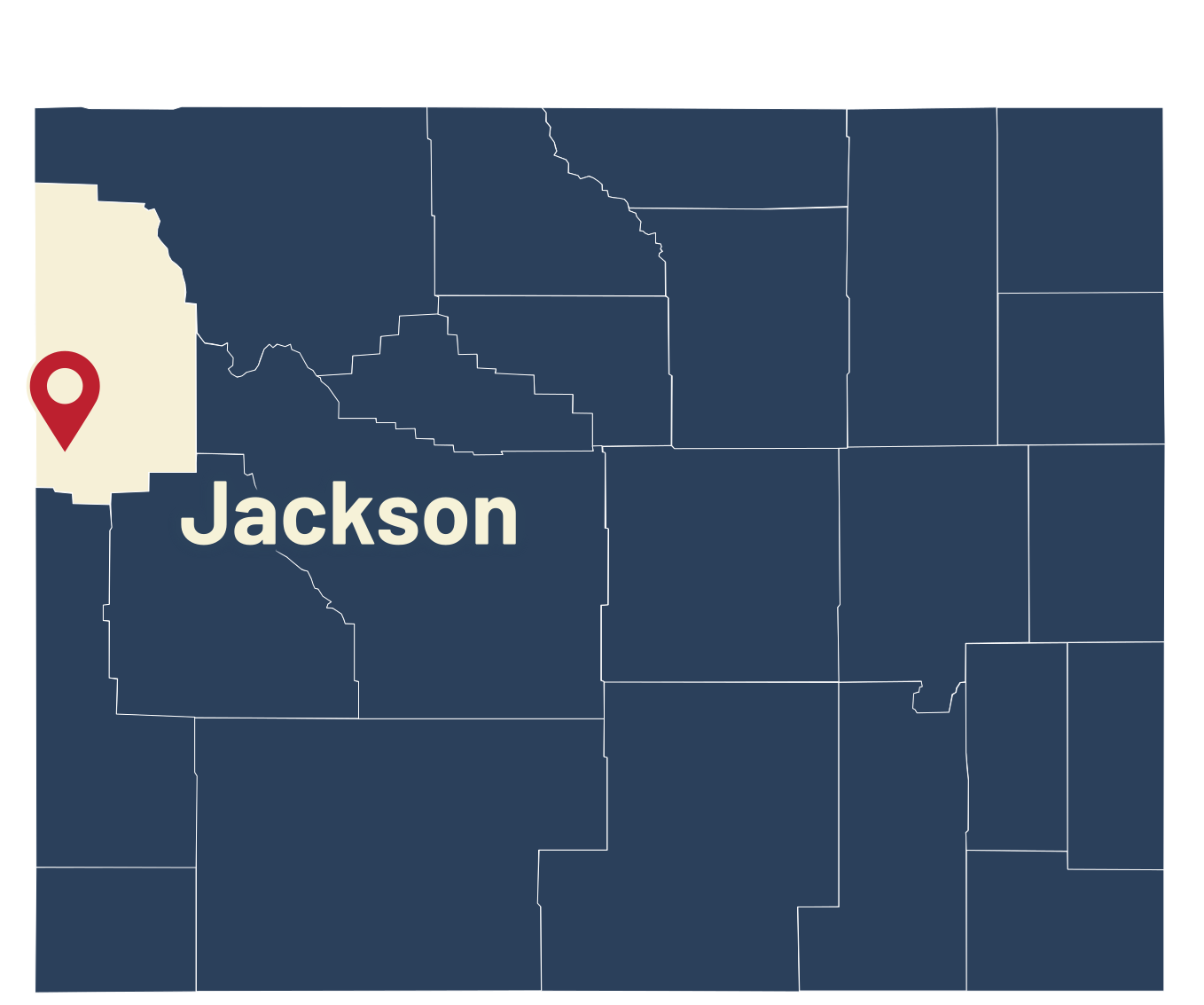
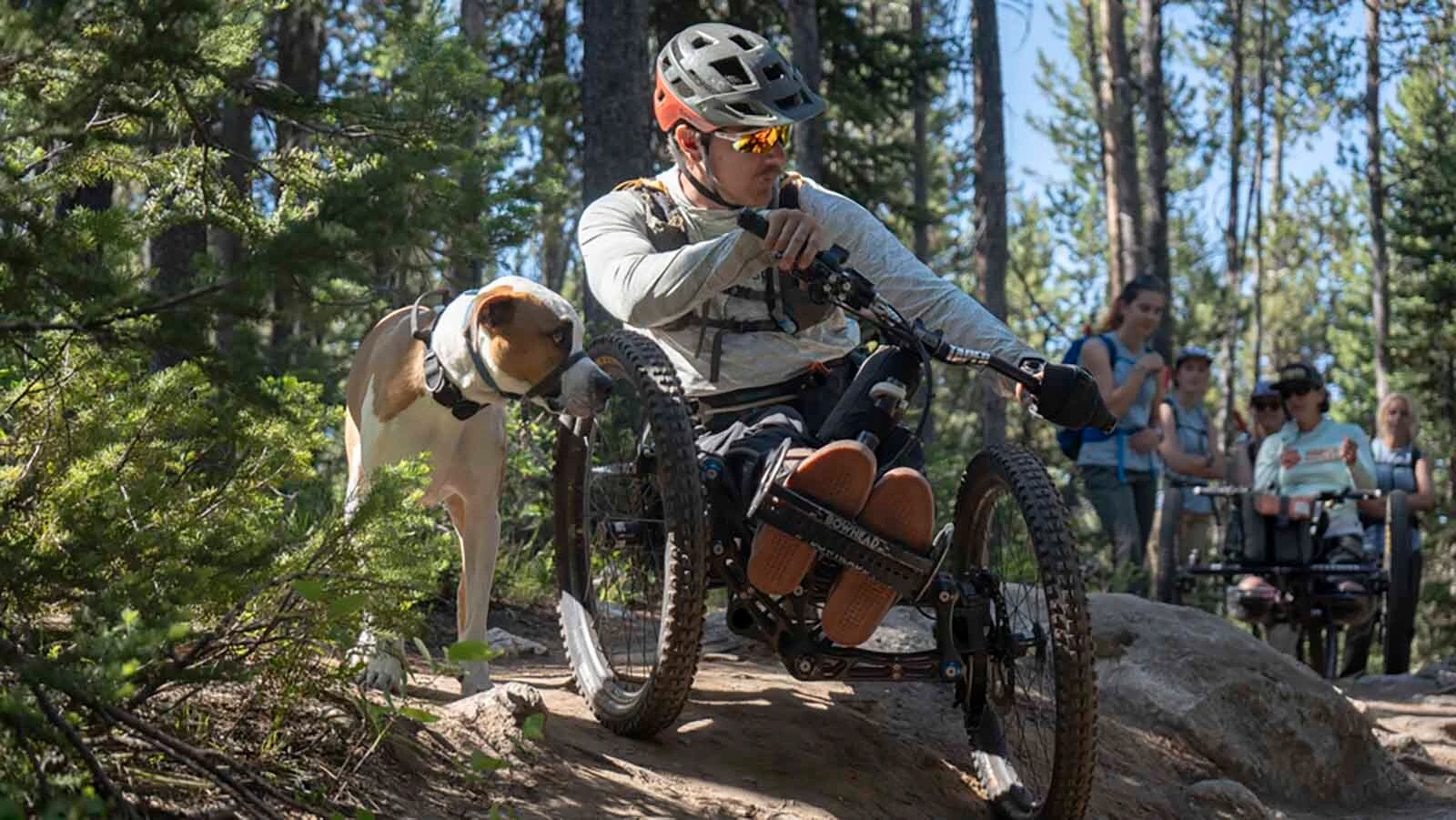
That kind of independence is where Stone’s lending program in Jackson is starting. He already has two joystick-operated Terrain Hoppers, with a goal of making them available in spring 2027 for outings in Grand Teton National Park and the surrounding area.
Stone’s decision to start with that type of equipment grew from a conversation with two veterans visiting Jackson.
Both were quadruple amputees who used prosthetics. They’d tried to hike to Hidden Falls in the park but couldn’t handle all the stairs. So they were sitting at the dock while their families continued without them.
“They didn’t get to see their kids see the falls,” Stone said. “And they were a little bummed out.”
Stone asked the veterans what they would have needed to keep going. When they said they needed something trail-capable with joystick controls, Stone realized the All Terrain Hopper was probably the best, all-around bet for them and for his charity, too.
“They’re totally joystick usable,” Stone said. “So it opens the door for about as many people as possible with disabilities to have access to them and use them and maintain their independence.”
They won’t work for everyone, Stone said, but “you’ve got to start somewhere.”
Miles Of Opportunity
Even the right trail equipment can be stopped by the wrong obstacle.
A narrow bridge, two closely spaced rocks, or a trailhead barrier designed to keep out off-road vehicles can block those using adaptive equipment.
Addressing those obstacles doesn’t have to mean paving a path through the woods, though, Stone said.
“As the technology has gotten better and more awareness around all this has grown, people have been able to wrap their head around the idea that it doesn’t have to be like an ADA-compliant paved trail to support people with disabilities,” he said. “It’s just a few minor tweaks here and there on the trails, and we can open up miles of opportunity in the outdoors.”
Sometimes the issue is how much room a rider has, or how sharply the ground tilts under the equipment.
“A lot of it is just the width of the trail and the cross slope,” he said. “So left to right, how much is the trail leaning in one direction or the other?”
Stone recently completed an analysis at Happy Jack with Wyoming Pathways, creating a detailed report of changes that could be made to make the trail more accessible for those using adaptive equipment.
“Navigating trails shouldn’t be a guessing game,” Mike Kusiek with Wyoming Pathways said in an email.
The findings have been shared with Wyoming Trail FAIRIES to update trail information on mapping apps.
Stone is also working with Grand Teton National Park on improvements to the trail to Taggart Lake. His goal is to have lending equipment available around the time that work is finished.
A more usable trail still leaves people out if they don’t have the equipment to travel it. And better equipment doesn’t eliminate the need to remove barriers from trails and public spaces.
“I don’t know that we’ll ever be able to rely on technology to solve all the problems,” he said. “It takes a collective effort on all angles to be able to create real inclusion.”
Cherishing ‘Right Now’ Moments
For Rupple, the difference adaptive equipment is making is something she can measure in the distance between her family members.
Before getting Ezra’s all-terrain chair, it felt like the family was two different groups.
“I’m at the back of the pack with Ezra moving really slowly, and everybody else is 100 yards ahead of us,” she said.
Family members would come back to check on them and she and her husband would switch off, too.
But nothing changed the fact that even though they were on the same outing, they were not really able to experience it together.
Stone has seen firsthand what happens when that dynamic changes.
He was helping arrange equipment and volunteers for a girl whose Make-A-Wish request was to hike to a lake in the Tetons. She and her family made it all the way to Phelps Lake.
“That had an impact on everyone around that little girl,” he said. “And those moments are really important to be able to jump on right away.”
Timelines can be shorter than desired for families with a disabled loved one, Stone said.
“Right now might be the only moment,” Stone said. “And those moments can change a lot of lives more than most people recognize.”
The opportunity wasn’t just the disabled girl’s, he added. It belonged to everyone in the family who got to share it with her.
“It has an impact most people couldn’t even wrap their head around,” Stone said.
For Rupple’s family, Ezra’s chair has meant the family can go farther together, instead of stretching into two separate groups on the same trail.
Now the memories they’re making can be about the experiences they’re sharing — not the growing distance between them.
Renée Jean can be reached at renee@cowboystatedaily.com.