
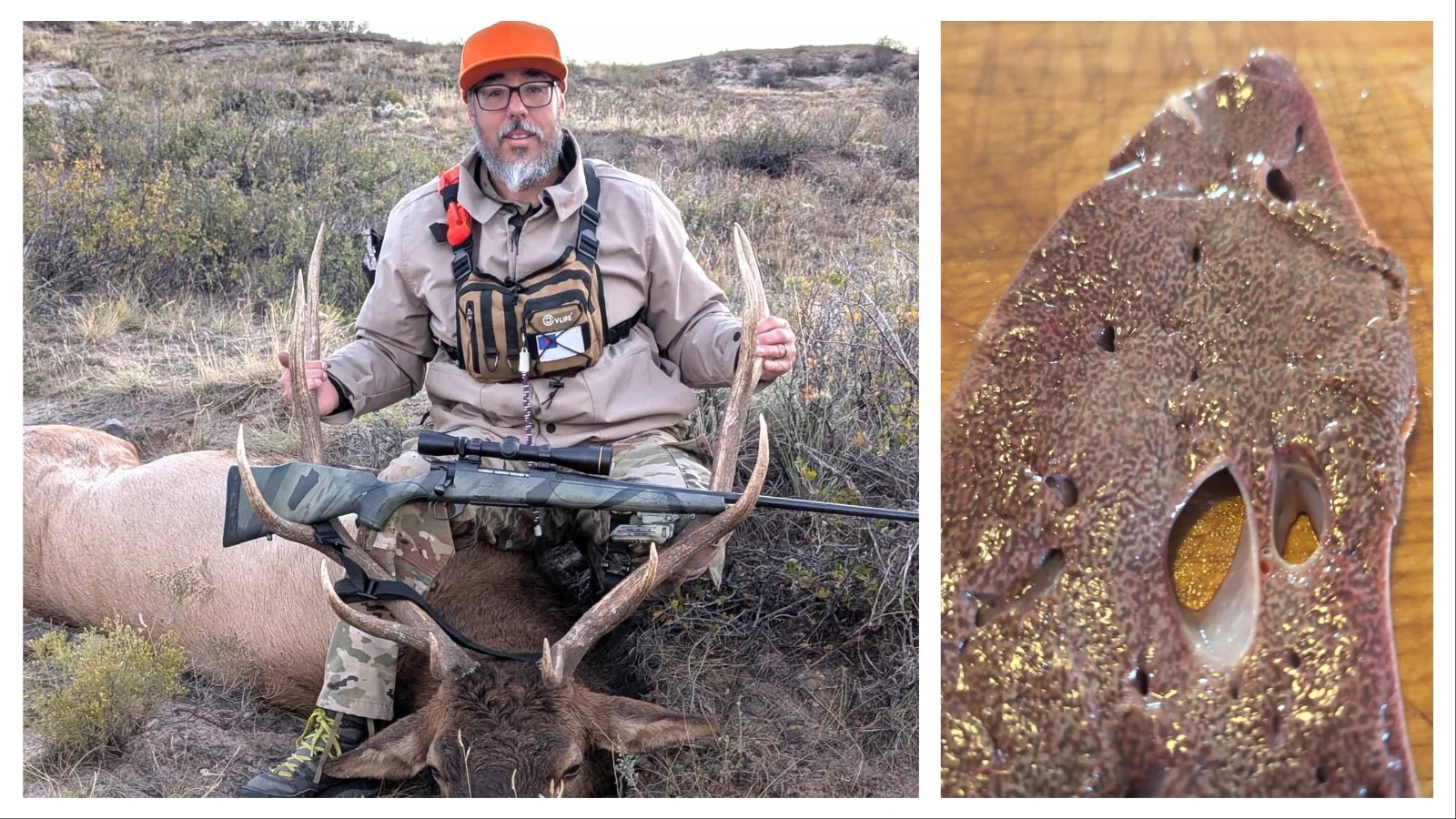
A successful hunter was taken aback when he found bizarre speckles on his elk’s liver, which led to wry comments in an online hunters’ forum about the possibility the bull was an alcoholic or even a meth head.
It turns out that although the bull Matthew Stowe of Cheyenne shot was young and appeared perfectly healthy, it was suffering from a heart defect. And that in turn caused a rare condition called “nutmeg liver.”
Stowe told Cowboy State Daily his family was looking forward to fresh elk liver. But after researching the condition and weighing his options, he decided it was best to pass.
He plans on sending the liver to the Wyoming Game and Fish Department for possible testing.
Some hunters in the forum advised him to skip eating any meat from the animal, but Stowe decided it was safe.
“The color of the meat looks good. And the normal elk smell — it's there,” he said.
Wildlife biologist Kevin Monteith told Cowboy State Daily that Stowe made the right call. While the bull’s cardiovascular problems likely did ruin the liver, Monteith said it shouldn’t affect the quality of the other meat.
Picture Perfect Hunt
Stowe is a relative newcomer to hunting but said he’s had plenty of success.
“I’ve lived in Wyoming since I was a little kid, but I just got into hunting about five years ago,” he said.
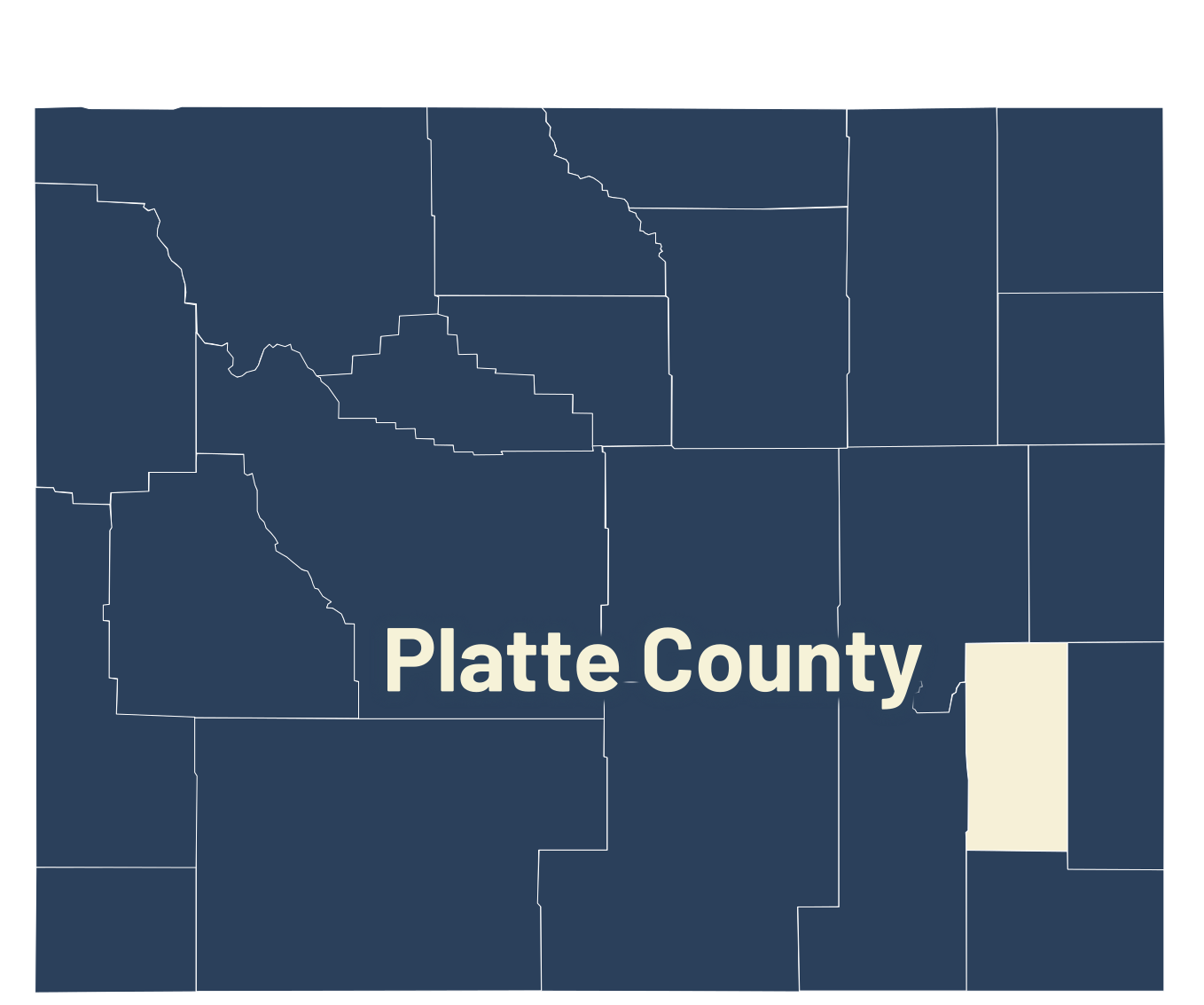
His family found a great spot in the Chugwater area. Before this year’s hunt, they’d already bagged two elk and “about four deer” there, he said.
There is some concern about chronic wasting disease (CWD) spreading among deer and possibly elk there, he said.
However, all the previous animals his family has taken have been healthy and disease-free, Stowe said.
He shot the latest bull elk Sept. 27.
The hunt went smoothly, Stowe said. They spotted elk, and he got a shot opportunity after hiking several hundred yards.
Shot Kept Liver Intact
It happened fast, he said.
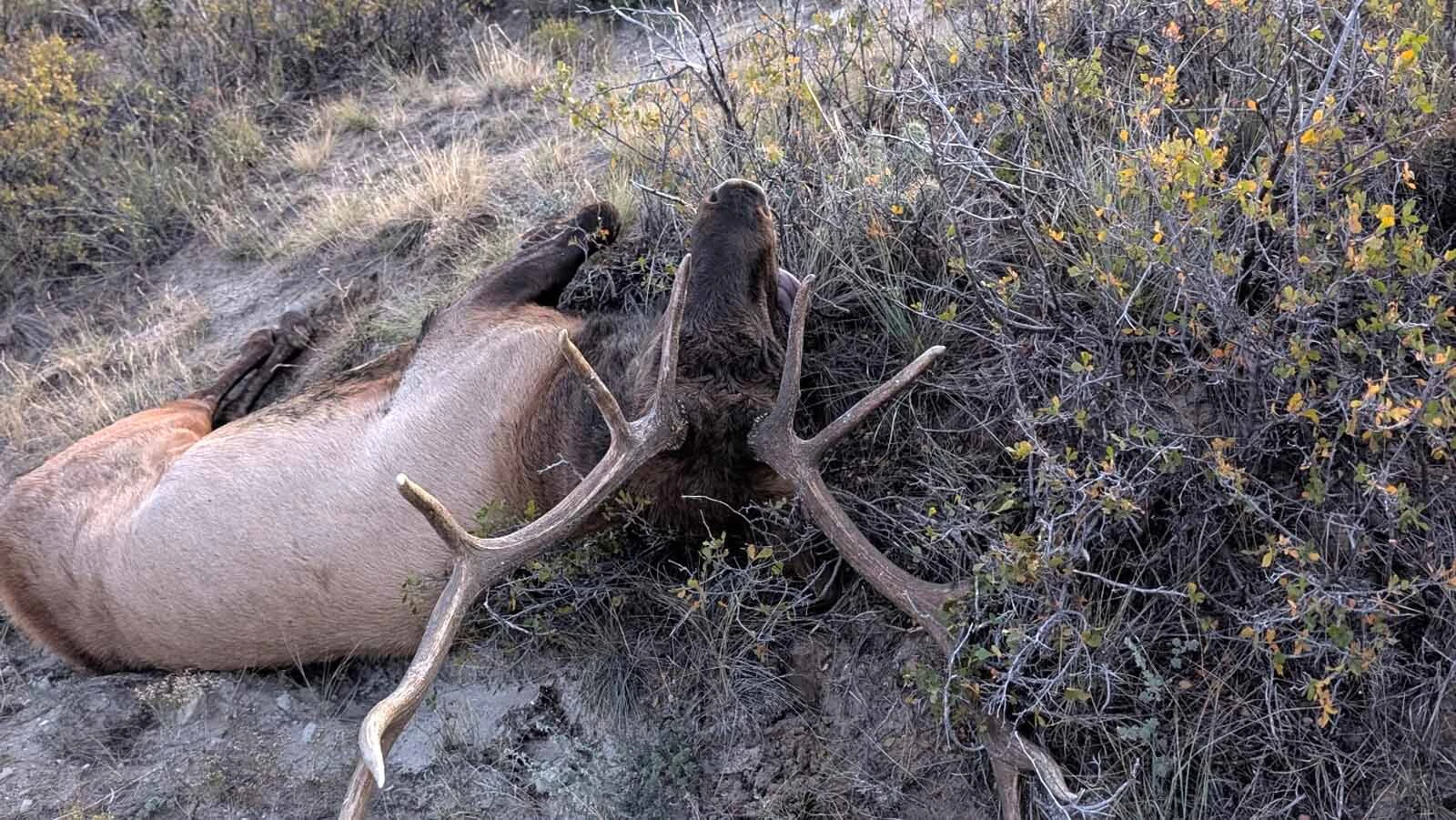
“I didn’t have a chance for a broadside shot because he was coming right at me. So, I just shot him in the throat,” Stowe said. “He went down instantly.”
A neck shot seemed like a bonus at the time, because that meant the liver should have been fully inact.
“Elk liver has all sorts of healthy minerals and vitamins in it,” he said.
So, while not every hunter relishes liver, his family likes it.
By law, Wyoming hunters must retrieve “all edible portions” of a big-game animal’s meat, defined as the quarters, backstraps and tenderloins.
Along with the liver, Stowe said, “I took everything I was required to, and a lot more,” such as neck and rib meat, which are excluded from the definition of "all edible portions."
He plans to make jerky from the tougher meat.
‘Weird Specks’
The family does its own butchering. Stowe said he didn’t notice anything wrong with the liver until he started slicing it into cookable portions.
“I started seeing all of these weird specks in the liver” and decided it was best to call it quits, he said.
They’ve already cooked and eaten some of the backstraps, he said.
After he posted a photo of the liver in the hunters’ forum, some commenters started calling it “nutmeg liver.”
He’d never heard of that, so he started researching it.
Circulation Issues
Nutmeg liver is a rare, chronic condition caused by the animal’s heart pumping blood inefficiently, usually on the right side of the heart.
That, in turn, can cause blood to back up in the veins leading to the liver. And the liver can suffer damage and become loaded with toxins.
Which is why a nutmeg liver is often considered unfit for human consumption, though appearance alone does not establish whether the liver is safe to eat.
“It’s a blood circulation issue. It’s not parasitic or any other condition with disease concerns,” said Monteith, a biologist with the Haub School of Environment and Natural Resources at the University of Wyoming.
He said he’d never heard the term “nutmeg liver" but noted there’s no reason to think that a circulation defect in an animal would necessarily compromise the overall quality of meat from muscle tissue.
Another concerning finding hunters might encounter is “hydatid cysts, sometimes found in the lungs,” Monteith said.
Those are caused by tapeworm larvae, and “the meat is still safe to eat,” he said. “Sometimes, the muscle can have different tapeworm cysts, white dots in the meat. The dots do not look really appealing, but it’s still safe to eat. Just don’t feed it to your dogs.”
Still Going Hunting Again
Stowe said shooting one elk that might have nutmeg liver is hardly enough to discourage his family from returning to their favorite hunting spot.
They plan to return later this month to hunt deer.
“My son is ready to get his first deer this year,” he said.
Mark Heinz can be reached at mark@cowboystatedaily.com.


