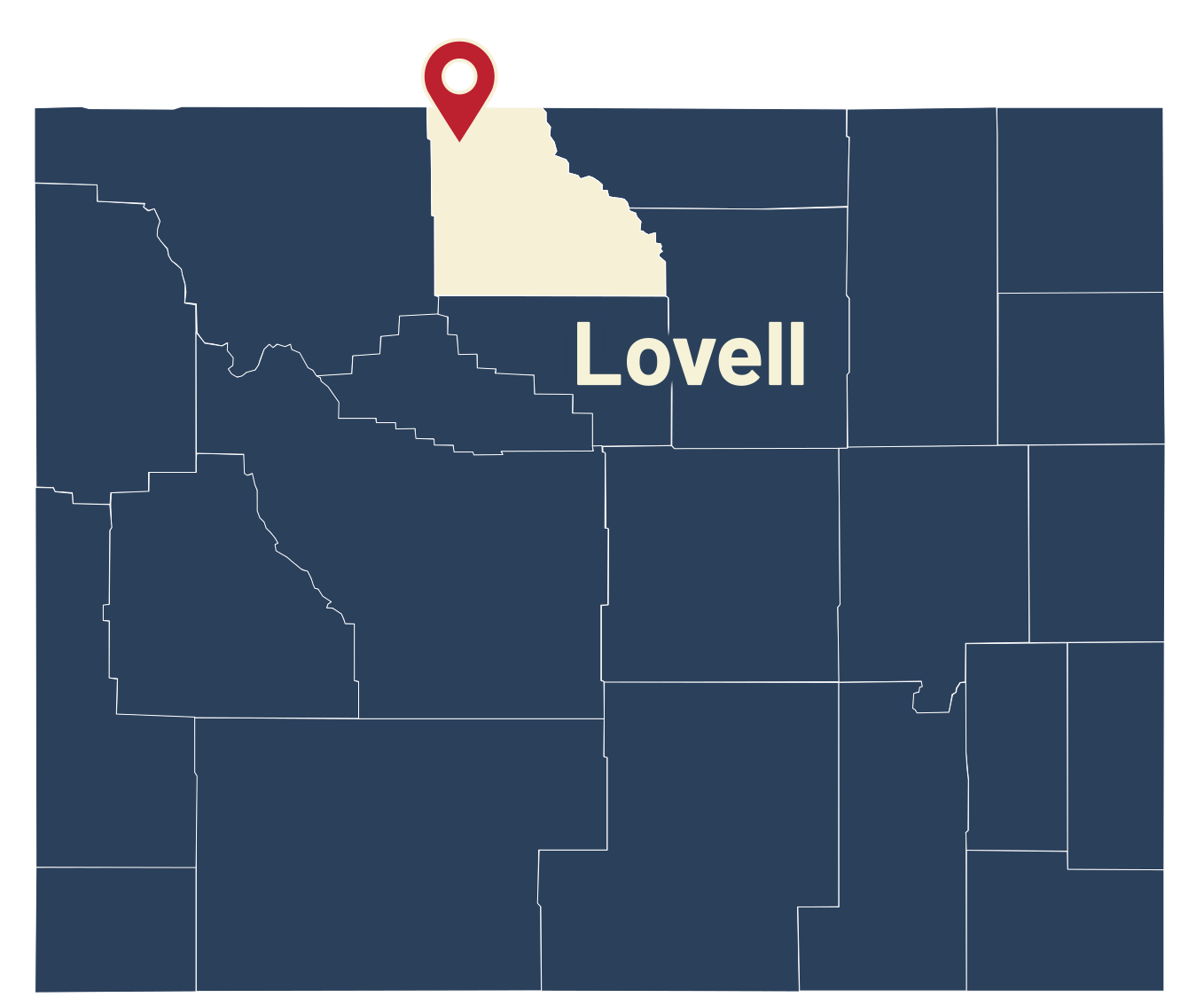
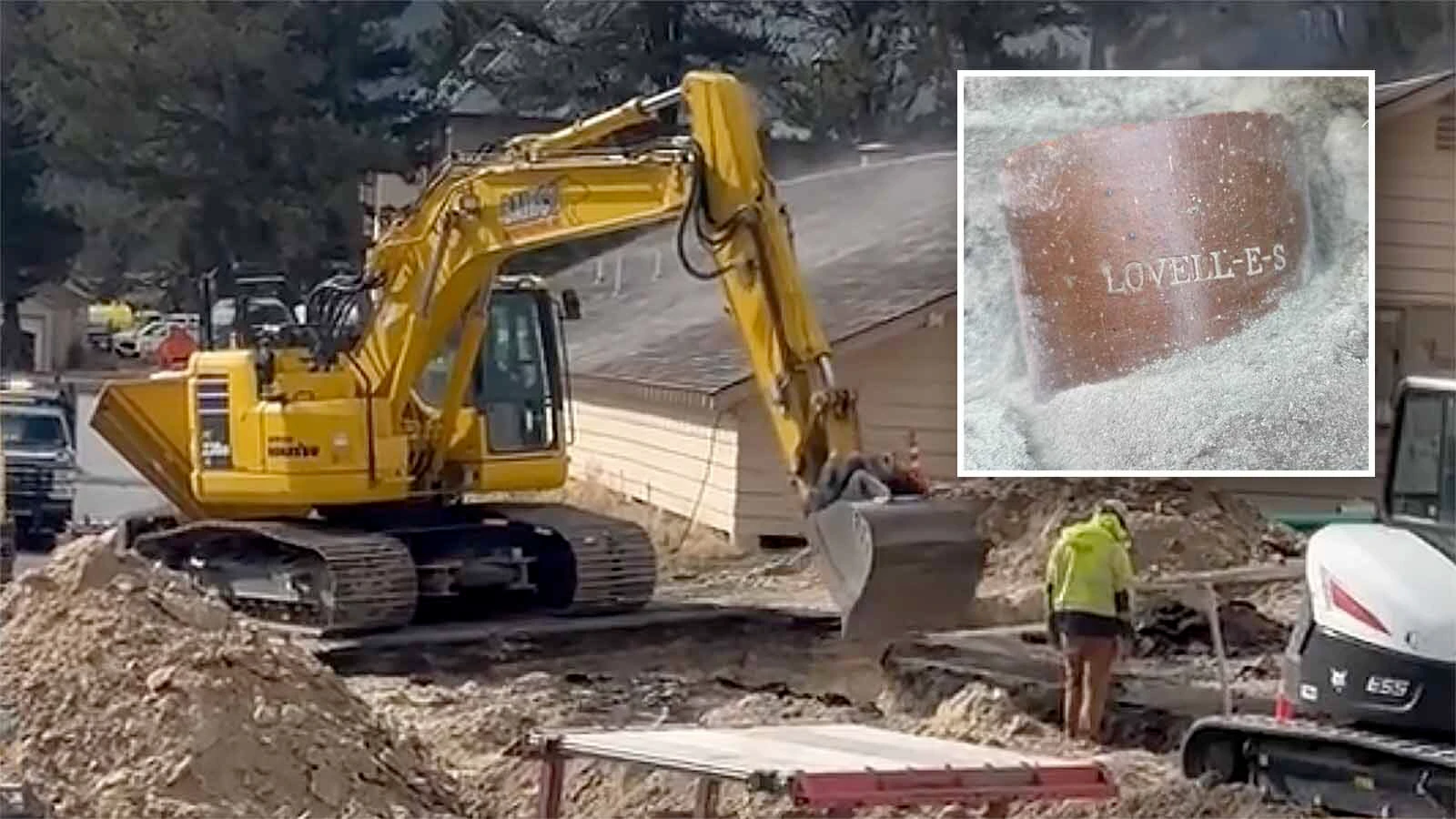
When Bairco Construction, a civil and utility construction firm based in Lovell, Wyoming, was hired to replace some plumbing in Glacier National Park, they were surprised to find a piece of home buried in the northernmost reaches of Montana.
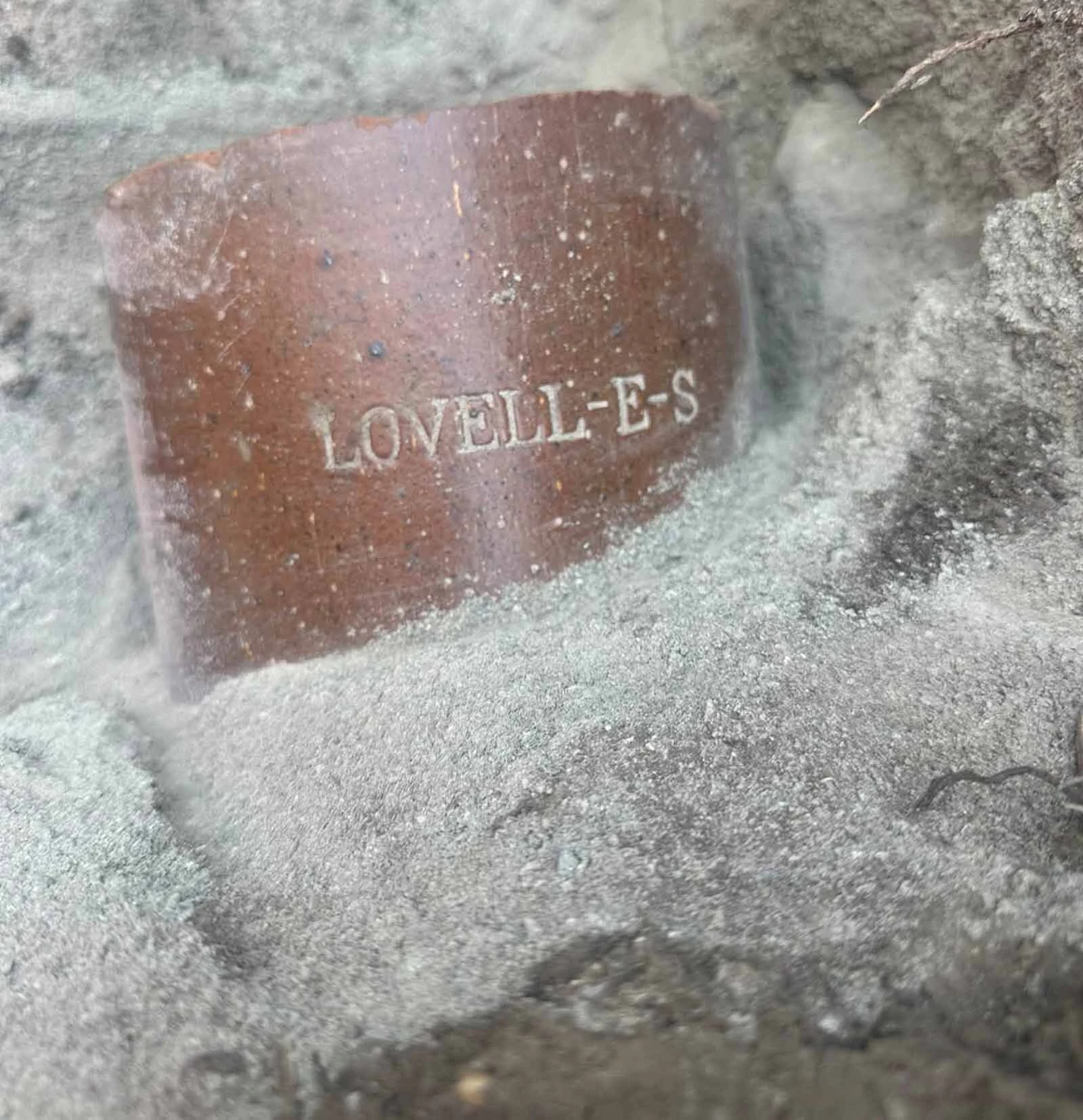
As their excavators dug into the ground, they uncovered old clay pipes installed around the 1950s. On those pipes, they saw a familiar “Lovell-E-S” stamped on the outside.
“Finding that product, that came out of our home base, was a cool feeling,” said Devin Bair, vice president of Bairco Construction. “It looks brand new, and we’re talking 70 years after it was installed. It looks amazing.”
The same happened when they were replacing the 90-year-old plumbing at Mammoth Hot Springs in Yellowstone National Park.
It’s a testament to the craftsmanship of the Lovell Clay Works, which turned tiny Lovell into an industrial hub that thrived for decades, only to almost vanish. The works are gone, but the pipes are as solid as ever.
“Every time we find clay, we look for Lovell,” Bair said. “We pull it out, wash it off, and look to see where it came from. We get excited when we find it.”
Buried History
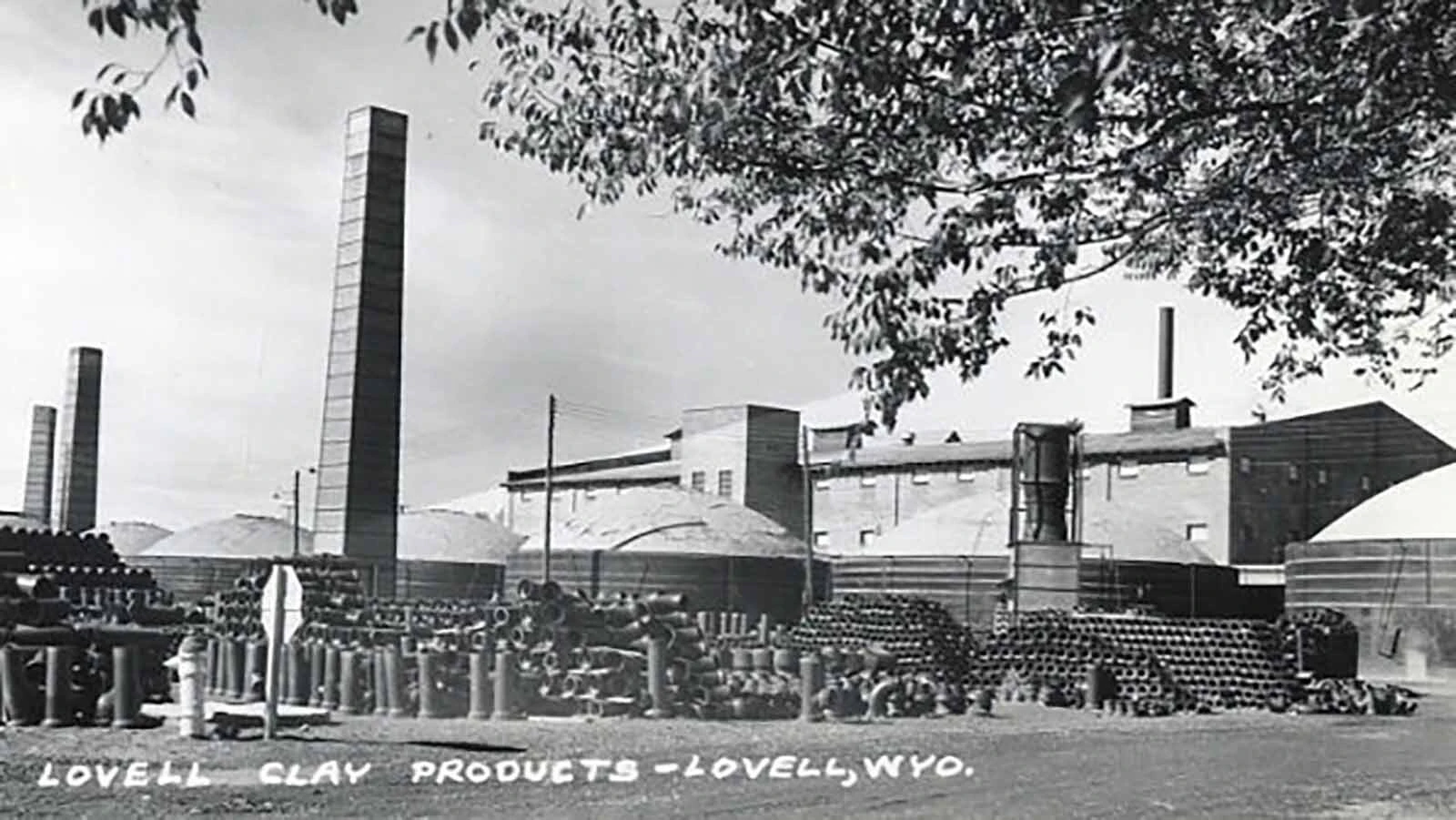
For a company as large and successful as Lovell Clay Works, surprisingly little of its history still exists. Karen Spragg, curator and director of the Lovell-Kain Museum, has tried to fill in those sizable gaps as best she can.
“I’ve looked at old newspapers, lawsuits, and business records, and spoke to the daughter of the last owner,” she told Cowboy State Daily. “We didn’t have a book put together on it, and there’s very little detail on the internet.”
All of Spragg’s research is contained in a single folder. She’s still trying to build a timeline of the Lovell Clay Works and its operations, even with the company’s legacy evident throughout town.
“If there’s a brick house in Lovell, they’re bricks from the Lovell Clay Works. Or Big Horn Clay Products. Or Lovell Brick and Tile. It’s had many names,” she said.
Most of the company’s remaining history is buried in clay sewer pipes still in use today. That clay brought businessmen and many industries to Lovell.
The story of the Lovell Clay Works started with George Warren and a $300,000 tile factory in Warrenton, Oregon.
Warren, a banker based in Washington, built the tile factory on a deep sea harbor so he could ship hollow bricks to Australia. The relationship was lucrative but ended prematurely when the United States entered World War I.
“There was nothing they could do but close down that factory, and so Mr. Warren did a lot of research and came to Wyoming,” Spragg said.
Warren and his associates, Warren Overpack and O.S. Strasburg, came to Lovell for high-quality clay being quarried near Sheep Mountain, four miles east of Lovell, close to the present-day Wyo-Ben bentonite plant.
Apparently, the clay was of such high quality and quantity that Warren decided to re-orient his entire life and business around it.
Lovell Bought In
In March 1919, Warren and his associates approached the Lovell Commercial Club with a plan and a proposition.
“They decided that they could close and ship their factory to Lovell, and so that's what they decided to do,” Bragg said. “The Lovell Commercial Club proposed that they would advance him and guarantee him the $65,000 to bring that plant out here.”
For comparison, $65,000 in 1919 is equivalent to $1.26 million in 2026.
Lovell residents held a public stock subscription to raise the money. Warren loaded his $300,000 seaside factory on 50 railcars, and delivered it to Lovell.
Warren also bought an existing brickyard that immediately started making bricks for the foundation of the reassembled factory.
The factory was placed on land owned by the Strong family, one of the first families to homestead near Lovell in the 1880s.
In April 1919, the Lovell Chronicle announced that operations at the new Big Horn Clay Products would begin immediately, employing around 200 men.
The Lovell Gas and Electric Company, which offered “the best electric equipment in northern Wyoming,” supplied the natural gas to power the immense operation.
Warren even convinced the Chicago, Quincy, and Burlington Railroad to build a new siding so the bricks, tile, and pipes could be loaded onto trains directly from the factory.
“When the plant was finally up and running, they could make about 50 tons of material a day,” Scragg said.
Brick By Brick
The Big Horn Clay Works got off to a big, but not good, start.
According to Scragg’s research, numerous creditors, including Lovell Gas and Electric, had already filed liens against the clay company by Sept. 1919.
Warren and his associates defaulted on their debts, so ownership of the factory transferred to R.E. Richardson, manager of Lovell Gas and Electric.
H.J. Arnoldus and J.T. Brewer leased the factory in January 1922. They failed within six months.
The Cross Gas Company bought the factory for 40 cents on the dollar in May 1923. They spent six years making nothing on bricks but a fortune from the factory’s gas consumption.
Finally, Richardson got his act together. With some local partners, he incorporated The Lovell Clay Products Company on Oct. 1, 1929. They purchased the clay plant from the dissolving Cross Gas Company the day after one of the most fateful days in American history.
“The Cross Gas Company sold it on Oct. 29, 1929,” Scragg said. “That was the day after the Great Stock Market Crash.”
Lovell Clay Products figured out how to make the operation profitable and sustainable, despite the Great Depression. They would operate the clay factory until its closure in the 1970s.
Common Clay Of The New West
Since then, Scragg has struggled to piece together the history of Lovell Clay Products and how it manufactured vast quantities of bricks, tile, and pipes. She knows the new owners seized the momentum and never let it go.
They modernized operations as soon as they took ownership. Horses and wagons gave way to front-end loaders, steam engines to electric motors, and the original beehive kilns were replaced with 11 modern kilns, more than doubling the factory’s clay-product output.
They even found and started quarrying a new clay pit.
“They were making improvements every year,” she said.
By 1940, operations were going so well that Lovell Clay Works opened a new brick plant in Billings, Montana.
Modernized operations were bolstered by modernized marketing. Lovell Clay Works tried to warn consumers about metal pipes and promote its “vitrified glazed clay sewer pipe.”
To prove their product’s superiority, advertisements compared photographs of rusted, crushed metal pipes with perfectly intact clay pipes laid in Sleepy Eye, Minnesota, in 1883; New Richard, Ohio, in 1828; and ancient Babylon in 2000 B.C.
“Vitrified clay pipe never wears out,” they claimed.
Business was booming. By the 1950s, Lovell Clay Works was selling throughout Wyoming, Montana, the western halves of Nebraska and the Dakotas, and northern Colorado.
How did they do it so successfully? Scragg wishes she knew.
“I have their business records, the sketches, the plans, the pipes. We have everything, but that isn't going to tell you how it operated,” she said. “I even have Mr. Richardson’s journal, but that’s more of his personal story and genealogy.
The key to a successful business is a consistently solid product. In Bair’s view, there’s no question about the quality.
“The pipes are very durable and look amazing,” he said. “A lot of the systems installed during that time are still functioning.”
Bair and his crews can determine the approximate age of the Lovell Clay Works pipes by examining their stamps and seals.
The joints of older pipes were sealed with coal tar pitch or concrete grout. Systems installed more recently have joints with rubber seals.
The Lovell Clay Works stamps are particularly interesting for Bair.
“When you see the old pipe, you can tell it’s somebody with a hand stamp,” he said. “Every piece of pipe is different, whether it’s stamped at a different angle or a different section, harder here, softer there. Those are the fun ones to find. You can tell somebody in that factory was hand-stamping every piece of pipe that came out of there.”
Pipe Dream Over
In the 1967 film “The Graduate,” Dustin Hoffman’s character receives “just one word” of advice from Mister McGuire.
“Plastics,” he said.
That same word ended the Lovell Clay Works.
“The invention of plastic essentially made clay obsolete overnight,” Bair said. “Once the plastic industry got going, that was the end of clay pipe and terracotta tile.”
In 1950, there were 110 factories making clay pipe in the United States. By 1975, there were only 14.
Lovell Clay Works was one of the last. It ended with a letter from Lovell Clay Products to its power supplier, Montana-Dakotas Utilities Inc.
“Dear Mr. Hettinger,” the letter read. “This is an appropriate date to inform you that we have completed operations that require high-pressure natural gas. We have cooled our boilers and fired our last kiln. We have no plans for resuming operations in the future. Yours truly, The Lovell Clay Products Company.
The letter was dated June 13, 1975, the last day of operations.
“When polyvinyl chloride pipe was developed in the late 1960s, the market fell out,” Scragg said. “They sold the brick factory and cut off the gas.”
Buried Legacy
For as successful as Lovell Clay Products was in its heyday, there’s hardly a trace of it in modern-day Lovell. The massive factory has long since been demolished, even as the infrastructure built with its products still stands on street corners or lies buried underground.
Scragg wishes there was more to talk about the company and its history, but there isn’t much more to find. Even local newspapers, a consistent source of historical information, were lost when The Lovell Chronicle building caught fire in 1935.
“I've been working on this, trying to find stuff, and it's very hard,” she said.
The best pieces of history she’s received recently are clay pipe fragments recovered during local construction projects.
Bair and Bairo Construction has been finding Lovell’s clay pipes throughout the western U.S. Their company, which specializes in heavy-duty underground utilities for civic agencies, covers the same general area where Lovell Clay Works marketed and sold its products.
Lovell Clay Works claimed that “roots could not pierce” the dense, “rock-like” walls of their clay sewer pipes. Bair said that’s more or less true for the pipes, but not the joints.
“They didn’t have a great system of sealing those joints over the years,” he said. “Tree roots get inside of them, and over time, they come apart.”
Still, vitrified glazed clay pipes came with a minimum 50-year guarantee. Bair and his crews are excavating pipes installed nearly 90 years ago, and they look brand new.
“We’re replacing and rehabilitating old sewer systems with PVC and poly-sewer,” he said. “Those systems haven’t been replaced for 70 to 90 years, but that pipe’s still in the ground.”
Lovell Workmanship Travels Well
One of the many customers that bought from Lovell Clay Products in its heyday was the National Park Service. When Yellowstone National Park installed the first plumbing infrastructure at Mammoth Hot Springs, Lovell Clay Products provided the pipes.
“All the pipe at the Mammoth headquarters was put in travertine,” Bair said. “All the trenches were dug by hand with air hammers, but they had to blast a lot.
Bair reviewed historical photographs and documents about the process at the Yellowstone Heritage Center in Gardiner, Montana. They discussed how they placed mattresses from the Mammoth Hotel over the blast site to ensure none of the rocks hit the building.
When Bairo Construction won the contract to modernize those systems, they removed and replaced much of the Lovell Clay Works pipe.
Finding Lovell Clay Works pipes in Yellowstone wasn’t too surprising for Bair. Finding those pipes in Glacier National Park, within shouting distance of the Canadian border, was.
“We just dug some up last week,” he said. “Nearly 70 years later, it is still fully functional.”
Bair was impressed that the National Park Service would purchase clay pipe from Lovell and transport it nearly 500 miles to Glacier. He sees it as a testament to the product's quality.
“They installed that back in the 1940s and 1950s, when the roads weren’t nearly as good as they are today,” he said. “To get that clay pipe hauled up to Glacier? That’s a pretty good haul on a tougher drive.”
Clay pipe can’t last forever, but Bair noted that his company only replaces what’s specified in the contract. While many Lovell Clay Works pipes have been replaced with modern PVC plumbing, many of those 70- to 90-year-old clay pipe systems still work perfectly well, despite their age.
“There's still active Lovell pipe running sewer and drain in Yellowstone and Glacier right now,” he said. “It’s pretty remarkable to find a piece of Lovell history this far from home, and that a Lovell contractor is here working alongside it all these years later. We keep our eyes open for it everywhere we go.”
Andrew Rossi can be reached at arossi@cowboystatedaily.com.