
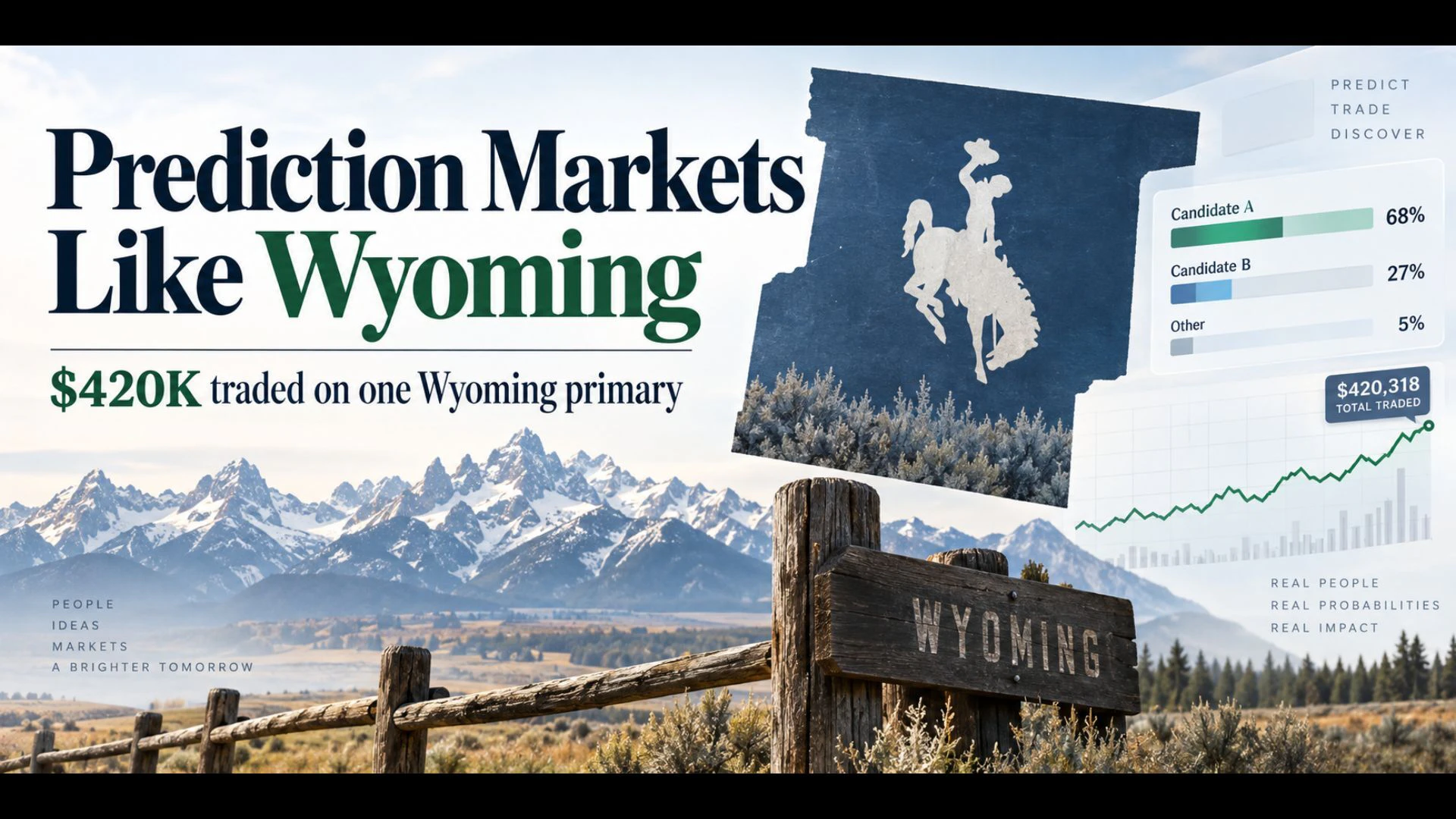
The following is sponsored content from Geyser Marketing.
Wyoming may be the least-populated state in the country, but prediction markets seem unusually interested in what happens here.
The U.S. Census Bureau estimates Wyoming had about 589,000 residents in 2025. Yet traders are putting hundreds of thousands of dollars behind questions involving Wyoming elections, turnout, margins, and sports.
The clearest example came during the 2026 Republican gubernatorial primary.
On Polymarket alone, the race generated roughly $419,530 in trading volume.
Wyoming GOP Governor Primary Trading
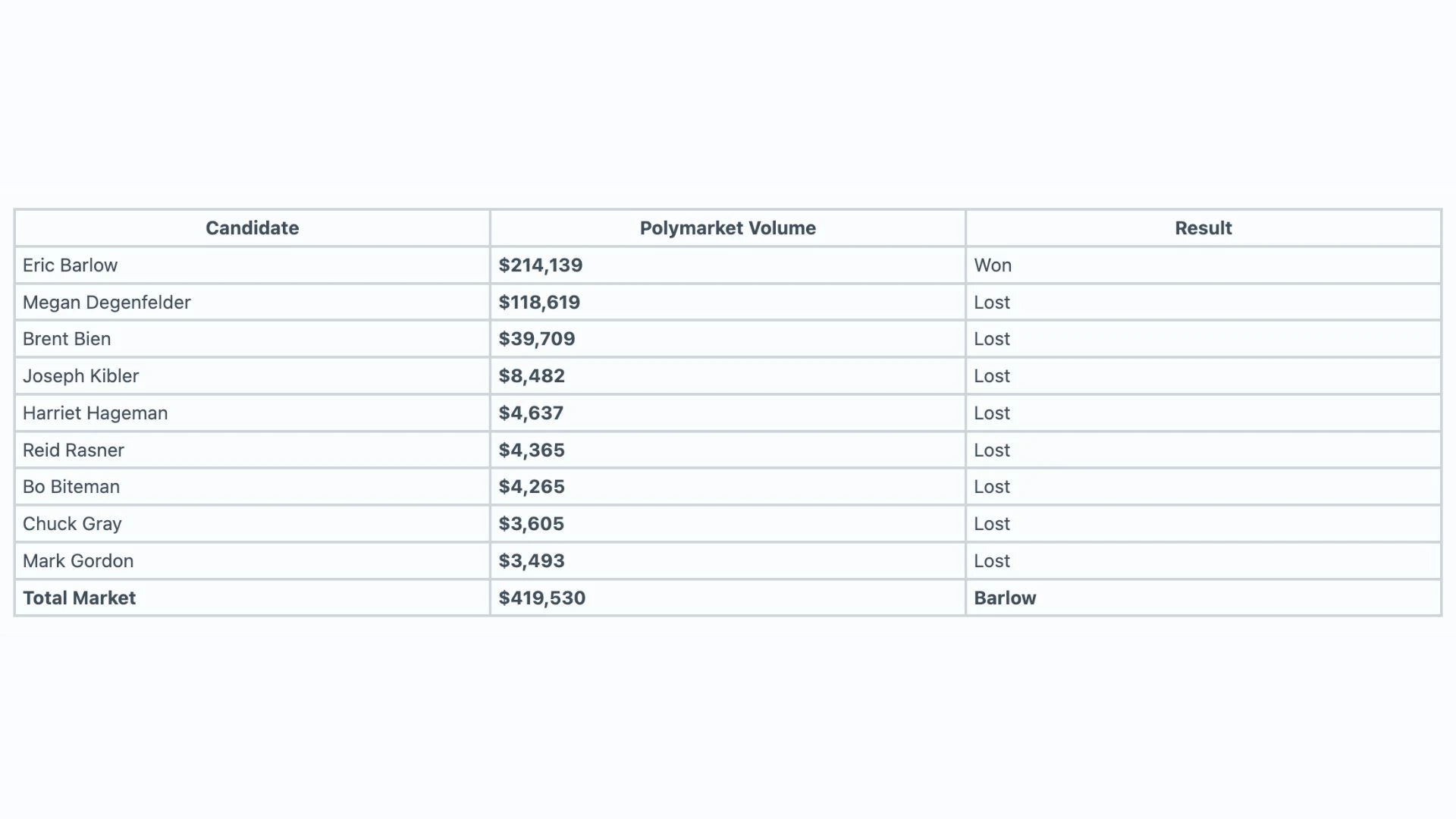
Wyoming GOP Governor Primary Trading
That is not campaign spending or political donations.
It is prediction-market trading on the outcome of one Wyoming primary.
And the primary was hardly the end of it.
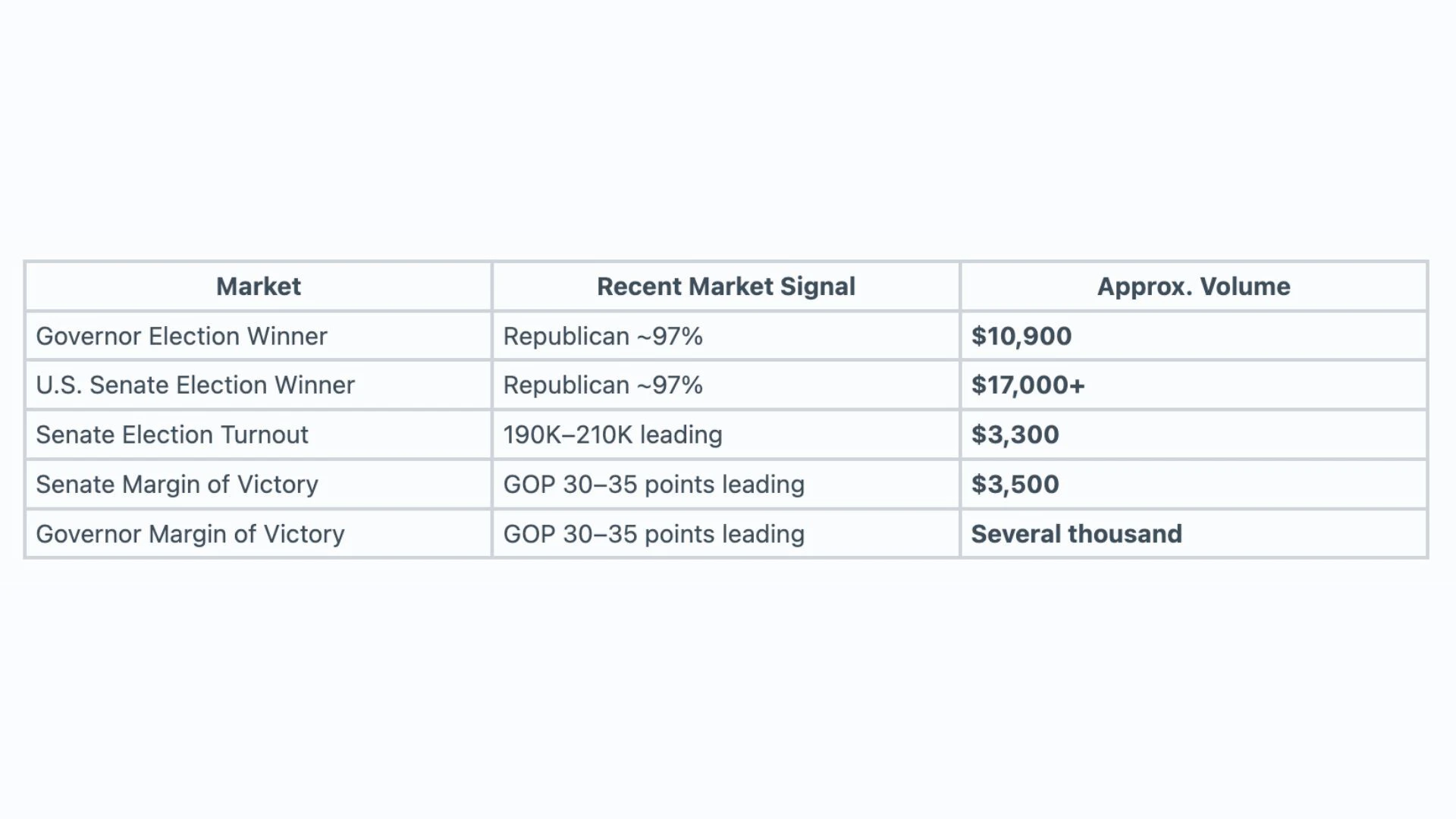
Current Wyoming-related markets include the governor’s race, U.S. Senate race, turnout, victory margins, and Wyoming Cowboys games.
Wyoming Markets Traders Are Watching
Prediction markets are different from polls. Traders buy and sell contracts based on an outcome, and prices move as money enters the market.
A contract priced around 60 cents generally corresponds to a market-implied probability of about 60%.
That does not mean 60% of Wyoming voters believe something will happen. It means traders are pricing that outcome at roughly 60%.
That distinction matters, especially in a state where traditional polling can be limited.
Wyoming also fits prediction markets unusually well.
The state has high-profile elections, competitive primaries, major energy and public-land issues, and a Division I football program. More importantly, many Wyoming questions have clear, measurable outcomes.
Someone wins an election.
A specific number of ballots are cast.
A candidate wins by a measurable margin.
The Cowboys either win or lose.
Those are exactly the kinds of questions prediction markets can turn into tradable contracts.
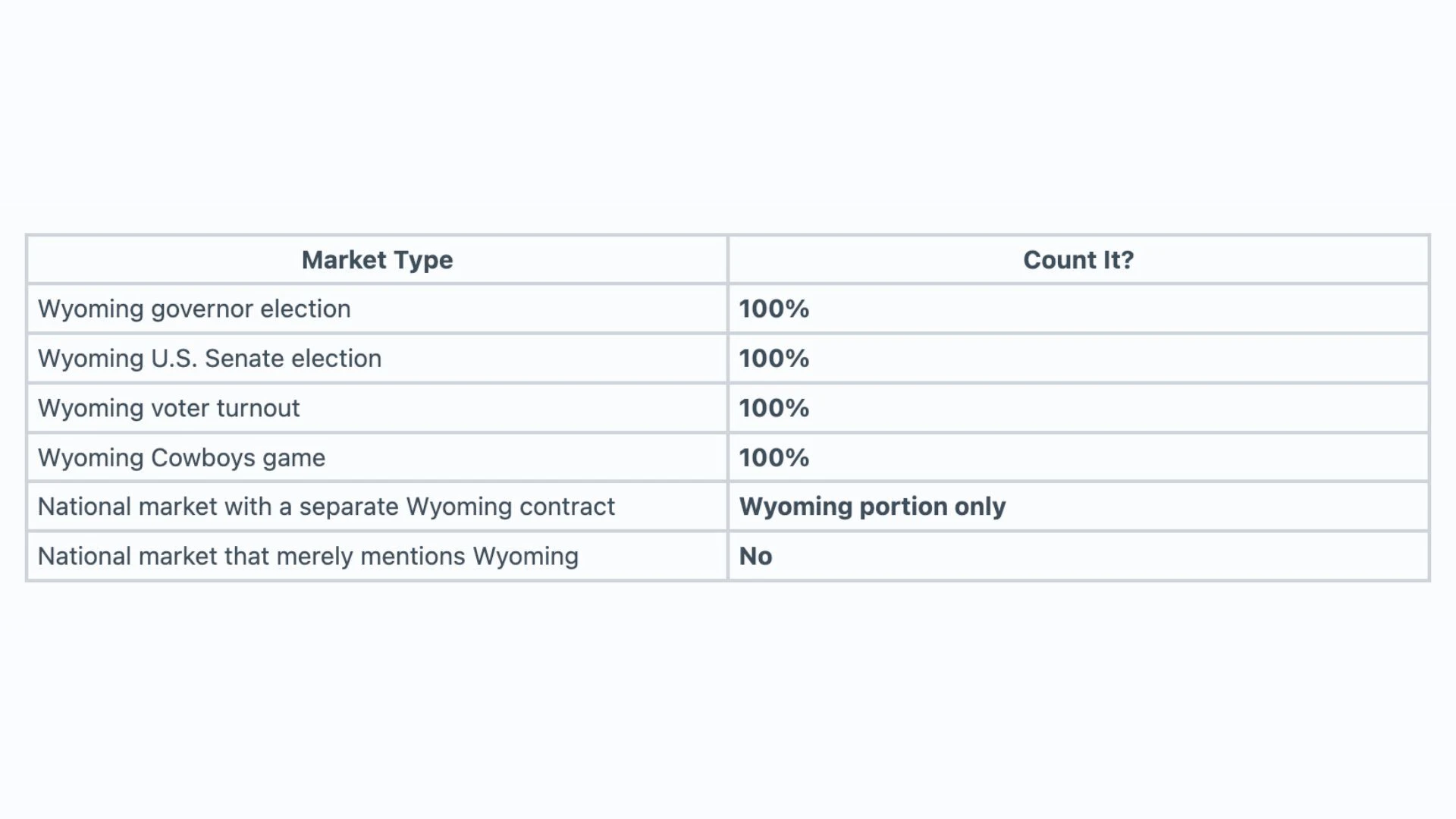
At CLEATZ, we have built a Wyoming prediction market tracker to aggregate this activity.
The goal is not to estimate how much Wyoming residents are trading. Exchanges generally do not make that data public.
Instead, we are measuring something observable:
How much money is being traded on Wyoming outcomes?
What Counts As Wyoming Volume?
Over time, that should give us a better picture of how much financial attention Wyoming attracts in prediction markets.
Trading volume is not public opinion, and it is not a guarantee of what happens next.
But it is a measurable form of attention backed by money.
For a state with fewer than 600,000 people, nearly $420,000 traded on one political primary is a pretty striking example.
Wyoming may be small.
Prediction-market traders certainly do not seem to think it is boring.


