
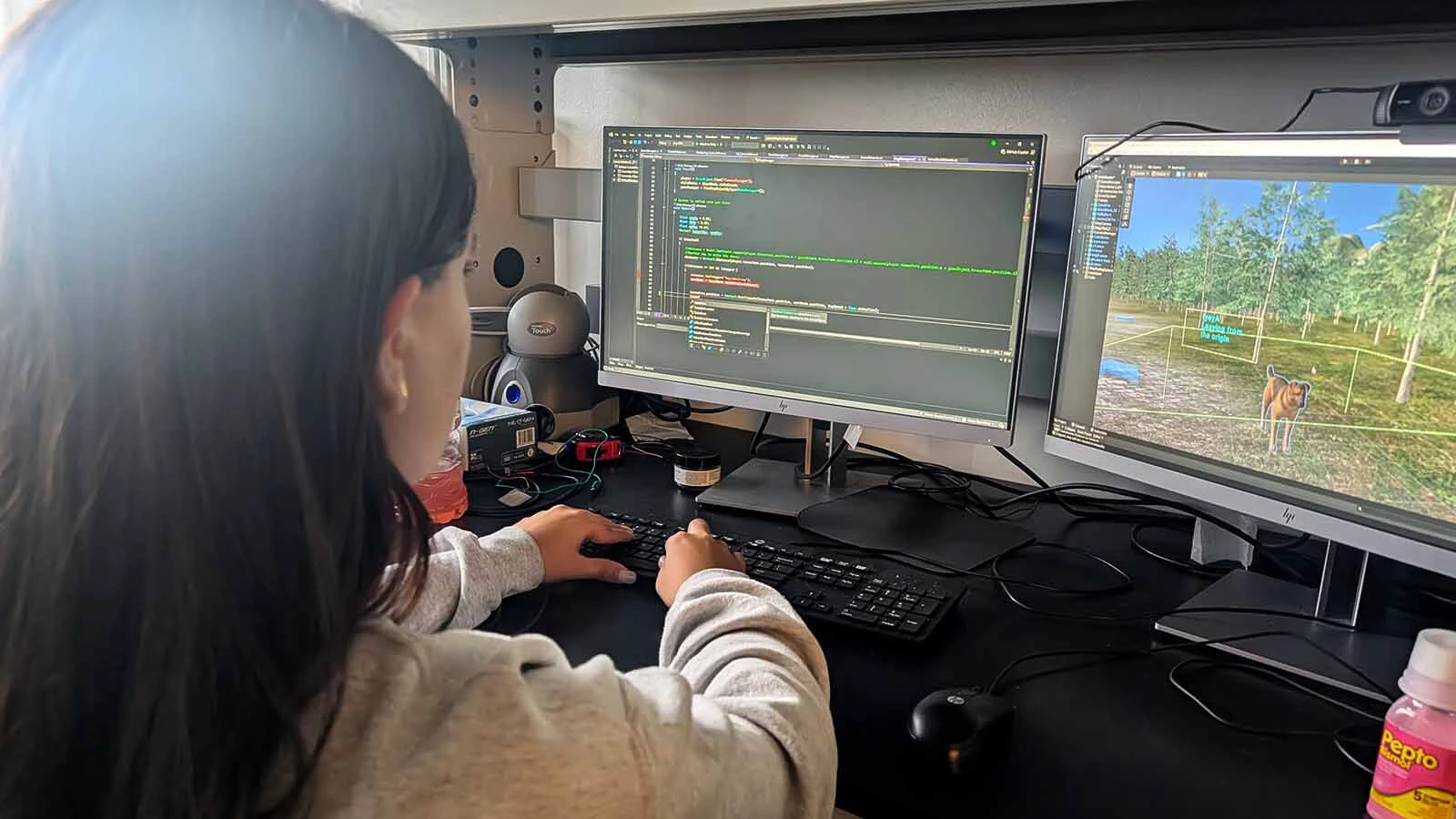
University of Wyoming developers and their Standing Rock Sioux tribal partners are trying to save the Lakota language, now spoken fluently by only about 2,000 people in North America.
They hope a video game guided by a canine character will help.
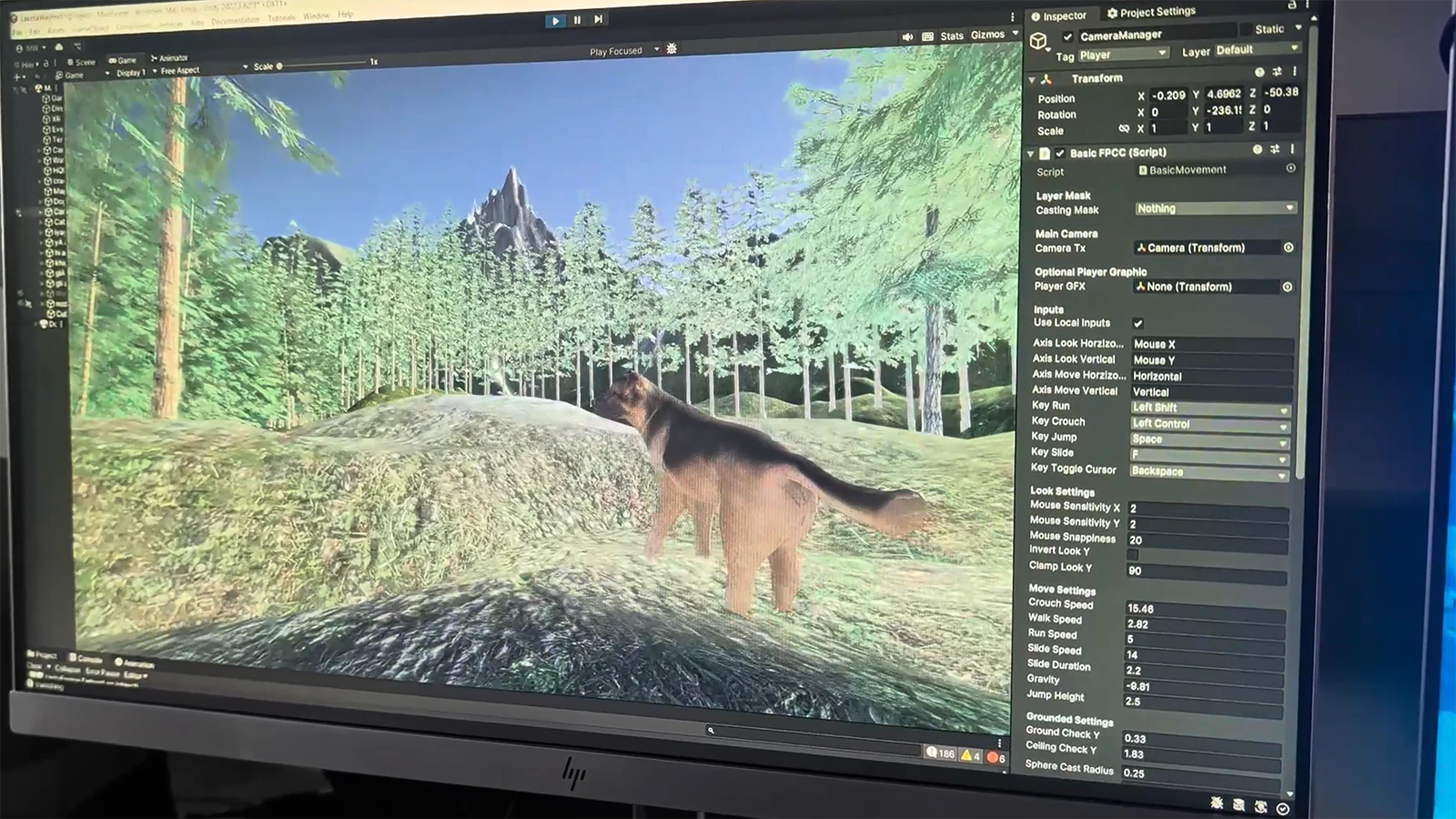
The game’s environment is a rich and inviting forest in the Black Hills (Pahá Sápa or ̌Hesápa).
Players are guided from a cabin to a pond (bléla) by a reservation dog (šúƞka), which also serves as a companion. Along the path (čhaƞkú) they encounter signs and other objects that use various Lakota travel verbs.
“In this game, we're not just memorizing words, we're actually communicating with these digital creatures, human or otherwise,” said Jessica Nelson, the UW team’s linguistic anthropologist. “All of those ways that dogs have of communicating — running around, sitting, looking at you, wagging their tails, barking — all of those things are communication.
“But the way that you interact with the characters shapes the relationship that you're having,” she added, “which is part of learning the language. It's something we really don't want to get wrong.”
UW faculty and students working on the project found it takes access to considerable funding for virtual reality to be transformed into a real-world language teaching tool.
But lack of money hasn’t stopped the team of linguists, computer scientists and tribal members from progressing toward their goal.
Fluent Speakers Over 70
Recent linguistic language surveys estimated about 2,000 people speak the Lakota language fluently as a first language, and many are over 70 years old.
“Today there aren’t many children growing up who are speaking the language at home fluently,” Nelson said.
That’s why it’s in critical danger of becoming extinct.
Nelson specializes in language revitalization. She and Milan Wolff, who recently earned his Ph.D. in computer science at UW, began exploring the idea of using a virtual-reality game to help teach the Lakota language two years ago.
“We were talking about the travel verbs in Lakota, and how speakers have to track a lot of different kinds of information that we don’t really have to track in English,” Nelson said. “It can be very difficult to learn.”
Nelson and Wolff are both interested in “wayfinding,” the process by which people learn to navigate their environments both in the real world and in virtual worlds.
“That aligns really well with Lakota travel verbs,” Wolff said. “So it seemed like a perfect match to give back to the Lakota community and also understand something very fundamental about how we interact with virtual reality.”
Amy Banic, director of the Interactive Realities Research Lab at UW and one of Wolff’s professors, is a key member of the team. So is Jasmine Halladay, an undergraduate computer science student who works in Banic’s lab and the 3D Visualization Center.
Using Berenstain Bears
Halladay is the main developer for implementing the wayfinding aids and improving the VR game’s environment.
Nacole Walker and Elliot Bannister work for the Standing Rock Sioux Tribe and are also partners.
Nelson met Walker when she worked on a groundbreaking project for the tribe and the Lakota Language Consortium in 2011, which dubbed 20 episodes of the Berenstain Bears cartoon series in the Lakota language and made them available for free on YouTube. Some have more than 300,000 views.
For Nelson, the project opened up the possibility of using virtual reality to help introduce the Lakota language, especially to children and young adults.
“I met a young man recently who told me he grew up watching that series,” Nelson said. “It was a fun project, but it was also very significant in our efforts to help people learn the language.”
Walker is now the director of the Standing Rock Sioux lyapi Language Program, but she was a college intern for the office when she worked on the Berenstain project.
Bannister is the tribal digital humanities specialist. Part of their strategic plan is to work on creating resources for tribal members at in-person and online events.
“We know that with the ever-growing use of technology that a way to rope in learners is to use technological resources,” Walker said. “Virtual reality just seems like one of those next steps, so when we were approached by the team at the University of Wyoming, it definitely felt like one of the things we wanted to pursue and collaborate on.”
Forced Assimilation
Assimilating Indigenous peoples into American society in the late 19th and early 20th centuries depended on the suppression of each tribe’s unique language as a central aspect of its culture.
Indian residential schools in North America separated Indigenous children from their parents and enforced this assimilation process with beatings and other forms of violence for speaking tribal languages.
But the Lakota language, which like many Indigenous languages did not have a traditional written form, survived.
Tribal members developed their own ways of writing the language, including the efforts of at least one Lakota linguist. Lakota persisted through the natural immersion afforded by daily conversation in the home and at reservation events. Fluent tribal members wrote letters to family and friends, reinforcing how important sustaining the language was to their community.
The Lakota language includes oral and nasal vowels, pitch accents, and unique uvular consonant sounds pronounced from the throat.
UW's $600,000 Grant
The university applied for about $600,000 from the National Science Foundation. Wolff said most of the funds would be used to develop the game itself, but money is also needed for virtual-reality headsets for the Lakota community, recording more Native speakers and traveling to reservations.
Unfortunately, Nelson said, NSF funding for endangered languages and digital projects like UW’s has been put on hold.
“We’re continuing the project, hoping for the best at this point and looking for other funding,” she told Cowboy State Daily.
Nelson, who teaches the Lakota language at UW, said the team wants the game to be approachable and usable for young players, but also engaging for adults. She said the game should be fun for everyone “from the elementary-age level to 99-plus.”
“The ways that kids learn language are also ways that are good for adults to learn language,” she said. “We have advantages. We already know how to read and write. We can just kind of analyze a language in a way that kids don't analyze yet.
“But the more that you can learn language in a fun way, you know, the better. In class we play ‘Go Fish’ and board games. Anything that can decrease the anxiety level is great for language learning.”
Another challenge, she said, is “trying to figure out how much language to put in (the game) so that they're kind of immersed in the language, but not overwhelmed by the language.”
“I feel like nowadays we're surrounded by so much digital tech that we're kind of used to seeing all of these amazing things everywhere,” Nelson said. “But they're actually very difficult to do.”
Commercial video-game developers have budgets with millions of dollars and can afford to hire teams of creators. UW, so far, has mostly depended on a handful of undergraduate researchers.
“They’re huge. We could never compete with that,” Nelson said. “But for game players that’s part of their reference point, so we are kind of implicitly in competition with them.”

‘Linguistics Nerdy Zone’
Nelson is also using the project to do some immersive language documentation.
“If you think about it, most documentation is either written or just recordings. So there's a lot that you miss, like the facial expressions,” Nelson said. “You go into the linguistics nerdy zone, you know, the exact position of the tongue and the lips.
“With VR technology, you can actually document a speech interaction and re-experience it all over again. Or pause it and look at it in 3-D.”
Nelson emphasized, though, that “we’re not saying VR tech is going to save the language; that would be highly problematic.”
“We're looking at specific features of VR tech and how they line up with specific features of the Lakota language in ways that we think are really useful,” she said.
Nelson said when UW applied for money from the National Science Foundation and the National Endowment for the Humanities, it thought the project could be completed within two years.
That remains a realistic goal, she said, if proper funding can be obtained.
A guiding principle, Nelson said, is that the final product will be owned by the Standing Rock Sioux.
“We don't want to produce something that is then owned by somebody else who is not the tribe, especially because it involves their language,” she said. “We want them to have full control over what happens to it so the game will be as accessible as possible to community members.”


