For eagles, Wyoming’s roadkill is a huge benefit and also the bane of their existence.
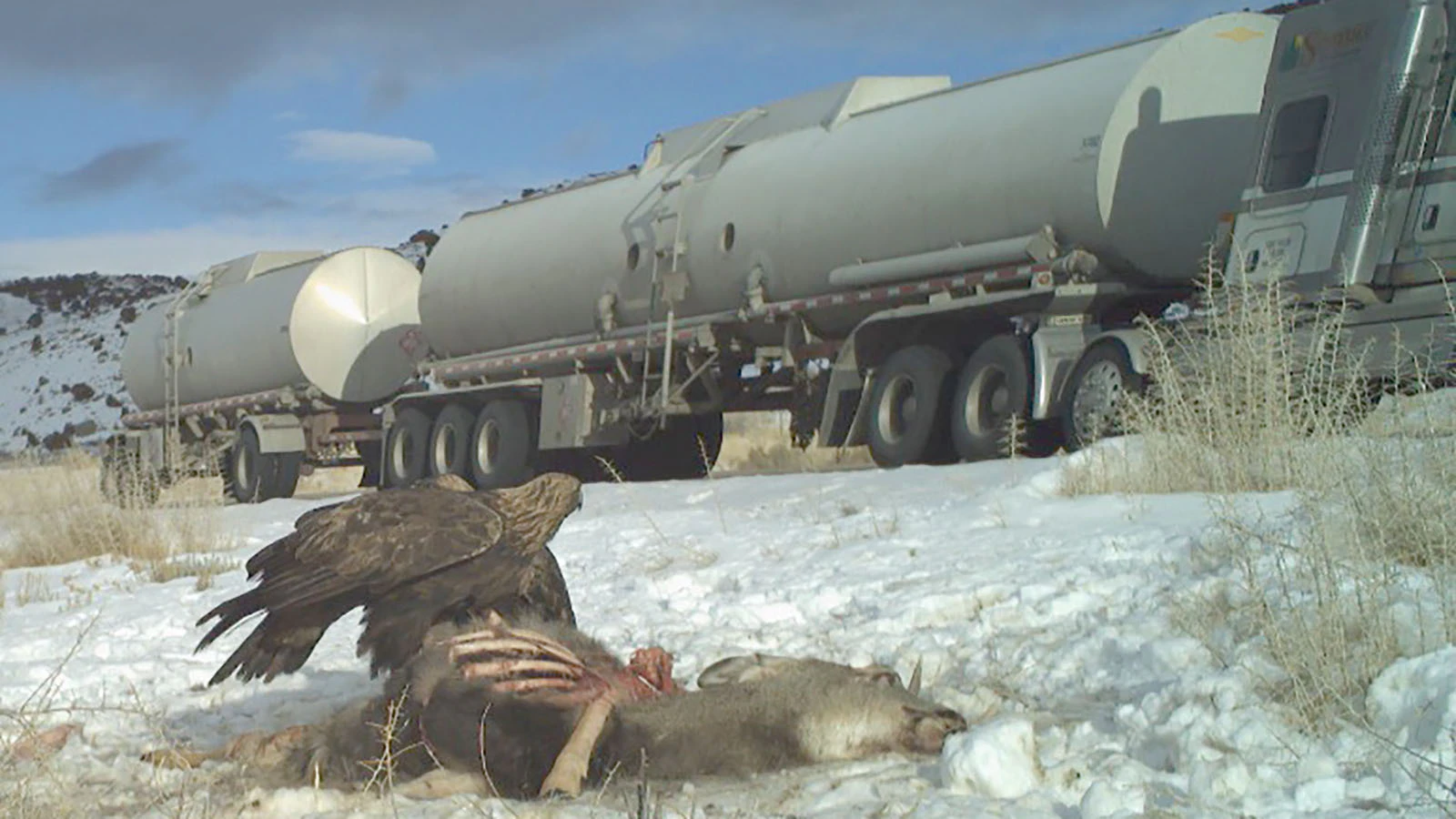
The carcasses of creatures large and small that met their fate on highways are a vital source of food for eagles, especially during the winter, when other pickings are slim.
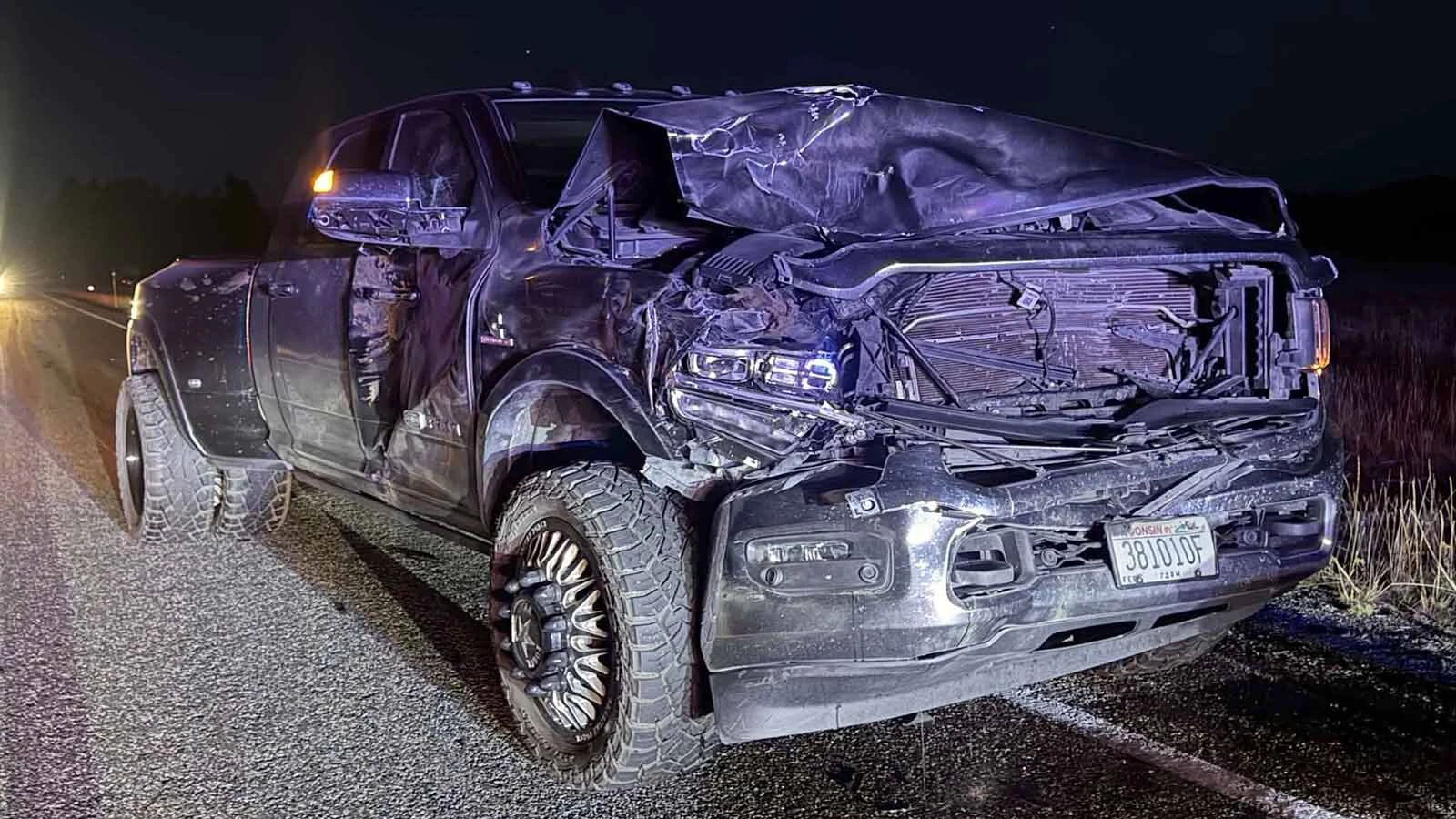
But that puts eagles in direct proximity to hurtling vehicles and, too often, they become part of the grim roadkill tally.
To cut back on the raptor carnage, conservationists have taken to sending crews out to pull carcasses away from roadways.
The goal isn’t to completely remove roadkill, but rather to get it far enough away so eagles can get a bellyful of carrion without risk of being roadkill themselves.
“Our ‘magic distance’ is about 12 meters, or 40 feet,” Steve Slater, conservation science director for HawkWatch International, told Cowboy State Daily.
Most highway rights of way in Wyoming and surrounding states are wide enough that carcass-dragging crews can achieve that distance without crossing fences onto private property, he added.
‘Roadkill Hot Spots’
Eagles are generally regarded as mighty predators, but during the winter primary prey sources such as rabbits can become scarce, and eagles transition more toward scavenging, Slater said.
Human highways have created a smorgasbord for them.
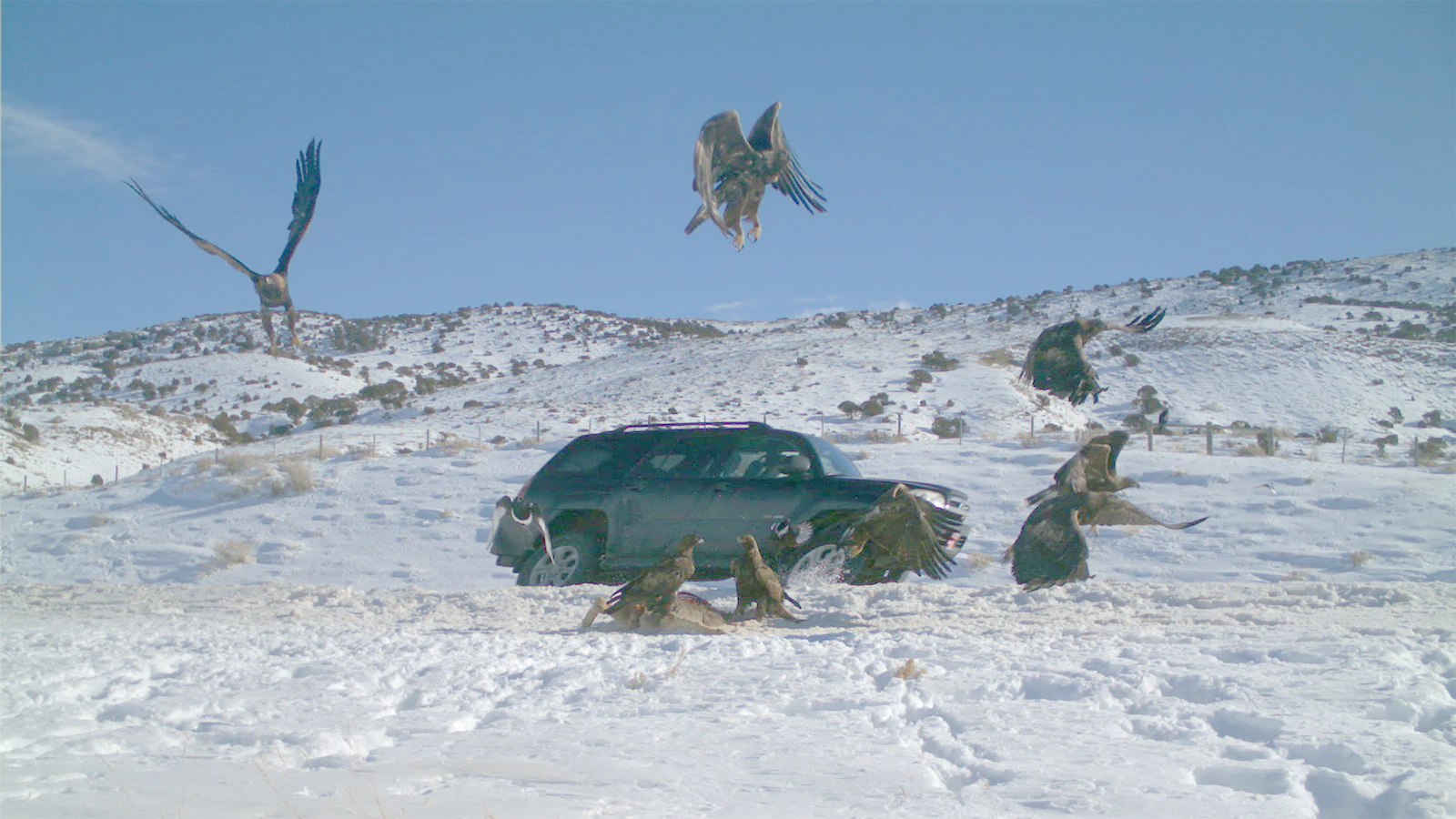
“It’s basically providing them with that food they’ve come to depend upon in the winter. They know where the roadkill hotspots are,” he said.
In Wyoming, that includes stretches of U.S. Highway 189 between Interstate 80 and Kemmerer.
“In the winter, you can have many dozens of golden and bald eagles along that stretch of road,” Slater said.
Wyoming Highway 789 going south out of Baggs toward Craig, Colorado, is another gathering place for hungry eagles, Slater noted.
The eagle strike crews’ task is simple, Slater said.
“They drive those roads looking for carcasses and drag them off to a safe distance,” he said.
Only Pros Allowed
Well-meaning people sometimes reach out to HawkWatch International, wanting to volunteer for carcass-dragging, he said.
Because of liability issues, Wyoming Department of Transportation (WYDOT) safety protocols, and other factors, only paid employees are allowed on the crews.
Raptor researcher Chuck Preston told Cowboy State Daily that eagle vehicle strikes aren’t as common in northwest Wyoming.
The Meeteetse highway south of Cody and the Belfry highway to the north are where most of the strikes seem to happen in that area, said Preston, the founding curator of the Draper Natural History Museum at the Buffalo Bill Center of the West in Cody.
He recalled that during one drive into work along the North Fork highway in the early 2000s, he spotted an eagle feeding on roadkill alongside the road and slowed down.
"The eagle took off and only just barely cleared the top of the heap," he said. “Boy, it reminded me how you have to be alert and careful."
‘They Get Nailed’
Preston’s experience demonstrates what frequently happens to eagles.
It’s not so much that they get struck while eating carcasses directly on the road, Slater said.
Rather, what frequently happens is a carcass is close enough that the eagle might flush (try to take flight) at a vehicle’s approach.
Smaller scavenging birds, such as crows and magpies, are nimble enough to flush and get away from vehicles.
However, eagles, being much bigger, need more time and more lift to gain enough altitude to avoid a collision, particularly if they’ve been eating heavily, he said.
“They take off and think they can get enough lift to get above a vehicle. And especially if it’s a high-profile vehicle, or a semi-truck, they can’t get enough lift, and they get nailed,” Slater said.
Preston agreed that takeoff for eagles is “a lengthy process," and so it’s important to get carcasses back from the road so eagles will feel safe enough to not flush when vehicles zoom by.
One Of Many Factors
Wyoming’s golden eagles are of special concern because their population has been steadily declining for the past couple of decades, Preston said.
The causes are numerous, he said, adding that habitat loss is of particular concern.
But research is indicating that vehicle strikes might be killing more eagles than previously thought, Preston said.
Collisions with wind-turbine blades are frequently cited as a cause for eagle deaths, and that is a significant factor, Bryan Bedrosian, conservation director at the Teton Raptor Center, told Cowboy State Daily.
And in the immediate vicinity of wind energy projects, the death toll can be significant.
Countermeasures, such as painting one blade of the turbine black or sensor systems that shut down turbines when eagles approach, are putting a dent in the casualties, Bedrosian said.
“The number one cause of death is still illegal shooting of eagles and lead poisoning,” he said.
Copper Bullets Better
Bedrosian is among a growing chorus of voices calling for hunters to switch from lead ammunition to bullets made from copper or other alternatives.
Eagles frequently get lead poisoning from the remains of big-game animals shot with lead bullets.
Conserving eagles means tackling the threats from all sides, Bedrosian said.
“Efforts to move roadkill ungulates back away from roads” make a difference, he said.
Golden eagles need all the help they can get, because they reproduce slowly, he added.
Each nesting pair might have a chick only every other year. And the survival rate for chicks in the first year of life is about 50%, he said.
In the second year, the survival rate for young eagles jumps to 80% and then can go as high as 90% after that, Bedrosian said.
“They can live up to 25 or 30 years if they can get through that first year,” he said.
Mark Heinz can be reached at mark@cowboystatedaily.com.