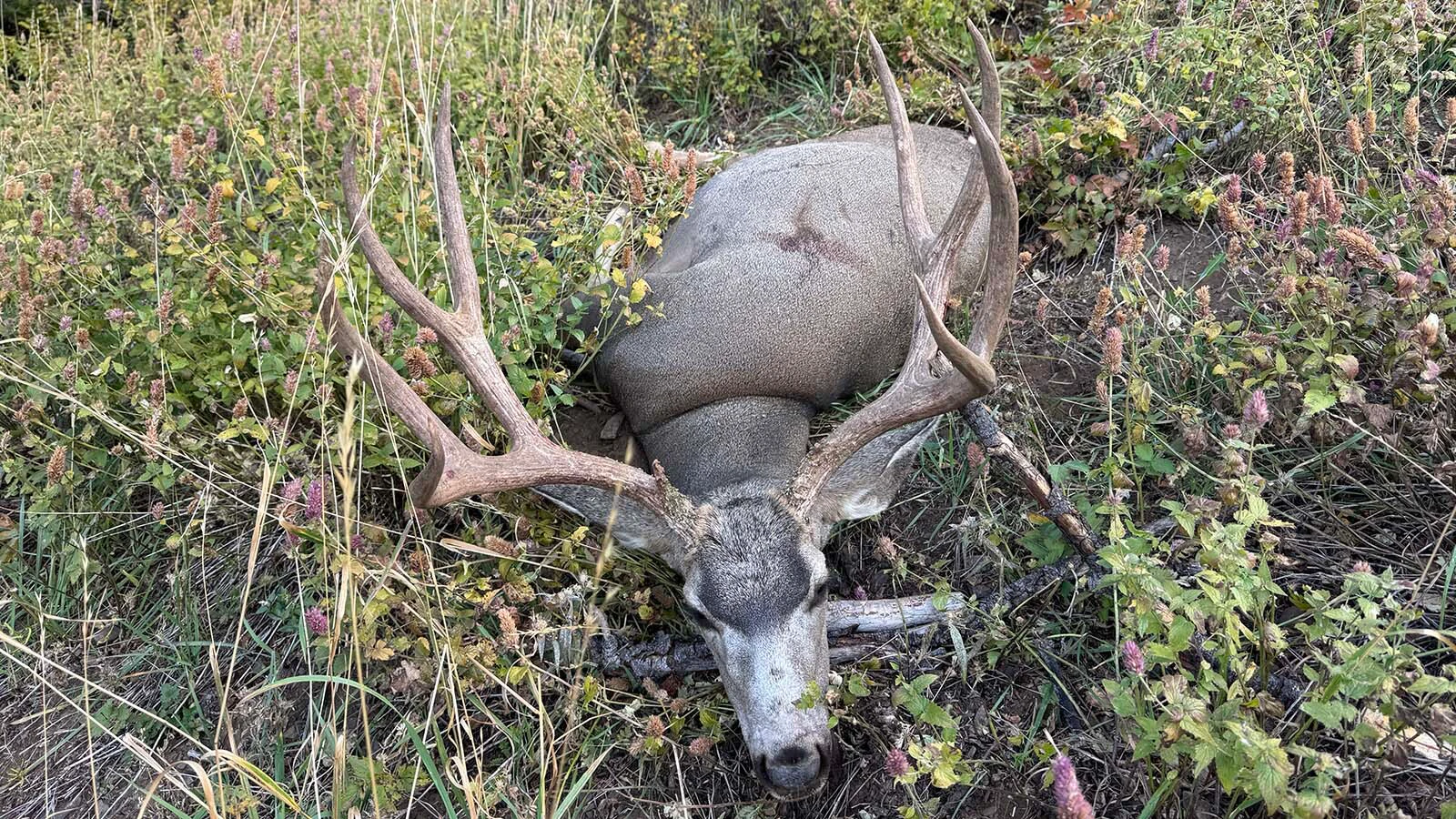
Hear the words “Wyoming moose archery hunt,” and it will likely conjure up images of a hunter sneaking through thick willows or hiding in thick, dark timber.
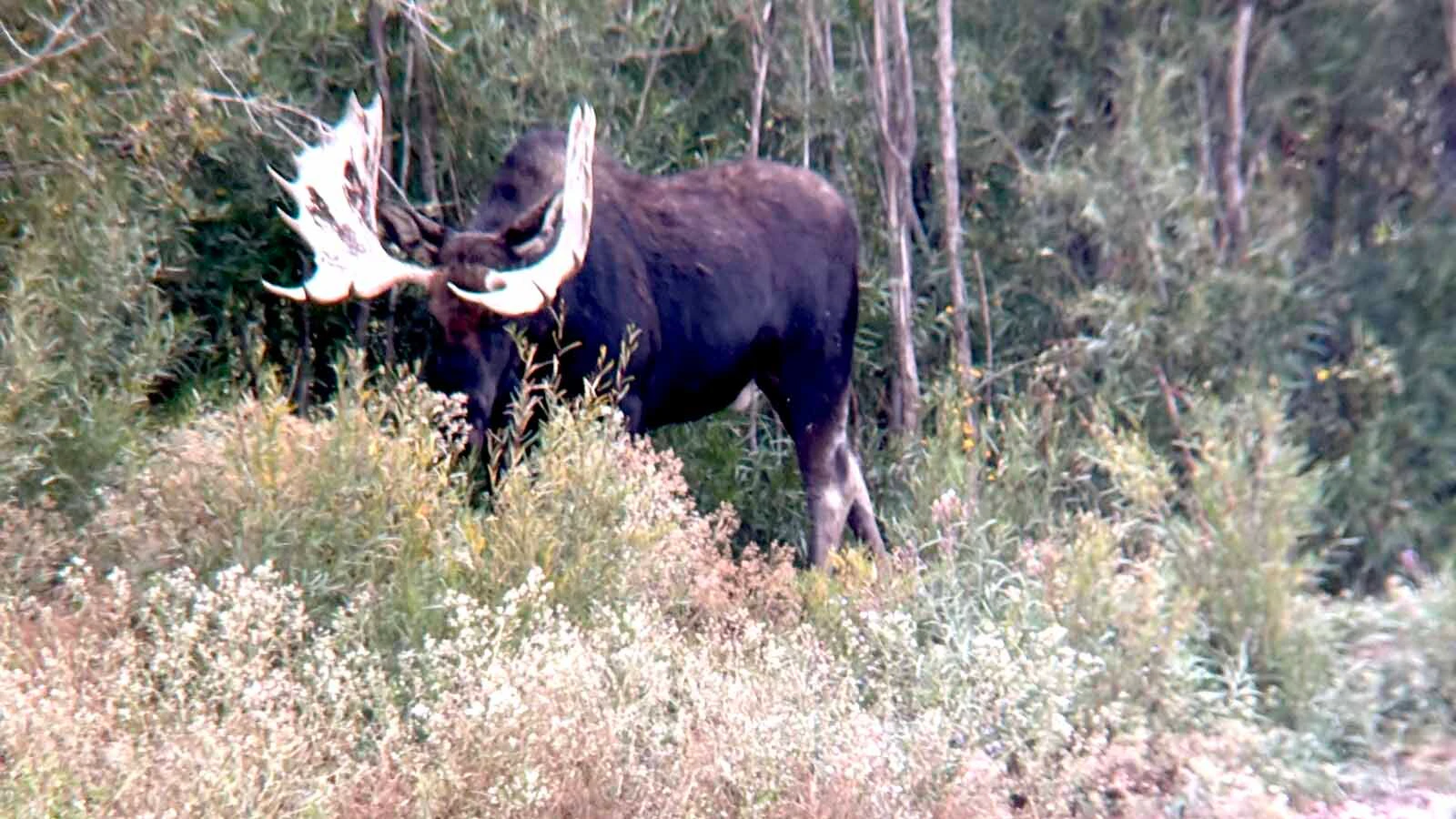
After waiting 18 years to draw a once-in-a-lifetime moose tag, Zach Key found himself trying to figure out how to get within bow range of two huge bull moose hanging out in a wide-open southwest Wyoming alfalfa field.
He ended up faking out the bulls by holding a realistic 2D cow moose decoy in front of him and simply walking right into the field.
And after the larger of the two bulls dropped, the second bull decided to try “sparring” with its fallen comrade, Key said.
An unusual hunt that Key will never forget, for sure. Which matters, because moose hunts in Wyoming are a once-in-a-lifetime deal.
“Even if you don’t end up killing one, that’s it. Once you draw a moose tag, you don’t get another chance,” Key said.
Decoys to the Rescue
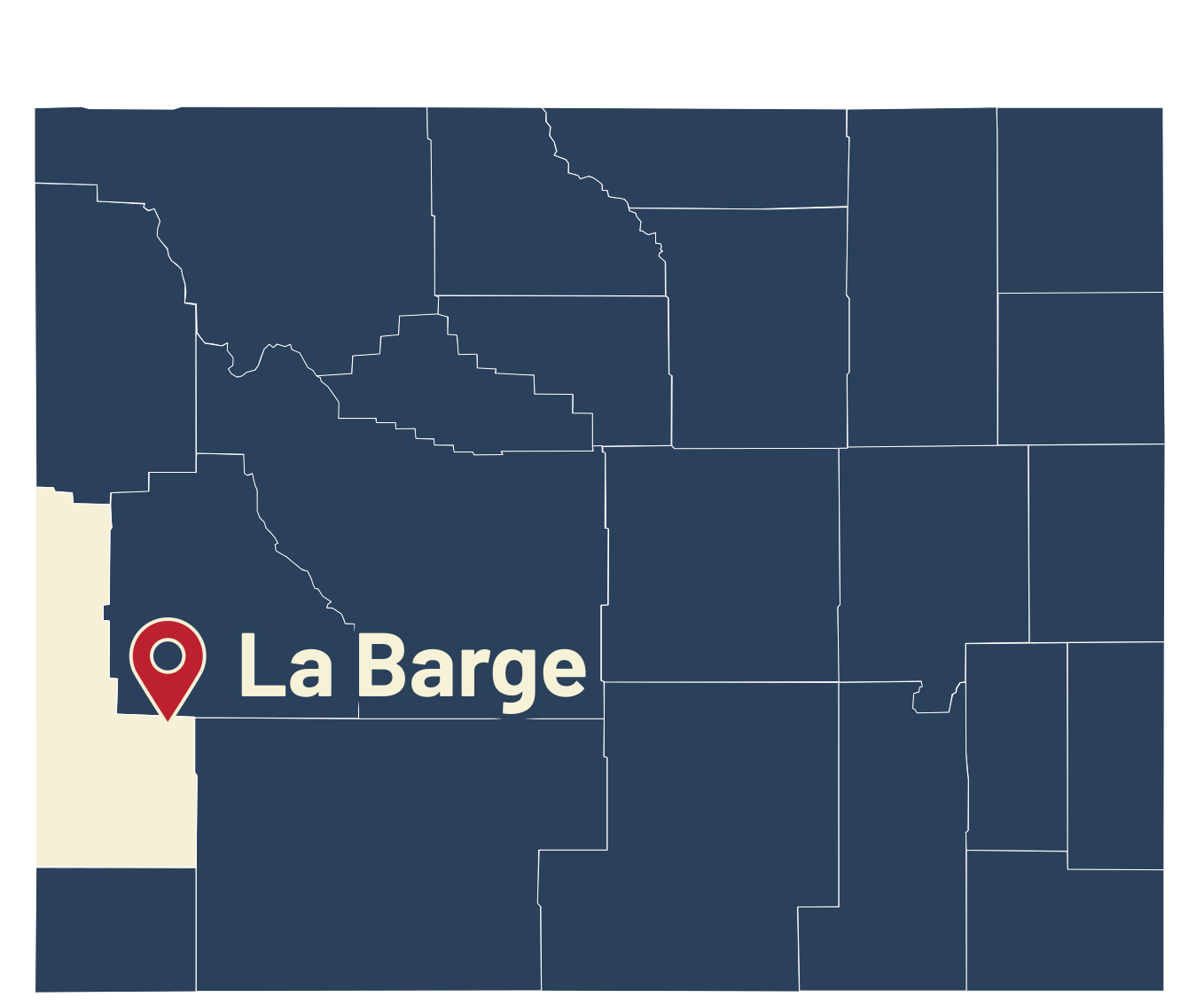
“I was hunting in a huge hay pivot (field), with absolutely no cover on it,” Key, who lives in La Barge, told Cowboy State Daily.
Crawling into the field and trying to lure the bulls toward him by imitating moose grunts, or “glunking,” wasn’t working.
Then he had an epiphany: What about using a cow moose decoy, or two?
He had one 2D decoy rushed overnight from the Montana Decoy Co. and borrowed another from a friend.
He hunted on the morning of Sept. 11 with no luck and then went to his son Parker’s football game.
That afternoon, he entered the field, holding one of the decoys “in front of me like a shield” and walked at a normal pace.
“I was basically standing straight up and walking. They (the bulls) didn’t even raise their heads from feeding. I can’t believe they couldn’t figure out it was a fake moose,” he said.
He got to within a reasonable distance, set up the decoys, and hunkered down about 30 yards away, hoping for the best.
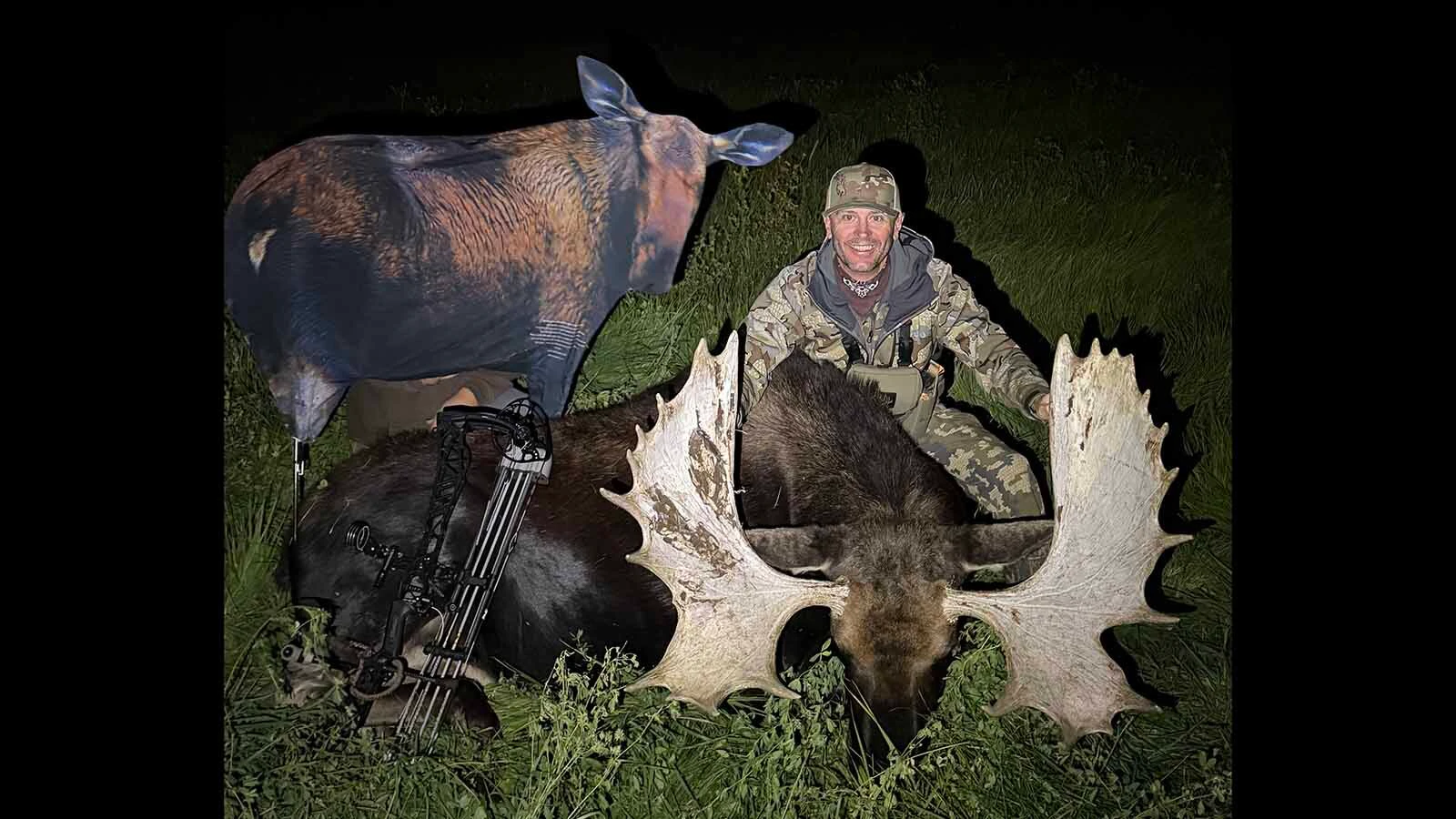
Bowhunter Zach Key held a 2D moose decoy in front of him to cross an alfalfa field during his hunt for this huge bull moose in southwest Wyoming. (Zach Key) 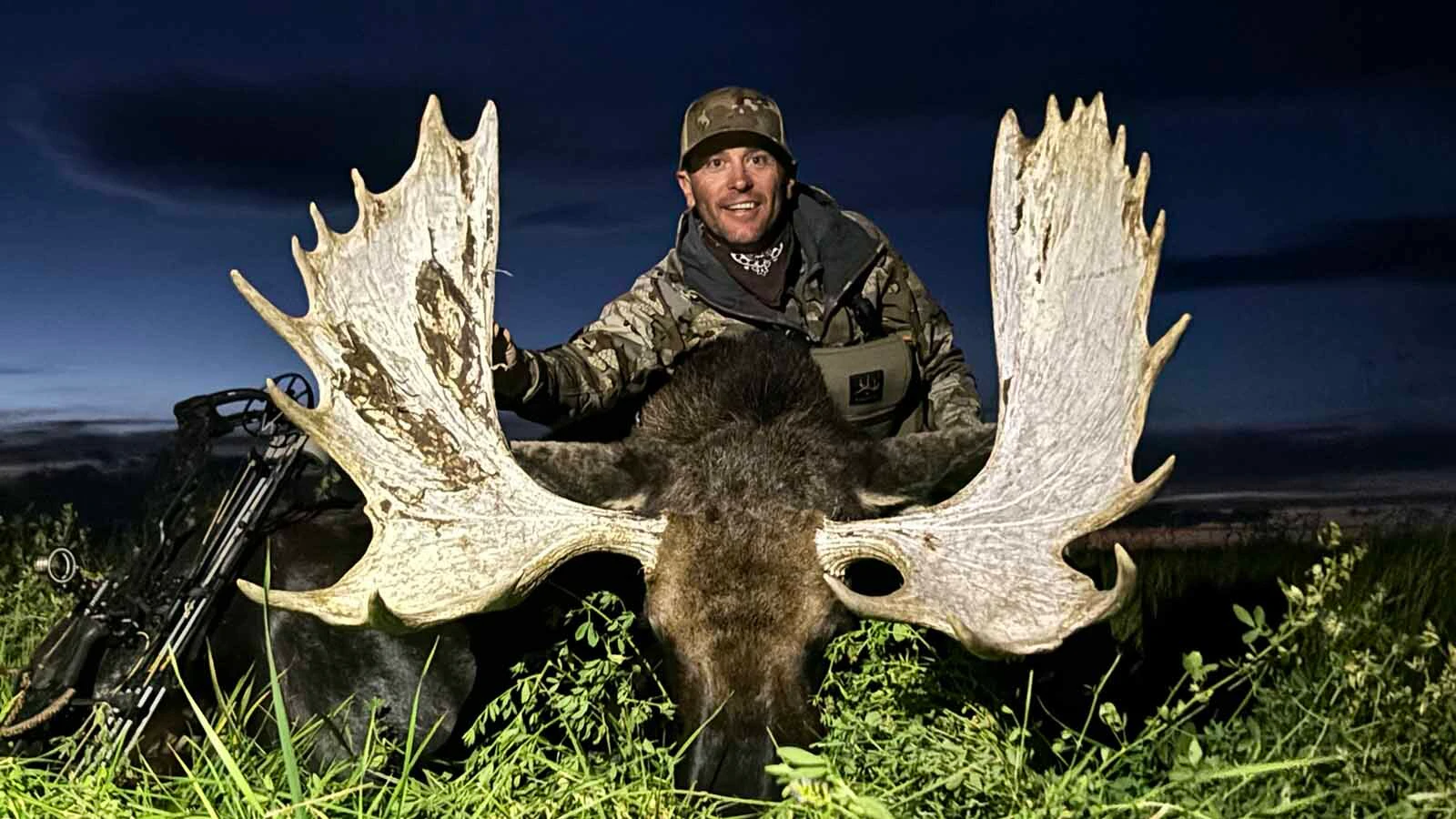
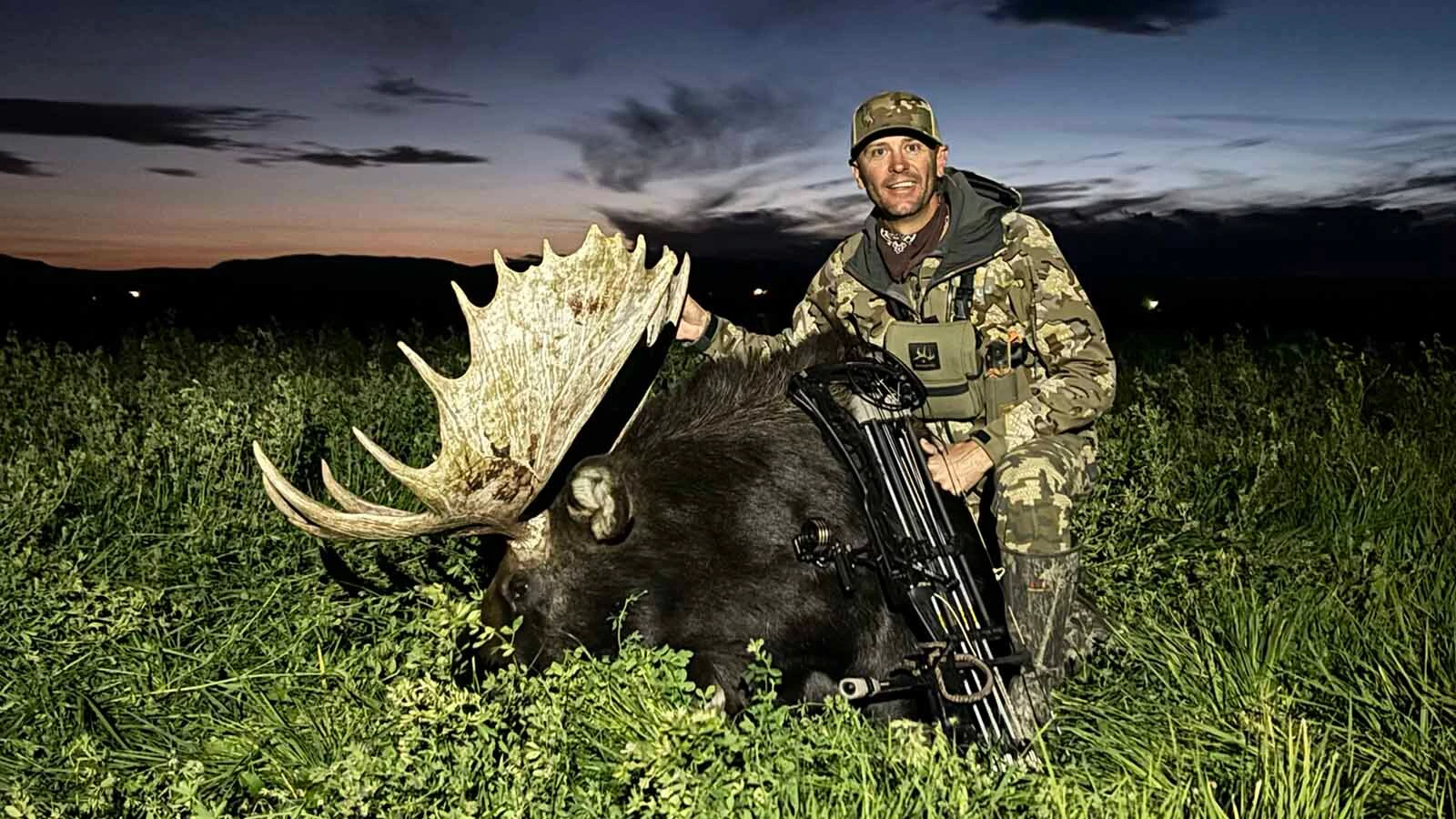
After trying 18 years to draw a moose tag, Zach Key wasn’t sure how his hunt would go. He ended up dropping this trophy-sized bull in an alfalfa field. (Zach Key) 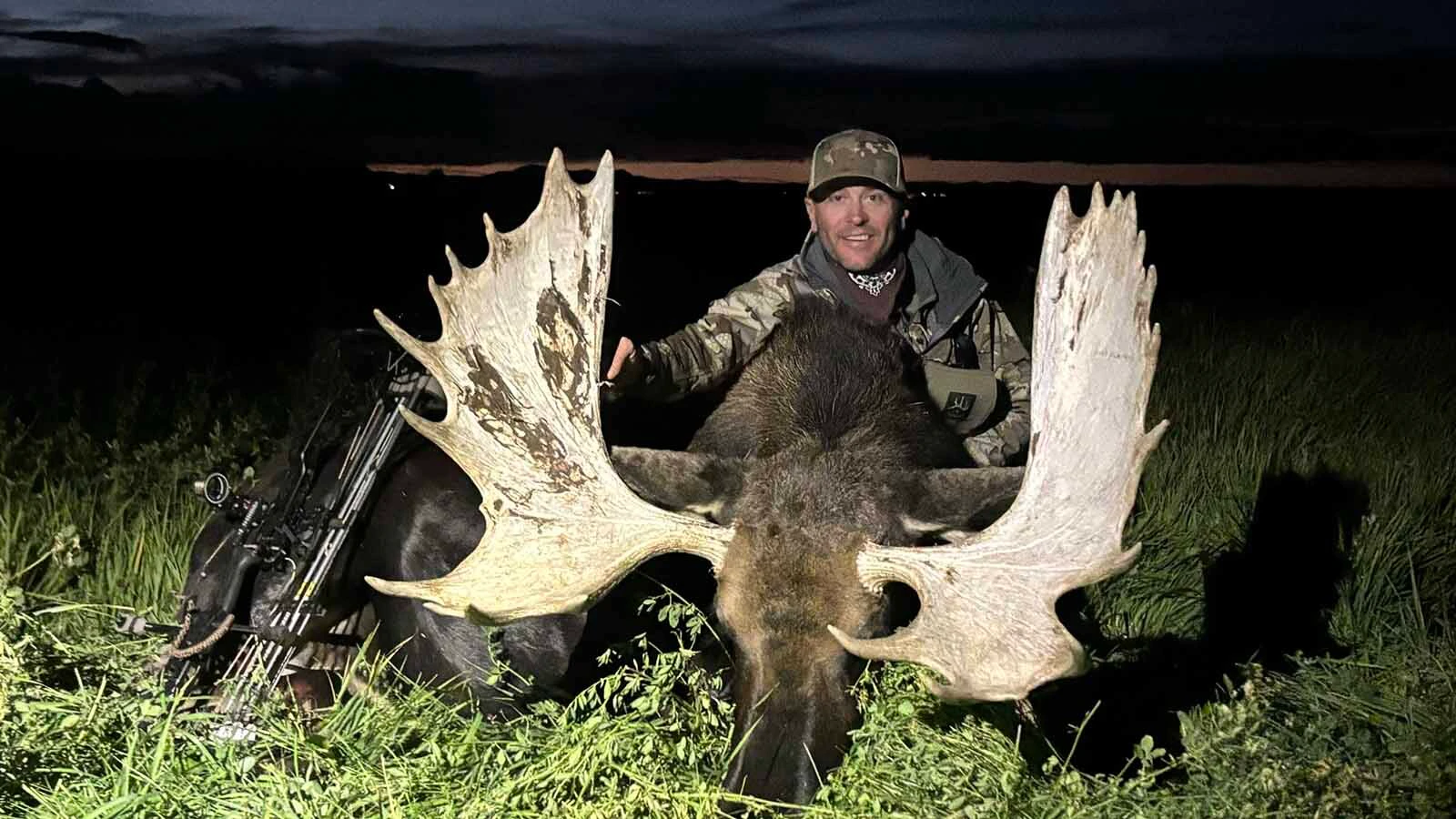
After trying 18 years to draw a moose tag, Zach Key wasn’t sure how his hunt would go. He ended up dropping this trophy-sized bull in an alfalfa field. (Zach Key)
The Long Wait For A Tag
Just drawing a moose tag is a feat.
It’s a game of building up preference points, which can be purchased, at the rate of one each year, after the annual Wyoming hunting tag draws.
Key had to deal with “points creep,” or the number of preference points required to have a reasonable chance at a moose tag continually rising because of fluctuations in the moose population, the number of tags allocated, and other factors.
“When I started, I needed 10 points. Then 12 points, and eventually 18,” he said.
After 18 years, he’d compiled the 18 points needed for the best odds and drew his tag.
His father, Pat, had drawn a tag in the same southwest Wyoming moose hunt area around 2013.
Pat arrowed a bull with antlers that scored 164 5/8 inches. That’s well over the 155-inch score required for a bull Shiras moose to be entered in the coveted Boone and Crockett Club hunting trophy record books.
Shiras are Wyoming's only moose species. They’re considerably smaller than Alaska moose but are still massive, easily outclassing elk.
Despite his father previously bagging a record-book moose there, the hunt area Key drew a tag for isn’t especially known for huge bulls.
The Snowy Range in southeast Wyoming is best known for producing monster moose. But that hunt area requires 25 preference points.
“I didn’t want to wait 25 years to draw a tag. Waiting 18 years was bad enough,” Key said.
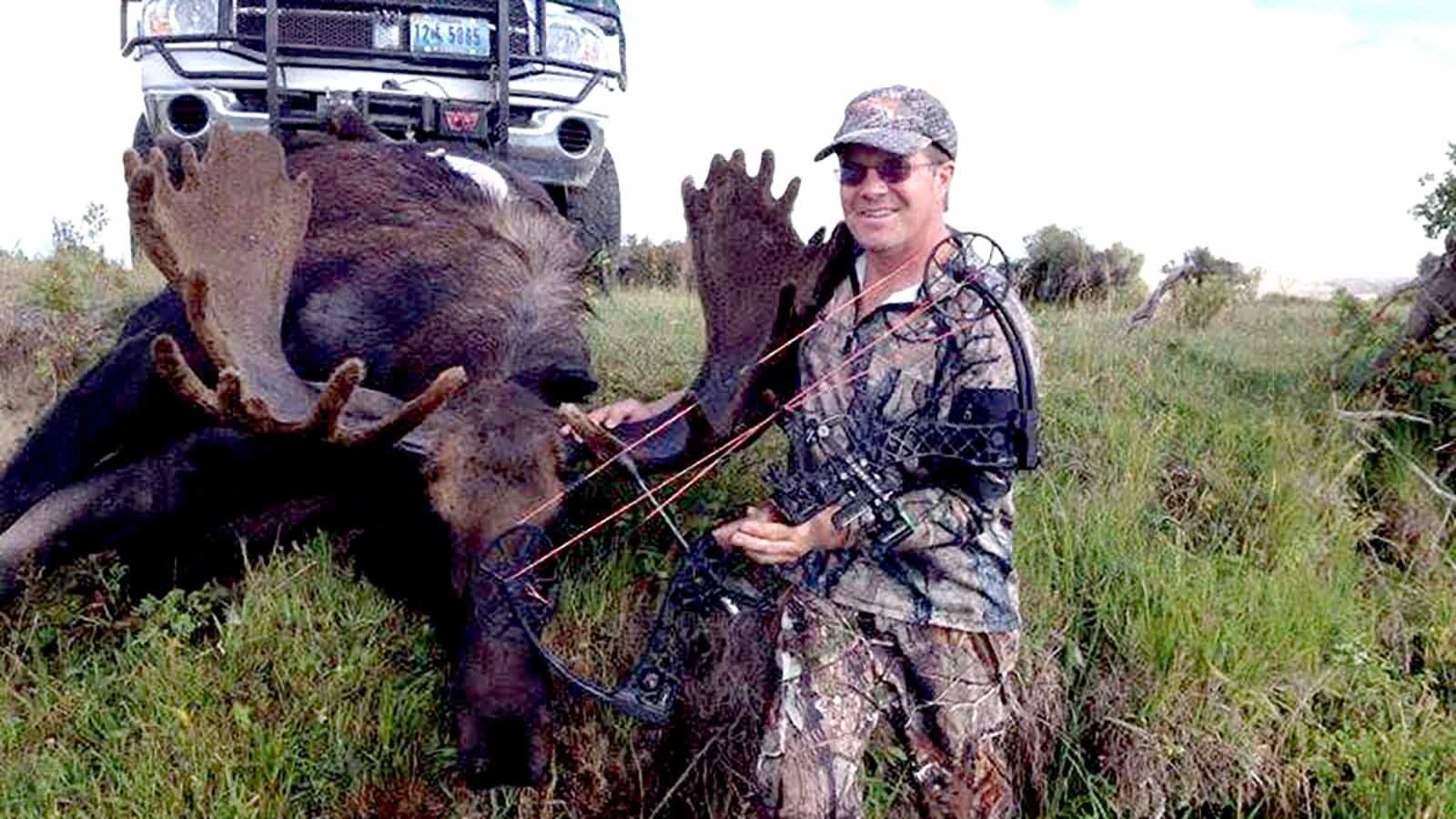
Zach Key’s father, Pat Key, bagged this trophy-sized Shiras moose in southwest Wyoming in 2013. It fell in a river, and they had to use their truck’s winch to pull it out. (Zach Key) 
After trying 18 years to draw a moose tag, Zach Key wasn’t sure how his hunt would go. He ended up dropping this trophy-sized bull in an alfalfa field. (Zach Key)
A Local Tip
Once Key had his moose tag, there was scouting to be done.
And it wasn’t only a matter of finding moose but also finding bulls in a place where he could get permission to hunt.
“The Game and Fish (Department) cautions hunters who apply for moose tags there; the area is almost all private land, and hunting access isn’t guaranteed,” he said.
Key scouted for the day and “looked over about 70 moose and spotted two bulls that I thought were big enough.”
But he couldn’t get permission to hunt on the land those bulls occupied.
The meaning of “once-in-a-lifetime” for his tag started to sink in.
“I started to have this weird anxiety,” he said.
Would all the years of anticipation of drawing a moose tag turn out to be for nothing?
Then a local game warden gave Key a tip about “two good-sized bulls hanging around a strip of willows next to a hay pivot” on a nearby ranch.
The landowner granted him permission.
‘Everything Happened At Once’
After walking in behind his decoy and setting up, Key tried grunting and glunking to get the bulls’ attention.
Even with the decoys there, it still wasn’t working, and daylight was fading fast.
The legal shooting light ended at 8:05 p.m. At 7:25 p.m., he made another attempt at calling.
And the bulls started coming, straight for the decoys.
“The biggest bull kicked the littler bull out of the way and kept coming. Every step he took, he was ‘chuckling’ at me,” Key said.
“After so long of nothing happening, everything happened at once," he said.
When the bull was about 10 yards away from the decoys and 30 yards from him, Key drew his bowstring.
“He must have caught my movement in his peripheral vision, because he jumped a little bit and turned like he was going to leave. So, I grunted at him again, and he stopped,” Key said.
His shot was true. The razor-sharp broadhead missed the bull’s heart but devastated both lungs.
“He went about 30 yards and stopped, wobbled around for a little bit, and then tipped over,” Key said.
A leader in his church had offered a prayer for Key to have a successful hunt that evening, and he’s sure the intervention of faith tipped things in his favor.
Picking A Fight With A Dead Bull
Key thought the drama was over, but then the smaller bull approached.
He was aggressively tilting his antlers toward the fallen bull.
“It was like he was trying to spar with the bull that was down on the ground,” Key said.
He noted that he’s seen similar behavior in white-tailed deer bucks.
“There have been times when I shot a buck, and another buck would come up and start trying to lock antlers with the one I shot,” he said.
Such behavior actually is common among ungulates, biologist Kevin Monteith told Cowboy State Daily.
During mating season, males establish a pecking order. Sometimes that’s through direct fighting, but that carries the risk of injury, said Monteith, a biologist with the Haub School of Environment and Natural Resources at the University of Wyoming.
Lower-ranking males might have to await other opportunities, he said.
“Consequently, when a male perceives a weakness in another male, especially if he was higher ranking, the lower-ranked male will not hesitate to take advantage of the situation and achieve rank above the weakened male,” he said. “Never a missed opportunity to gain rank and access to female ungulates in the rut.”
Volleyball-Sized Heart
After the second bull finally trotted off, Key called a couple of friends to come help.
It took until 2:20 a.m. to get the bull skinned, quartered, and loaded into his pickup.
Key has bagged plenty of deer and elk, but processing a moose carcass was at another level.
“It’s incredible how fricking big they are,” he said. “The heart’s the size of a damn volleyball.”
With the bone still in, the moose’s carcass yielded 565 pounds of meat, Key said.
“I’m betting he weighed 900 to 1,000 pounds on the hoof," he said.
The antlers are 42 inches wide, and Key hopes that it might even surpass the score of his dad’s moose.
“I’m guessing it will score about 165 inches,” he said.
He’ll get the antlers officially measured after a mandatory 60-day drying period.
Key plans to have the meat processed at a local butcher shop.
“I’ve had people tell me that moose meat is really good, and I’ve had other people tell me that it sucks,” he said. “That hanging period is important to cure and tenderize the meat."
Mark Heinz can be reached at mark@cowboystatedaily.com.