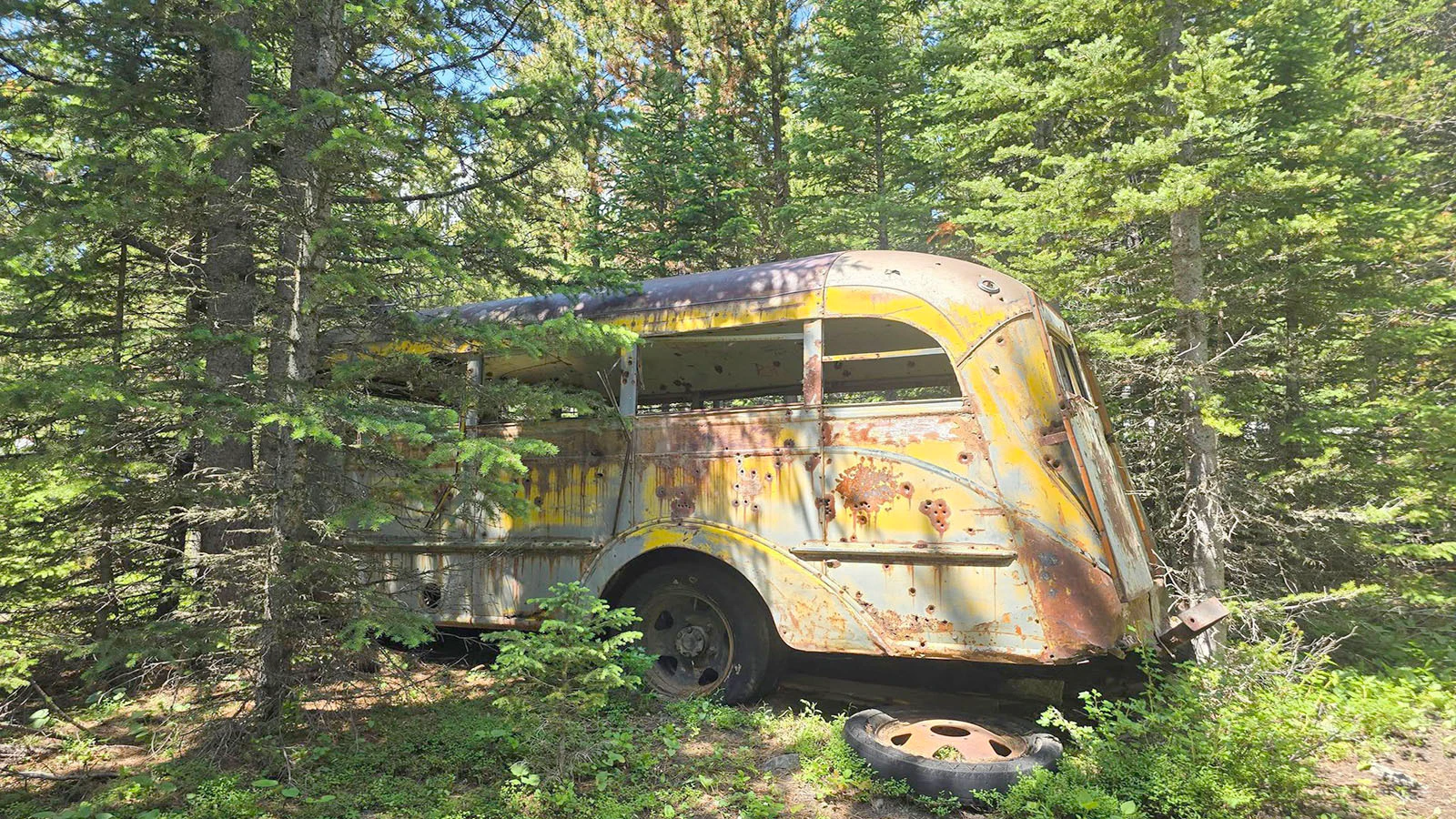
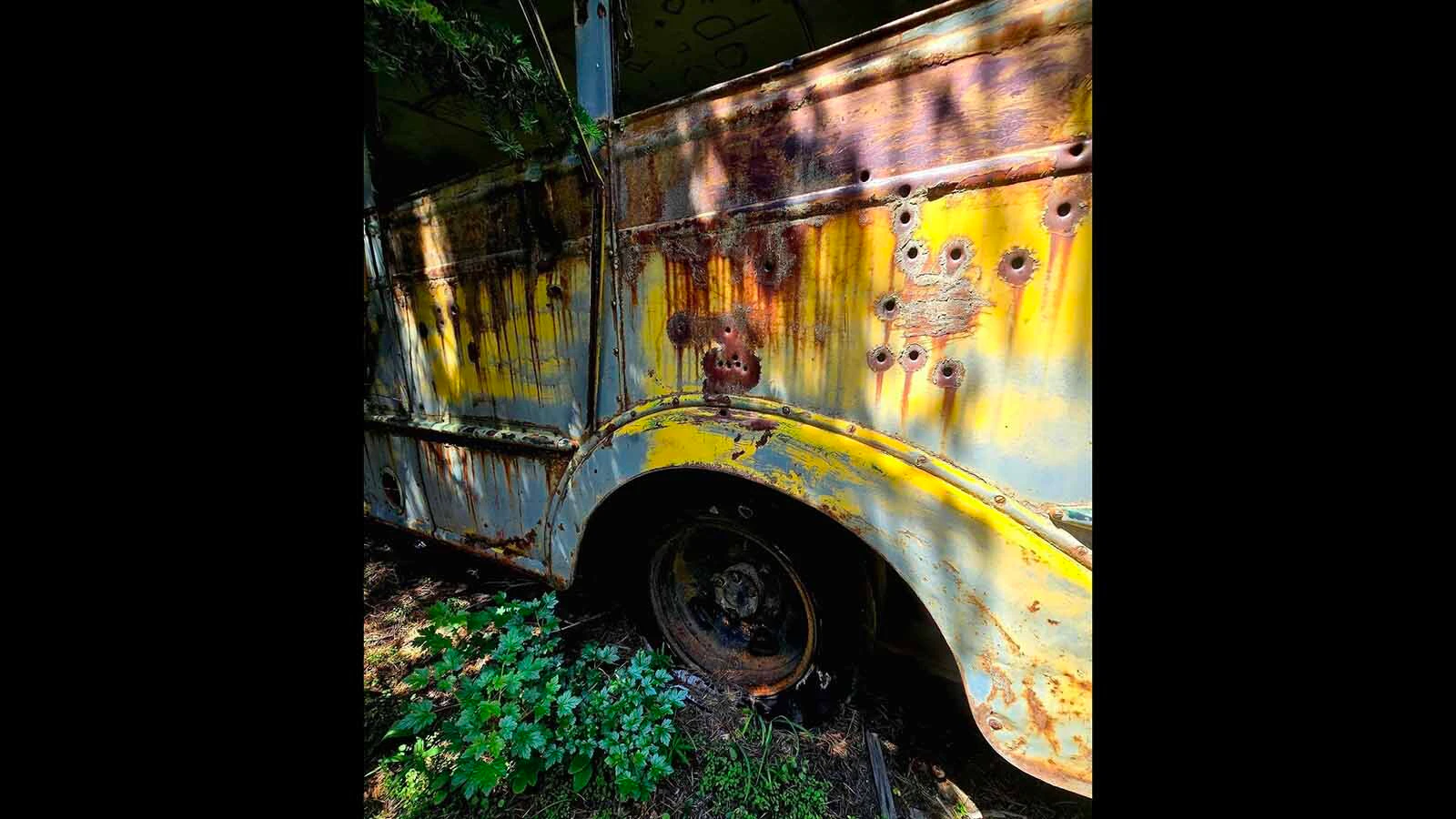
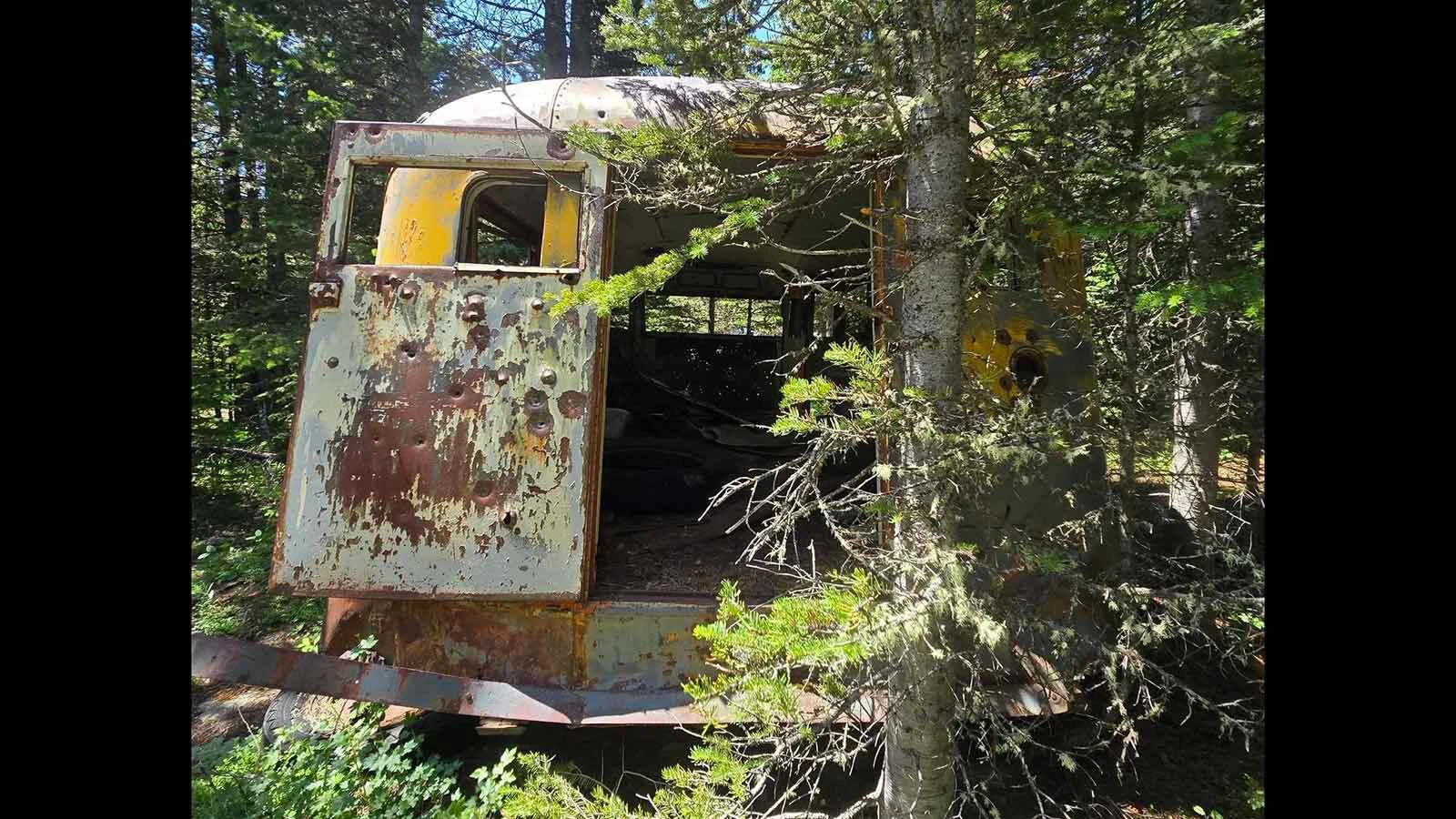
There’s a mysterious abandoned yellow school bus in the Bighorn Mountains that doesn’t take anyone anywhere, and hasn’t for decades.
Anyone exploring in the vicinity of Little Goose Falls near the Penrose Trail will find the bus sitting at the top of a rocky uphill trail. It’s reminiscent of “Magic Bus 142” in the remote backcountry of Alaska, made famous by the book and movie “Into the Wild.”
There’s a lot of history symbolized by the bus in the Bighorns, though none of it is as tragic as the last months of Chris McCandless’ life as chronicled by author Jon Krakauer. And, unlike Magic Bus 142, how this bus got there and who lived in it remains a mystery.
Catching The Bus
Kathy LaDuke was enjoying off-roading in Bighorn National Forest earlier this month when she encountered the bus.
“We were with the Bighorn Mountain Crawlers, and they knew it was there at the mine,” she told Cowboy State Daily. “You go past Little Goose Falls and take the next trail to the left. It's rocky as hell and all uphill.”
The bus, sitting between several trees, is just there. There are no signs explaining its history or how it ended up in the mountains.
LaDuke shared the history that was shared with her.
"The long story short is that it was a false gold claim,” she said. “They shot gold fragments into the hillside so it would test good and got investors to put money into it. Once the original owner had enough investors, they skipped town with the money before anyone realized it was a dud.”
That tracks with the long history of mining in the Bighorns. Many miners flocked to the mountains, hoping they had the Midas touch and could pan their way to fortune.
Gold Diggers
According to the website The Diggings, there have been 10,513 mining claims staked on public land in Bighorn County, and another 297 in Sheridan County.
Miners and mining companies in the Bighorns have been looking for abundant elements such as iron, copper, and silica, but have also explored for gold, tungsten, and uranium since the late 1800s. Their success has been mixed.
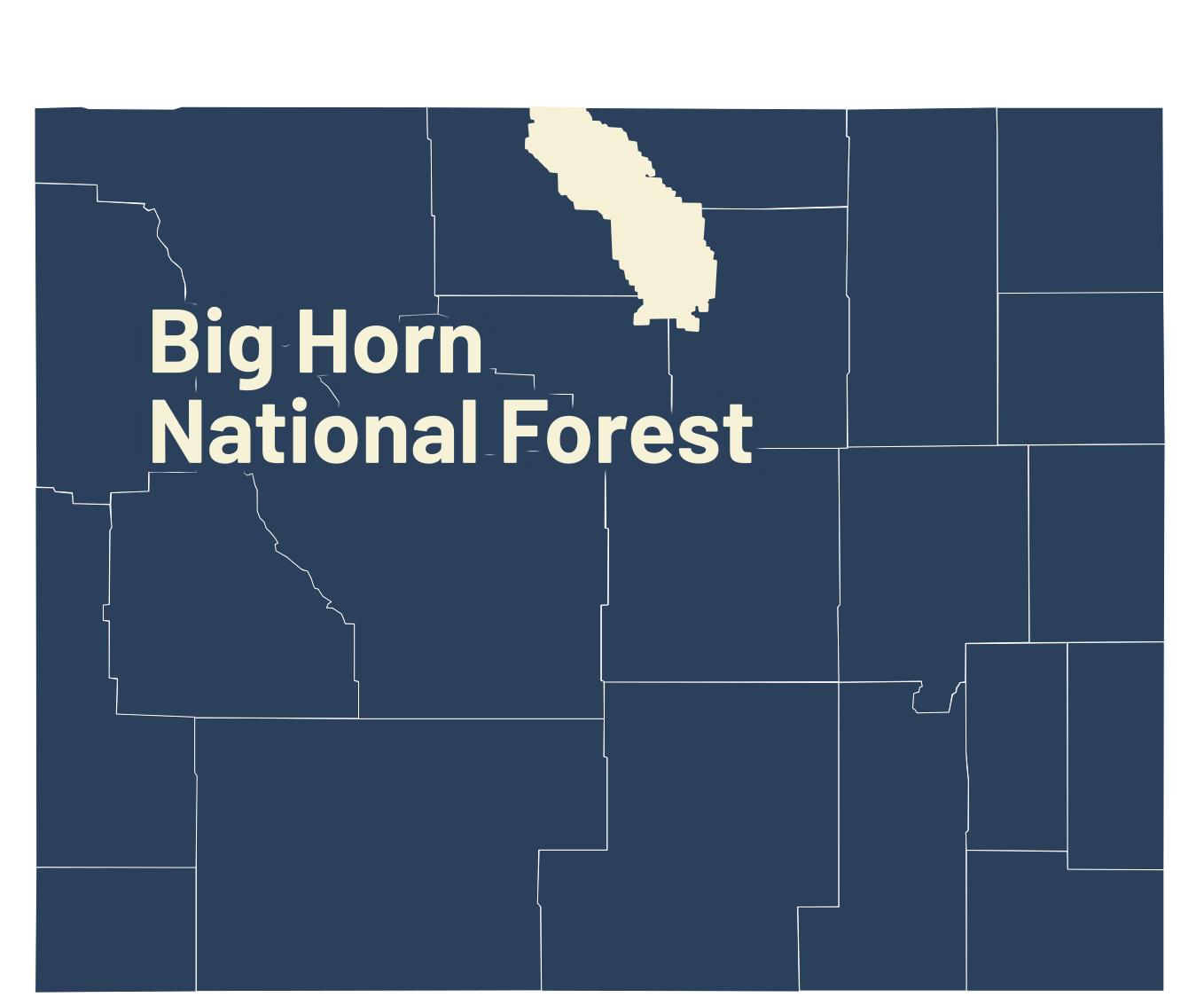
Sara Evans Kirol, public-affairs specialist for the Bighorn National Forest, was familiar with the bus, located at the end of Forest Road 521. Based on its location, she said she believes it was associated with prospector Carl Craig.
“It's reported he was looking for silver, gold, and platinum primarily and started in the mid-1950s to the 1960s,” she said. “His family continued mining in the area after his death in the 1970s, but (the mine) was last mined in the late 1970s.”
Many mining relics are abandoned near the bus. LaDuke saw the concrete support structure near its opening, an oil barrel riddled with bullet holes, and the names of many miners etched into stone.
The greatest mining story of the Bighorns is “Lost Cabin Mine,” a supposed motherlode of silver and gold that enthralled mountain men, miners, and Wyoming newspapers in the late 1800s.
According to legend, the only person who claimed to have discovered the Lost Cabin Mine was C.T. “Rattlesnake” Jones, an eccentric man who kept rattlesnakes as pets.
In 1890, Rattlesnake Jones burst into the Wyoming Saloon in Buffalo, claiming to have found the long-lost spot and produced gold nuggets as his proof.
As Jones was drawing a map to lead others to the spot, one of his pet rattlesnakes bit his neck. He died, leaving the map to the motherlode unfinished.
That account is probably fictitious.
There was a real “Rattlesnake Jack,” a colorful character named Jack McIntyre. He was a renowned trapper in Wyoming and Colorado, known for his skill in handling rattlesnakes, who died by suicide – shotgun, not snakebite – in 1911.
That Rattlesnake Jack had no association with mining in the Bighorns. Meanwhile, the Lost Cabin Mine remains unfound, if it even exists.
Gold mining continued in the Bighorns for nearly a century, but no fortunes were made. Most of the old mines have since been abandoned and will gradually be reclaimed by the federal government.
Wyoming’s ‘Into The Wild’ Bus
So, why is there an old school bus in the Bighorns? It was probably placed there to facilitate people’s careers rather than their education.
“(We were told) the school bus is where the workers slept,” LaDuke said. “I’m not sure about that, but it looked pretty legit.”
Buses were often converted into makeshift barracks for miners and other laborers in remote areas. In fact, that’s the origin of Magic Bus 142 of “Into the Wild” fame.
The 1946 International Harvester K-5 bus was placed on the Stampede Trail on the northern edge of Denali National Park to accommodate construction workers improving the road to the Stampede Mine.
The bus was converted into living quarters with a few beds and a wood-fired stove. The mine closed in the 1970s, but the bus remained a well-known shelter for hunters and hikers for decades.
McCandless lived in the bus for three months until he died sometime in August 1992 for reasons still disputed today. His emaciated body was discovered, still in his sleeping bag, inside the bus a month after his death.
Author Jon Krakauer turned McCandless’ story into the 1996 book “Into the Wild,” which was adapted into a film directed by Sean Penn in 2007.
Inspired by the story, several people attempted the “Magic Bus Pilgrimage,” going into the wild to see the bus and pay homage to McCandless. Two people died while crossing the Teklanika River to reach it.
In June 2020, the Alaska Army National Guard used a Boeing CH-47 Chinook helicopter to get the bus out of the wild so nobody would attempt to find it again. It is now in the collection of the Museum of the North at the University of Alaska in Fairbanks.
The abandoned bus in the Bighorns doesn’t have an ill-fated story attached to it, other than a nearby mine that didn’t pan out. Nobody's concerned about potentially fatal pilgrimages to reach it, and even if someone did, they’d probably be found pretty quickly.
Instead, the abandoned Bighorn bus is a footnote in the history of mining in the Bighorn Mountains. Nobody’s calling for a CH-47 Chinook to remove it, so it’ll likely remain a peculiar landmark in the mountainous woods for many years to come.
“Mining has been occurring in the Bighorn National Forest since the late 1800s to the present day,” Kirol said. “Relics, such as a decaying school bus, remain.”
Andrew Rossi can be reached at arossi@cowboystatedaily.com.