Most Wyoming residents know the name “Sublette.”
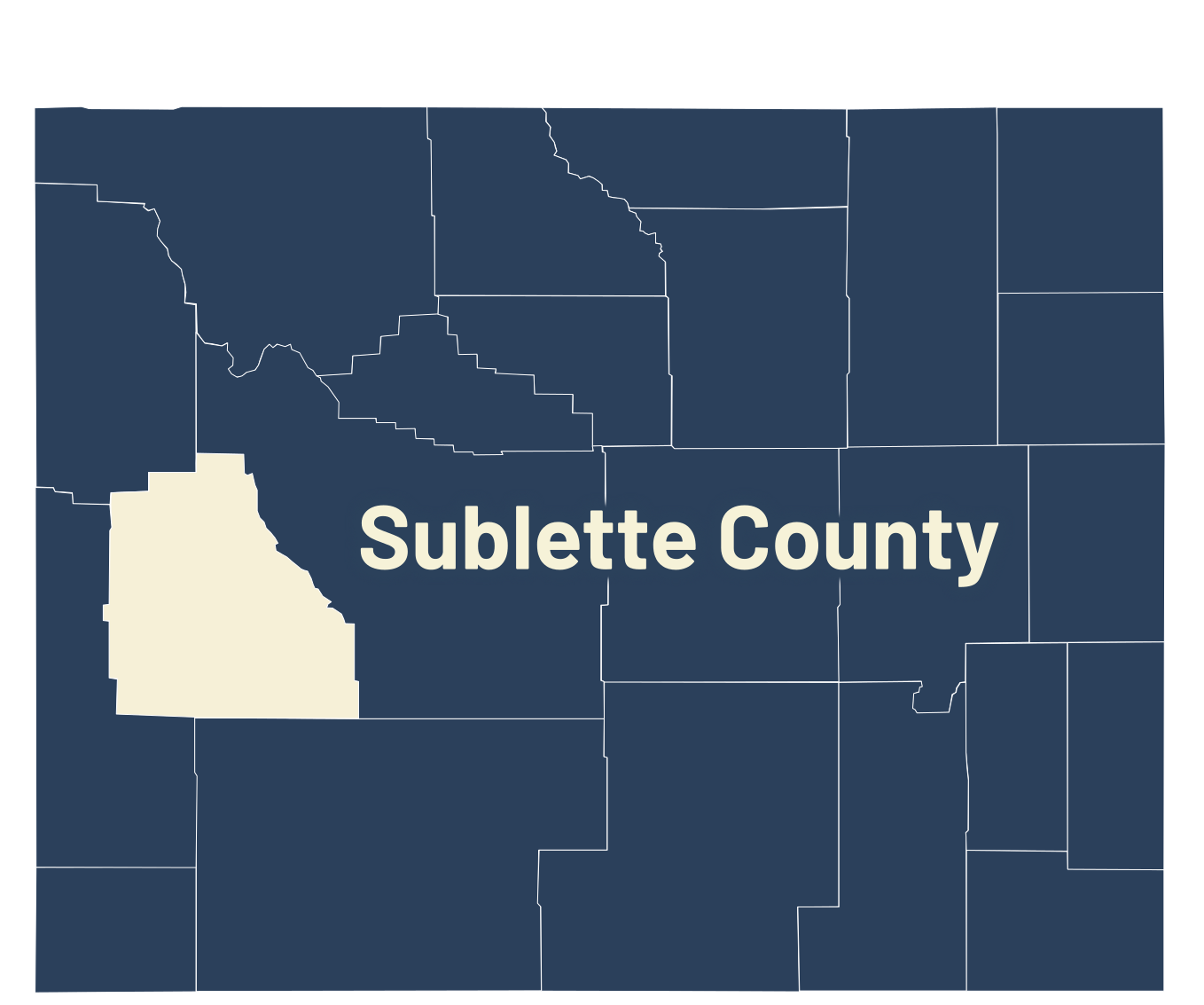
It’s a county on the west side of the state.
Before that, it was the last name of a noted trapper and Wyoming frontiersman with the first name of William who blazed trails and trapped furs along with Jedidiah Smith before becoming a successful businessman in Missouri.
It’s also the name of four of William’s brothers who also spent time in the West during the rowdy mountain-man era.
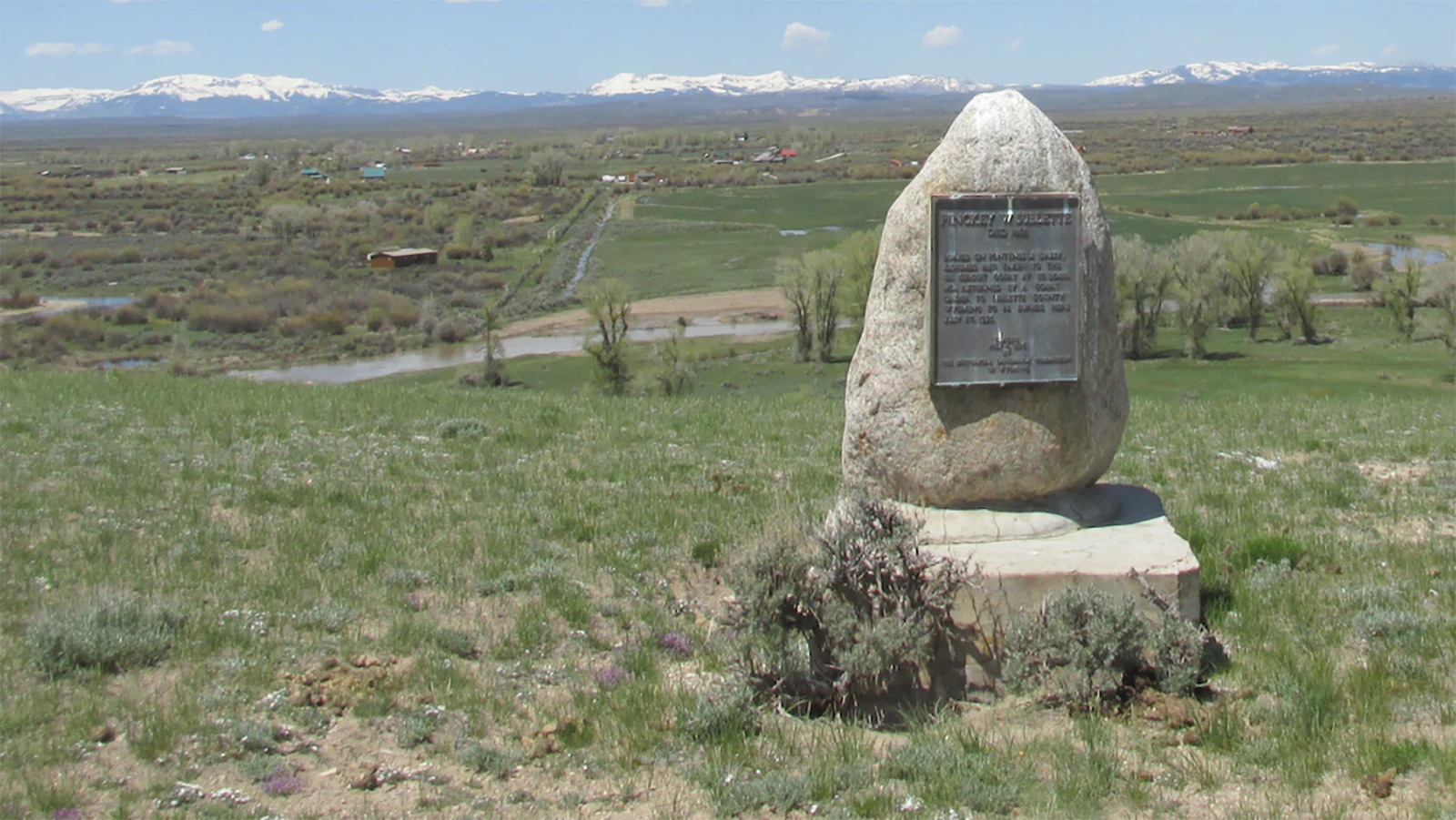
And on a grave near Daniel overlooking Horse Creek and the famous rendezvous grounds is a monument to the middle Sublette brother, Pinckney.
Whether the bones buried beneath the stone are his has never been verified.
Those bones did some traveling in late 1890s and then collected dust in a Missouri county courthouse for 38 years before finding their way back to same region they were unearthed along Fontenelle Creek in 1897.
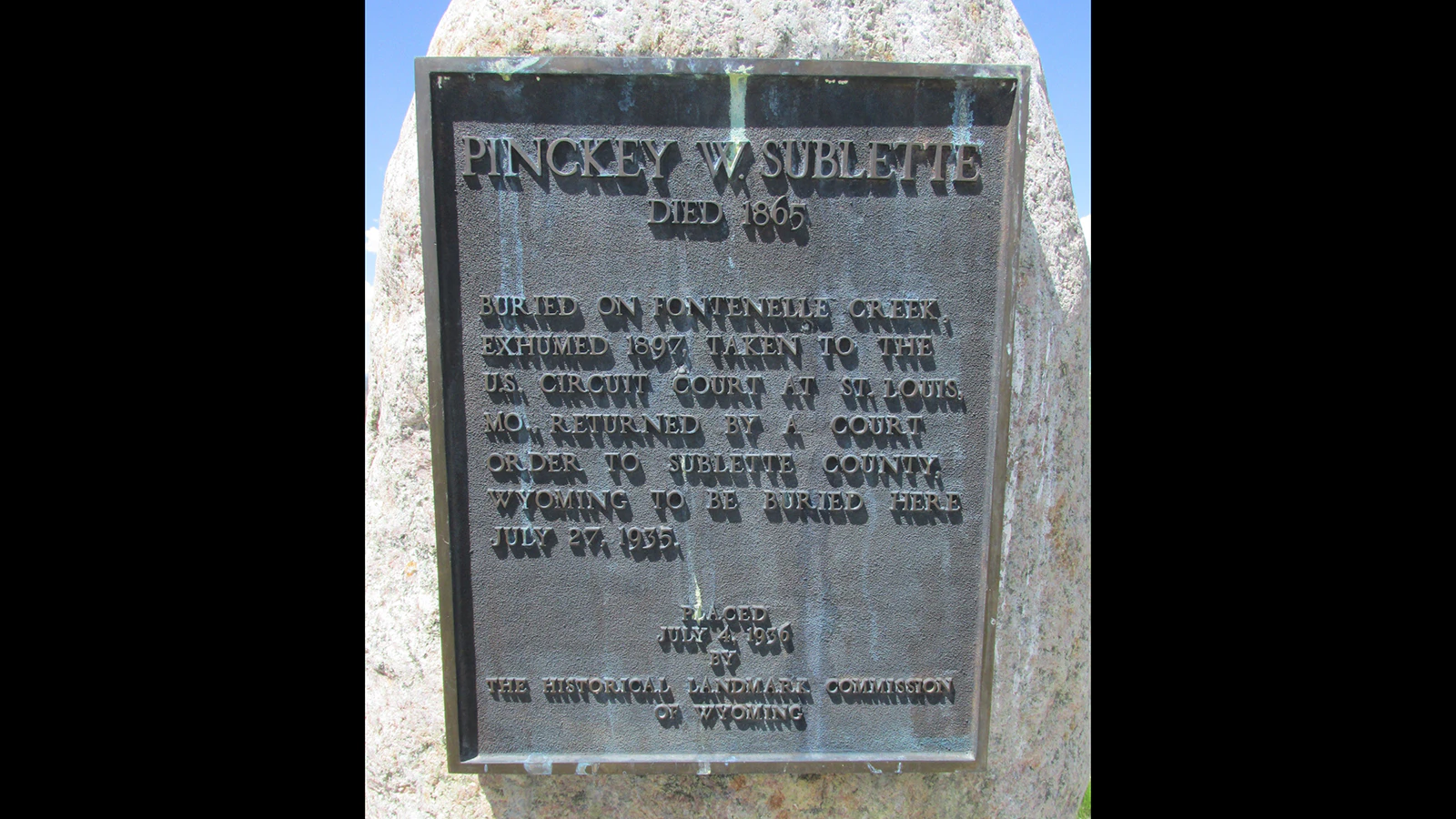
Pinedale’s Mountain Man Museum Director Clint Gilchrist agrees that despite a 1936 monument sign that misspells Pinckney Sublette’s name as “Pinckey” and honors the bones below as his, it can’t be proven.
“Even to this day we don’t really know,” he said.
The saga of those bones began with the arrival of William Sublette into what is now Wyoming in 1823 from Missouri.
He was born in Kentucky in 1799 and his father— in 1817 or 1818, according to different accounts — took the family to Missouri, where he operated businesses, including a tavern that was part of their home.
When Phillip Sublette died in 1820 and their mother passed two years later, William took responsibility for his brothers and sisters. Inspired by another brother, William headed west in 1823 to be a mountain man with the Ashley Henry fur company led by William Ashley and Andrew Henry.
Fur Trade Beginning
The enterprising William, along with brothers Milton and Andrew, found success in the fur-trade business.
Gilchrist said William Sublette brought his brother Pinckney to the West in the late 1820s to experience life on the frontier.
At that point William, along with Smith and David Edward Jackson had purchased the fur company from Ashley and Henry.
Differing accounts say the middle brother was born in 1807 or 1812 and might have been in failing health. The fatherly William thought the West could help him.
“Almost certainly he came out here through the Green River Valley,” Gilchrist said.
In theory, there is evidence Pinckney was killed in Idaho the spring of 1828 after arriving in the Green River Valley for the 1827 rendezvous.
Evidence of Pinckney Sublette’s death comes from an account provided by Ashley to Missouri U.S. Sen. Thomas Hart Benton in a letter published in the Daily National Intelligencer and Washington Express in Washington, D.C., on April 22, 1829.
In the letter, Ashley shares that information provided by William Sublette made clear American fur trappers were having struggles with Blackfeet Indians on the west side of the Rockies.
Ashley believed they were the result of British instigators associated with the Hudson Bay Company.
Ashley recounted a fight between Blackfeet and some of the men working for William Sublette and Jackson’s company in 1828 after a group of trappers spent time near the Hudson Bay men.
He wrote that the formerly friendly natives had been turned against the men.
Pinckney Sublette was among three killed after a crew of trappers led by James Tulloch met a party of 60 Hudson Bay trappers on the “Lewis’ Fork of the Columbia where the two parties remained together some days,” Ashley wrote.
“Mr. T (Tulloch) states that after he had left (The Hudson Bay Camp) some three or four days, but while within 20 miles of it, he was attacked by a party of 30 or 40 Indians, who killed the three men mentioned, plundered him of about $4,000 worth of beaver furs, 44 horses and a considerable amount of merchandise,” Ashley wrote. “It is believed Blackfeet Indians committed this outrage.”
Business Success
More than a decade later, William Sublette had moved back East and become a successful businessman in Missouri, getting out of the fur trade and operating a store, investing in land, businesses, and serving as a director at a bank.
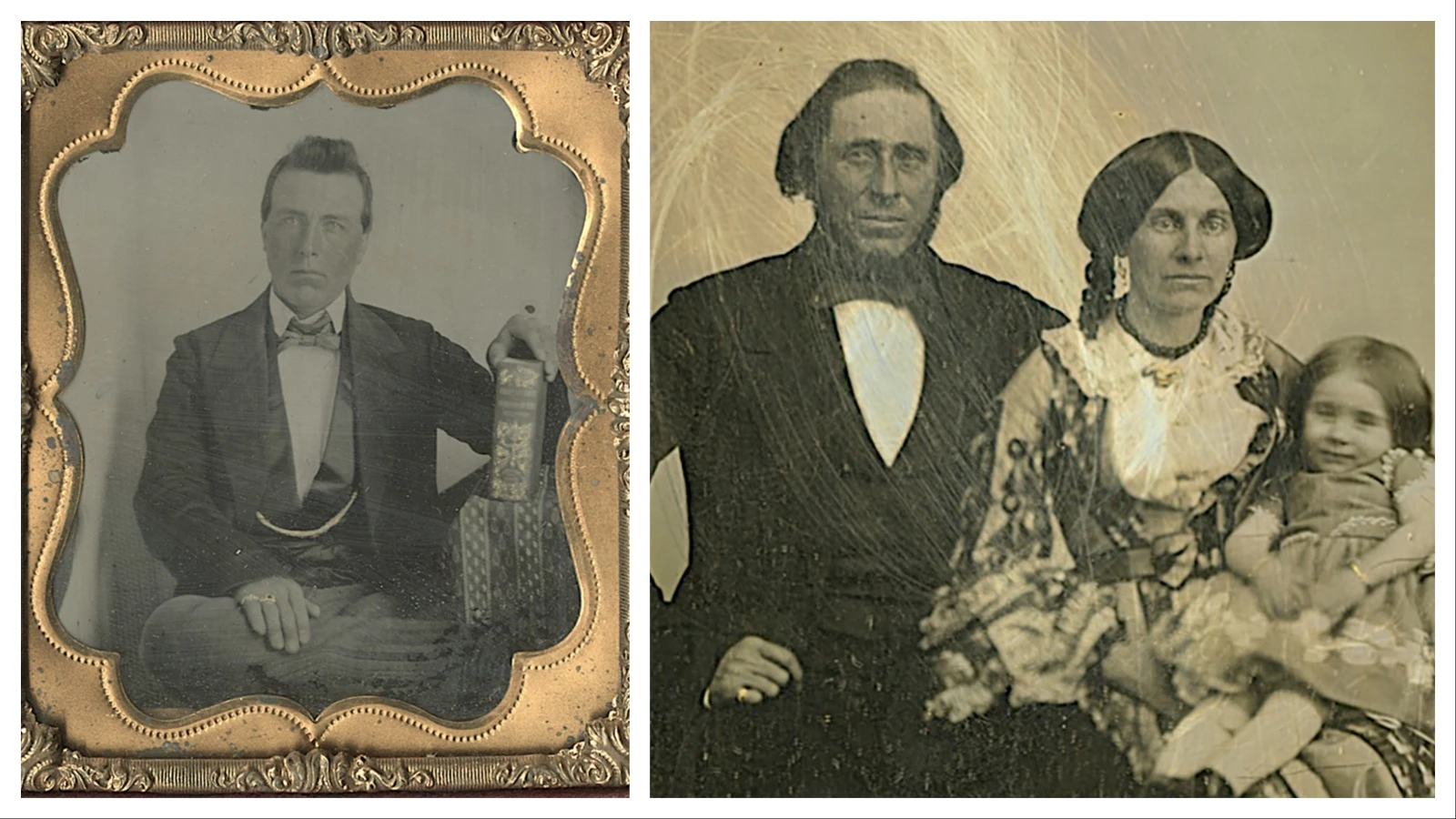
He married Frances Hereford, the 22-year-old daughter of a business associate, on March 12, 1844.
Sublette died on July 23, 1845, after losing a battle with what historians believe was tuberculosis.
He willed his wife his estate and fortune but stipulated that she could not change her name.
On May 21, 1848, Frances married Sublette’s youngest brother, Solomon.
Together they produced three children, a boy Solomon Jr. in 1849 who lived two years, a girl, Esther, in 1853, who lived eight years, and a son, William, born in 1856 and who died in 1857.
Solomon Sublette died on Aug. 31, 1857, in St. Louis and was buried in the same cemetery plot as his brother, William. Frances followed him a month later on Sept. 28, 1857, her name is below William on the grave monument.
Solomon and Frances, who inherited his brother’s expansive holdings and farm when William died, had not left a will as far as was known.
His siblings had all died — Milton following the amputation of his leg due to a wound received fighting Indians in 1837 and Andrew by a grizzly bear attack in California, according to one account in 1853.
Frances left her estate to her daughter, Esther “Fannie” and to her Hereford family.
Fannie’s death in 1861 sent the estate into the hands of the Hereford heirs.
Acres of prime St. Louis real estate initially part of William Sublette’s Sulpher Springs farm was parceled and sold by some of the Herefords and in some instances, according to newspaper accounts, were taken over by squatters.
But that was not the end of the story.
Attempts by Sublette heirs to get in on the inheritance were initially shut down by the court.
But decades later, when real estate was booming in the 1890s, Sublette heirs wanted to know if Pinckney Sublette had died before or after his niece.
One of the heirs learned from a John T. Clopton of Sedalia, Missouri, that he had met Pinckney Sublette on the Yellowstone River in 1864.
This story triggered a search for the missing brother.
‘Sensational’ Lawsuits
On Sept. 19, 1895, the Mexico, Missouri newspaper The Weekly Intelligencer reported that lawyers representing Pinckney Sublette heirs planned to file “sensational suits” to take back 250 acres of prime St. Louis real estate as well as land in California and other areas of Missouri.
“The prospective plaintiffs contend that all this Missouri and California property should have passed into the hands of Pinckney W. Sublette in 1858,” the newspaper reported.
Members of William Sublette’s father’s family, the Whitleys from Kentucky, also believed they should have been heirs instead of the Herefords if Pinckney Sublette had been alive longer than Esther “Fannie” Sublette.
In 1895, Pinckney Sublette heirs sent one of their own, a William Whitley McKinney, to find a long-lost uncle who had lived in the Intermountain West since 1866 to track down information on Pinckney Sublette and learn anything about his final status.
McKinney and his uncle traveled through Idaho, Montana, and then to Wyoming’s Green River country, where they located grave in a farm field.
They allegedly found a tombstone partially hidden under the grass that had the initials “P. W. S.” Underneath was the letter “D” indicating death and below that the year “1865.”
They made the trip south after meeting Davy Comptors, an old miner in Bannack, Montana, who told them he had worked for Pinckney.
The Mexico, Missouri, newspaper, The Weekly Intelligencer, noted Comptors’ story about how Pinckney had been “captured and raised by the Crows as a boy and then made a big chief.”
“He had established a trading post on the banks of the Green River, about 10 miles from Evanston, Wyoming and there he died,” Comptors had told McKinney as reported on Sept. 19, 1895. “He was buried on the banks of the Green River where the Fontenelle empties.”
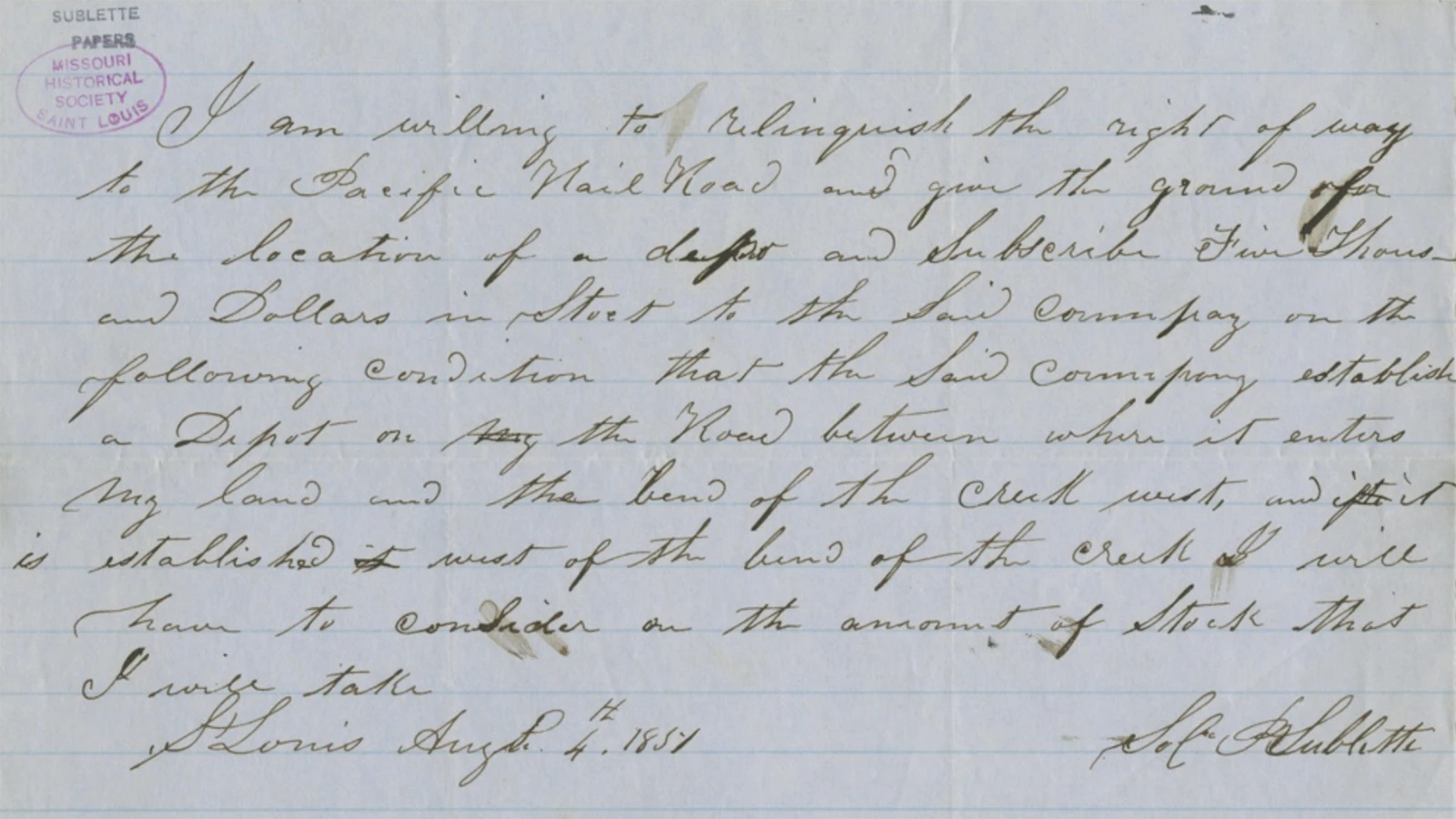
Meanwhile, in 1896 an alleged handwritten will of Solomon Sublette surfaced. It was sent to an attorney in an envelope with nothing else inside.
The document was signed on April 15, 1856, and witnessed by two men, an E. C. Smith and a James S. Thompson.
In the will’s language, published in the St. Louis Post-Dispatch on March 27, 1896, Solomon Sublette left his personal property and real estate to his wife and listed the counties where he owned property.
In the event of Frances’ death, his estate was to his daughter, Esther or “Fannie.”
If Esther died single or unmarried it read that: “I bequeath all said property to my brother, Pinckney W. Sublette, if living.”
“And at his death, if single, unmarried and without issue I bequeath said property to my next of kin on my father’s side,” the newspaper reported.
That would be the Whitleys.
Worn Paper, Faded Ink
The reporter described the paper that the will was written on as worn and slightly torn where it had been folded. The ink on the document had faded.
The witness E. C. Smith was never located, but Thompson, a retired banker, was found and the Post-Dispatch reported that he verified Solomon Sublette had asked him to witness the document.
An attorney for the Sublette relations, who numbered about 80 members, told the newspaper the will could have been hidden by someone who benefitted from it not being known and then who possibly at the end of their life wanted to make things right.
The estate in question was valued at $500,000.
However, a Missouri probate judge rejected the will for lack of proof.
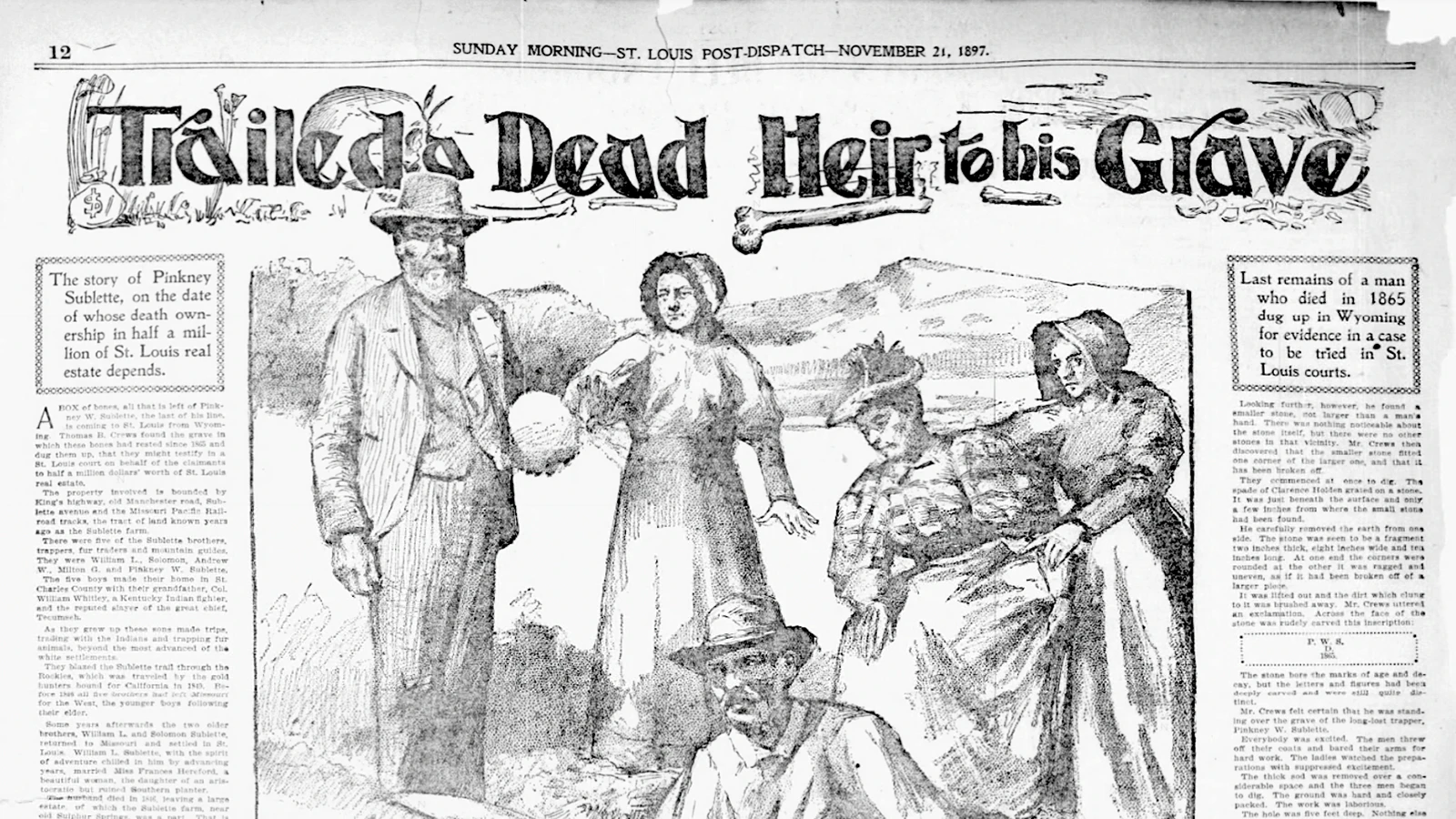
In 1897, attorney Thomas Crews, representing the Sublette heirs made a trip to Wyoming and with information supplied by McKinney went to a ranch owned by Charles Robeson who told Crews about the grave and the headstone, the St. Louis Post-Dispatch reported on Nov. 21, 1897.
“Some were found who remembered a solitary grave on the north bank of Fontenelle Creek about one mile from its mouth,” the newspaper reported. “They said that for many years after permanent settlers had occupied the valley, not only was the grave plainly visible, but a slab of stone has stood at its head.”
The newspaper reported that after a search, Crews located the grave and found the partially buried headstone that had been broken with the letters “P. W. S” etched in the stone and the date “1865” representing the year of death.
Crews recruited others to help him dig up the grave and when they dug down, they found a skeleton in a grave lined by stones and no coffin.
“A grinning skull looked into the face of the diggers,” the newspaper reported.
Crews exhumed the skull and bones. He had witnesses sign statements and brought the bones as well as the headstone back to St. Louis where they were stored in a wooden soapbox at the courthouse.
A Confession
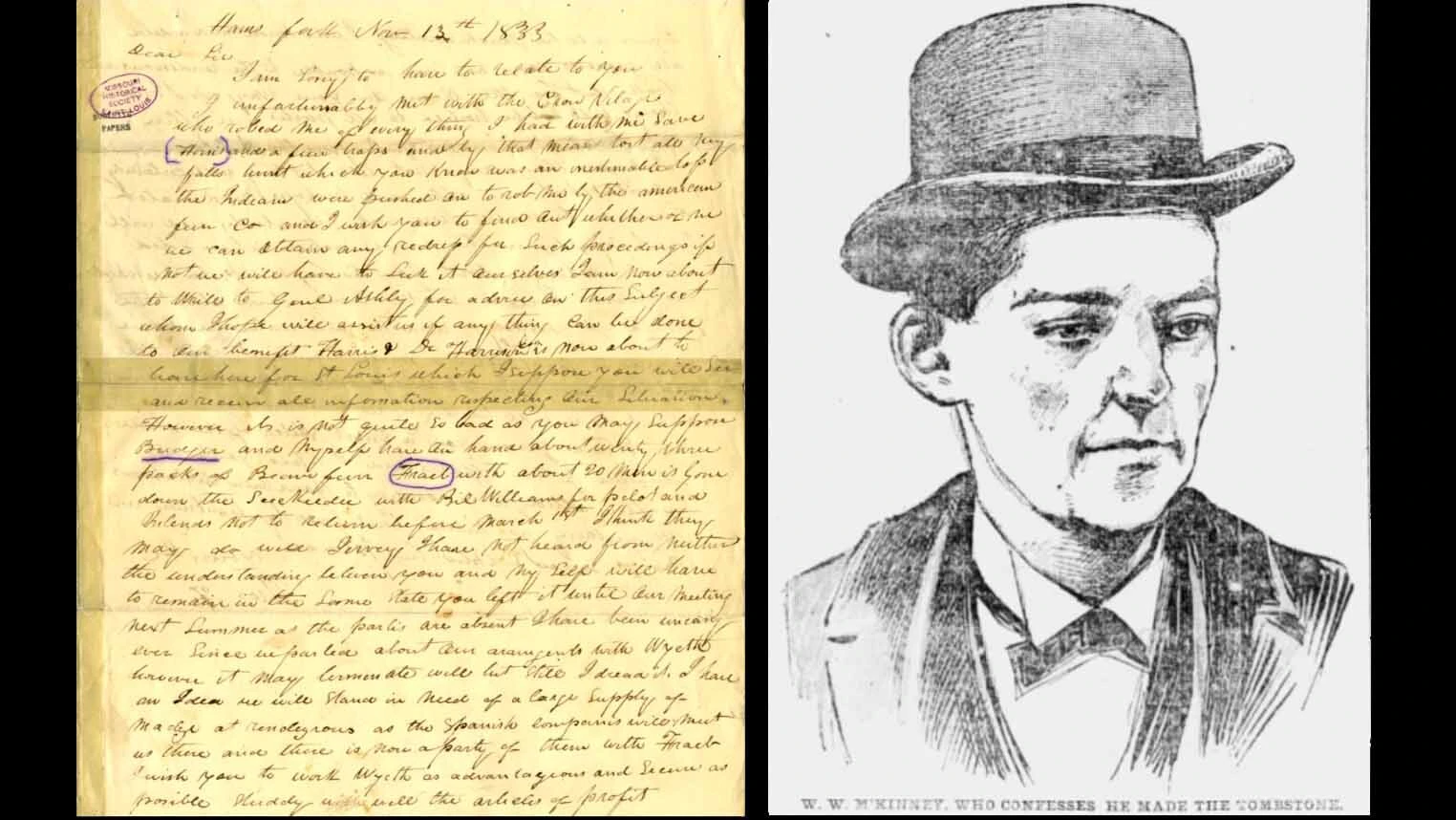
In 1898, the young McKinney made headlines again by airing a “confession” published in several Missouri newspapers that stated that when he had gone West to find the grave of Pinckney Sublette no one they spoke with on their journeys ever knew a Pinckney Sublette. They all knew “Bill” Sublette.
In the article, the young man confessed that he had created the headstone with the initials on it and partially buried it with a broken corner to make it look as if it had been there for years. He said there was never any “Pinckney Sublette.”
Attorneys for the Sublette heirs disputed his story about the headstone and called him a liar. They also said even if it was true, the headstone was not crucial to their case.
On May 25, 1899, the Louisville Courier Journal, in Louisville, Kentucky, carried a front page story stating the the bones of Pinckney Sublette were going to be presented as evidence in the case involving the Sublette and Whitley heirs.
The case went to trial in 1900 and a Judge Charles W. Holden from Fontenelle, Wyoming, testified about the grave on the ranch property, the St. Louis Globe-Democrat posted on March 1.
Clopton, a public administrator from Sedalia, Missouri, testified that he had met Pinckney Sublette in 1864 in Wyoming.
The old miner from Bannack, Comptors, also apparently testified about meeting Pinckney and working for him.
On June 18, 1900, a Judge Woods who heard the case of the Sublette heirs ruled that those who had owned the properties of Solomon Sublette the decades after his death had acquired them properly.
“The court finds that Pinckney W. Sublette died long prior to May 16, 1861 and left no descendants surviving,” he ruled. “It follows as a matter of law that plaintiffs are not heirs of said Frances E. Sublette and have no title to the premises in controversy under the statute of descents and distribution; therefore, judgment is rendered for the defendants.”
The Sublette cousins appealed to the Missouri Supreme Court and the suit apparently sent back to circuit court.
Scary Bones
The bones taken out the grave along the Fontenelle Creek remained in the soap box in a closet for the next 30 years.
On Aug. 30, 1906, a story in a Maryville, Missouri, newspaper described how an “attache” at the courthouse known for pranks stuck the skull on top of a broomstick in a cleaning closet to frighten Black janitors.
“Since that time, it is said the closet has not been inspected by a colored employee,” The Weekly Democrat-Forum and Maryville Tribune reported.
In 1913, three St. Louis boys were playing on the grounds of a brick manufacturer and found a casket partially uncovered in the ground by rain. The Globe-Democrat reported on May 4 that the casket of “ancient and costly construction” had a glass panel on top of it that the boys broke and looking in saw skeletal remains and ran away.
People in the neighborhood said it was part of an old cemetery that once housed members of the Sublette family. Former family attorney Crews told an inquiring newspaper reporter that there would be little evidence associated with the casket that would help settle the controversy linked to the bones of Pinckney Sublette in the courthouse.
Continued efforts by the Sublette heirs’ failed again in 1926. The 250 acres was then estimated at $3 million. They again appealed the case to the high court. The bones remained in the closet.
The Missouri Supreme Court rejected the families' arguments in 1928, effectively ending the battle.
In 1930, the bones along with hundreds of court files were moved and the bones placed in a new container, according to an article on July 6, 1930, St. Joseph Gazette, in St. Joseph, Missouri.
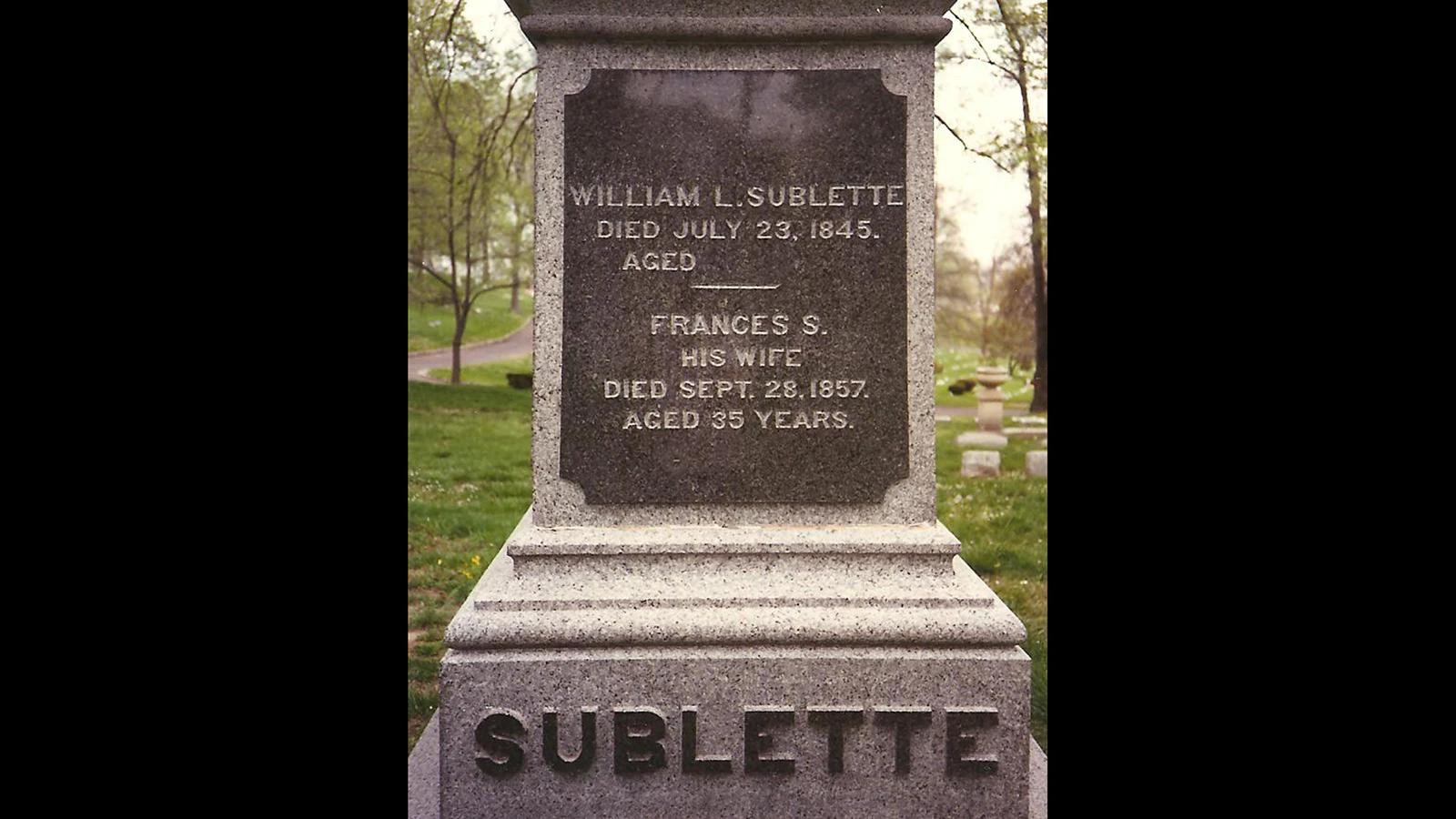
William Sublette’s grave in Missouri. His death and estate triggered what would be a decades long fight by heirs. (Courtesy Missouri Historical Society) 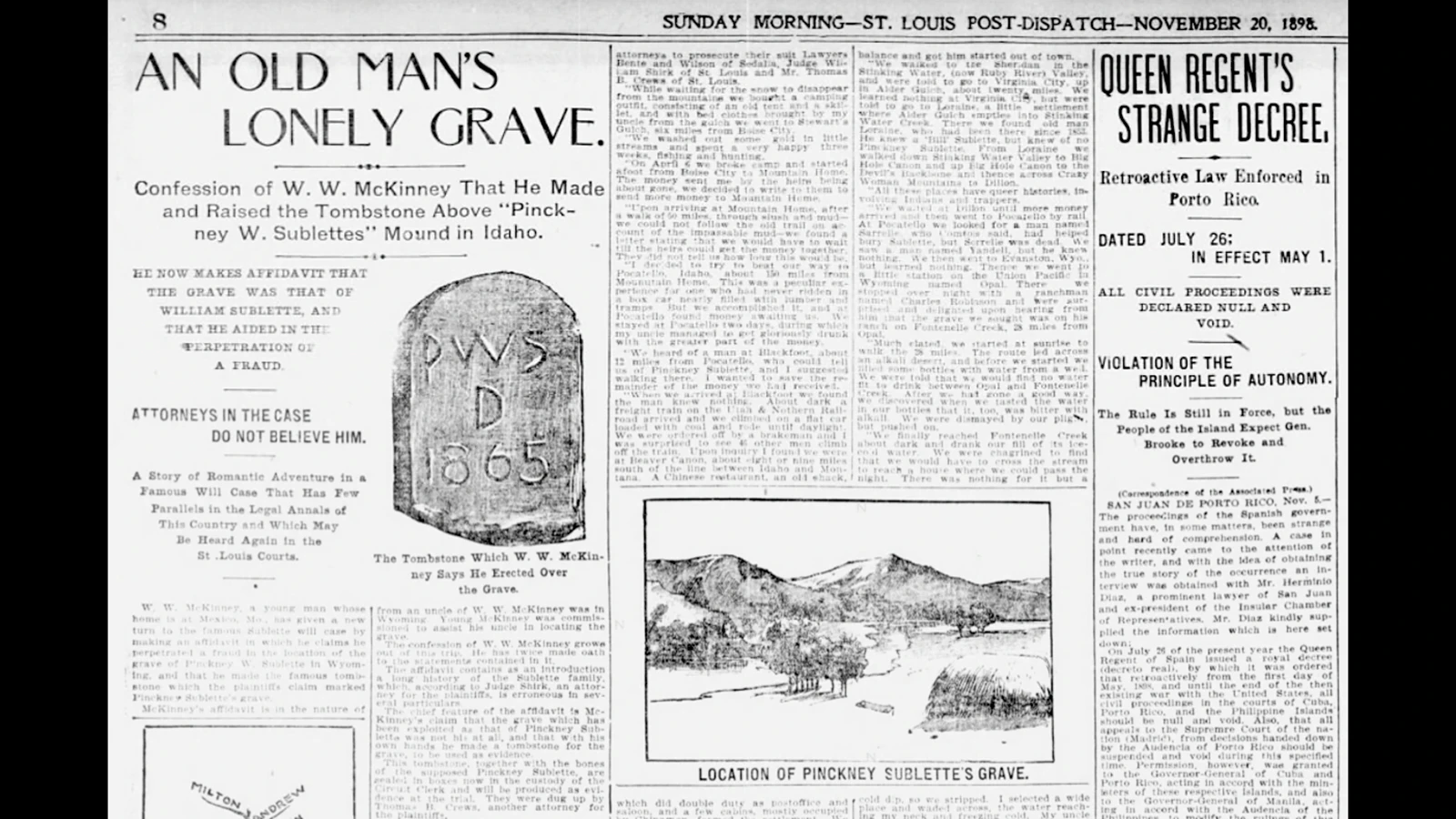
The young heir to Pinckney Sublette, W.W. McKinney, told the newspaper that he fabricated the tombstone that had the initials of Pinckney Sublette’s name. (Newspapers.com)
Heading Home
As the 100th-year anniversary of the Grand Rendezvous of 1835 approached in Wyoming, Gilchrist said a Sublette County man sought a way to bring the controversial bones back to Wyoming.
“P. W. Jenkins one of the founders of the Sublette County Historical Society thought that Pinckney’s bones shouldn’t be in an evidence locker in St. Louis, that they should be back out here in the mountains where they were found. These are the bones that were dug up on Fontenelle Creek.”
Gilchrist said Jenkins through one of Pinckney Sublette’s relatives was able to petition the court to allow the bones to return.
A front-page story in the Casper Tribune-Herald on July 21, 1935, reported on the plans for reburial at the event on July 23. Former Gov. B. B. Brooks and historian A. J. Mokler were the headlined speakers for the occasion.
“In connection with the commemoration of rendezvous events, there will be interred at the mouth of Horse Creek by the Green River the remains of Pinckney W. Sublette,” the newspaper reported.
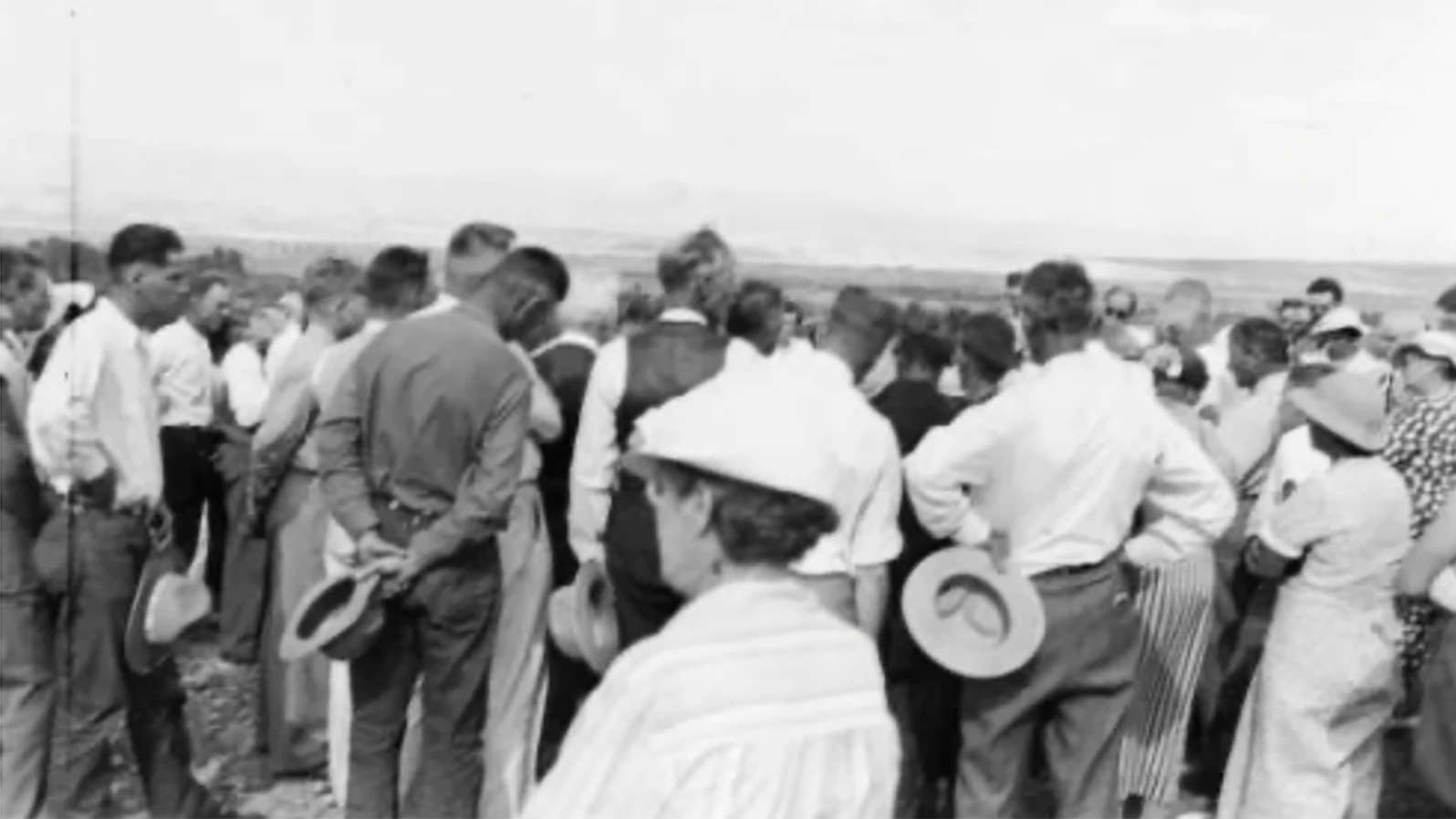
A photo of the gathering shows a large crowd gathered around the burial ground.
The marker that still stands on Seven Mile River Ranch Road east of Daniel begins with Pinckney’s name misspelled and then states:
“Buried on Fontenelle Creek, exhumed 1897 to the U.S. Circuit Court at St. Louis, MO. Returned by a court order to Sublette County, Wyoming to be buried here July 27, 1935.”
Dale Killingbeck can be reached at dale@cowboystatedaily.com.