Main Street Wyoming is caught dead center in an economic boxing match, and business owners say they’re taking hits from both of the heavyweights in this ring.
On one side of the ring is Team Inflation. On the other is the Federal Reserve’s favorite knock-out champion, high interest rates.
This week, for Federal Reserve Chairman Kevin Warsh’s first Jackson Hole symposium, local entrepreneurs are having trouble deciding which way they hope Warsh goes.
Instead, they’re just trying to stand strong in the crossfire.
“Typically, in the normal world, I’m pretty pro-growth, so I’m like, ‘Can you lower the interest rates? I want things to speed up.’” Gannett Peak Technical Service co-owner Tighe Fagan told Cowboy State Daily. “So lower the rates and we can borrow more money, we can do more stuff, and people can buy houses.”
But this isn’t a “normal” economy right now.
“What I’m seeing right now is kind of the opposite, where my costs are just going up. Healthcare is going up, a lot of our vendor prices are going up, a lot of the software we pay to use is going up,” he said. “So I’m kind of on the other side, too, where I’m worried about all of these. It just feels like we haven’t caught a break since it feels like 2020.”
Inflation feels like it’s still too out-of-control to necessarily support an interest-rate decrease, Fagan added.
“I’m just seeing too many costs out of control,” he said. “Everybody’s like jacking up their prices to us, so we’re going to have to jack up our prices. You just see it rippling. So I’m definitely kind of on the side of keep (interest rates) solid, or move them up to get inflation back under control.”
Warsh’s Tenure So Far
The uncertainty felt on Wyoming’s Main Streets by business owners like Fagan is mirroring a broader standoff on Wall Street.
Warsh, who took over the top spot at the Federal Reserve in May, has sharply criticized his predecessor Jerome Powell, who he said lacked credibility and relied too much on traditional tools and forward guidance.
Warsh is fighting his own battles with credibility now.
Bond markets went into a tailspin after the Fed’s July policy meeting, when the Federal Open Market Committee voted 9 to 3 to leave interest rates unchanged and Warsh declined to spell out what would cause him to recommend raising or lowering borrowing costs.
Long-term U.S. Treasury yields spiked sharply, with the 30-year yield jumping to a 19-year high and the Dow Jones Industrial average dropping by more than 1,000 points.
“I understand the desire for rolling forecasts and commentary from this committee,” Warsh said at the time. “But, for our part, we need to observe market reaction to developments, direct and unfiltered.”
Warsh said he believes forward guidance from the Fed is interfering with market signals and creating less flexibility in the decision-making processes. He wants the market to respond to real data, rather than predictions.
That aside, Warsh has also said publicly he’s committed to reaching the Fed’s mandate for 2% or less inflation rates and believes the body might have to act more aggressively later, if the economy heats up.
Even Realtors Say Hold Steady
It’s not just business owners leaning toward the “hold firm” or raise interest rates camp, either.
Even Realtors, who would like to see lower interest rates to unstick the housing market, say they’re not sure anything should change just yet.
“From a real estate perspective, a lot of people are on the fence on buying because of the fact interest rates are so high," southeast Wyoming Realtor Alexander Lexington told Cowboy State Daily. “I foresee that if interest rates eased, there would probably be a little bit of an uptick, a little bit of a housing boom and what not.”
Given current inflation rates, however, he’s not sure lowering interest rates is the right move. Particularly as he’s seen a steady supply of both new listings and closings.
Cheyenne Realtor Dominic Valdez had much the same take on which levers to pull in the economy, and lower interest rates isn’t the lever he would pull either.
“You know, historically, 6-7% is pretty normal,” he said. “We got really spoiled with the rates right after the pandemic, and I think that was anomalous. Those days are not coming back. We might get to five someday when we have some more stability.”
For right now, Valdez sees keeping interest rates steady as a reasonable course.
“Maybe that’s kind of against the tide a bit,” he said. “I think most Realtors want to see interest rates come down, and I get that argument as well. It’d be nice to be able to get somebody in a house with a reasonable payment.”
The marketplace has been responding to high interest rates, Valdez added.
“Interest rate buy downs are still happening quite a bit,” he said. “Like the seller is making it a little bit more palatable to the buyer and saying, ‘Hey, we’ll put in $8,000 or $10,000 toward an interest rate buy down for you to make it more affordable for a year or two.”
Teton Wealth Gap
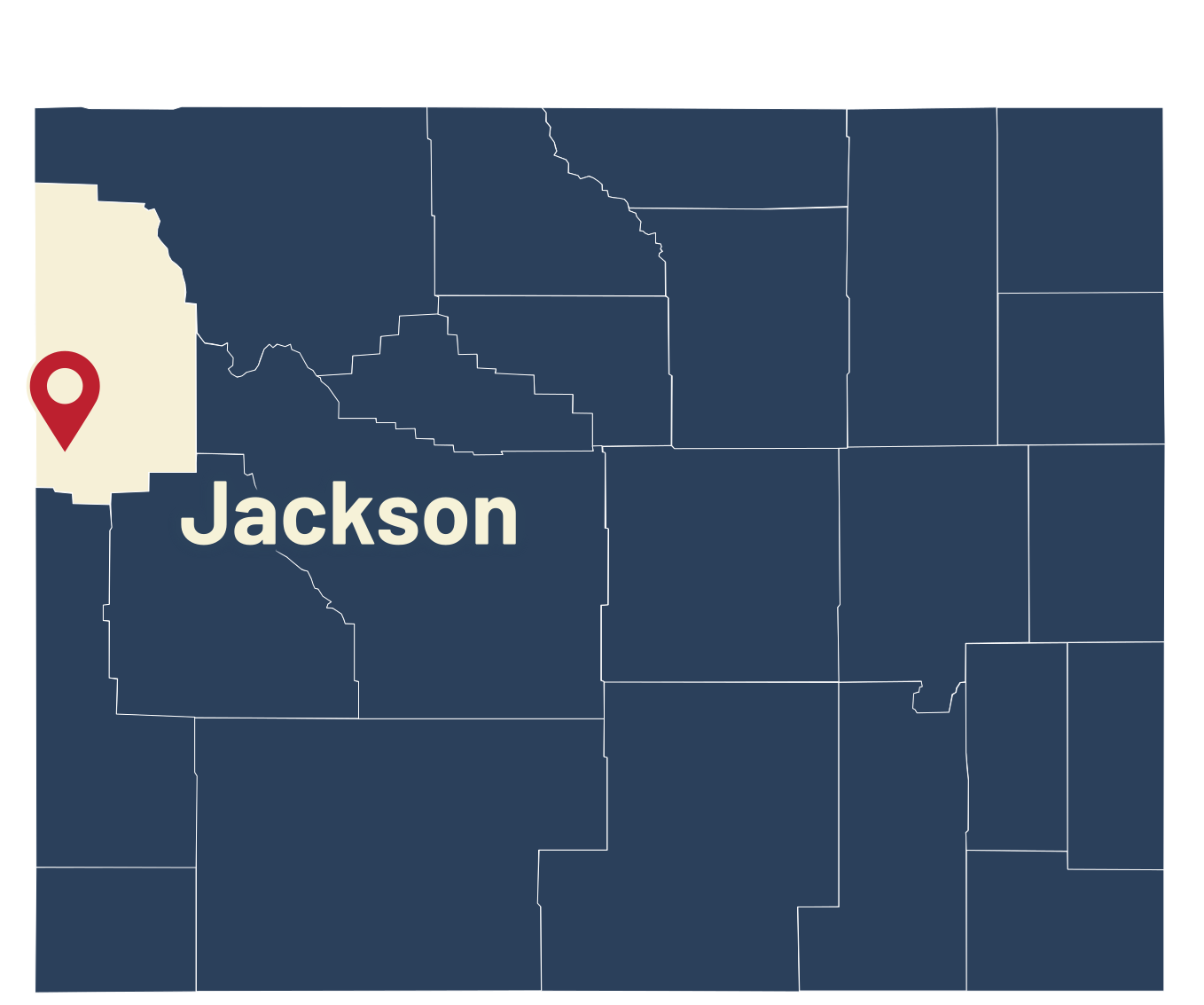
Lower interest rates wouldn’t hurt retail shop owner and pharmacist Laura Lee Nelson’s feelings. She owns Stone Drug in Jackson, a business that celebrates its 50th anniversary this year.
“That would be helpful, so I could buy a house. That’s just personally,” she said, adding, “I still don’t understand how all that works.”
Nelson was referring to raising and lowering interest rates, the Federal Reserve’s most common lever when inflation rates are rising. The theory is that raising interest rates cools demand for buying, taming price increases by lowering the demand curve of the supply-demand equation.
The opposite, lowering interest rates, helps increase demand for borrowing and spending, to give the economy a boost.
It’s limited in range and scope, however, and, if interest rates are already low from a previous shock, then lowering them more has a diminishing return when the next shock comes.
Nelson, like Realtors, said the economy has been OK so far for her store.
“In May, I was thinking this was going to be one of those years where we had to bargain with every customer on price,” she said. “I had someone who didn’t want to buy $120 binoculars. They wanted something more reasonable, so I thought, ‘Oh dear, it’s going to be one of those summers.’”
But subsequent customers haven’t pressed her on prices.
“I don’t know what turned around,” she said. “I think people are more stingy right now because they’re worried about what’s happening and thinking maybe I should save money instead of spending it.”
Nelson said she’s aware the Federal Reserve comes to Jackson Hole every year, but the outcome of that meeting has always seemed mysterious. The elite gathering in her own backyard feels more like a photo op than anything else.
“We never see a person,” she said. “I don’t even know if they ever come up with solutions at this meeting. We never hear one word about it. Just a picture of all the big stars up by the Tetons, and I’m like, ‘Wow, Woop-tee-doo’ at their thousand-dollar rooms.”
Playing The Pharmacy Game
Nelson said her biggest economic problems come from the reimbursement model from insurance companies.
“It’d be nice if they didn’t penalize us so badly,” she said. “I mean, just pay us a little more. Why can’t they just pay the pharmacy? I don’t understand that. Sometimes we make $1 on a $500 prescription.”
Nelson added she refuses to charge people a “consulting” fee if they have questions about their medications.
“I’ll joke with people sometimes if they want something,” she said with a chuckle. “I’ll say, ‘Well that’ll be $10. And they’re like, ‘What?’ And I say, “I’m just kidding.’ But yeah, it’d be nice if they would pay us a little bit more, but that’s between the insurance company and the drug company. This never will be solved.”
Nelson isn’t waiting on solutions from Washington, D.C., she added. She’s already taken steps of her own, like diversifying into items like camping supplies to help lift the pharmacy.
“It used to be the pharmacy held the store,” she said. “You made your money with the pharmacy and the front-end was just fluff. But now the front end pretty much equals the back end, so we have to make sure we’re really up-to-date on the up-front stuff.”
Fuel Costs Are A Big Pain Point
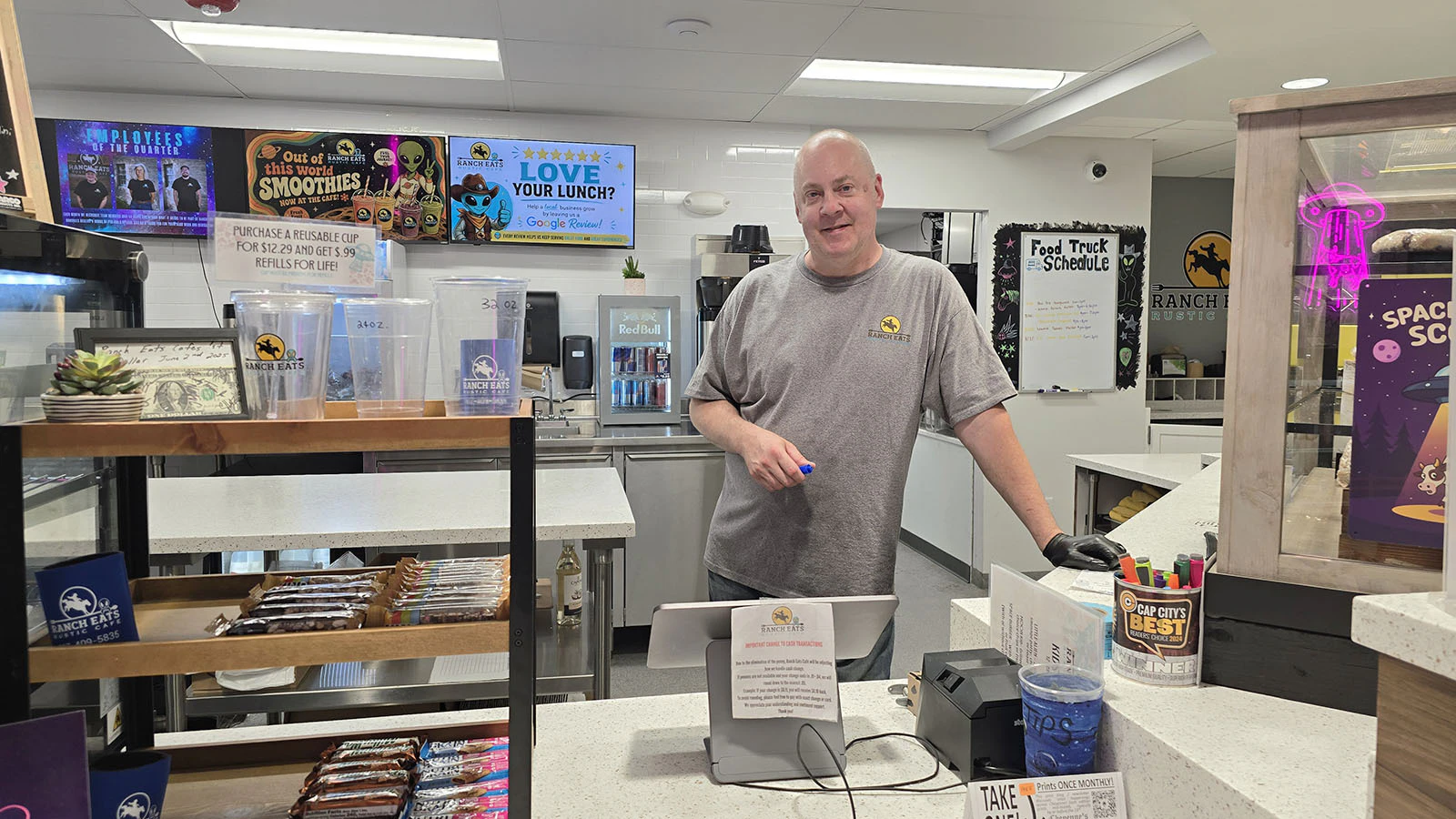
What Ranch Eats owner Troy Strand sees in the food business is lots of love and understanding from his customers.
“Most people get it when I explain why our pricing has gone up a buck here or there, due to the cost of food and fuel,” he told Cowboy State Daily, adding. “As a general rule of thumb, I haven’t had to raise anything much yet.”
That’s because, in general, he’s ordering in large volumes from services such as Sysco, unlike many smaller food-truck operations that, because of smaller quantities, are forced to buy from more expensive retailers.
So far, Strand has been able to successfully negotiate new deals whenever he’s faced a big price increase, keeping things as close as possible to the same cost.
Fuel costs, though, have been a real pain point.
“We spend on average about $4,000 a month on the normal fuel price, and we’re upwards of $6,000 a month because of the cost of fuel,” he said. “That is what, let’s see, $24,000 more a year.”
Filling up his food truck Wednesday morning cost upwards of $265.
“Just beat somebody up over the fuel,” Strand said he would tell Warsh, even though he knows the Fed doesn’t set fuel rates. “I mean, there’s a refinery in my backyard here, so I don’t understand what’s going on here.”
So far, Strand hasn’t had to translate higher fuel costs into an across-the-board price increase. But he does plan to open his brick and mortar cafe for extended hours on the weekend this winter, mainly because the food truck is less cost-effective than the cafe when the weather turns cold.
National Averages Miss A Lot
Nationally, the Fed will talk in terms of averages and aggregates during its annual meeting. But as University of Wyoming economist Anne Alexander points out, those averages can bury what’s happening in a rural, resource-dependent state like Wyoming.
“Wyoming’s low unemployment rate — currently about 3% — can obscure the fact that many Wyoming communities face worker shortages, extremely limited and expensive housing that limits growth, an aging labor force, and very thin labor markets,” Alexander told Cowboy State Daily. “Our rural areas are experiencing teacher shortages, health-care professional shortages, accountant shortages, and lawyer shortages — and that’s just to name a few.”
Wyoming’s economy, meanwhile, is unusually exposed to swings in energy markets or federal policies.
“Agriculture, tourism and hospitality and small businesses feel high interest rates, transportation costs, and trade-policy changes especially acutely,” she said. “At the same time, Wyoming is pursuing real diversification in advanced energy, technology and value-added industries. Access to capital will help determine how quickly those opportunities become jobs.”
Alexander added she was speaking with folks from the Federal Reserve Bank of Kansas City on Tuesday.
“They’re excited about the kind of things they’ll be talking about at the conference,” she said. “The theme this year is ‘Financial Innovation: Implications for Payments and Policy. That could have some interesting implications for Wyoming.”
If Warsh is listening, Wyoming business owners aren’t expecting miracles from the Federal Reserve, whatever it decides.
They’re just hoping that someone is thinking about how the levers they do pull will land in a state that has wide open spaces and thin labor markets, with sticker-shocking $265 fill-ups.
Renée Jean can be reached at renee@cowboystatedaily.com.