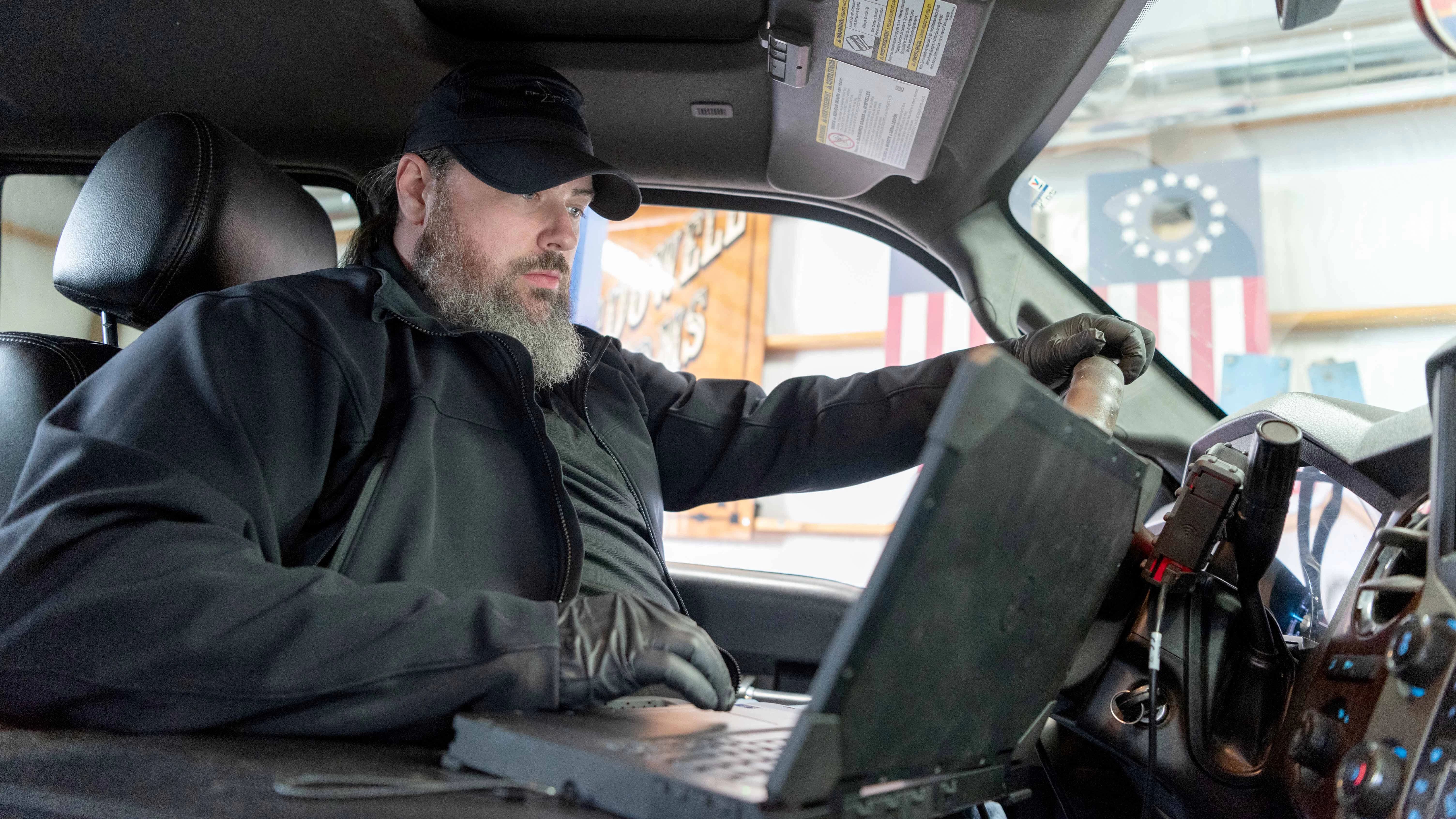
Matt Geouge is building a device that blocks vehicles from spying on their drivers, because in 2018 his fiancée noticed grey Toyota Tacomas were following her.
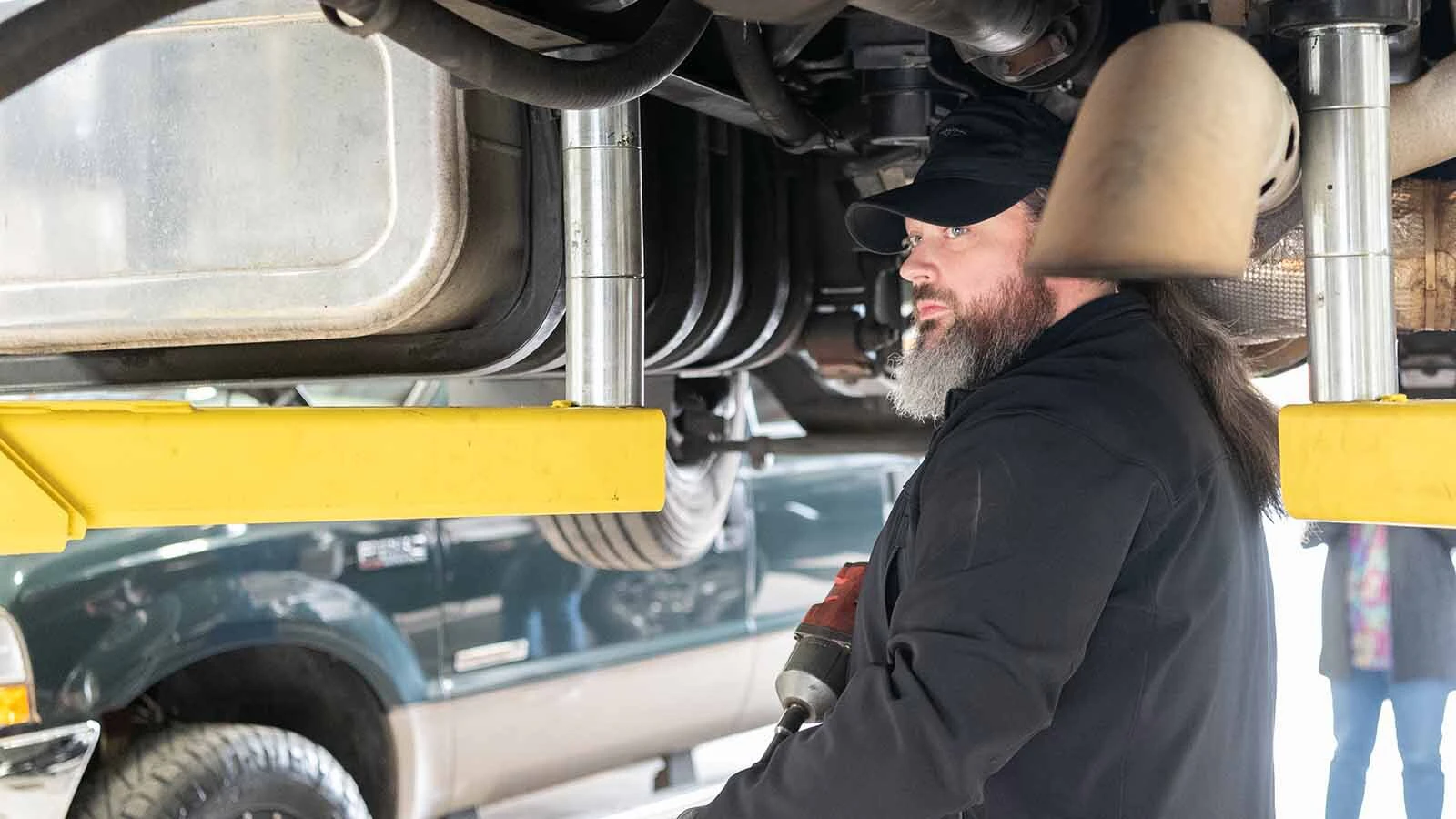
Geouge had started a smalltime diesel operation in his mother’s garage in Hendersonville, North Carolina, his senior year of high school. As emissions systems on diesel trucks grew more constraining throughout the early 2000s, Geouge started writing “delete” software tunes that let trucks disobey the systems and regain their horsepower.
That got farmers’ and truckers’ rigs out of the emissions handicap, or “limp” mode. It also snowballed into a multi-million-dollar business and earned widespread renown for Geouge, at least in Ford aftermarket circles.
But Geouge’s work also landed him in the federal government’s crosshairs because deleting runs afoul of federal emissions laws.
The U.S. Environmental Protection Agency hit Geouge with a $4 million civil penalty in 2018, court documents say.
That was about when the grey SUVs started following Caroline Jackson, Geouge’s fiancée, the couple told Cowboy State Daily in separate interviews Friday.
No one believed Jackson for three months, she said.
She climbed the Blue Ridge Parkway until cellphone service vanished. She drove to rock quarries and deep into the Cherokee Indian reservation.
Even when she could ditch the tails, they always found her again, Jackson said.
Along for the ride, her 7-year-old son thought they were going on an “adventure.”
'State Of Denial'
But Jackson was haunted.
The Presbyterian-raised North Carolinian and holder of a master’s degree from the University of North Carolina at Greensboro was not the type who’d spent her life looking over her shoulder for cops, she said.
“It was horrifying,” said Jackson. “And I don’t’ consider myself overly paranoid. Especially as a person who wasn’t doing anything wrong. I’d just be going to the grocery store or the hardware store.”
She wondered if Geouge’s competitors were tailing her to glean trade secrets.
Geouge doubted Jackson’s claims at first. But soon he also saw the grey SUVs. He struggled to rationalize that they were following him.
“It’s one of those things, you’re in a state of denial until it becomes so obvious, you can’t reject the idea anymore,” he told Cowboy State Daily.
The pair started leaving their cellphones at home, but the grey Toyotas still found them, Geouge said.
In late autumn 2019, Geouge spent 20 hours of garage time dismantling and scouring his 2017 F350 for a GPS tracking device.
He found none.
But he found the “black box” telematics modem – standard in newer-model vehicles – the satellite radio antenna, and the GPS hardware. He ripped them out.
Jackson said she was able to ditch the grey SUVs after that.
Geouge stripped telematics devices from another of their couple’s vehicles, and the grey Toyotas fell away from that one too, he said.
Geouge reasoned that investigators were using his own vehicles’ data-transmitting hardware to track him and Jackson.
“I’m not going to say that’s total empirical evidence, but it’s pretty damn strong circumstantial evidence,” he said.
Withering
Geouge didn’t have the mental energy to fight all that. He’d halted his tuning work and shuttered his business Spartan Diesel after the EPA’s civil case.
Around late 2020 and early 2021, the federal government shifted from pursuing merely civil actions against delete techs to charging felony-level prosecutions – a use of the Clean Air Act some environmental-law attorneys still dispute as unlawful.
The second Trump administration later agreed, telling the public early this year that it would stop prosecuting delete techs in criminal court.
But first, the U.S. Department of Justice sent one letter each to Jackson and Geouge, alleging each had violated the Clean Air Act.
Jackson said she’s still unaware how she violated the Clean Air Act.
“I don’t know how to tune a truck,” she said. “Really, they were just using me as leverage.”
The U.S. Attorney’s Office of North Carolina charged Geouge in 2021 with two felonies: Conspiracy to violate the Clean Air Act and tax evasion, punishable by a collective seven years in prison.
Geouge spent roughly $4 million on legal fees, he said.
He pleaded guilty to both felony charges in January 2022.
Jackson said she believes Geouge settled the case to repel the threat of criminal prosecution the prosecutor had made against her.
Geouge still maintains publicly he did not commit tax evasion, calling the heavier charge a lever prosecutors pulled to make him plead guilty to the environmental crime.
In the discovery phase of that criminal case, Geouge and Jackson said, they learned their tails had been state police agents. Geouge said the federal government “goat roped” the agents into following them.
While awaiting his sentencing hearing, Geouge learned that Jackson was pregnant.
He was sentenced in June 2022 to one year and one day in prison, and ordered to pay $2.5 million in restitution, which he said the government accepted as a substitute for the earlier civil fine of $4 million.
He checked into prison at USP Lee, Virginia, on July 28, 2022, and prepared to miss his baby’s birth.
But due to serious medical incidents, Geouge was released to home confinement that December. Forty-three days later, his son was born.
He prepared to rebuild his life as a convicted felon. A gunmaker of several years, he’d lost his federal firearms license, and the trust of the business and banking community.
Jackson cast Geouge’s reputational damage as heartbreaking.
“I know people have been through much worse. But I look at it like if you live through a war; except the war was only in our household, and everyone around us didn’t experience this,” she said.
She started pushing for a presidential pardon. She wrote 70 different letters and received “mostly rude responses.” She eventually connected with Wyoming-based lobbyist Jeff Daugherty and Colorado-based attorney Stewart Cables, who have helped multiple delete artists win pardons. They took on Geouge’s case.
On July 3 of this year, President Donald Trump pardoned Geouge and eight other diesel techs.
Modern Cars Are Spying On You
To Geouge, another injustice remained: Modern cars spy on their drivers.
Newer model vehicles contain black box telematics devices, GPS tracking, smartphone integration systems, and other infotainment systems that lift users’ data.
For example, cars can watch their drivers with cameras, including for fatigue and distraction. Numerous newer models have in-cabin microphones.
Audi’s privacy statement for model years 2019 and newer says the car system can disclose the driver’s data “to third parties for their own marketing purposes.” The company may disclose “information about you and your vehicle” to law enforcement or others when it has reason to believe someone is being harmed, the agreement says.
A privacy notice by FCA US, the parent company to Jeep, Dodge, Ram, Alfa Romeo, Chrysler, and Fiat, says the company may collect information from mobile devices and may track the driver “to provide tailored services.”
It also may collect telematics information through the vehicle itself “that concern your vehicle and driving patterns,” and under a broad definition of user consent, share that data with third parties or insurance companies.
Satellite radio company Sirius XM’s privacy agreement says it will, as the law and user allow, sell or share sensitive personal data, precise geolocation and other data to targeted advertising entities and analytics providers.
These realities superimposed on the Geouge couple’s own experiences put them in survival mode, Jackson said.
Then that dawned into the realization others are facing the same dystopia, she added.
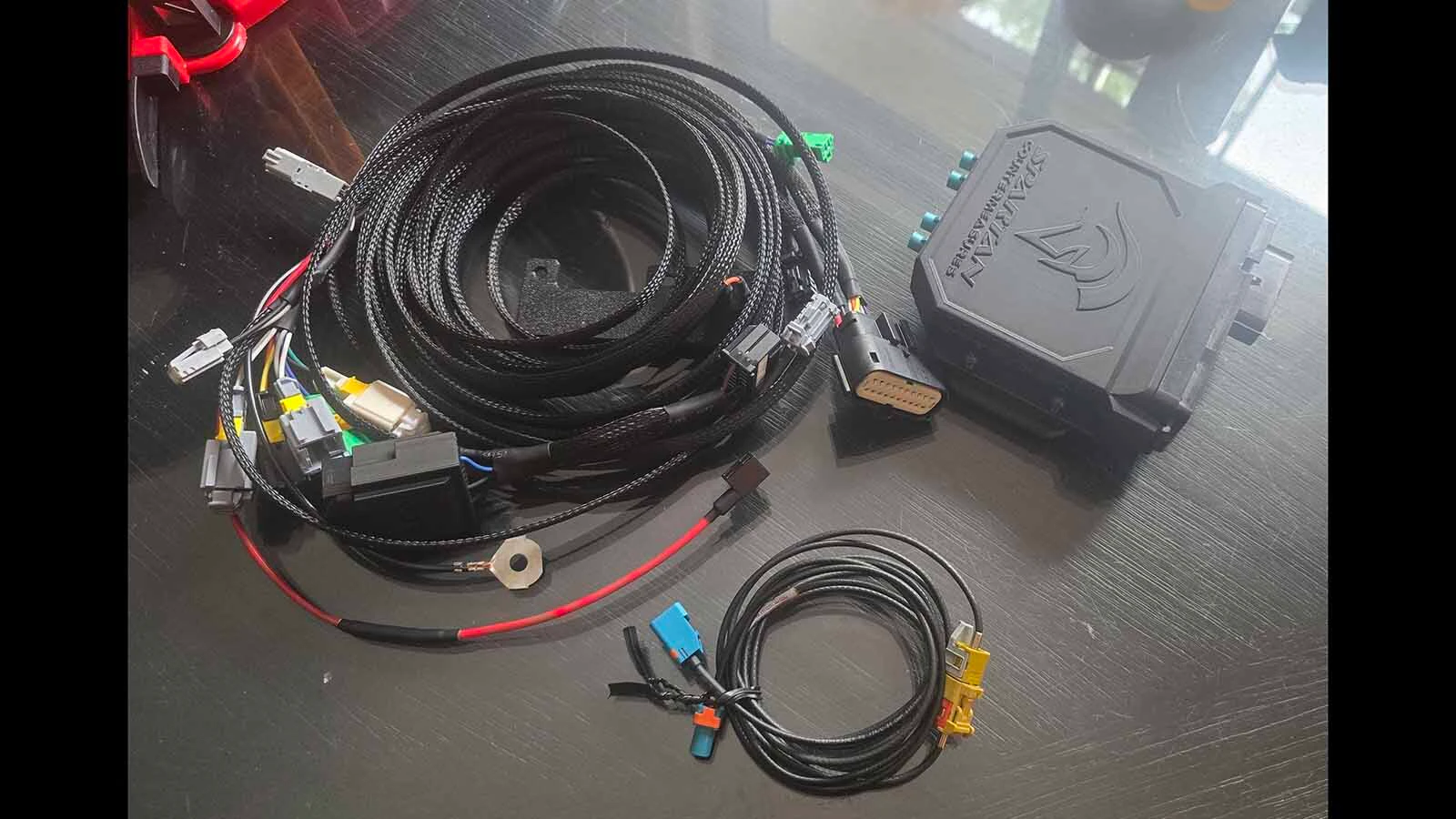
Geouge has now launched a new business, Spartan Countermeasures, and is in the beta-testing phase of his new telematics and data router. He cast the project as a welcome reset: this product is legal.
“We built it because we realized that if an advanced technical mind like Matt’s didn’t engineer a physical firewall to stop the tracking, nobody would or even could,” Jackson said.
If that’s a lofty view of Geouge, his former employer Roger Shiflett, who gave him a job during the criminal case, isn’t going to cut it down.
“He’s a freaking genius,” said Shiflett, who told Cowboy State Daily that he has lost touch with Geouge since the man’s prison stint. “If he’s inventing something, it wouldn’t surprise me one bit. He’s one of those guys.”
The federal government’s 2021 indictment also inadvertently corroborates Geouge’s ability to invent a telematics re-router. It says he loaded, sold, marketed and wrote vehicle software tunes starting as early as age 22 for a business that amassed at least $10 million gross revenue.
But millions of dollars in legal fees, several hundred thousand dollars gone to restitution and multiple business closures later, Geouge is back where he started: Working out of his mother’s garage in Hendersonville.
“It’s simultaneously hilarious and makes me want to rip my hair out,” he said.
Geouge filed for a patent in March 2025, to build and market a hardware device that acts like a train track directional switch. Wired on one end through the auxiliary switch, the device’s other end links to the black box and other data-transmitting devices and lets them operate as normal.
But when the user switches the device to “off,” it reroutes the radio frequency signals into a ground plane on a circuit board instead, said Geouge. It grounds the antenna circuit to his circuit board instead of the atmosphere from which it’s trying to read the circuit, he added.
The Battlefield
Geouge believes he’ll face immense opposition as he unveils his new product, first to aftermarket vendors and car dealerships.
Sure, the government will bristle, he said.
But he theorizes that original equipment manufacturers (OEMs) will erupt, and that they make massive revenues selling people’s data to third parties.
Geouge doesn’t have hard proof of that. But he pointed to a controversy this year in which the car industry threatened to pull its products from the entire state of California over a proposed anti-stalking law.
The law sought to make companies provide an “off switch” option for data-tracking in vehicles.
A lobby group representing General Motors, Toyota, Volkswagen and other lawmakers successfully pushed an alternate bill that punts the deadline to July 2027 instead of July 2026. They called the earlier deadline unrealistic.
California is the most restrictive state in the U.S. regarding vehicle emissions.
And yet, said Geouge, “you never see these OEMs moan and complain about the cost of development in complying with California’s emissions laws,” even though compliance costs billions of dollars.
“To me that’s a pretty damning piece of evidence,” said Geouge.
Beta Tester
Isaac Jones is a flower farmer who lives on the other side of the county from Geouge, and knows him from Geouge’s old diesel-wrenching days.
Jones agreed to let Geouge beta test the routing device in his 2013 F350.
“My truck isn’t quite as complex as the newer ones,” said Jones. “You’ve got like the satellite radio, because that tracks you, then you’ve got the GPS.”
Jones said he’s hopeful that Geouge’s product will have a much broader consumer base than the delete business. That’s because privacy concerns affect the political left and right, the white collar as well as blue collar workers, and especially – added Jones – victims of stalking and other crimes.
“This is a product that will appeal to a little miss in her Ford Festiva or Subaru who, her ex-boyfriend is just a freaking creep and works at the police station,” said Jones.
The hardest part for Geouge, said Jones, is to design and craft tiny connecting devices for each different vehicle model, and all the vehicle’s little modems, antennae, and systems.
When Jones switches off everything, using the switch Geouge put in his truck, the truck is as dumb and disconnected as its 1980s ancestors.
But the AM/FM radio still works.
“Those don’t track you,” Jones said with a laugh.
Clair McFarland can be reached at clair@cowboystatedaily.com.