
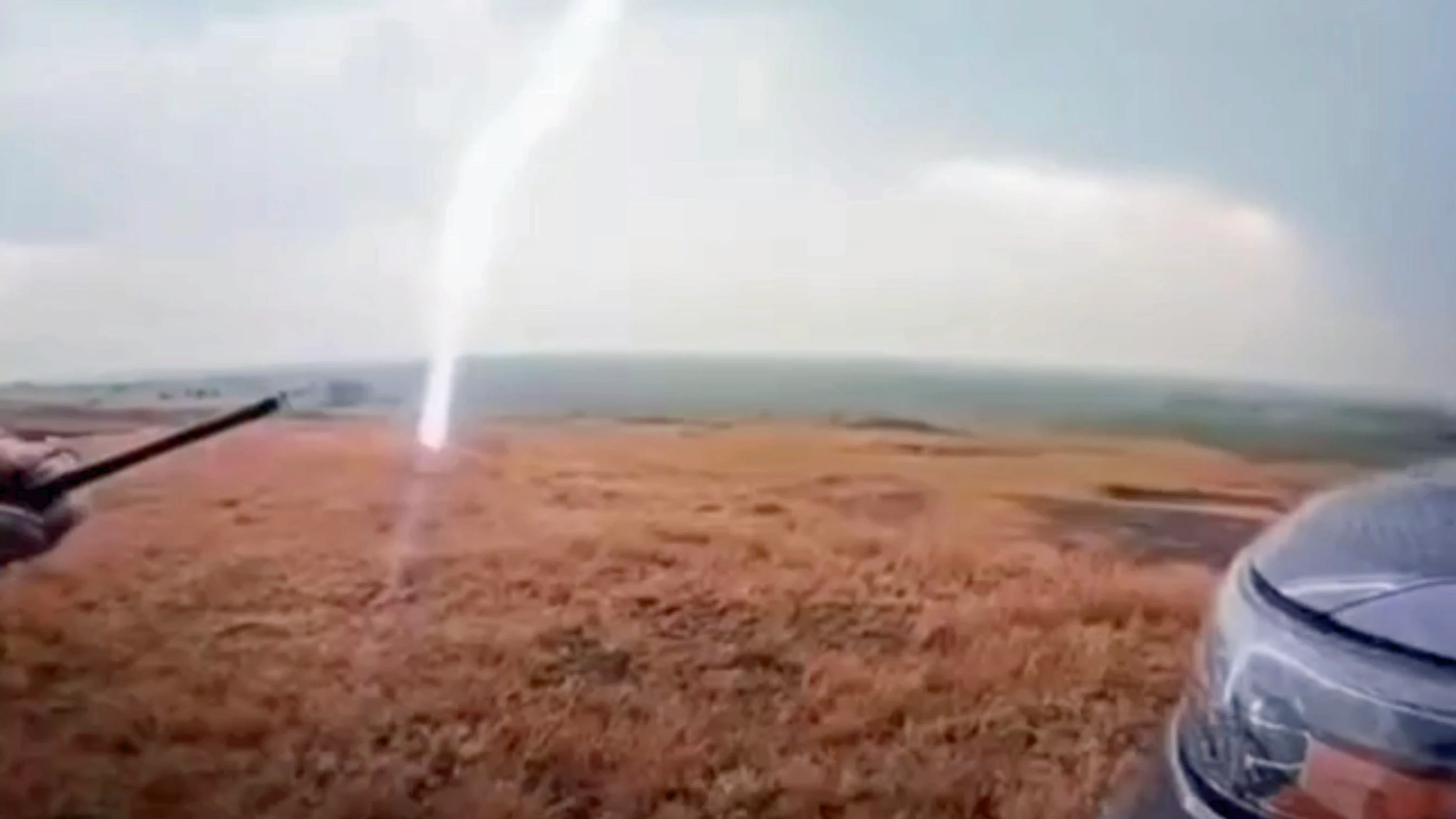
Two South Dakota Highway Patrol troopers nearly got the shock of their life from a lightning strike.
The troopers were searching for someone with “a purple shirt” when lightning suddenly struck the ground just south of Rapid City, according to a video the highway patrol posted.
They were within 50 feet of the spot where the bolt of energy hit the flat, open prairie where they were standing.
The troopers were shocked and ran, but neither was harmed. A typical lightning bolt is 54,000 degrees.
"That's one way to light up a manhunt," the patrol said on its social media post.
One commenter complimented the highway patrol for the abrupt editing of the posted video.
"SDHP editing is great. There was definitely a bad word coming," Justin Harmon wrote.
Another suggested the highway patrol receive some extra funding.
"Better make a note for budgetary increase in uniform pants cause there’s going to be some new ones needed," wrote Mark Lefebre.
The South Dakota Highway Patrol could not be reached for additional information.
The Shocking Truth
August is the peak of “the lightning season” in the Rocky Mountain Region. Atmospheric conditions favor the development of afternoon thunderstorms, which tend to be short-lived but potent enough to generate powerful blasts of lightning.
“Our thunderstorm season is our thunderstorm season in Wyoming, Montana, and the Dakotas, and August is the peak of it,” said Cowboy State Daily meteorologist Don Day.
The common belief is that lightning will always strike the tallest point in any particular area, whether that’s a mountain top, a skyscraper, a tree, or the tallest person in a flat field.
While that tends to be true, Day cautioned it’s “no guarantee.”
“It’s true that you want to be away from the higher ground and the highest object, but lightning is going to go where it wants to go,” he said. “Lightning hits the ground all the time. That’s how we get wildfires on the plains.”
According to the Centers for Disease Control and Prevention, about 37 million lightning strikes hit the ground each year in the United States. The odds of being struck by lightning are less than one in a million, and almost 90% of all lightning strike victims survive.
Nevertheless, there were 517 lightning-related deaths in the U.S. between 2006 and 2025.
In July 2022, a 22-year-old man was killed by a lightning strike during a NOLS wilderness expedition in the Absaroka Mountains. Another man in the vicinity of the strike was severely injured
Many lightning-related deaths and injuries occur without a direct strike. The energy can travel through plumbing and electrical systems, wired devices, and even the metal bars in concrete walls and floors.
“People in the western U.S. have been injured or killed by just being along or touching a fence,” Day said.
How-To Guide
If someone’s concerned about being struck by lightning, the best thing they can do is get low and small.
Whatever you do, don’t drop flat. That might seem obvious, but Day said it’s actually putting yourself in a high-risk position.
“What you want to do is have the least amount of your body touching the ground,” he said. “The best thing you can do is squat in a ball and try to position yourself on the ground so that only your toes are touching, and you’re conducting as little electricity as possible.”
Are there any warnings of an imminent lightning strike? Science says yes but, again, it’s not a guarantee.
“There will be a buildup between the positive and the negative energy before the strike,” Day said. “Some people have heard a light buzzing sound or felt static electricity. There are some famous photos of people with their hair standing up, just like if they’d rubbed a balloon on their head, before a strike.”
Two women at the Horseshoe Bend Overlook in Arizona’s Glen Canyon National Recreation Area experienced this in March 2024. They were amused when their long hair started standing straight up as energy collected in the atmosphere.
Day didn’t find it particularly amusing.
“There is, without a doubt, a very strong correlation between a phenomenon that they observed and an imminent lightning strike,” he said. “So, you probably shouldn’t try to take pictures and upload them to social media.”
Day said these can be “brief warning signals” of an imminent lightning strike, but it doesn’t always manifest that way. There often is no warning.
“The thing about lightning is that it can be really unpredictable where it hits,” he said. “You shouldn't assume that you're going to get that warning sign, but it has happened.”
Just Get Inside
When someone’s hiking in the mountains, working in the fields, or floating on a river during a thunderstorm, there will always be a risk that they could be struck by lightning. In Day’s opinion, it’s a severely underestimated hazard for all Wyomingites.
“I believe that lightning is one of the most underappreciated weather dangers that we live with,” he said. “This may sound like overkill, but if you hear thunder, especially if you know it's close, you're at a risk of being struck or being affected by lightning somehow.”
When out in the open with no shelter, it's best to get low and keep as much of your body off the ground as possible.
The safest option, though, is to go inside when the thunder rumbles. Day doesn’t see that as much of an imposition for the sake of safety.
“In this part of the country, thunderstorms don't last very long,” he said. “If you get chased inside because of thunder and lightning, odds are you're not going to be inside for hours waiting for it to go away. It's one of those things where you get yourself into a safe position, be patient, and let it pass.”
Andrew Rossi can be reached at arossi@cowboystatedaily.com.


