
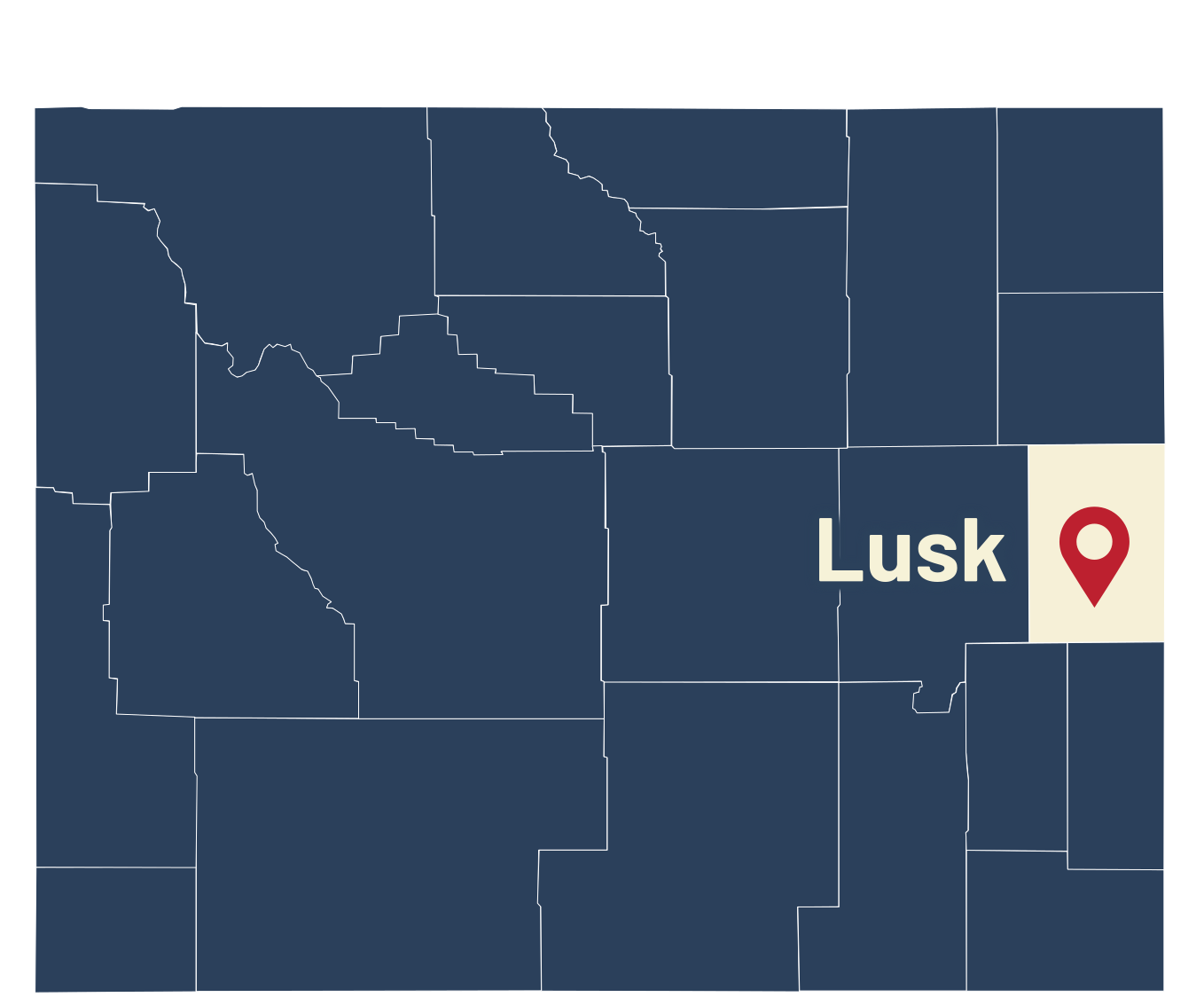

Just over two miles southwest of the little eastern Wyoming town of Lusk, the Lusk Rest Area offers weary travelers a little roadside oasis, complete with picnic shelters, a playground, a wildflower garden, drinking fountains — and an honest-to-goodness telephone.
Not a cellphone, mind you, but the kind that takes actual coins.
Semis rumble past. Families stop to stretch their legs and use the toilets in a building designed to harness energy from the sun and ground.
The black-and-silver payphone is tucked against a brick wall. It's the kind that once stood outside gas stations, in hotel lobbies and bars.
The chrome face is scratched and smudged. A heavy black receiver hangs from its cradle, tethered to the machine by a long steel cord. An orange-and-blue advertisement promises four minutes of in-state long-distance calling for $1, or a local call for 50 cents.
The company whose logo appears on the advertisement, Qwest, hasn't operated under that familiar name for 15 years, but the telephone is still there — and, the thing actually works!
Voice From The Past
The receiver is heavy, built with the heft of something you could chuck through a windshield.
Lift it from the cradle and the telephone responds.
Beep. Beep. Beep. Beep.
Punch a number into the metallic keypad, and a woman's recorded voice comes over the line, matter-of-factly reminding the caller that a 1 must be dialed first.
Apparently, even in 2026, the rules of long-distance calling remain nonnegotiable.
It's a peculiar experience, standing in a Wyoming rest area with a telephone receiver pressed to one ear, being instructed by a disembodied woman on the proper etiquette of making a call.
The metal buttons are sticky, each one answering with a satisfying click as the user dials the number to a faraway library — the only non-resident number she knows by heart.
Someone at a front desk far away chirps a greeting.
“This is the Wyoming Department of Time Travel. What year is it?”
"Excuse me?"
Click.


Every Few Blocks
For much of Carl Niswonger's working life, leaving the house without a phone in hand was normal.
The 80-year-old former Mountain Bell worker spent decades in telecommunications, including time maintaining hundreds of payphones in Yellowstone National Park.
Those machines were more than conveniences. They were a vital connection between travelers and the people waiting for them hundreds or thousands of miles away.
Tourists could call home. A motorist with a broken-down vehicle could summon help. Someone traveling alone could let relatives know where they were and when they expected to arrive.
He remembers the days when payphones were ubiquitous with everyday life.
Back then, they were everywhere. Gas stations, bars, cafes and downtown sidewalks had them.
In some towns, a person might pass one every few blocks.
Niswonger said he never let his daughter go anywhere without change in her pocket. If she needed a ride, she could find a payphone, drop in a coin and call home. Her parents would come get her.
He watched the telephone business change from operator-assisted calls and party lines to a world where people carry a telephone everywhere they go.
"I don't even like the cellphone, but I have to carry one," he said.
At 80, he still has a landline, a benefit of his retirement from the telephone company. He suspects that when it finally stops working, nobody will bother repairing it.

Vandalism
Nowhere was the payphone more indispensable — or more profitable — than Yellowstone National Park.
Niswonger volunteered for his first summer assignment repairing payphones at Yellowstone in 1982. At the time, more than 300 of them were scattered throughout the park, and the work was divided between two technicians.
Each man was responsible for roughly 150 machines, which meant traveling from one location to another, cleaning them, making repairs and collecting the money. They were expected to check the machines at least every other day.
Some of the coin boxes at Old Faithful filled so quickly that Niswonger had to empty them twice a day. Each held roughly $250 in nickels, dimes and quarters, meaning a single machine could bring in about $500 a day.
At the height of the operation, Niswonger recalled shipping approximately $25,000 a week in coins from the southern half of Yellowstone to a counting center in Denver. His counterparts on the northern side, which included the bustling Old Faithful area in the southwest part of the park, shipped twice that.
"I never left the truck unlocked," he said. "That was a cardinal rule. We had to protect that money."
Vandalism was one of the biggest headaches. People snapped receiver cords, broke the dialing mechanisms and damaged the hookswitches. Others tried to steal the machines outright, hoping to crack open their metal bellies and get at the coins.
Once, a county sheriff returned a stolen pay phone that thieves had attacked with hammers and picks. The machine was destroyed.
The coin box, however, remained stubbornly intact.
"All I had to do was order a key," Niswonger recalled.
He opened the box, recovered the money and sent the battered telephone to the scrap heap.
The last known Yellowstone payphone was reported dead this summer.
Telephone Company That Disappeared
Mike Horan, a WYDOT spokesman, said that while the agency owns and maintains the rest area, it doesn't own or maintain the payphone, collect money from it or pay for its telephone service.
The orange-and-blue Qwest logo on the Lusk payphone is a relic survivor of a complicated corporate family tree stretching back to the days when telephone service was a regional business.
For much of the 20th century, Wyoming's telephone system was associated with Mountain Bell, part of the Bell System that connected communities throughout the Rocky Mountain West.
Mountain Bell's operations eventually became part of U S West, one of the regional companies formed after the breakup of the Bell System in 1984.
In 2000, Qwest acquired U S West, bringing its name and distinctive blue-and-orange branding to telephone equipment, advertisements, bills and company vehicles across the region.
Eleven years later, Qwest itself was swallowed by CenturyLink.
In July 2024, WYDOT surveyed its five districts to find out how many payphones were still standing. Four districts responded, identifying 10 machines. The fifth district never responded, meaning there could be more.
For now, they're not costing WYDOT anything, so the agency has largely left them alone.
Wyoming's First Of A Kind
In the 1960s, President Lyndon Johnson and first lady Lady Bird Johnson championed an ambitious campaign to improve the appearance of America's highways.
Their efforts helped produce the Highway Beautification Act of 1965, encouraging landscaping, the removal of unsightly billboards and improvements to roadside facilities.
In February 1966, the Wyoming Highway Department hired an architect to design what would become the state's first roadside beautification area at Lusk.
At the time, its amenities were something of a revelation.
There were picnic tables, shelters, barbecue grills and playground equipment, including swings, a slide and a merry-go-round.
It became a popular local picnic destination, not merely a place for weary motorists to make a quick stop.
Decades later, the state decided to bring the aging facility into a new century.
In 1998, WYDOT partnered with the Federal Highway Administration and a Wyoming architect on an updated design incorporating passive solar and geothermal technology.
The new building used sunlight, thermal mass and ground-source heating and cooling to reduce energy consumption.
It reopened in November 2000, bringing the roadside stop into the 21st century.
Today, visitors can still see signs explaining the unusual building design.
Outside are mature trees, grassy lawns, picnic shelters and a playground. A small area is marked as pollinator habitat, while drinking-water stations stand ready for passing travelers.
And inside, mounted against the brickwork, is an old-fashioned piece of technology still doing the very job it was built to do decades ago — connecting one human being to another.
Kolby Fedore can be reached at kolby@cowboystatedaily.com.


