
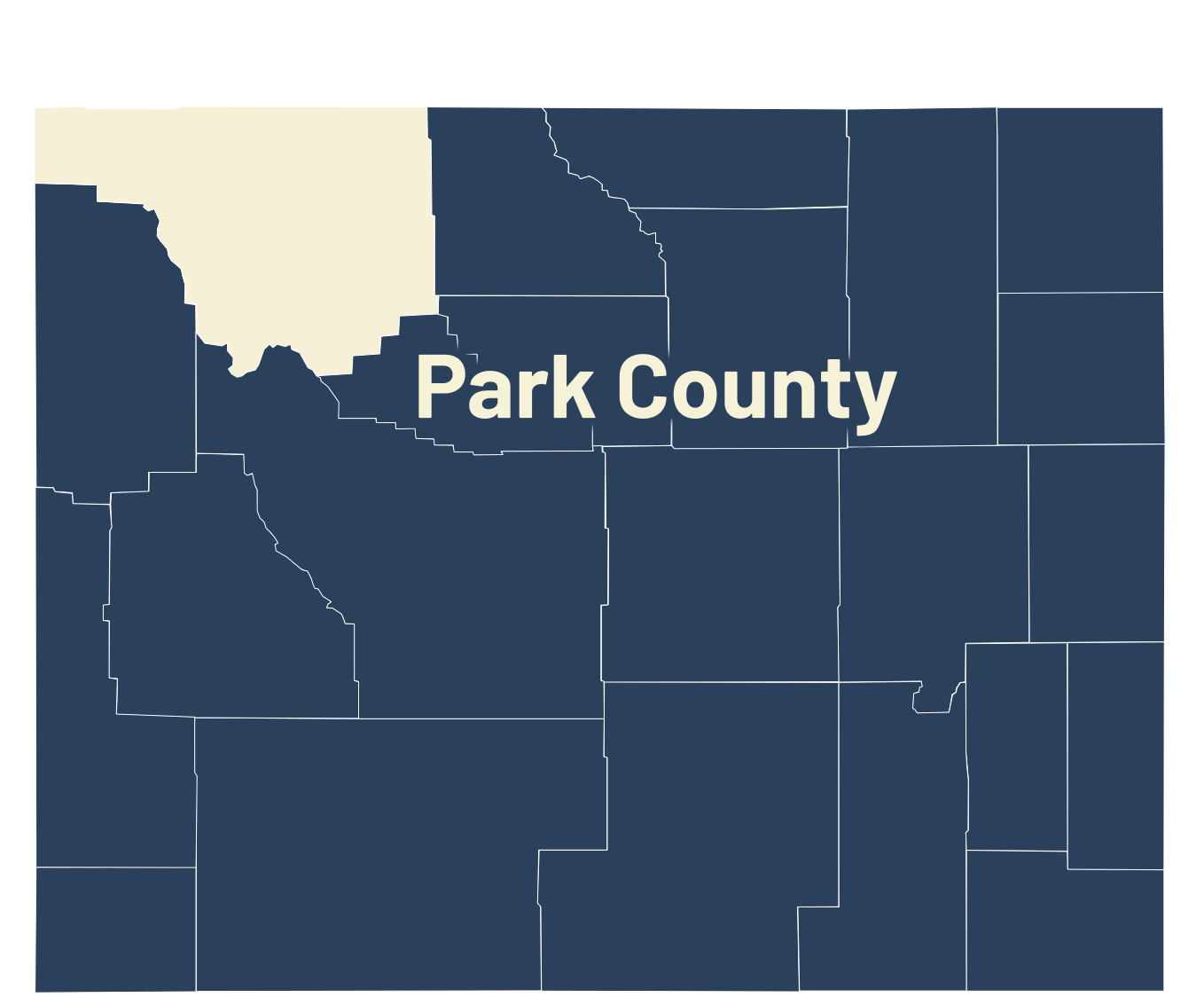

Dozens of horses might have been exposed to a highly contagious disease recently at the Park County Fair in Powell.
On Tuesday, Smallwood Horses announced it was placing its Powell facility under a voluntary two-week quarantine after one of its horses presented symptoms of an infection of the bacterium Streptococcus equi, also known as Strangles.
“This horse presented no symptoms before, during, or immediately after (the) fair,” Ashley Smallwood said in a statement. “Veterinarians contacted about possible exposure suggest that the horses attending the fair be monitored for symptoms.”
Britt Whitt of Whitt Veterinary Services in Powell released a statement saying strangles is “a highly infectious disease” with “high morbidity and low mortality.”
“In the case of an outbreak, many animals that are exposed will develop the disease, but very few will die from the disease,” Whitt said.
Whitt was not available for additional information at the time of publication. Smallwood told Cowboy State Daily she would “absolutely not” discuss the exposure and quarantine.
How Serious Is Strangles?
Erin Brus is a Certified Equine Massage Therapist (CEMT), veterinary technician, and horse owner working in Park County. She had strong feelings about the strangles exposure at the Park County Fair.
“On a personal level, there are a lot of words I cannot use,” she told Cowboy State Daily. “On a professional level, I’m severely disappointed.”
Brus explained that strangles affects horses like a combination of “pneumonia and a really bad head cold.” Symptoms include a high fever, swollen lymph nodes, nasal discharge, lethargy, and loss of appetite.
What concerns Brus and other horse owners is how easily strangles can spread.
“It is, by far, one of the most contagious sicknesses there is,” she said. “It’s as easy as sharing a water or feed bucket with a friend, and owners can transfer it off their boots, jeans, shirts, and hands.”
Brus said she’s constantly disinfecting her equipment and herself to prevent spreading any infections to the horses she owns and works with.
“I’m a paranoid horse owner that when I heard about this, I immediately texted the vet I work with to see if I needed to do anything,” she said.
Around 75% of horses infected with strangles come out of it within two weeks and develop an immunity within three to six weeks, according to Brus. The infection can be fatal, but usually only for foals or immunocompromised adults.
Where’s The Outrage?
Brus has been following the spread of strangles this summer. According to the data she’s reviewed, via northernag.net, the impact has stretched across Wyoming.
“We have 12 confirmed cases in Wyoming across seven different counties this summer,” she said.
A June 17 article published on northernag.net said that strangles cases had been confirmed in Albany, Campbell, Carbon, Converse, Park, Sweetwater, and Weston counties.
In her statement, Smallwood said, “We can all use this as a learning experience about biosecurity when traveling,” and that “when we do take our horses places, they can be exposed to disease without knowing.”
Brus took some exception to that, calling out “the horse community as a whole" for not testing their horses before taking them to fairs, rodeos, and other events throughout the country.
“If you are taking your horse anywhere — the fair, across state lines, to a sale — you need to be doing a full panel for everything,” she said. “You need to see if your horse has any diseases, sicknesses, or issues before you do anything.”
Brus said she believes the Park County Fairgrounds and other Wyoming venues with horse-related events should implement mandatory bacterial cultures, blood tests, and polymerase chain reaction (PCR) tests before any horses are allowed on the grounds.
If the horse comes back clean, off to the fair. If it doesn’t, the horse can be quarantined at home without the risk of infecting other horses at a high-density event like a fair or rodeo.
“It's the wisest decision, especially in (Park County),” she said. “You have rodeo people coming in and out all summer. It’s 90 days of people in and out consistently. If you’re going anywhere with your horses, more people need to do it.”
In November 2025, an outbreak of equine herpesvirus-1 (EHV-1) and EHV-4 was reported in four states. If infected animals aren’t treated, the respiratory illnesses can progress into equine herpes myeloencephalopathy, a serious neurological condition with a 75% mortality rate.
The source of the outbreak was a horse at the World Championship Barrel Racing Finals in Waco, Texas. Around 1,000 horses attended the event.
Like strangles, EHV-1 and EHV-4 can be spread by horse-to-horse contact as well as via shared buckets and people's clothes and equipment.
Better Safe Than Sorry
Of all the thoughts and emotions Brus had when she heard about the strangles exposure at the Park County Fair, she wasn’t surprised.
“Professionally, I am disappointed in the horse community as a whole,” she said. “Getting horses tested needs to be at the forefront of their minds, and many aren’t doing it.”
Brus doesn’t see the strangles situation at the Park County Fair as an unfortunate accident. Even if the infected horse wasn’t showing symptoms, it clearly had been exposed to strangles at some point.
“The best way to beat this thing is when it hasn’t fully developed in their system,” she said. “If you share a water bucket with a friend, now both your horses have strangles because one of them was a carrier without symptoms. Even if you’re taking your horse to visit a friend’s house, you don’t know if they’ve gotten their horse tested.”
In Brus’ opinion, the lesson from the Park County Fair incident is the consequences of irresponsibility.
If someone’s horse is going to mingle with other horses from around the state, it should have a clean bill of health, even when it isn’t showing symptoms. Brus said that isn’t happening, which is how strangles and other equine diseases spread so far and quickly.
“If you’re smart, you’ll get ahead of it,” she said. “PCRS don’t cost that much. Microbial cultures are two-day, low-cost. When you get your horse tested, it clears everything up.
Brus also shared her concern about upcoming fairs. Several are already underway, and the Wyoming State Fair in Douglas starts Aug. 11.
Could a horse exposed to strangles at the Park County Fair show up and spread the infection at other fairs? Brus said there’s a good chance it could happen, and might already be underway.
“From what I've heard, they're keeping it under wraps because they don't want to panic the community,” she said. “Fairs are a huge thing right now, and with a Park County outbreak, we don't know what state fairs are even going to look like.”
Prevention is the best way to protect horses from strangles, she said. That’s why Brus wishes, and hopes, more horse owners will start regularly testing their horses before taking them anywhere.
“It’s like going to a walk-in clinic for a cold and getting antibiotics early,” she said. “It’s better to be safe than sorry.”
Andrew Rossi can be reached at arossi@cowboystatedaily.com.


