

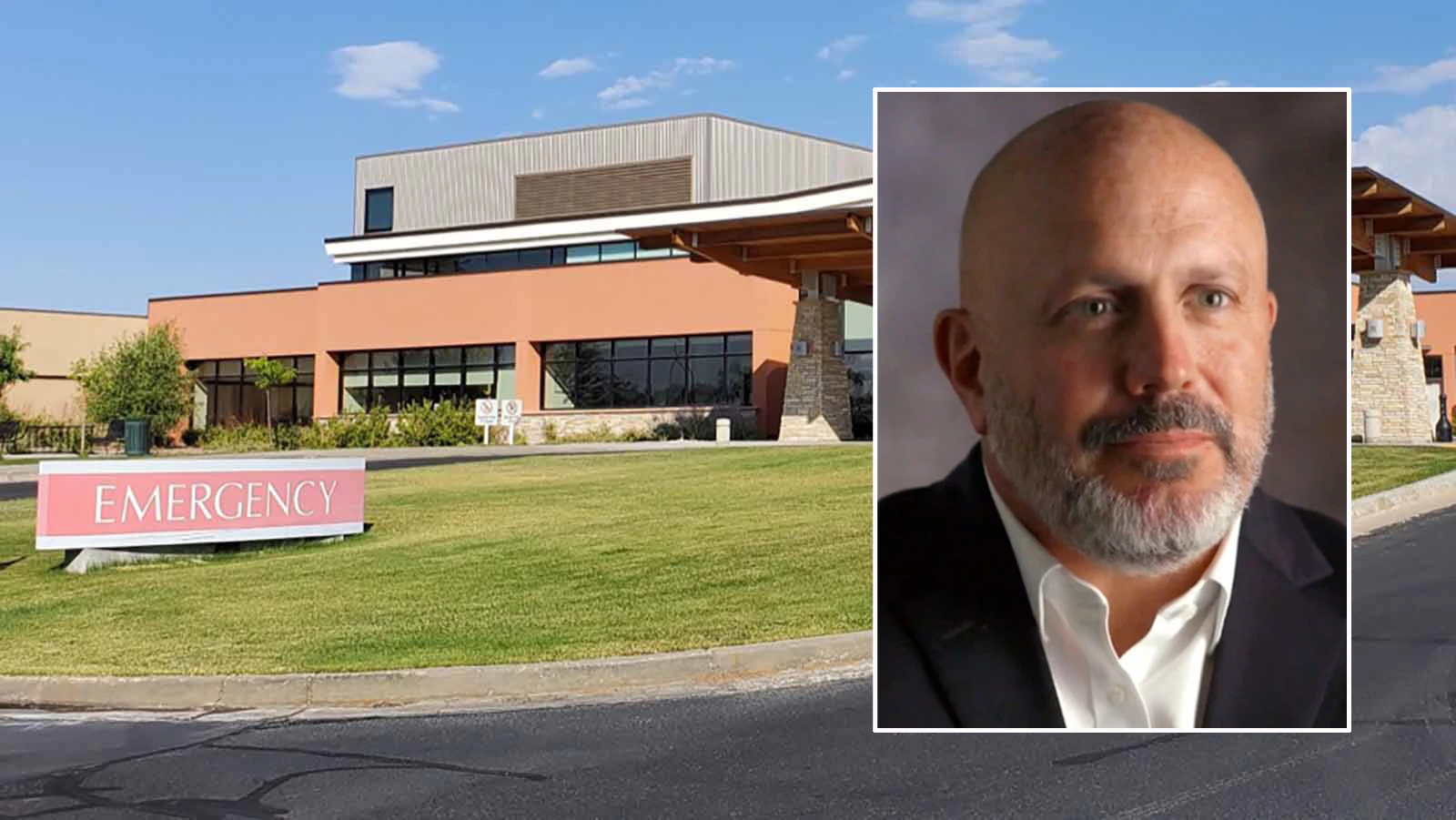
The patient who broke a Rock Springs nurse's nose and chased him through a hospital emergency department last week cannot be criminally prosecuted because the attack was the direct result of severe mental illness, Sweetwater County Attorney Danny Erramouspe said Monday.
Wyoming law requires a person to have a necessary level of mental capacity and intent to be held criminally responsible for an act. The patient did not have that mental capacity, Erramouspe said.
“It was clear that due to this individual's severe mental illness we would not be able to prosecute," Erramouspe told Cowboy State Daily, adding in an official statement that it was not an easy decision.
“These are among the most difficult decisions prosecutors make. I never take any satisfaction in telling a victim that charges cannot be filed, but it is sometimes required by law and the facts.”
What Happened In Rock Springs
The explanation comes one week after Christian R., an emergency room nurse at Memorial Hospital of Sweetwater County, was punched in the face after asking the patient if he’d taken his nighttime medication.
Christian, who asked Cowboy State Daily to withhold his last name, said the blow broke his nose and touched off a chase through the emergency department, where the patient repeatedly caught him and continued the attack by throwing more punches and kneeing him in the head and face.
A security officer intervened as the chase reached the department lobby, allowing Christian to seek the safety of a locked supply closet. He was treated for a nasal fracture, facial injuries and bruising.
Before the attack, the patient had been committed to the Wyoming State Hospital in Evanston, where he received psychiatric care under court order. The patient was being treated under Wyoming's Title 25 statute, the state's legal process for involuntarily hospitalizing people whose mental illness makes them a danger to themselves or others.
At some point, doctors determined his condition had improved enough to enter what is known as the convalescent phase of treatment, which serves as a transitional stage between inpatient hospitalization and full release.
In this stage, the patient was returned to Sweetwater County and continued treatment through Southwest Counseling.
But the transition did not go smoothly.
“Earlier in the day I had a separate conversation with the patient … and he was normal to me and didn’t pose a threat,” Christian said. “It wasn’t until the incident that it (changed).”
Sweetwater County Attorney Said
Under the mens rea standard, a Latin term translated as a "guilty mind,” prosecutors must prove not only that a person committed a criminal act, but also that they possessed the mental capacity and intent necessary to be held responsible for it.
"We get cases like this periodically," Errasmoupse said. "Someone has dementia. Someone has a traumatic brain injury. Sometimes a special-education student with diminished mental capacity assaults a teacher or aide."
That does not automatically shield someone from criminal responsibility, but in this case, Erramouspe said, the patient's psychiatric condition was so central to the attack that criminal prosecution was not legally available.
"Sometimes people are injured and are victims of something that we can't ethically or legally charge," he said.
Civil Options Also Face Significant Hurdles
The county attorney's decision closes the door on criminal prosecution, but not necessarily every legal remedy.
Mark Aronowitz, a Jackson attorney with the Spence Law Firm and president of the Wyoming Trial Lawyers Association, explained that civil lawsuits operate under a much lower burden of proof than criminal cases.
Even so, Aronowitz said the path to a civil case would be complicated, beginning with the practical questions about a patients’ financial resources and ability to satisfy a judgment.
"Even if you prove they were negligent and breached their duty, is this someone you can even recover from?" He said.
Aronowitz explained that such an incident might be more likely to implicate institutional liability. Whether that liability exists here would depend on facts that are not yet publicly known, namely what providers knew about the patient's history before the assault.
"If this person has a known history of doing this, if there were five other assaults in the last year, then there might be accountability somewhere because someone could have done something to prevent the sixth time," Aronowitz said.
On the other hand, if the incident stemmed from an unexpected deterioration in the patient's condition, as the hospital implied, a civil suit would likely fail.
"If it's a one-off without any foreseeability, without any notice or knowledge, then it's hard to say to somebody, 'You should have seen this coming,'" he said.
Christian told Cowboy State Daily previously he intended to pursue criminal charges; he did not indicate an intention to pursue a civil lawsuit..
He is entitled to workers compensation, which would cover workplace-injury-related medical care as well as around two‑thirds of lost wages.
A System Without Easy Answers
Christian’s misfortune highlights one of the most difficult realities in behavioral healthcare: predicting when a person is truly ready to return to the community.
Lindsay Simineo, executive director of the Wyoming Behavioral Health Alliance, said involuntary commitments may stabilize a person's condition, but it doesn’t mean a person's struggles are over.
Wyoming's Title 25 system is built around a difficult balance between public safety and individual liberty, she said.
"We want to be able to protect the public and protect people from themselves when they are in danger," Simineo said. "We also do not want to have a system that can take the rights of people easily."
The question hanging over the incident in Rock Springs is whether the assault reflects a failure by a provider, a facility, or Wyoming's broader mental-health system.
Simineo cautioned against assuming any one answer.
Mental illness is often not a one-time crisis, she said, but an ongoing cycle of stabilization, decline and renewed treatment.
"If somebody is considered chronically mentally ill, then you can see these repeated cycles of somebody becoming stable and then they go back," she said. "They can have a structured treatment plan that's given upon release, but if they don't engage with it, then yes, they are going to need additional support again."
At the same time, Simineo said providers can only control so much.
"Humans have free will and humans have choice," she said.
For that reason, she believes the more productive question might not be who failed, but what additional resources, safeguards or supports might prevent similar incidents.
"What did they need in addition?" she said. "What do they need in addition to make situations like this less frequent?"
Erramouspe expressed a similar view.
"The mental health crisis is much larger than Title 25, and it's larger than what the Sweetwater County Attorney's Office can address," he said. "That's just the nature of mental health. Somebody has to deal with these patients, and many times it puts healthcare workers in a very dangerous situation."
Zakary Sonntag can be reached at zakary@cowboystatedaily.com.


