

Four candidates are running for the Republican nomination to a legislative House seat in north-central Wyoming – and they all say they won’t join the Freedom Caucus.
That seat’s incumbent and outgoing Rep. John Winter, R-Thermopolis, is a founding member of the Wyoming Freedom Caucus.
But the four men vying to replace him in House District 28 all told Cowboy State Daily on Monday they don’t intend to join the group.
Those are Meeteetse rancher Allen Hogg, Otto rancher Carlin Jones, Thermopolis attorney and former Navy SEAL Marshall Keller, and embattled Star Plunge hot springs pool operator Roland Luehne.
“I don’t believe I should be taking orders from a caucus,” said Keller. “I believe I should be listening to my constituents, for one.”
The Wyoming Freedom Caucus is a controversial group of state House Republicans. Its proponents say it’s the true voice of the Wyoming right; its detractors accuse it of sloppy legislating and groupthink.
It’s part of a larger national network of Freedom Caucus groups.
While the caucus has denied giving marching orders, its members have coordinated floor maneuvers in a group text with the state group’s director, court documents show.
“A lot of the stances in the Freedom Caucus, in my opinion, are more based on trying to get newspaper articles and time in front of social media and TV,” said Keller. “To pound their chests and say, ‘Look what I’m doing, and the courts and everybody else is against us.’ Instead of, looking at the Constitution and the laws we have and adjusting them based on what we can do.”
Keller, 54, said he’s an orthodox Christian and respects both the U.S. Constitution and Wyoming Constitution. He said he’ll follow the Wyoming Republican Party platform insofar as it doesn’t conflict with his faith or either constitution.
Jones, 33, said the caucus “muddies the waters” and it’s time for Republicans to unite around the state platform and curb division.
The division is not always the caucus’ fault, said Jones.
“At this point it’s creating a division that is harmful,” he said. “I don’t know whether it’s justified or not. But it’s there.”
Jones emphasized in a later text message that he finds the caucus’ planks “logical and sound.”
Luehne, 62, said he’s willing to vote with the caucus at times but “won’t be owned by them.”
“I don’t want to be owned by any interest groups,” said Luehne.
Hogg, 66, said he likes the caucus position on a lot of issues, but dislikes its methods. Secondly, he said, “they speak out of one side of their mouth when they say, ‘We want to maintain local control,’” but they counter that by voting to cut property taxes.
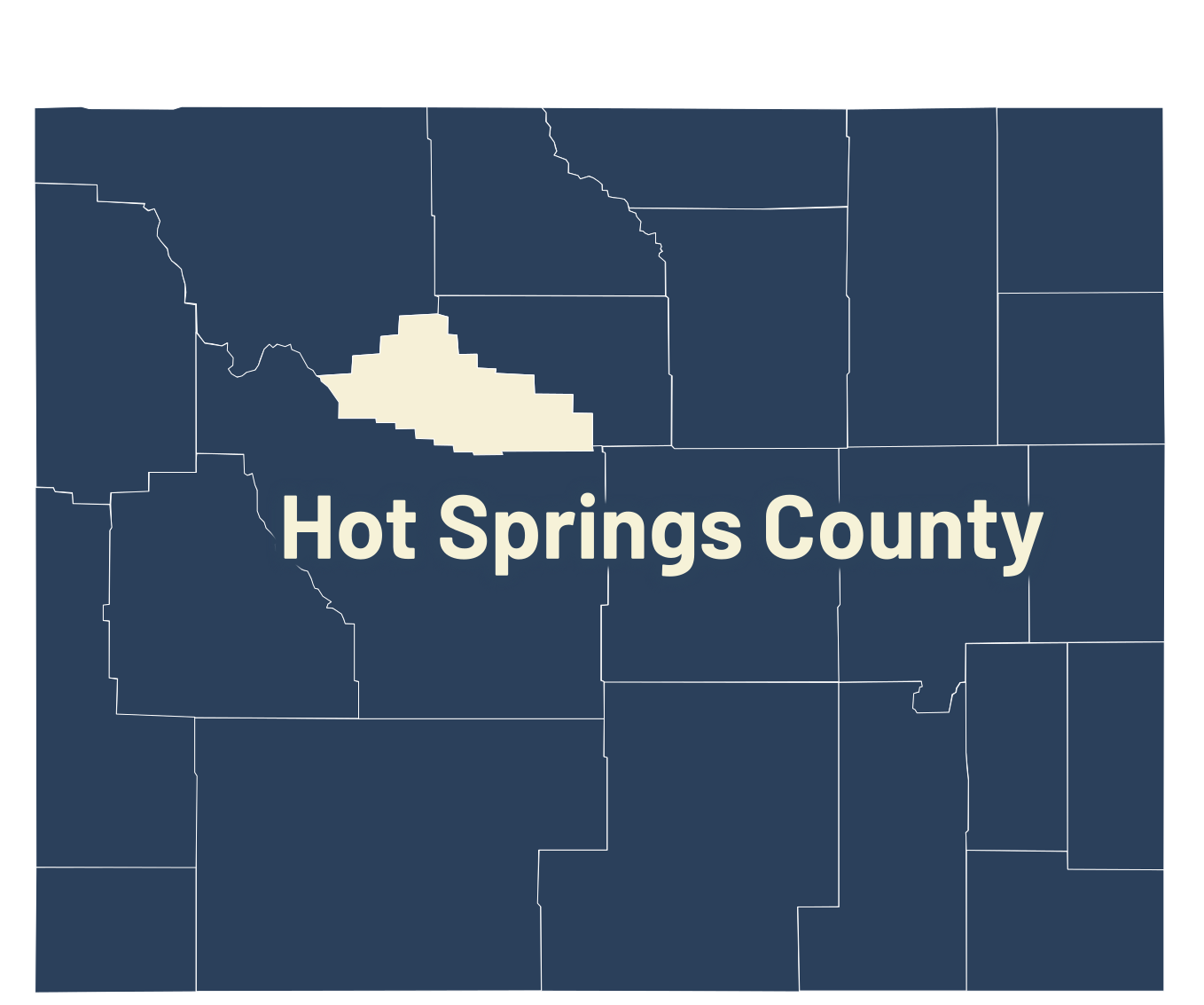
House District 28 covers all of Hot Springs County and parts of Park, Big Horn and Fremont counties. The primary election is Aug. 18.
State Rep. John Bear, R-Gillette, said on behalf of the caucus, "The new representative for HD 28 has big shoes to fill."
Winter has served in the House since 2019.
"At the end of the day," continued Bear, "there are only ever two votes: aye or nay."
Bear asserted that if people are voting with the Freedom Caucus, "they'll be voting for tax relief, parental rights, and smaller government."
The "smaller government" claim sits differently with different people. On the one hand, cutting property taxes cuts government. On the other hand, Hogg noted, it could prompt more state-controlled revenue structures and erode local governments' autonomy.
Bear added: "I find it curious how you characterized Carlin's response. We have a very different statement from him."
And There’s The Difference
All four men cast themselves as conservative.
Jones, Hogg and Keller said they’re pro-life. Luehne said he’s pro-life but up to about 90 days’ gestation,. “I like women to be able to choose,” he said.
They gave varying thoughts on the 50% residential property tax cut slated to appear on the November general election ballot.
Here Keller and Hogg diverged from Luehne and Jones.
“I’m not a fan,” said Keller. He noted that the Legislature delivered a 25% residential property cut last year. Property taxes fund schools and local governments. Firefighters rely heavily on those revenues, as do other county services.
“We haven’t even had time to observe fully the effect of the current reduction in taxes,” said Keller, who’s a trustee for the Hot Springs County School Board. “We’re still figuring out how to deal with that.”
Hogg said he agreed with the 25% cut when it passed, but as he learns more about what property taxes fund, he’s opposed to the ballot initiative.
“That’s going to hit way too hard, especially on the smaller communities,” said Hogg. “It takes away from the local control.”
Hogg said shifting the state’s revenues onto other kinds of taxes also shifts power to the state government, away from county governments.
Starting Point
Jones favors the 50% proposed cut and said cutting residential property taxes altogether would be a good starting point in the broader war against property taxes. He cast property taxes as unjust.
“We have to take a serious look at government expenditures, a serious look at waste and overspending,” said Jones, adding that Wyoming doesn’t have a revenue problem but a spending problem.
“I’m not even sure it’d be necessary to issue an alternative tax,” he said.
Luehne told Cowboy State Daily on Monday that property taxes have gotten out of hand, and questioned why a person should still have to pay the government to live in a home once that home is paid off.
“I’d like to get rid of it if possible,” said Luehne of property taxes. “We need to cut it as far back as humanly possible.”
Like Jones, Luehne said the government should accommodate property tax cuts by downsizing.
“If it means losing a few state jobs I think that might be the right thing to do,” he said. “I’m sure they can find money other places than just property taxes. I think we can be creative enough.”
When lawmakers considered a bill to eliminate property taxes altogether in November, analysts anticipated it would remove roughly $644 million per year from local governments and schools.
That’s based on an LSO document that draws from 2025 assessments.
Each new “penny” or 1% sales tax brings the state about $237.5 million based on the 2025 distribution, Wyoming Department of Revenue Director Brett Fanning told lawmakers at the time.
So a 2% sales tax increase would bring the state $475 million “give or take,” he said.
A summary report from the Wyoming Department of Audit says counties’ collective revenues outpaced expenditures by about $199.4 million in fiscal year 2025. Special districts’ revenue outpaced expense by about $55.3 million, reportedly.
The picture was bleaker for Hot Springs County.
It posted nearly $9.8 million in revenues and more than $11 million in total costs.
Thermopolis posted nearly $6.8 million in total revenue and more than $6.9 million in total expenses in fiscal 2025.
Data Centers
Jones said he’s concerned about data centers and potential power rate and water utility rate hikes.
“They seem to promise the world and fall short,” said Jones. “Right now they have their eyes on Wyoming because we’re rich in energy. We have wide open spaces.”
Jones said he wants to protect Wyomingites from those potential cost fallouts and has concerns about “what data are they even processing?”
Keller, Jones, Luehne, and Hogg all indicated they want to end Wyoming’s sales tax break for large data center projects. Keller called the break “a bunch of horse shit” and said he too wants to insulate power users and residents from unfair costs brought by data centers.
Keller said he wouldn’t take data center opposition so far as to violate private landowners’ rights, however.
“If you have a complete ban, that’s the ultimate regulation, in my opinion,” said Keller. “I believe it violates private property rights, of people that own the land that may want to do business with them.”
Hogg also said a total ban isn’t feasible. The businesses have already set up shop in Wyoming.
But, Hogg emphasized Wyoming’s state agencies should regulate data centers, and its local governments should vet them as they approach each community.
Again, Hogg urged local control.
And beyond cutting the tax break, he said he’d like to find ways to lift more revenue off data centers.
Luehne said Wyoming should strike a balance between protecting citizens and reaping the economic benefits data centers can bring.
"They key is making the right deal," said Luehne.
The Silo
Hogg and Keller both disagree with the Legislature’s new “silo” barring school districts from using a sizable influx of public money in areas besides classroom instruction, largely teacher pay.
That erodes the ability of school districts closest to the students to put money where needed, said Hogg.
“Let the local boards decide where that goes,” said Hogg.
For Keller, the silo was “probably the breaking straw.”
“I didn’t see how it was fair to our bus drivers and custodians, and those type of people, to have them not be able to get a pay raise,” said Keller.
Teachers are slated for a roughly 12% pay raise under the silo system, while many schools are seeing other budget areas, and activities funding, drop.
“You can’t tell me that doesn’t instantly create division,” Keller said.
Economic Development
Luehne told Cowboy State Daily he’s running to boost private sector jobs. His economic vision prioritizes jobs, then taking care of seniors, farmers and ranchers, he said.
As operator of Star Plunge, Luehne has been involved in a lengthy battle with the State of Wyoming, in which he’s accused of cheating his company out of a lease deal.
“I’ve had so many people ask me to run because of my situation in the Hot Springs State Park,” said Luehne. “I personally have seen how the executive branch has overstepped with land grabs. I want to make sure something like that never happens to somebody else.”
He said he wants to create things to help economic development of communities, especially by paring back rules and regulations.
Jones also lamented what he called executive-branch overreach. He said the state engineer’s office has put rigid restrictions on his ranch, which took him a year and a half to resolve.
Jones also decried the long-running battle between the Thermopolis owners of the Tipi Resort and an earlier iteration of the Hot Springs County Commission, whose permit denial persisted through court challenges.
Backgrounds
Hogg said he stands out from his opponents through his lengthy ranching experience. His grandparents settled in the Meeteetse area in 1918 and his family has ranched the land since, he said.
“I think compared to my competitors, especially, I think I’ve got a much better idea of the issues surrounding agriculture in Wyoming,” he said. “I think that’s one of my strong suits.”
Hogg and Jones are both multi-generation Wyoming ranchers.
Keller moved to Gillette in 2011 and has remained in Wyoming since. That followed his military career, graduation from Montana Tech University and a boom-bust brush with gold mining in Nevada working as an exploration geologist.
“I got tired of chasing the commodity cycles,” he said.
He pivoted and earned his law degree from the University of Wyoming in 2019, he said.
Cowboy State Daily has reviewed documents confirming Keller served as a Navy SEAL.
Jones said he’s a lifelong Wyoming resident and fourth-generation rancher.
He said he hopes his youth brings fresh perspective.
“I feel that young energy paired with the wisdom of the other people in Cheyenne could be of great benefit to the people of Wyoming,” Jones said.
Luehne said he’s lived in Thermopolis since he was 10 years old, and has been helping to run the park since that time. He said he’s running to restore balance to the three branches of government and curb what he called the oversteps of the executive branch.
Clair McFarland can be reached at clair@cowboystatedaily.com.


