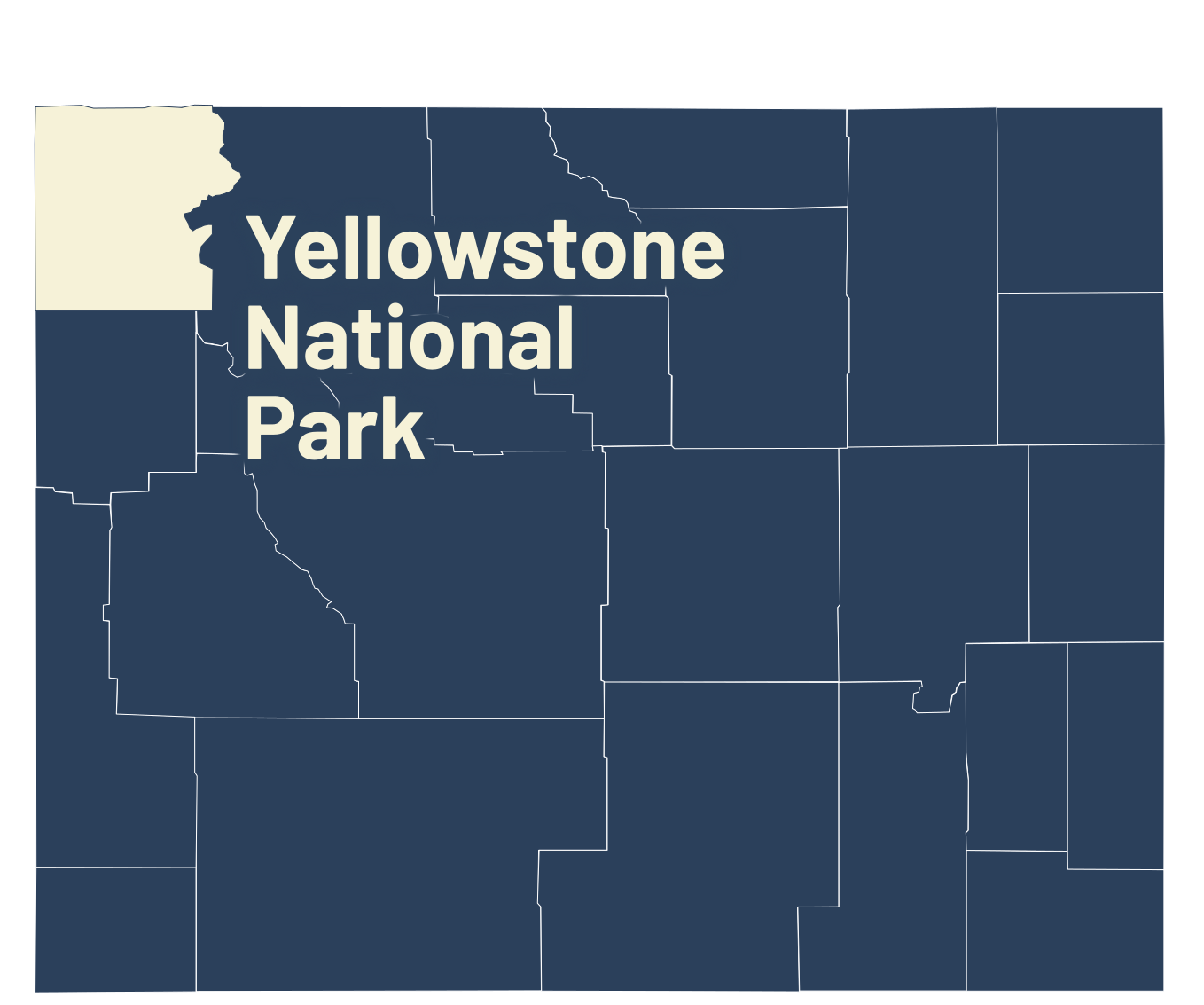
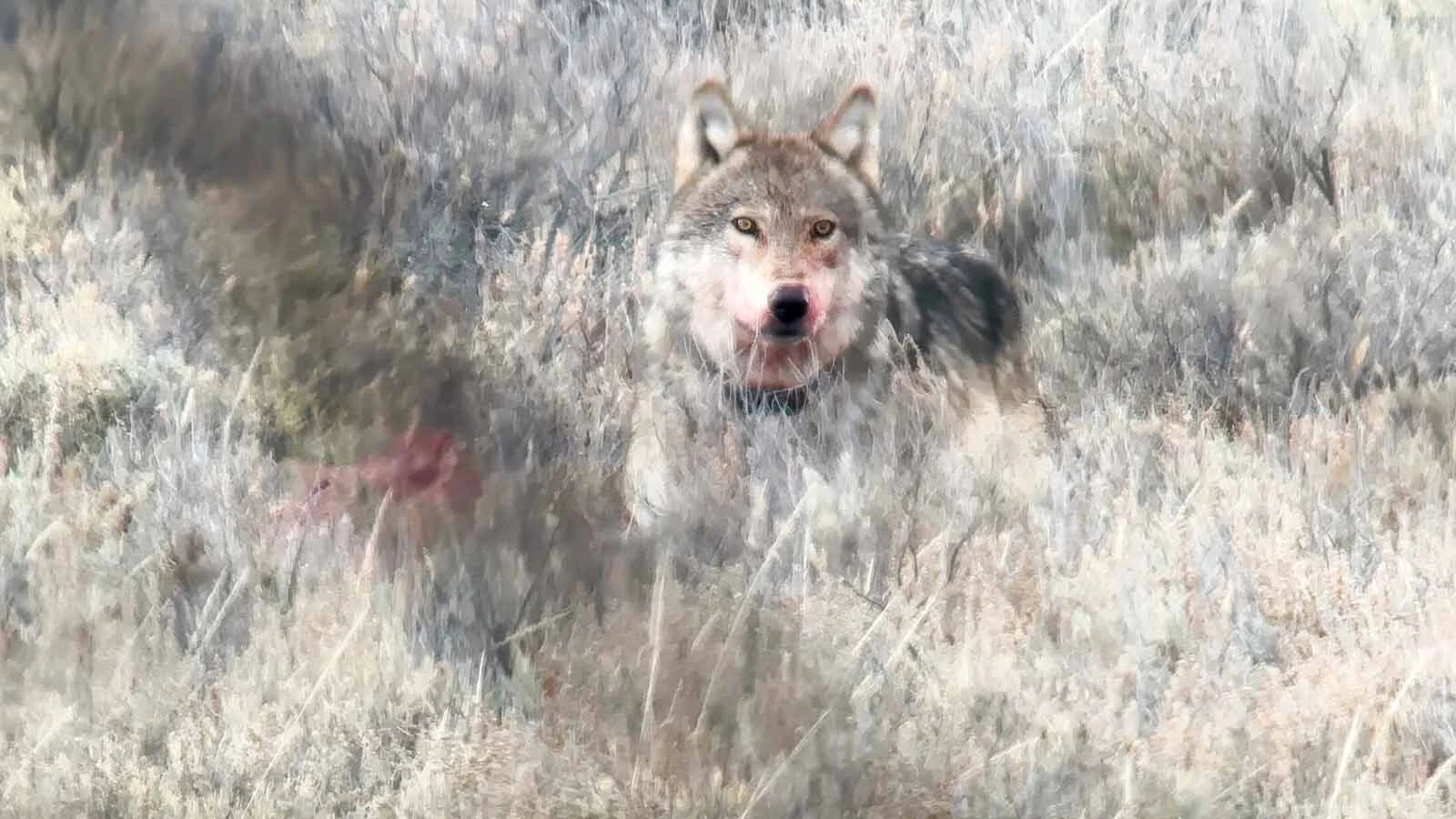
Yellowstone National Park's famed oldest wolf pack, the Mollie’s, was just following its stomachs when it left the safety of the park's boundaries recently and denned on the Shoshone National Forest, a Wyoming Game and Fish Department biologist says.
"They're looking for food," Ken Mills told Cowboy State Daily during an online interview Thursday.
The Mollie's have made brief forays out of the park previously. But this year, they made an unprecedented move, said Mills, a large carnivore biologist and wolf management specialist, and in doing so have created a tempest of controversy.
The Mollie's settled down east of Yellowstone — and within the boundaries of Game and Fish's Wolf Hunt Area 1.
A wolf hunting season is set to begin there Sept. 15.
That's prompted an outcry from conservation groups and wolf advocates, who want wolf hunting shut down there, at least for this year, to spare the Mollie's.
Of particular concern is the fate of Wolf 1090F. She's a member of the pack and, at age 12, is thought to be Yellowstone's oldest wolf. The average life expectancy of a Yellowstone wolf is about 4 years and the oldest known animal was Wolf 478F of the Cougar Creek Pack, which lived to be 12 1/2.
Game and Fish Director Angi Bruce and Game and Fish Commission member Bill Mai told Cowboy State Daily that Wyoming wolf management should be based on science, not "emotion" over one wolf or one pack.
Bruce and Mai said they and other officials have been flooded with emails calling for hunting to be suspended in the Mollie's denning area.
Among the groups opposing hunting the Mollie's is the Western Watersheds Project.
Erik Molvar, a wildlife biologist and the group's executive director, said wolf hunting isn't based on sound science but rather amounts to needless "trophy hunting."
Moving East
At its meeting July 14 in Sheridan, the Game and Fish Commission voted unanimously to accept the department's recommendations for the 2026 wolf hunting seasons.
That includes a total wolf mortality quota of 20, less than half the 44-wolf quota in 2025.
An outbreak of canine distemper among wolves in northwest Wyoming was cited as a primary reason for the reduction.
The mortality quota designates the number of wolves that can die before the hunt is shut down, regardless of how many hunters are left holding unfilled wolf tags.
The quota for hunt areas 1 and 2 was set at four.
That means a total of four wolves can be taken in either of those hunt areas, or both hunt areas combined, Mills said.
When the department set the recommended quota the Mollie's hadn't denned there yet, he noted.
At that time, there were 20 wolves in seven packs in Wolf Hunt Areas 1 and 2, he said.
Had the Mollie's been there, the quota might have been set higher, Mills said.
On Jan. 1, the Mollie's included seven adult wolves, he said.
One of the adults has since died, and another has returned to Yellowstone, where it might have found a mate, Mills said.
The pack is now thought to include five adults and five pups, he said.
The Mollie's in recent years had specialized in hunting bison. But that requires a large pack — and deep winter snow, which leaves bison more vulnerable.
The pack has shrunk because of poor "pup recruitment" in recent years, he said. And the mild 2025-26 winter, with light snow, made bison hunting difficult.
Previously, the Mollie's had taken hunting forays north of Yellowstone into Montana, Mills said. But rival packs there have grown too large for the Mollie's to risk it.
Wolf packs are highly territorial and will fight, sometimes to the death, over territory and prey.
So this year, the Mollie's followed elk east out of the park and onto the Shoshone National Forest, Mills said.
Governor Must Sign Off
Bruce said even if the Game and Fish Department wanted to alter the 2026 wolf hunting seasons the matter is out of its hands.
With the commission's vote of approval, the hunting season plan headed to Gov. Mark Gordon's desk for his signature and final approval, she said.
Gordon hadn't signed the proposal as of Thursday, Amy Edmonds, spokeswoman for his office, told Cowboy State Daily.
"The governor considers multiple factors when reviewing all rules, including public input, state and agency authority, and wildlife management objectives," she said in a text message.
Mai said he expected pushback on the 2026 wolf hunting season proposals, but not from the direction it came.
"I thought we would get a lot of negative public input. But I didn't think it would be in this regard. I thought it would be from some of those western Wyoming residents whose elk herds have been so affected by wolves because of the reduction in (wolf) quotas," he said.
Instead, the commission and department have been "flooded with emails" calling for the Mollie's to be spared, he said.
"The majority of those emails are from folks who aren't from Wyoming," and many came from other countries, Mai said.
Bruce said she thinks many of the emails were essentially form letters sent by groups opposing the hunts.
Mai said the commission understands the concerns of people who value wolves for wildlife watching and as a tourist attraction.
However, it came down to trusting the expertise of Game and Fish personnel, he said.
"Wyoming has an incredible department, with the top large carnivore biologists in the nation, for both bears and wolves," he said.
Bruce said the attention drawn by the Mollie's possibly reflects changing attitudes toward wildlife.
"We see that trend growing across the nation, very much personalizing, individualizing and almost humanizing wildlife," she said.
Is Wolf Hunting Sound Science?
Molvar said science actually favors wolves not being hunted.
Wolves are a self-regulating species, he said. As the wolf population grows, so does the tension between packs competing for territory and prey.
"They kill each other," Molvar said.
The Mollie's have tremendous scientific value because they were one of the first Yellowstone packs to specialize in hunting bison, he said.
"If those packs are continually decimated as they wander outside the park and they dissolve, they will never get back to the pack sizes needed to hunt bison," he said.
Moreover, wolves have significant economic value because they're one of the top draws for tourists, Molvar said.
Wolves hunted and shot outside the park might become skittish, thereby ruining wolf-viewing opportunities within Yellowstone, he said.
State authorities essentially ignored a 2019 proposal, led by Indigenous groups, to establish a 31-mile no-wolf-hunting buffer zone around Yellowstone's boundaries, he said.
"It would just be good stewardship and sound scientific management to put Yellowstone wolves off-limits for hunting," Molvar said.
Stop Telling Everybody Where They Are
Bruce and Molvar did agree that the location of the Mollie's den shouldn't be revealed.
The supposed location has been circulating on social media, Bruce said, adding that revealing such information is strictly against Game and Fish policy.
Ironically, that information is seemingly coming from parties claiming to oppose the Mollie's being hunted, she said.
Game and Fish doesn't publicly release information on pack locations to protect the wolves while they're denning with pups and to uphold the principle of fair-chase hunting once the season starts, she said.
Molvar said he, too, wants the pack's location to remain secret.
"It's smart for everybody, I think, to not advertise the location of this pack," Molvar said. "There are plenty of poachers out there who like bragging about their willingness to 'shoot, shovel and shut up' when it comes to wolves.”
The Mollie’s are named for the late Mollie H. Beattie, who was head of the U.S. Fish & Wildlife Service in 1995 when wolves were restored to Yellowstone and central Idaho. She died of brain cancer a year later.
Mark Heinz can be reached at mark@cowboystatedaily.com.