
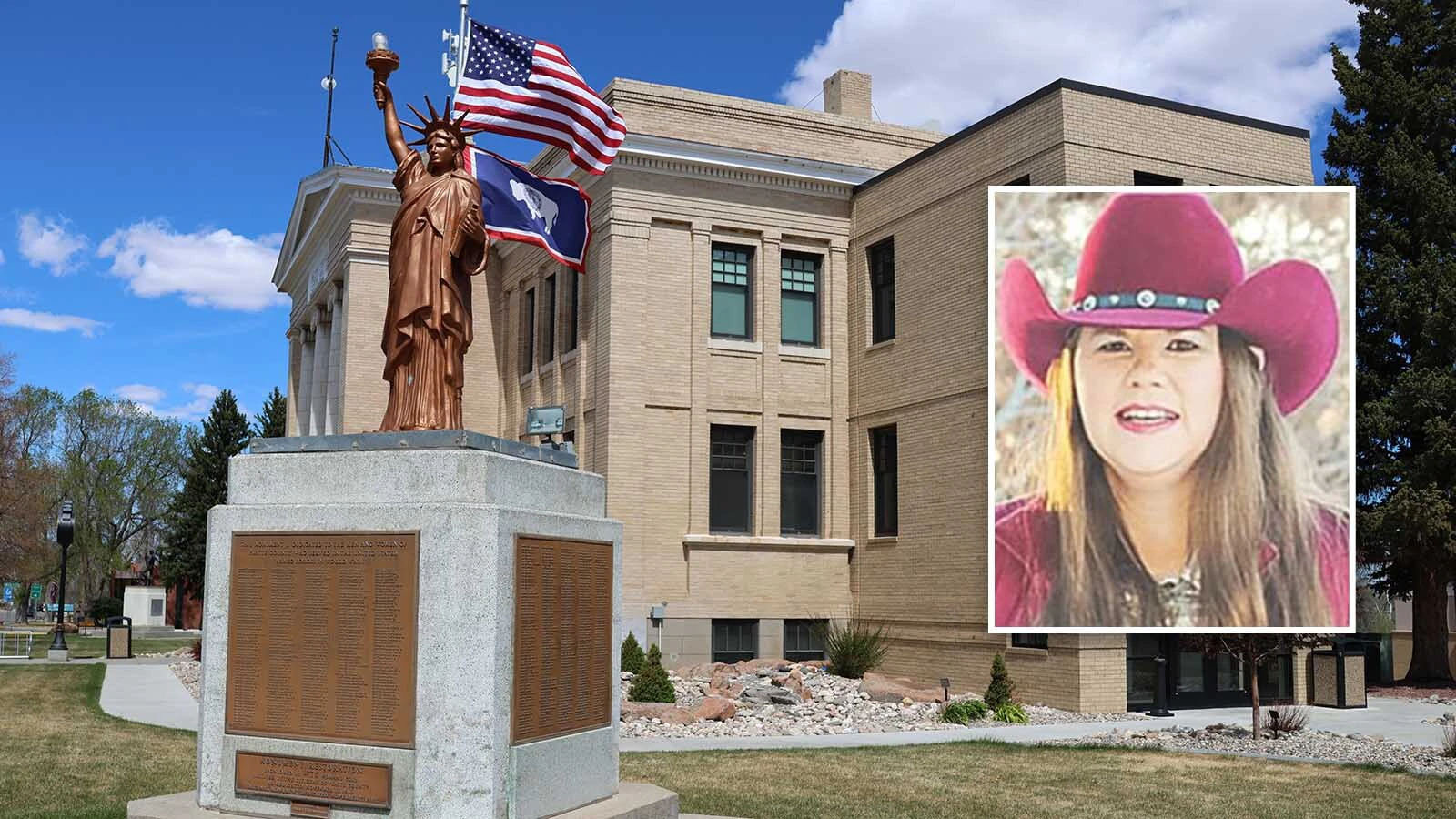
A former Wyoming reporter facing 20 forgery- and perjury-related charges in two court cases has waived her right to jury trials, instead choosing to have a judge decide her fate.
She’ll also have to do that facing the full force of evidence investigators found on her cellphone and two laptops after a judge denied her attempt to throw it out on technicalities in the law.
April Marie Morganroth, known in Wyoming as a news reporter by the name of Marie Hamilton, filed her motions to waive her jury trial this week.
Her attempt to quash the electronic evidence that allegedly ties her to forging exhibits presented to the Wyoming Industrial Siting Council and lying to the board in an environmental case dealing with wind farms in her first case was denied Wednesday.
The evidence also relates to allegedly forged documents related to the purchase of property she claimed was bought with money from a U.S. Department of Agriculture loan, according to court documents.
In each case, she faces 10 criminal charges.
The Warrants
Hamilton argued that all three search warrants — one each for her cellphone and laptops — were invalid because they were approved by a judge in another jurisdiction and for “technical irregularities.”
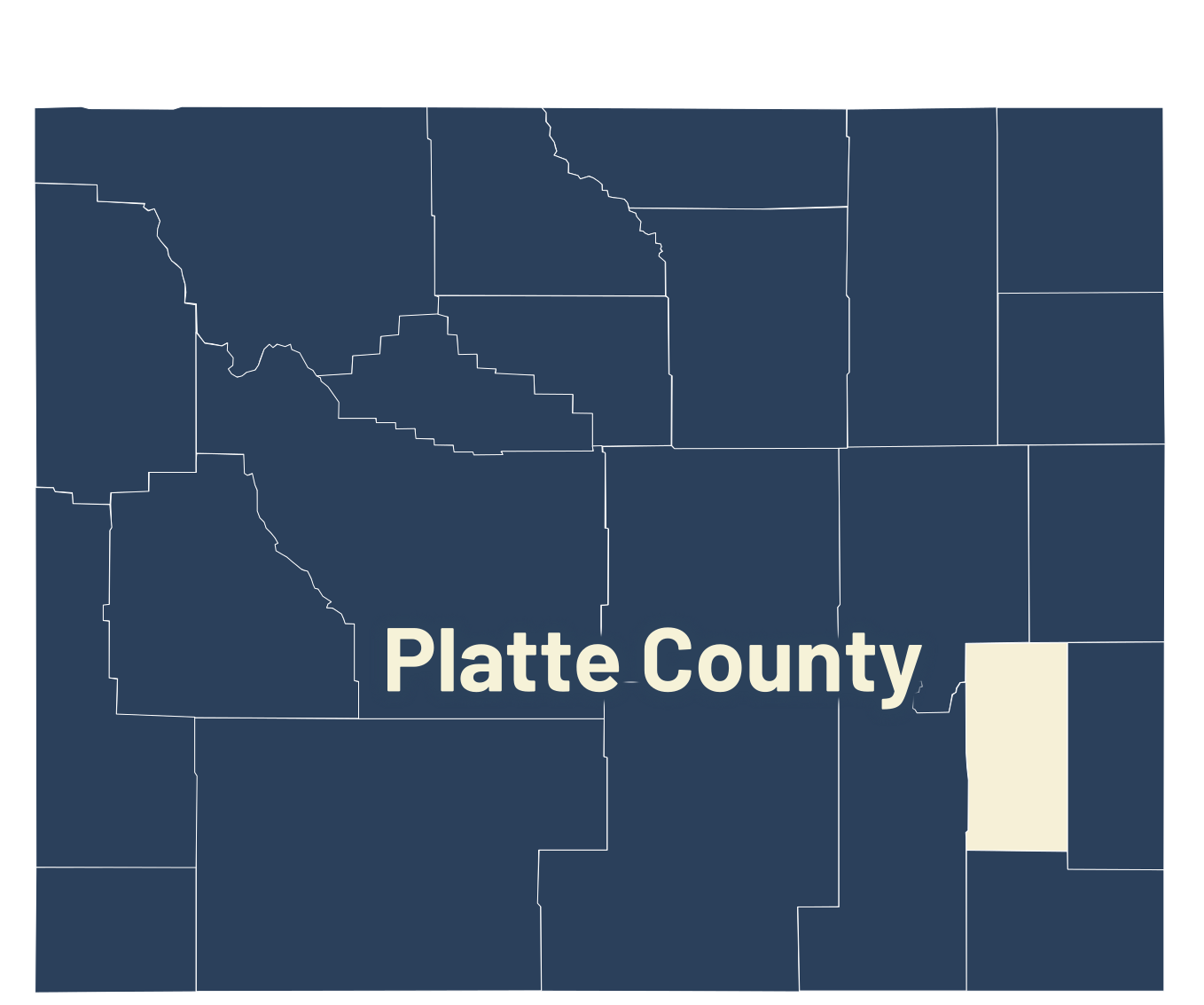
“Ms. Morganroth asserts that all three warrants are ‘invalid’ because they were signed by Judge Clark C. Allen, a Circuit Court Judge for the Eighth Judicial District and captioned in the Circuit Court of Converse County, as opposed to Platte County,” wrote Platte County District Court Judge Edward Buchanan in his Wednesday denial.
He also dismissed her claim that investigators exceeded the scope of the warrants and accessed more information from her devices than they were legally allowed to.
They did this by copying “bit-for-bit” her hard drives to then doing deep-dive searches of them, according to her motion to quash.
“Nowhere on any warrant does it state that an entire hard drive can be seized and copied,” it says.
Buchanan wrote that “courts have routinely upheld the seizure or copying of hard drives and other storage devices in order to effectuate a proper search for the categories of documents or files listed in a warrant.”
He continued to cite legal precedent that “a computer search may be as extensive as reasonably required to locate the items described in the warrant.
“There is no evidence before this Court to suggest that law enforcement improperly seized property or searched items beyond the scope of the warrant,” Buchanan concluded. “There are no grounds to exclude the evidence obtained during the searches.”
The First Case
Hamilton was first arrested in early March on suspicion of submitting forged documents and lying about her credentials during state permitting hearings in which she opposed a controversial wind farm project, according to an affidavit of probable cause filed in that case.
Hamilton was the publisher of the short-lived Wyoming Sentinel, a startup publication that has been inactive since late last year that covered Platte, Goshen and Laramie counties. She also has worked as a freelance writer for Wyoming outlets.
The case against her alleges Hamilton submitted forged documents meant to sway public officials, including letters purporting to be from a doctor and teacher.
Investigators also said Hamilton lied about her credentials and that she was a property owner near the project, the affidavit says.
The doctor and teacher later denied writing the documents Hamilton claimed were from them, the affidavit says.
Hamilton also claimed to own a property on JJ Road in Chugwater, making her a concerned landowner potentially impacted by the wind project, the affidavit says. However, the land actually belongs to somebody else.
The charges for her first case tally as three counts of possession of forged writings, three of forgery, and four counts of perjury.
The Second Case
About a month after hit with her first 10 forgery- and perjury-related charges, Hamilton was in court again, accused of 10 more.
Those charges relate to an attempted home purchase, according to court documents, and include five counts each of possession of forged writings and forgery.
When Converse County Sheriff’s Office Lt. Benjamin Peech investigated Hamilton’s claim that she bought property with a federal loan, he uncovered more irregularities, he wrote in an affidavit.
The property is registered under Platte County’s mapping system to another couple with a different surname, Peech wrote.
His investigation found that the other couple were willing to sell the property, and Hamilton told them that she and her husband wanted to buy and it and were prequalified for a USDA loan through Neighbor’s Bank.
Because the property didn’t meet loan standards, Hamilton told the couple she had been approved for a USDA grant to work on issues and bring the property up to standards, the affidavit states.
Hamilton and her husband made a deal with the homeowners in July 2025 to lease the property and use “sweat equity” to bring it up to the standards required for the loan, the affidavit states.
Documents provided to the couple and their Realtor included initial letters with USDA letterhead showing pre-approval from the “USDA Rural Development and Neighbor’s Bank” for a $365,000 loan dated June 10, 2025.
A letter provided by Hamilton to the property owners also showed USDA grant approvals for $35,000 dated Nov. 6, 2025, the affidavit says.
When Hamilton started to become late on rent payments earlier this year and had not provided work logs to the couple, they “began to be concerned and press Hamilton about her progress with improvements on the property,” the affidavit states.
Hamilton provided another letter dated Jan. 28, 2026, stating it represented USDA “Rural Development — Rural Communities Home Buyer Program Notice of Nearing Completion and Continued Work,” the affidavit states.
Page one of the letter states that the work was nearly “80%” complete, Peech wrote.
Other paperwork allegedly submitted to the property owners by Hamilton included invoices from “Cowgirl Demolition and Excavation LLC” showing she had paid $3,075 for repairs on the property’s home and “Pete’s Builders Roofing and Restoration” showing an invoice of $7,890 that was “paid in full.”
However, when contacted by Peech, the USDA and two contractors all said that they never sent any of those letters.
Hamilton is next set to see a courtroom on Oct. 8 for a conference ahead of a trial scheduled for Nov. 2-5.
She posted a $5,000 cash bond in her first case and remains free on a $20,000 signature-only bond in the second.
If convicted and given the maximum penalties and concurrent sentences, she could get up to 140 years in prison, 65 years in the first case and 75 for the second.
Greg Johnson can be reached at greg@cowboystatedaily.com.


