
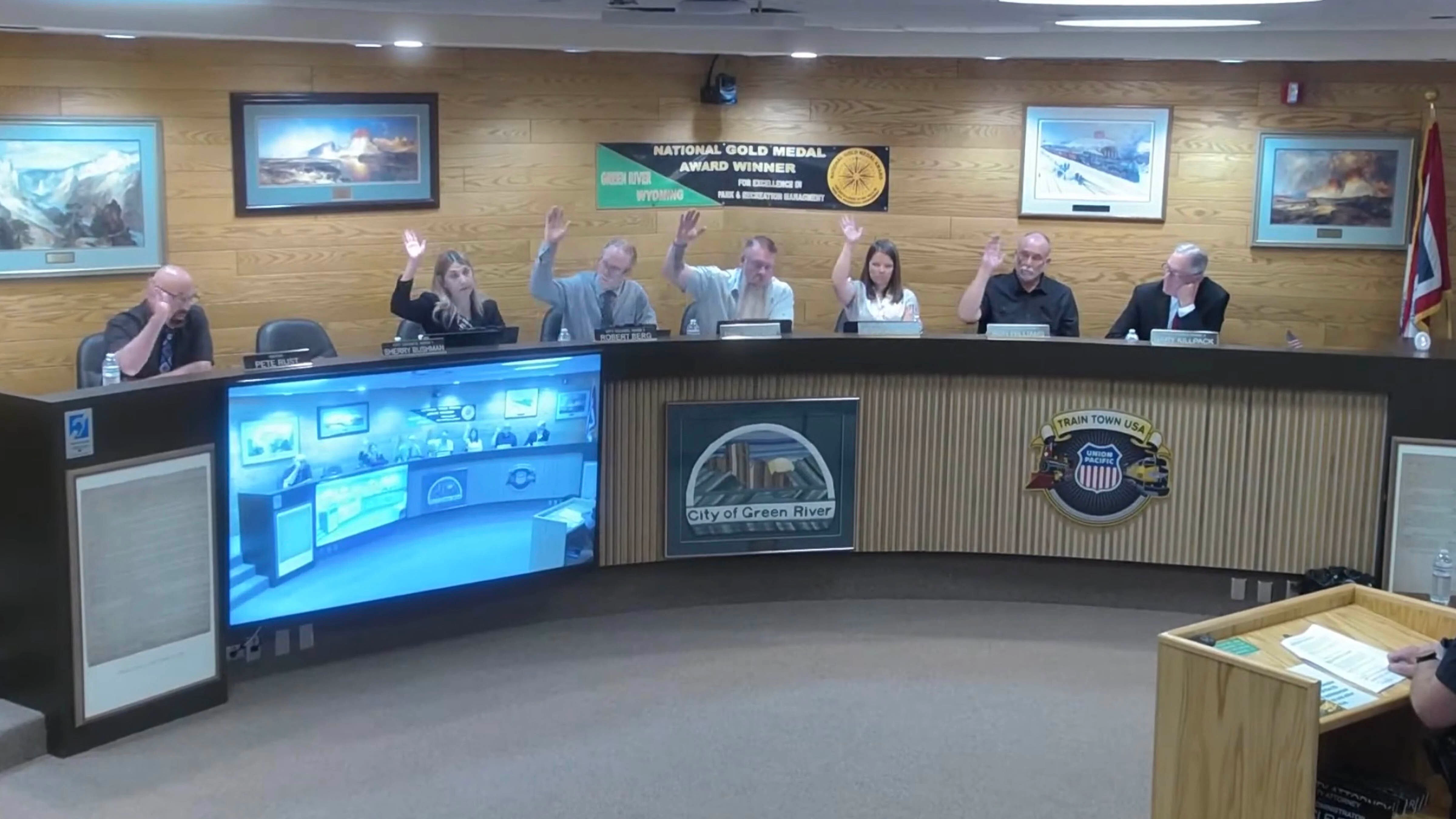
A vocal crowd of Green River residents opposed a nearly $112,000 anti-terrorism grant for license plate reader cameras Tuesday, and the City Council and mayor voted 6-1 against approving the grant award.
That means the Green River Police Department will not receive the $111,956 in federal Department of Homeland Security money that the Wyoming Office of Homeland Security had awarded it.
Green River Police Chief Shawn Sturlaugson had planned to install around four Motorola brand license-plate readers, largely at city entrances, to respond quickly to criminal getaway or vulnerable-person situations, he told Cowboy State Daily on Tuesday.
He defended the plan at the City Council meeting Tuesday evening, saying a guardrail policy is in progress. He hoped to limit data storage to 30 days and he had no intention of using the cameras proactively or on things like expired registration.
Green River City Councilman Gary Killpack moved to accept the grant award. Councilman Robert Berg seconded the motion for the sake of holding a vote, he said. Then Berg, Mayor Pete Rust, and the other four council members – Jessica Maser, Mike Shutran, Sherry Bushman, and Ron Williams – voted nay. Some of them applauded with the crowd after their nay votes.
The people's proactive shutdown is unique. Oftener in Wyoming cities such as Cheyenne, Jackson and Glenrock, the major outcry against license-plate reader cameras unfolds after the cameras are already in place.
In the case of license-plate readers that the U.S. Drug Enforcement Administration and Wind River Intertribal Council had installed at the entrances to the Wind River Indian Reservation, it is unknown if any public meeting was held on the topics prior to installation.
The Outcry
But first, numerous people attended the meeting and 10 spoke against the cameras.
No one spoke in favor of the license plate reader grant or installation effort.
Marshall Burt – a former lawmaker and the first Libertarian elected to the Wyoming Legislature – acknowledged that he’d “kicked the hornet’s nest” by raising awareness of the meeting and urging people to attend.
“I don’t know you, chief; I want to say you’re a good person and I believe you have good intentions,” Burt said to Sturlaugson.
Yet, he warned, Motorola would store the license-plate reader data and could aggregate or share it. Litigation is unfolding on these data problems nationwide. And the government can work around the Fourth Amendment by going through third-party data holders, said Burt.
“Now yes, I’d say we are more than (surveilled) every day of our lives,” he said. “A lot of those choices come from myself. If I use my phone and I add an app, and it says I’m going to be monitored, then I make the choice to be monitored myself, right?”
Burt suggested “strongly” that the city study Motorola’s software system closely.
Gregory Sherwin, who identified himself as a lifelong resident of Green River, cast the system as just another slow, well-intentioned erosion of freedom.
He urged the City Council to “defend these principles of due process, presumption of innocence and freedom of association – and the simple right to move about our communities without being constantly monitored, analyzed and profiled.”
Sherwin added, “These are not outdated ideals. They’re the foundation of a free people.”
As with many speakers, robust applause followed.
Another resident, Dr. Blaine Saunders, reflected on others’ comments.
“I’m grateful to be in this town. It’s nice to hear people stand up for their rights. Nice to hear they’re standing up for the Constitution,” said Saunders. “My grandfather was a Wyoming pioneer, and I think he’d be proud of what we heard tonight.”
Multiple people paid respects to Sturlaugson or thanked him for his service. He acknowledged their concerns and their passion.
“Ther’s no one who takes the Constitution and civil liberties more seriously than me,” said Sturlaugson, adding, “I also took an oath to protect the citizens of Green River … This is my job.”
He later said, “Outside of my uniform, I might be sitting with them (the critics).”
Apologies
Some council members apologized for voting in favor of the grant application months earlier.
“I also want to kind of issue an apology on my part,” said Councilwoman Jessica Maser. “Because when we applied for this grant – I know I voted in favor of it – I did not fully understand what this was.”
Councilman Mike Shutran said he wanted to echo Maser’s comments.
“This type of a situation I think the gravity’s probably a little bit more than we anticipated. I think public safety is always at the forefront, but undermining the trust of the citizens is something we probably can’t undo,” said Shutran.
Councilman Berg touted the advances of technology. But, he said, “I cannot vote for this due to the fact I’d be telling the citizens of Green River that I think I know what’s best for them. And they have spoken.”
Councilwoman Bushman gave an example of the cameras’ potential benefits – of flagging a sex offender near a school – but she voiced concerns about the potential for a data breach of Motorola’s system.
Ten people urged against the camera installation during the public comment segment. Several more sat in the room and watched. As of Wednesday morning, the YouTube stream of the meeting had garnered 118 views.
Rust and Killpack both speculated that though they heard staunch opposition Tuesday evening, “another side” would emerge from the residents with time.
Rust theorized some people with children want the cameras and will trade their privacy concerns for that safety reassurance.
“We are only hearing one side tonight,” said Rust.
Berg countered: “The other side had the same opportunity.”
Spectators erupted with applause.
Killpack moved to table the vote to a workshop to draw out that other side. His motion died without a second.
Though Rust defended the cameras and speculated about the silent “other side,” he explained his later nay vote on the grant approval by saying he’s concerned about the third-party data holding issues.
Clair McFarland can be reached at clair@cowboystatedaily.com.


