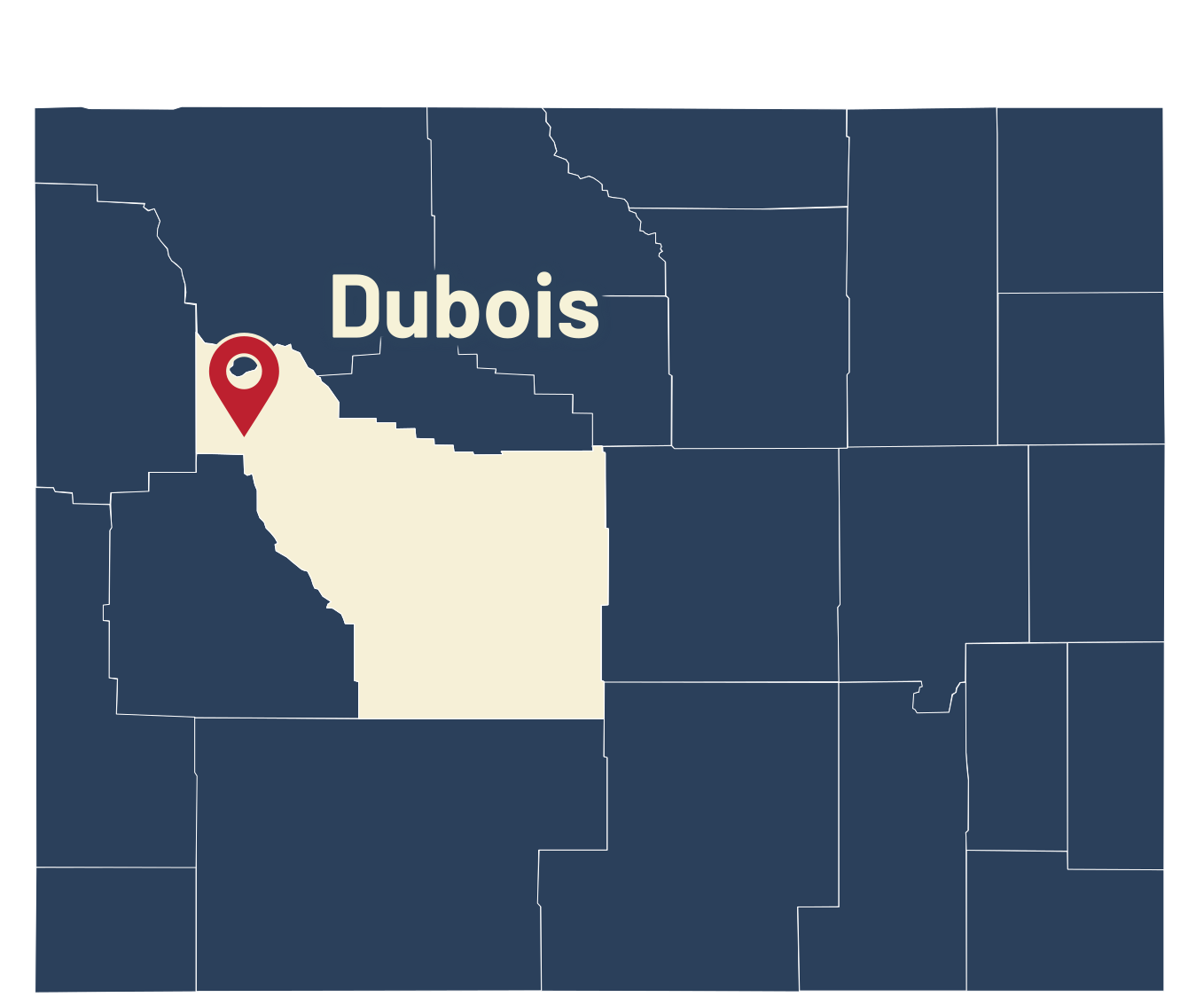
DUBOIS — It was a scene straight out of a Mad Max movie. Two tanks met like gargantuan beasts on a dusty field of battle tucked behind the National Museum of Military Vehicles on Friday.
The tanks were heralded first by the echoing rat-a-tat-tat of machine guns over the hills of Dubois, thrilling a crowd of hundreds that gathered to celebrate America’s 250th anniversary by watching these rumbling 42-ton tanks show off.
“Our thinking was this doesn’t have to just be solemn,” National Museum of Military Vehicles founder Dan Starks told Cowboy State Daily. “It can also be fun. And what’s more American than machine guns and tanks crushing cars?”
Starks didn’t get any disagreement from the huge crowds turning out for the daylong event devoted to America. More than 500 people showed up in the first hour, which offered two chances to see the tanks in action.
Starks couldn’t contain his grin.
“You see the crowd we’ve attracted with this kind of family fun,” he said. “So, because of that, the messages we’re delivering about the genius of our founding fathers is going to reach more ears, because we created a fun event, instead of just saying, ‘Hey, we’re going to be giving some lectures.'”
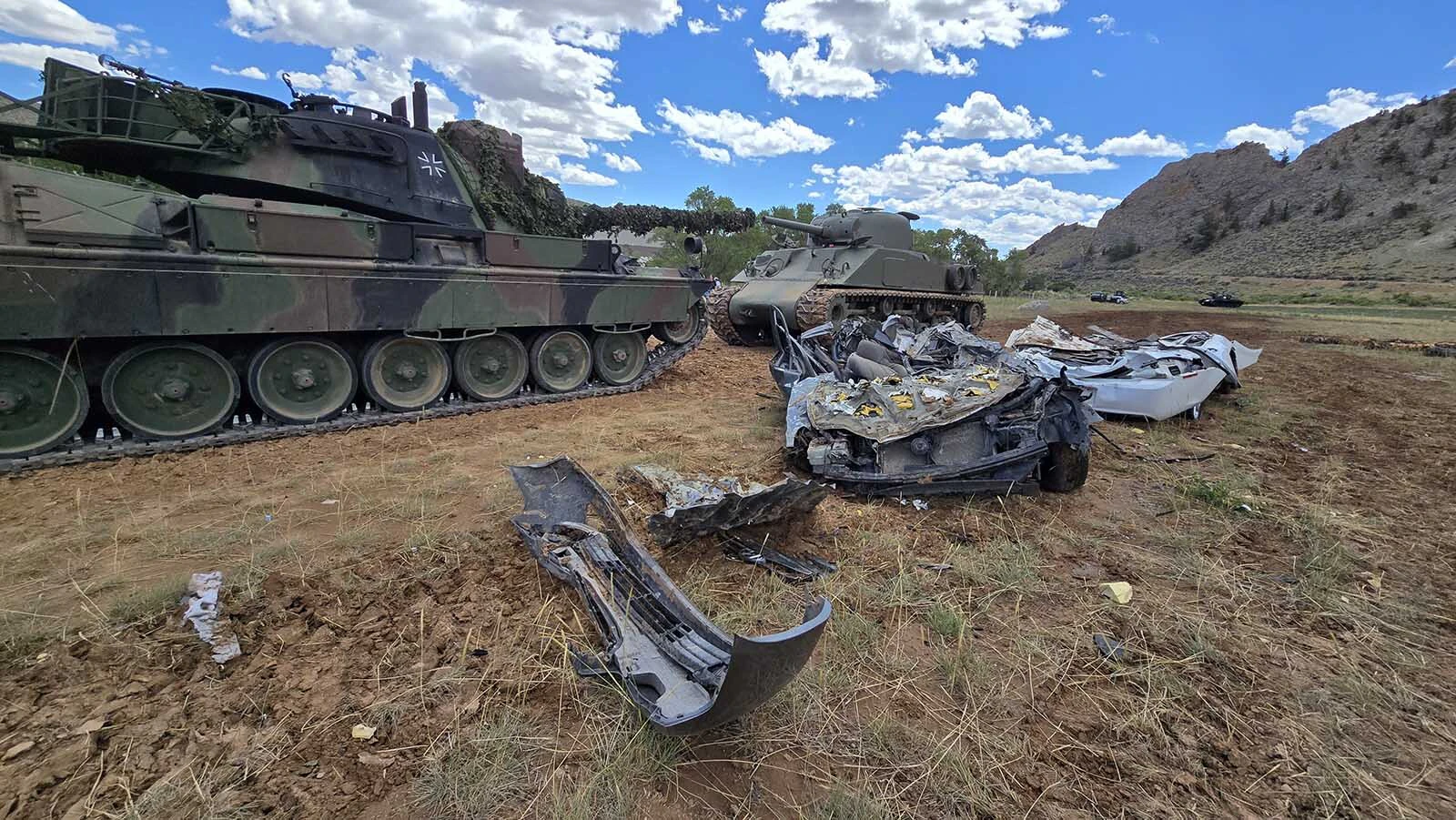
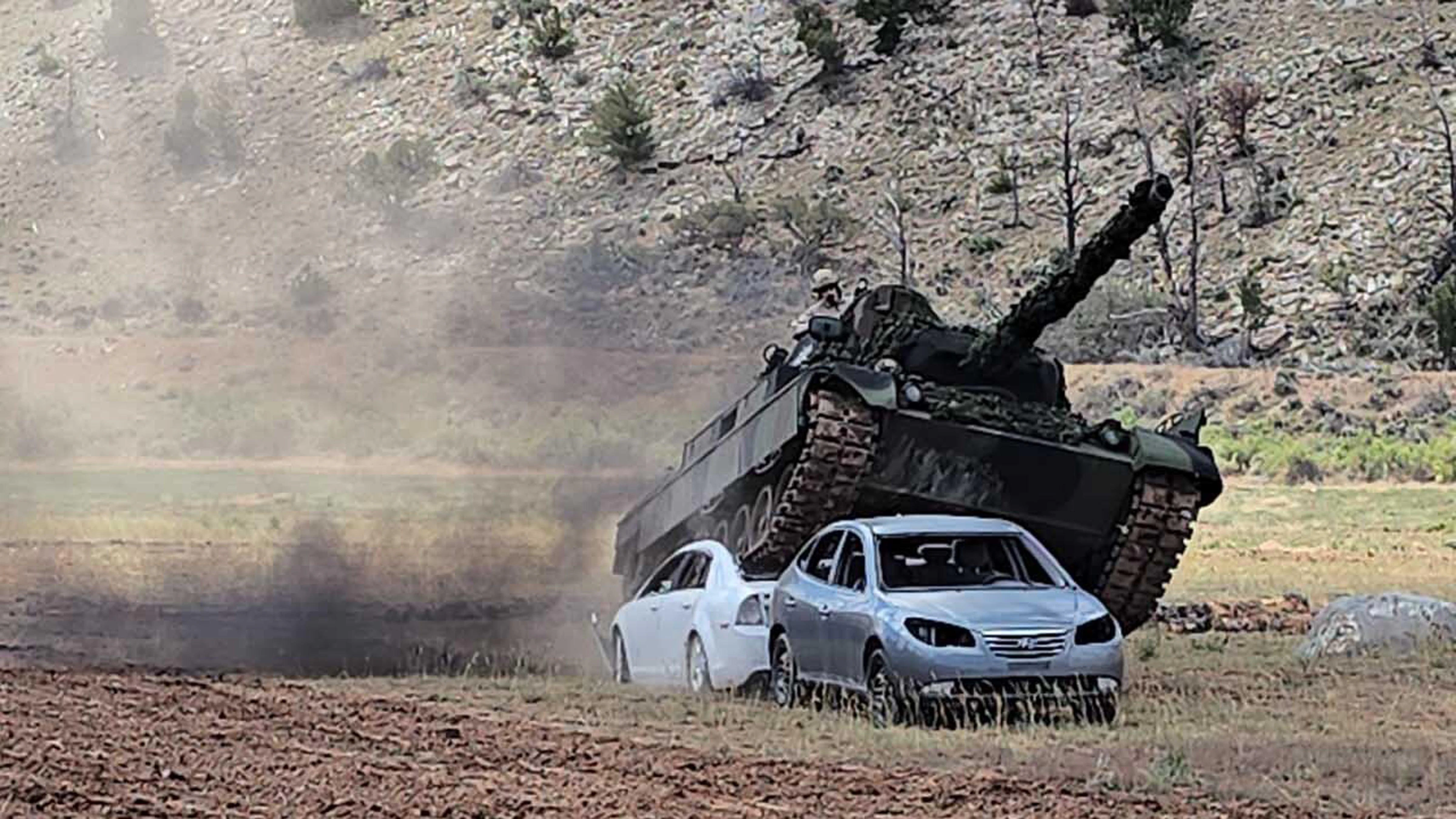
A Leopard tank, left, and an M4 Sherman Tank, right, made short work of these two vehicles. The two drivers said they barely felt anything rolling over these two cars. (Renee Jean, Cowboy State Daily) 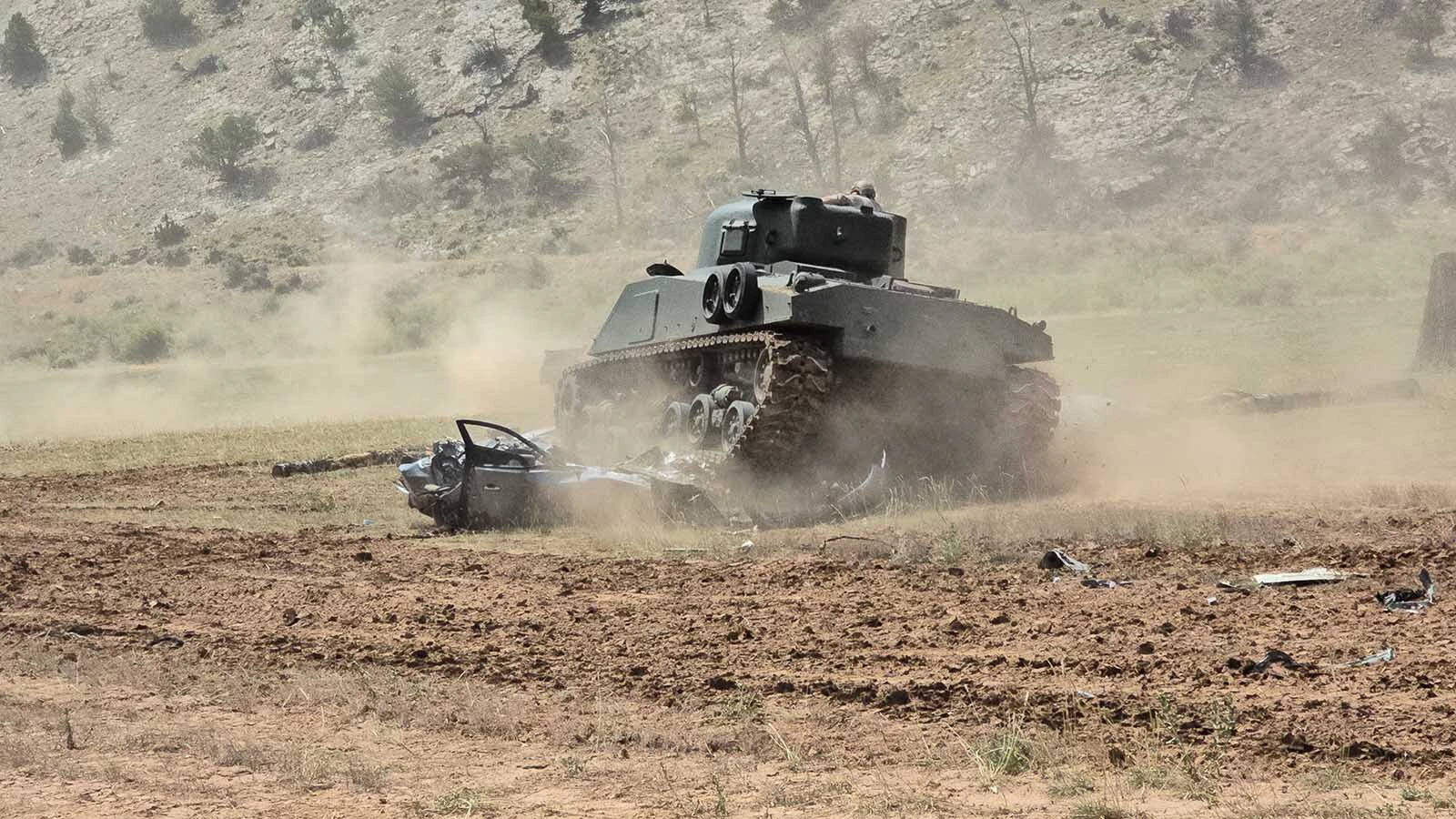
The M4 comes out for a turn at the two crushed cars. (Renee Jean, Cowboy State Daily) 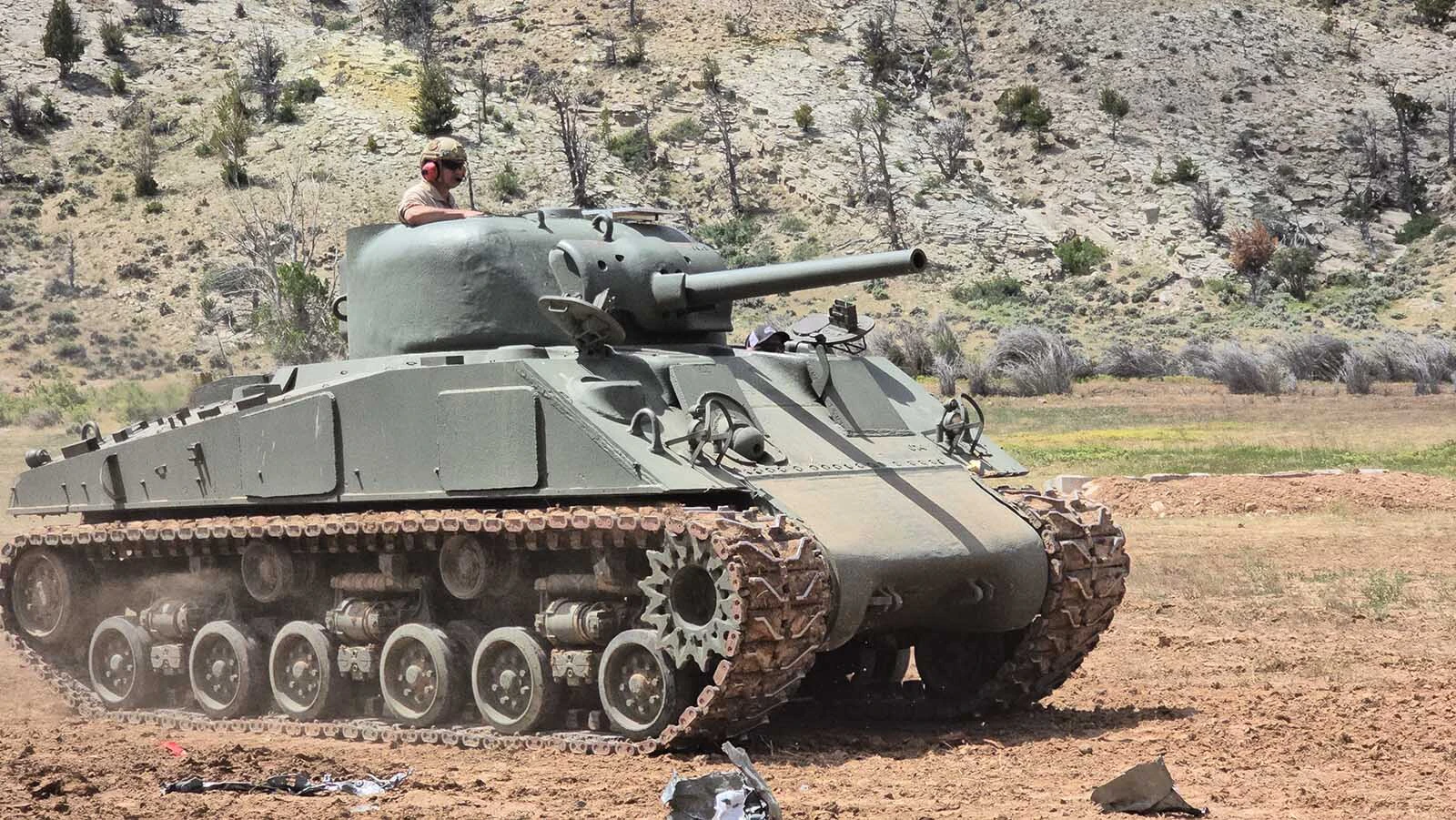
This Sherman M4 tank is 80 years old, but it's still got it. (Renee Jean, Cowboy State Daily) 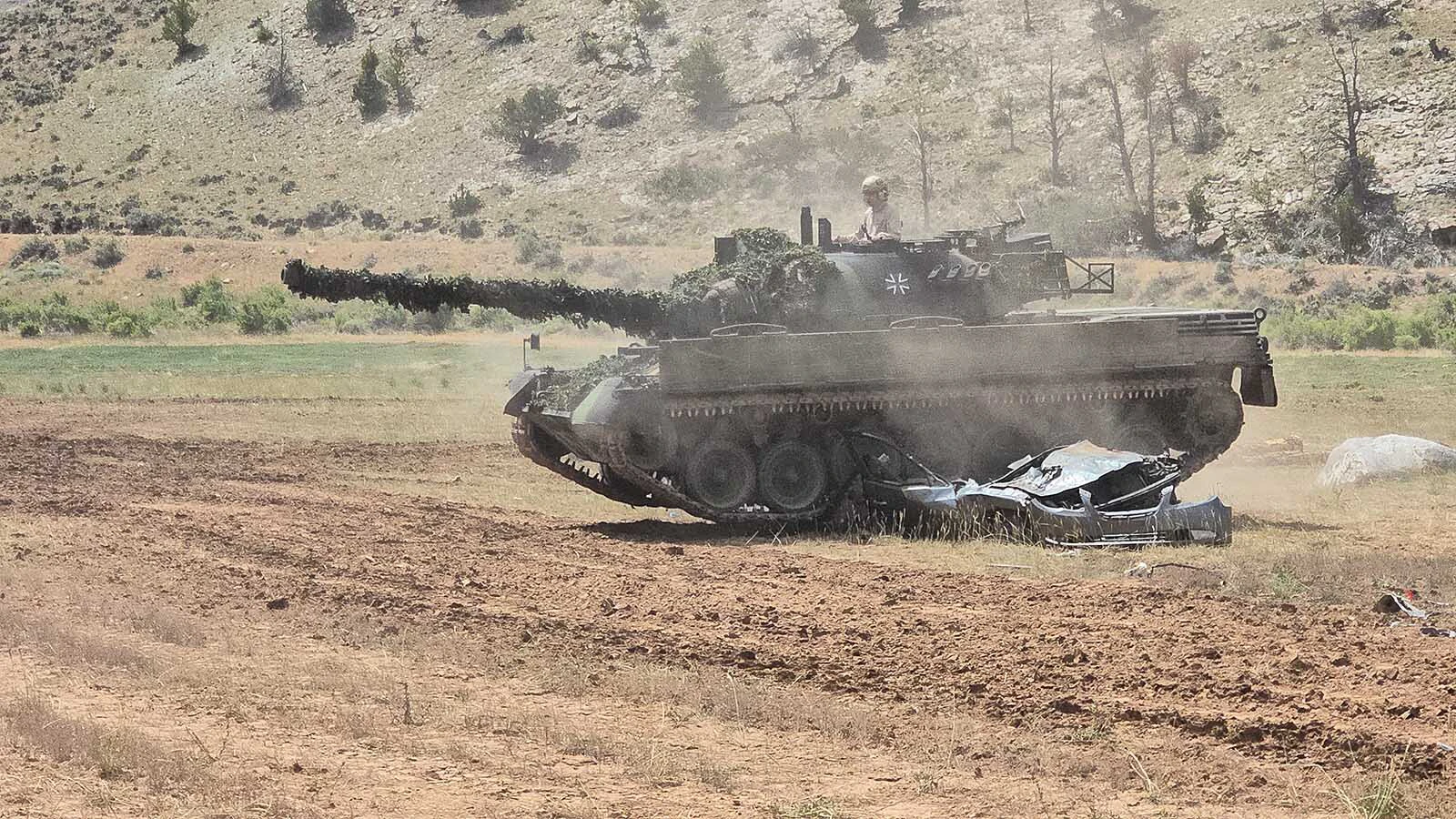
The Leopard gives the cars one more pass. (Renee Jean, Cowboy State Daily) 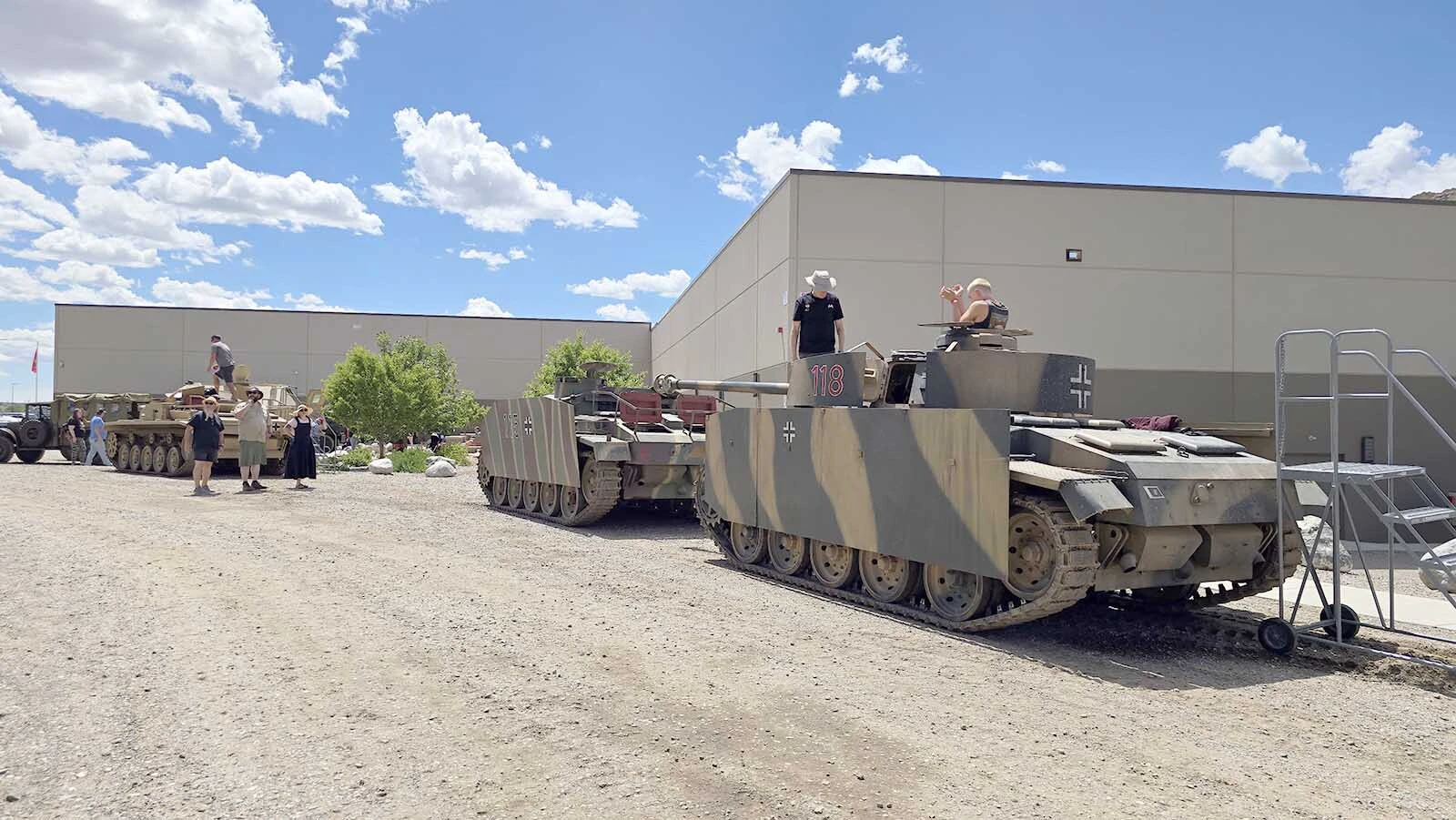
Tank rides were available at a daylong event celebrating 250 years of American history. (Renee Jean, Cowboy State Daily)
M4 Sherman Perfect For Crushing Cars
The star of the show was what Starks cheerfully calls the “Car Crusher.” It’s an 80-year-old M4 Sherman tank, which was the primary medium battle tank used by the United States and its Western allies during World War II.
It’s a tank that’s practically purpose-built for exactly this kind of spectacle, Starks said.
“We call it the car crusher tank for two reasons,” he said. “One, it has steel tracks, and so those tracks are quite a bit less likely to be damaged driving over a car — driving over steel with the potential of sharp edges.”
In fact, the Sherman’s steel tracks is one of the reasons it can’t be used in the annual Fourth of July parade in Dubois, which features around 25 tanks and other military vehicles from the museum to celebrate Independence Day.
“It would tear up the road,” Starks said. “But that’s exactly the kind of track to crush a car with. That particular tank also does not have fenders on the tracks, so there’s less that can get hung up from the car.
"So it’s really a good configuration to just have the ridiculous fun of crushing your car with it.”
Co-Starring The Leopard
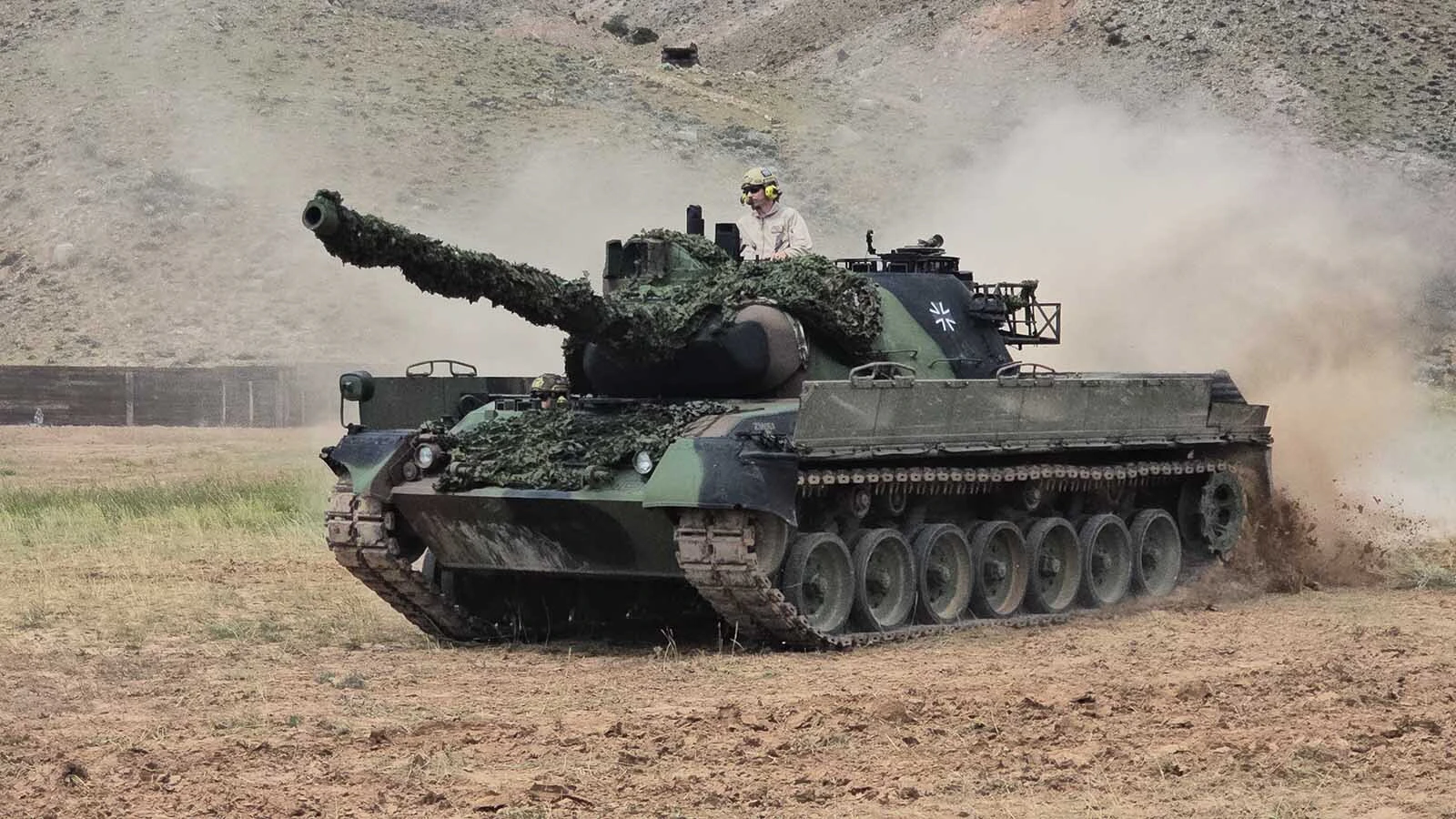
The M4’s co-star in this Mad Max approach to history was a 1981 German Leopard tank, one in a series of premier main battle tanks (MBTs) developed by Krauss-Maffei, now KNDS Deutschland GmbH & Co.
The original Leopard 1 MBTs revolutionized armored warfare in 1965, bringing superior mobility and a 105 mm gun to bear. Its successor, the Leopard 2, debuted in 1979 and is still one of the world’s most widely deployed advanced main battle tanks.
Leopards weren’t designed to go head-to-head with other tanks, said Tom Hartman, who drove a tank on Friday. Theirs was more of a “scoot-and-shoot” strategy.
“You’d see a target of opportunity, shoot it, and the second you shoot it, hit the reverse and speed away,” Hartman said. “Then you’d go another way and try to hit it from another angle.”
If the tank was spotted, it has a row of smoke grenades to deploy to put down instant cover in which to escape.
“You’re supposed to be able to create a massive smoke screen a few hundred feet wide,” Hartman said.
Canada was the first large purchaser of the vehicles, which are still in use by a number of countries, including Greece, Italy and Brazil.
For a while, they were readily available for around $100,000.
“Right now they cost anywhere between a quarter million dollars to $750,000,” Hartman said. “They made just a ton of these, I forget the exact figure, but a little country called Russia invaded its little neighbor friend called Ukraine, which doesn’t have a lot of Western tanks.”
Overnight, every available Leopard tank was suddenly headed to Ukraine.
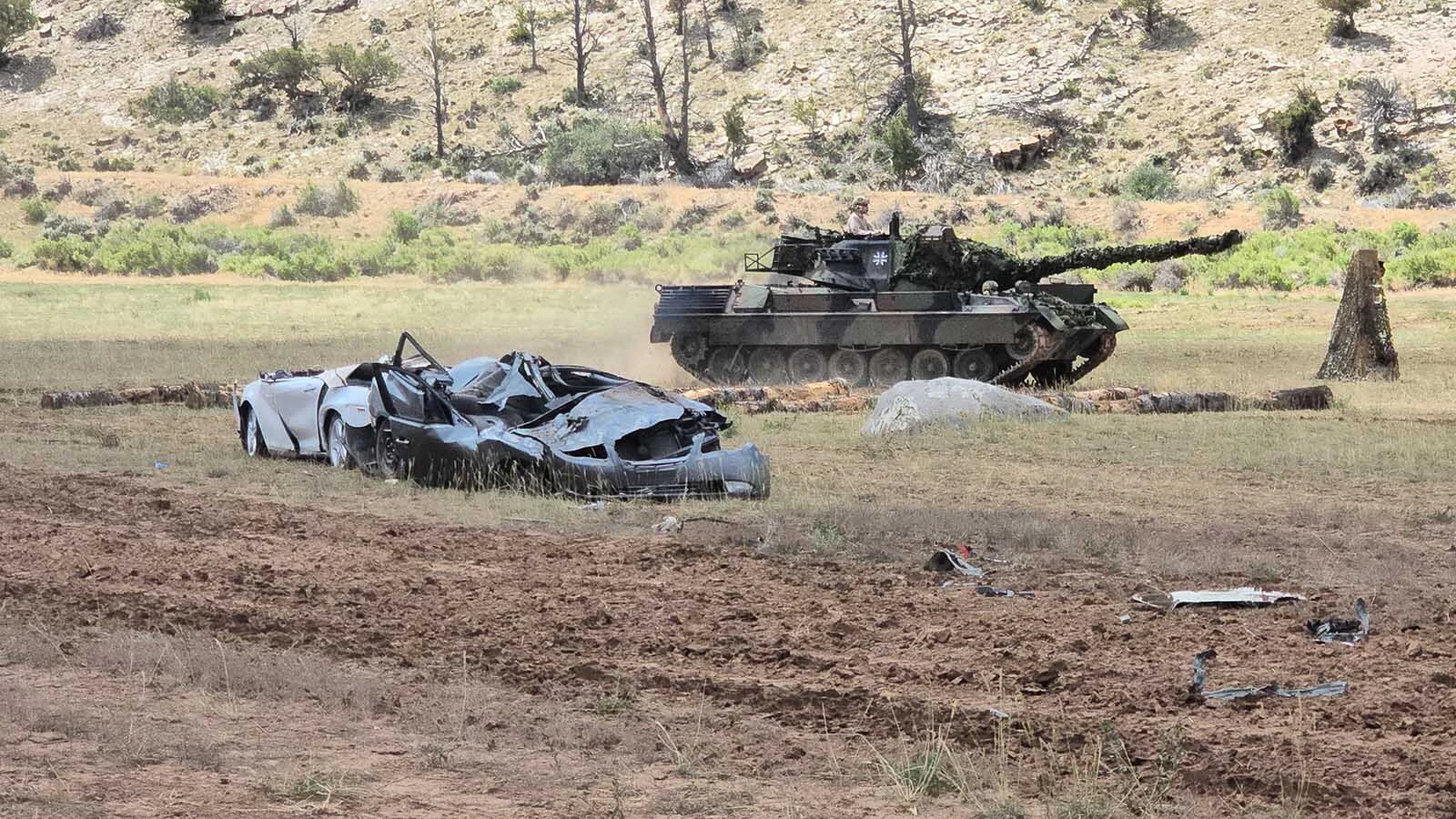
Two easily crushed cars after just a few passes with a tank. (Renee Jean, Cowboy State Daily) 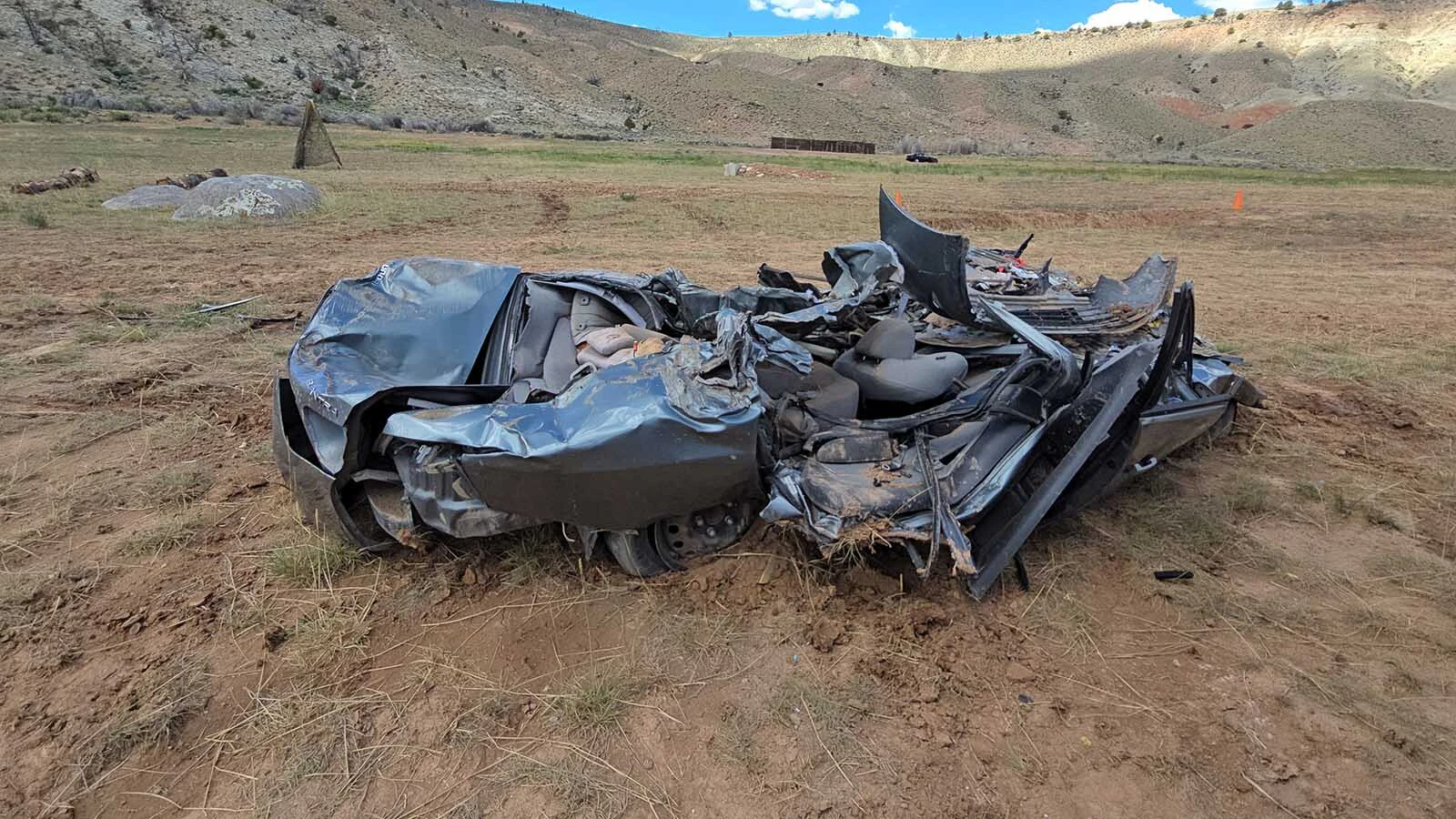
The twisted wreckage of a vehicle crushed by a tank. It only took two or three passes to produce this result. (Renee Jean, Cowboy State Daily) 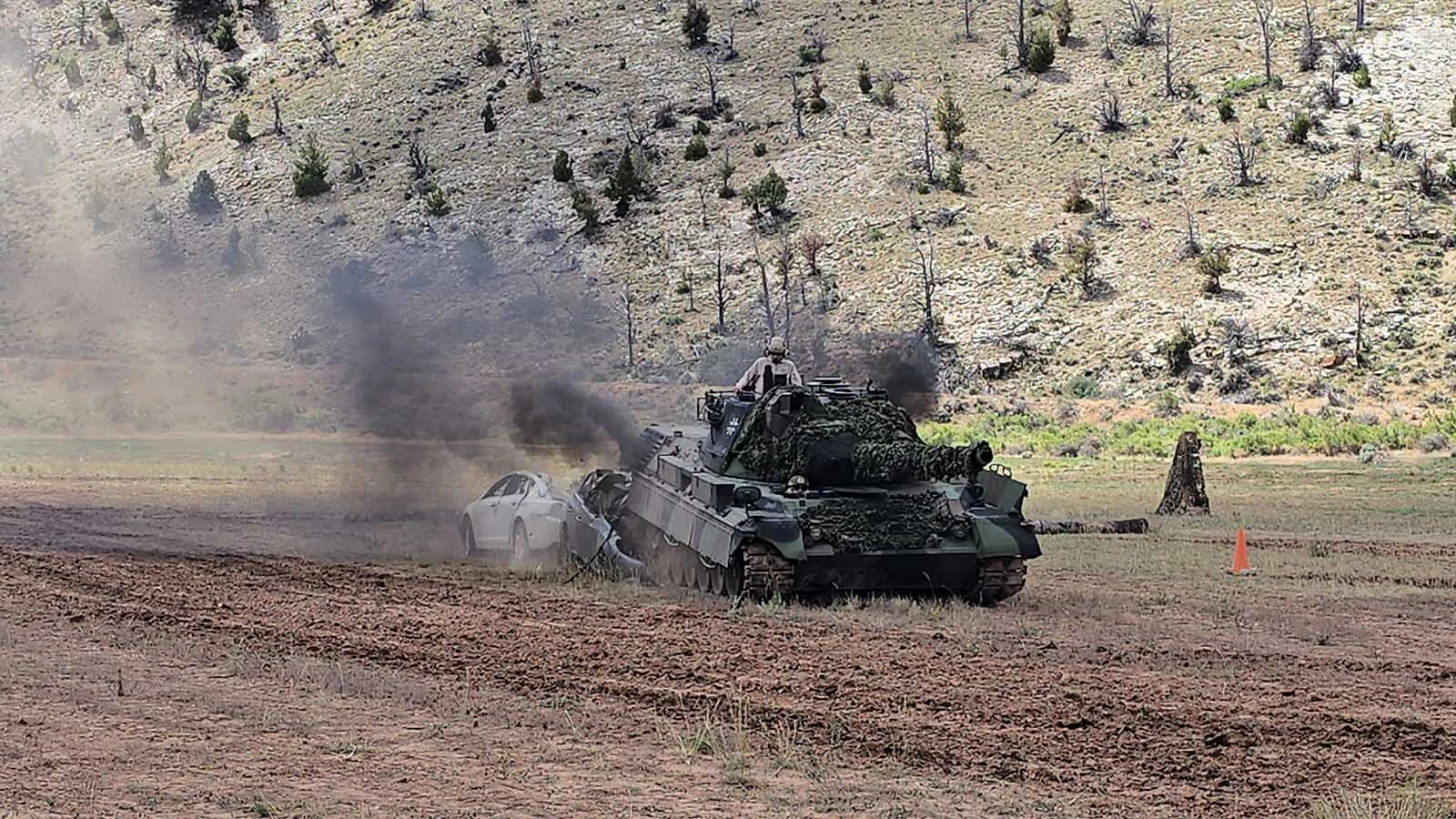
The Leopard tank drives away to the cheers of the crowd. (Renee Jean, Cowboy State Daily) 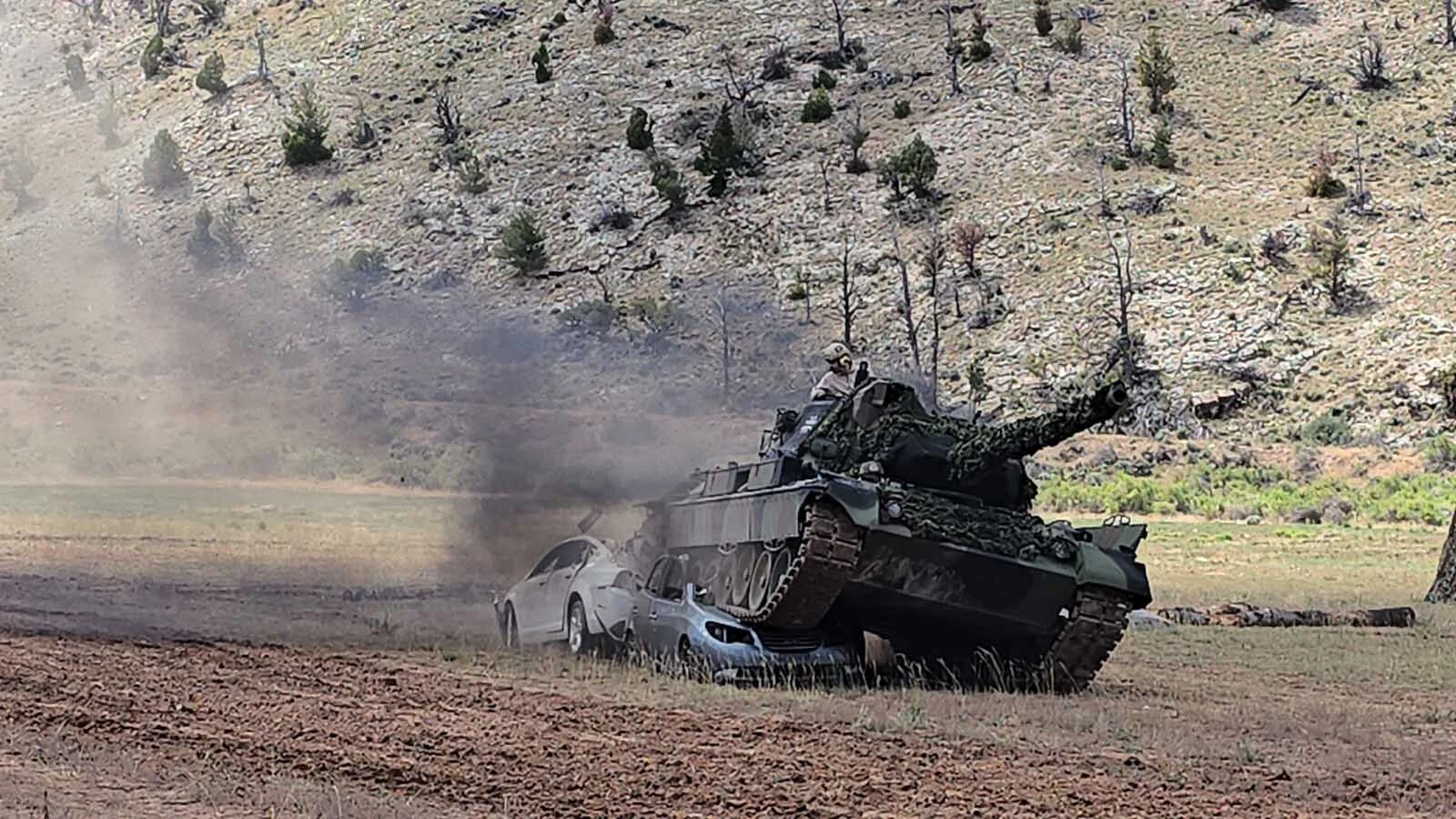
The cars are easily crushed by the weight of the 42-ton tank. (Renee Jean, Cowboy State Daily)
What It’s Like To Drive Over A Car
From a distance, it looks like something of a feat when a tank rolls right over a car.
People in the crowd cheered, kids squealed, and smartphones everywhere were rolling, getting video of cars being smashed flat.
For the tank crews, though, the real surprise was just how smooth the ride was.
“You can kind of feel it go like this,” Hartman said, demonstrating with his body leaning from one side to another. “But it’s not like one solid piece. You can feel it start to crush underneath you.”
That’s unlike the cinderblock wall, 2 feet high, that was part of the warmup obstacle course set up to demonstrate the tanks' capabilities before the cars were crushed.
“It was really fun,” added Jared Radison, another driver. “But it’s honestly surprising how smooth it is. We came down pretty healthy, but other than that, going on these cars, you almost don’t feel it.”
For Casey Ladelle driving the M4 tank for the first time, he wasn’t sure how fast he should really go in the historical 80-year-old antique.
“Like, how fast is too fast?” he wondered. “It’s an 80-year-old tank, and today was my first day hitting any obstacles with it.”
His first time rolling over the car, he hit it almost too slow.
“The second time, I knew what was going to happen,” he added.
So he let the car have it, and it felt “really cool.”
All three drivers, however, were cognizant that the power the tanks gave them also meant awesome responsibility as well.
“It’s a 42-ton machine that can go up to 45 mph,” Hartman said. “You do not want that going through anything out here, because you’re not going to feel it if you hit something.”
That had all three scanning the field, making sure they weren’t gong to run into each other or anything else.
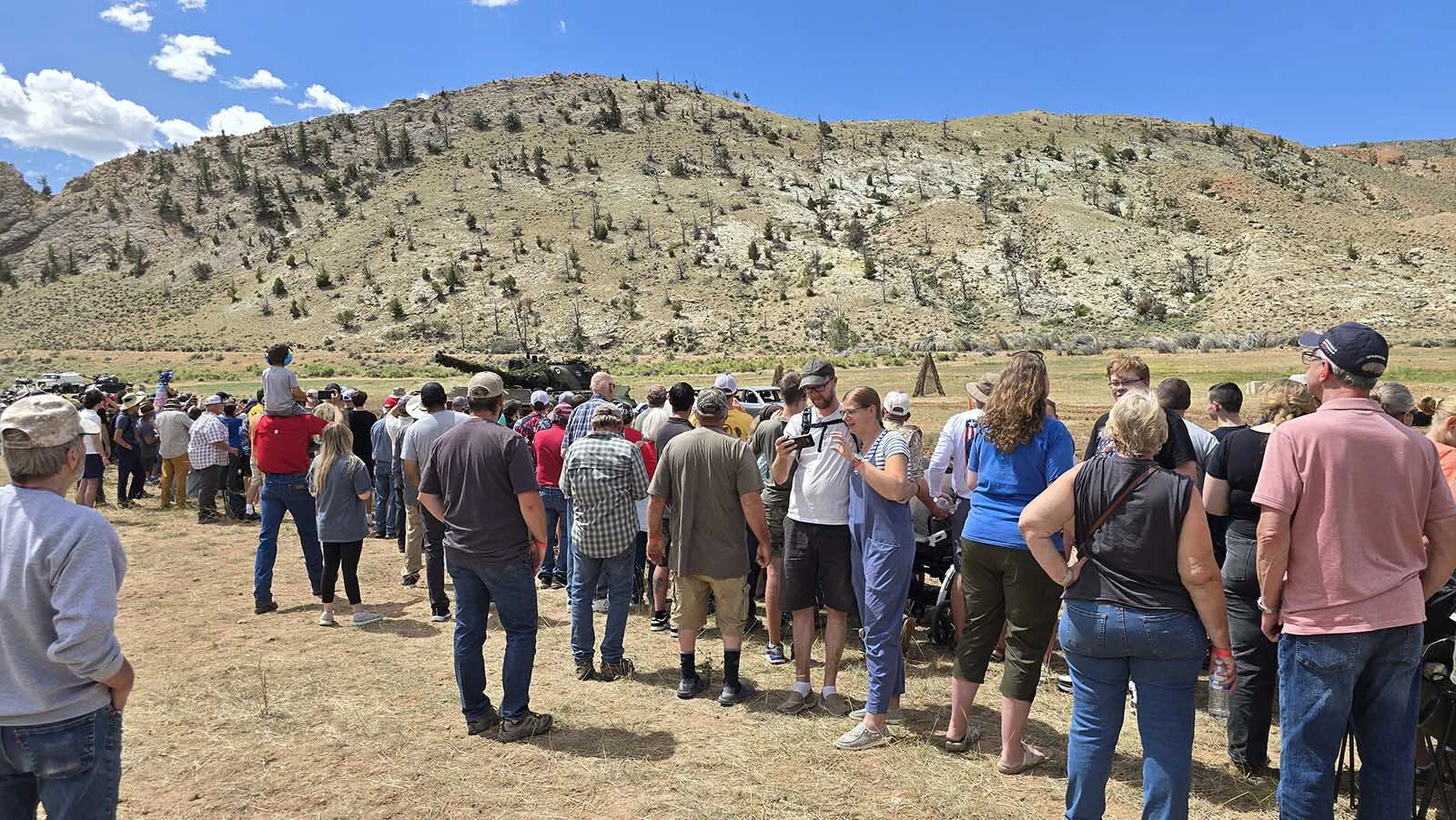
An appreciative crowd gathered to watch tanks crush cars at the National Museum of Military Vehicles on Friday. It was part of a day-long celebration of America. (Renee Jean, Cowboy State Daily) 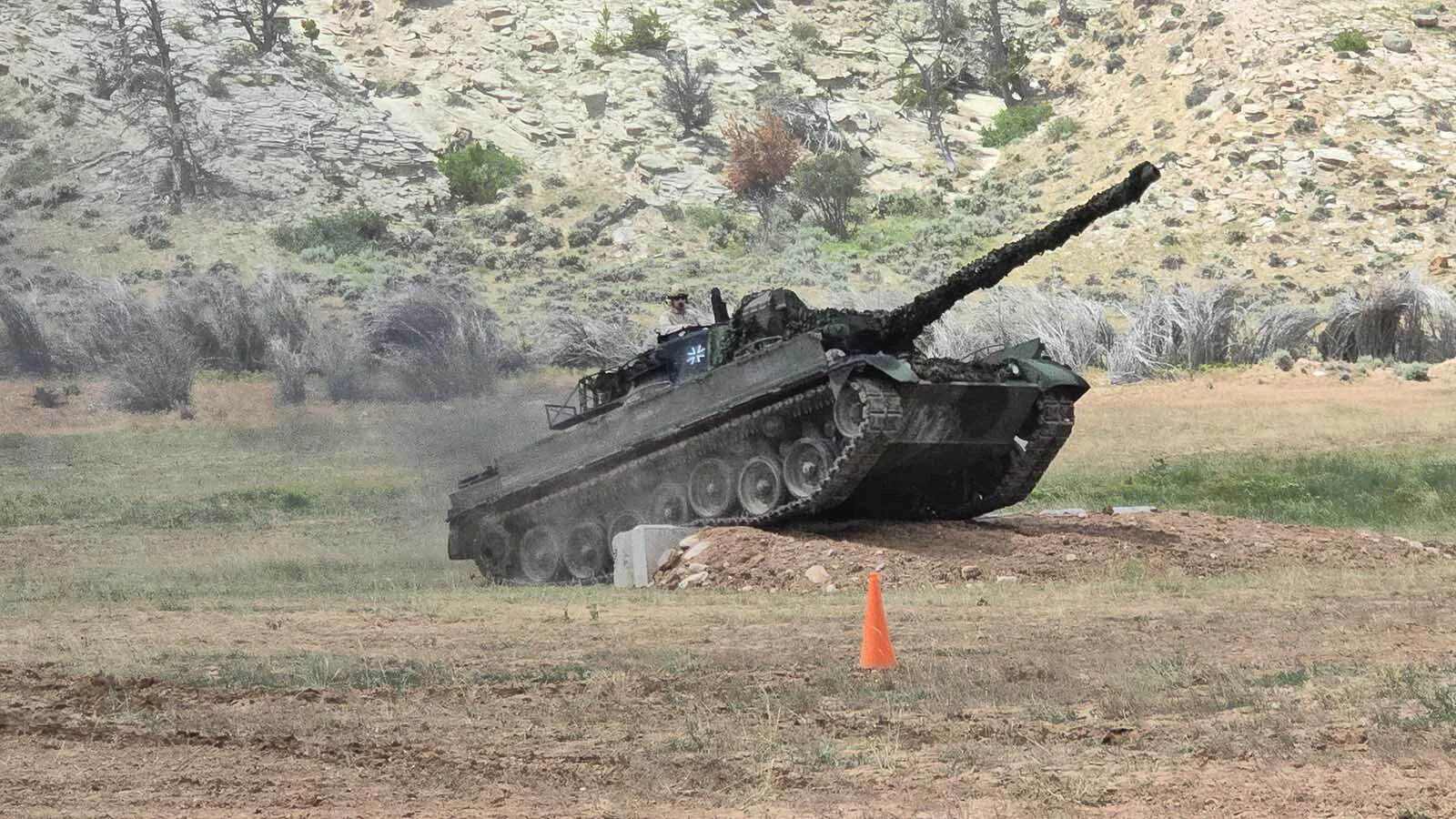
Up and over — a Leopard tank has no trouble climbing a 2-foot cinderblock wall in an obstacle course built to demonstrate the capability of that tank and a Sherman M4. (Renee Jean, Cowboy State Daily) 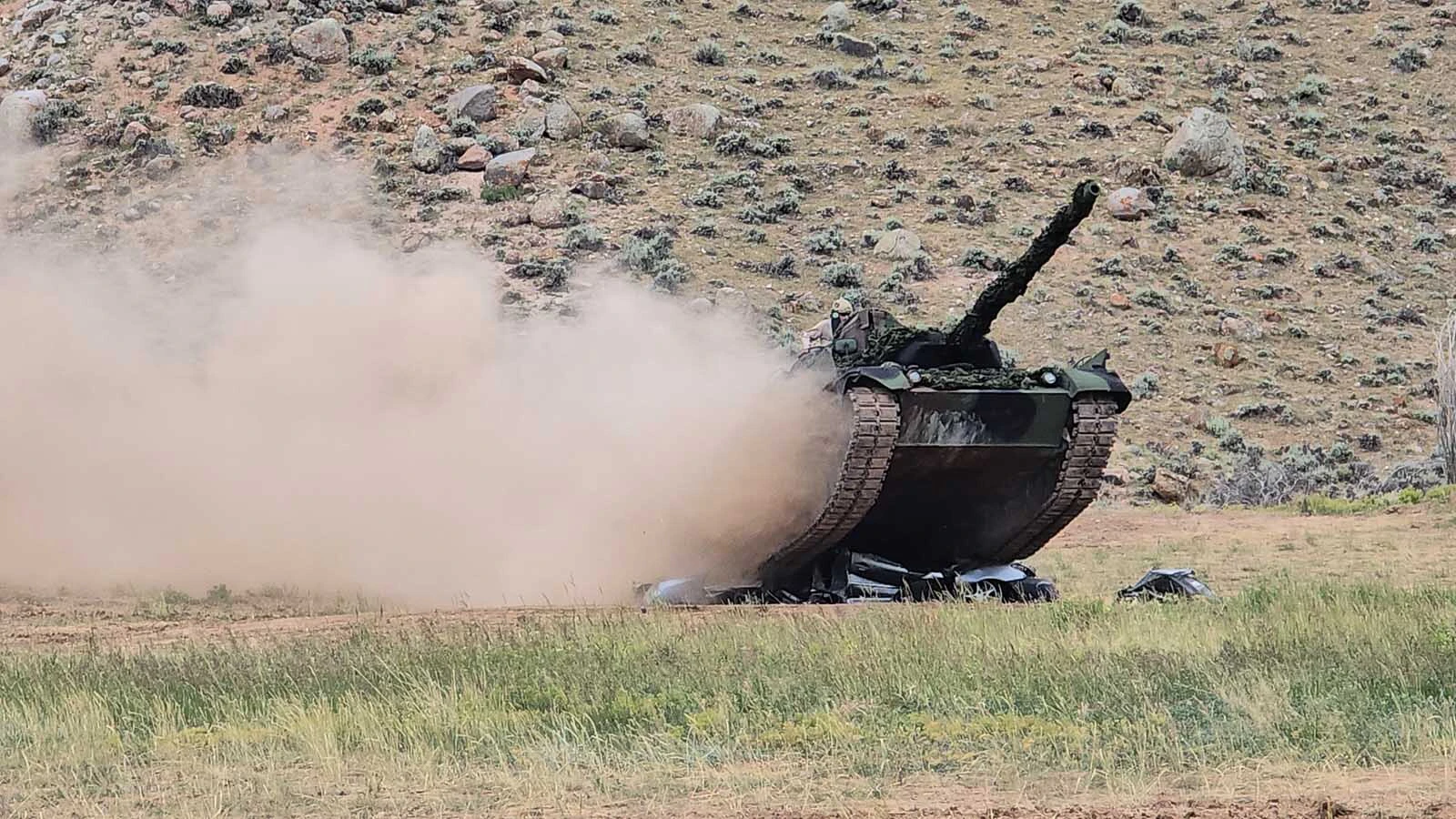
The Leopard tank is just making sure this white car is flatter than a pancake. (Renee Jean, Cowboy State Daily) 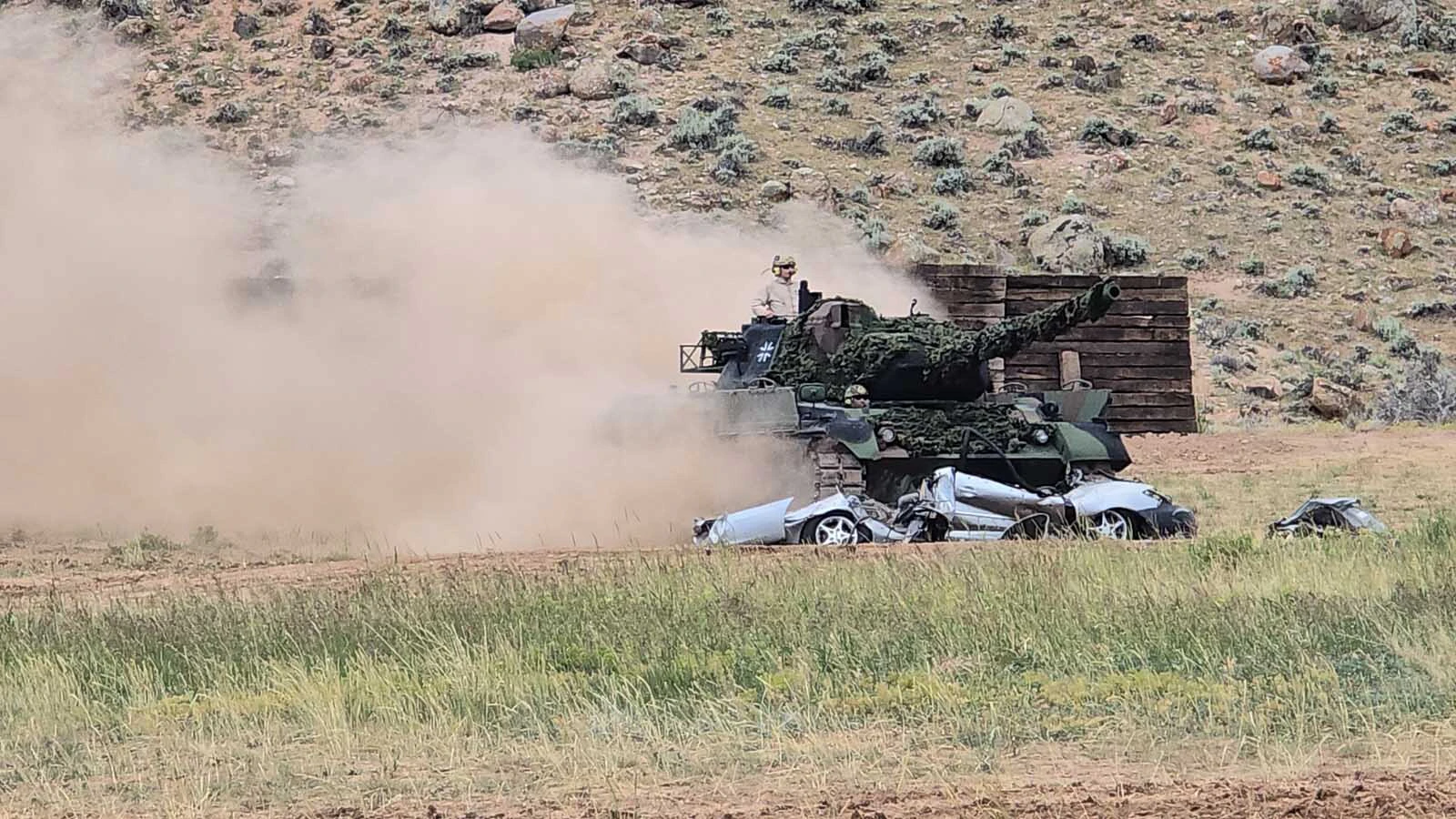
The Leopard tank is just making sure this white car is flatter than a pancake. (Renee Jean, Cowboy State Daily) 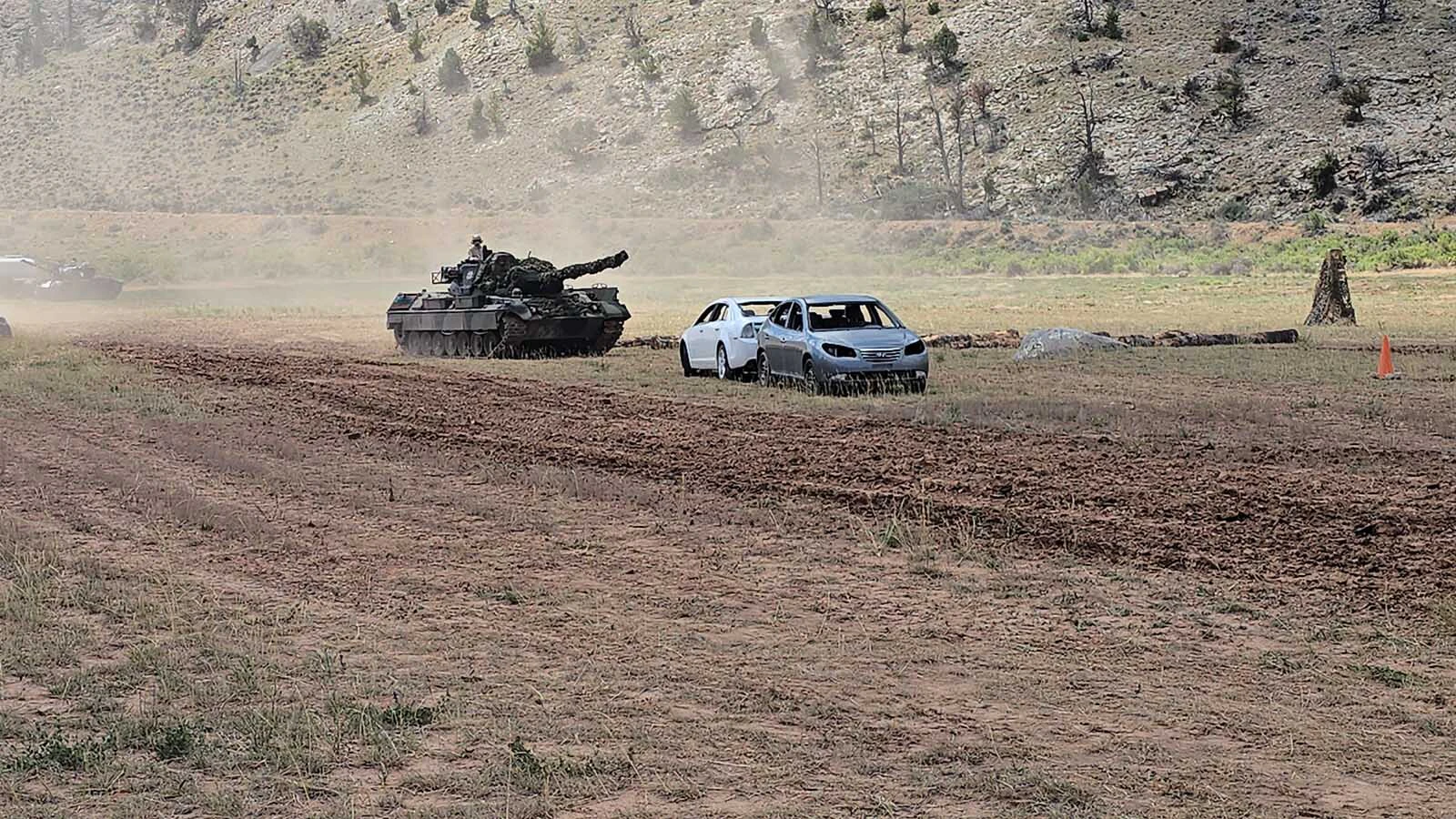
Two cars stand in this 1981 Leopard tank's way. (Renee Jean, Cowboy State Daily)
Affordable But One-Of-A-Kind
If the spectacle sounds one-of-a-kind, that’s not too far off.
Starks and his crew can rattle off a short list of places on the planet where tanks might be smashing cars.
“There’s one in Bovington, England, which is probably the most famous one,” Hartman said. “There’s one in Canada, the Oshawa Tank Museum, which is a phenomenal museum.”
There are also a couple of high-end commercial “experiences” in Texas and Las Vegas.
“I mean, no museums, where their whole thing is like education, do this, like, ‘We’re going to crush your car,'” Hartman said.
At the for-profit tank experiences, the cost is typically $1,000 to $1,500 per person to crush a car.
By contrast, spectators in Dubois got to watch the mayhem for $20, the price of regular admission, which also came with free rides and family-friendly demonstrations woven throughout the day.
From Crushed Cars To Constitution
For all the roar and spectacle, though, Starks is clear that the point of the event wasn’t just entertainment.
He paired the fun with new exhibits as well as with a few lectures, including a reflective talk from Starks on what he called — to a round of applause and cheers — the “genius” of America's Founding Fathers.
Knocking down a bad government, Starks told the crowd that was enjoying hamburgers and sandwiches from the museum’s canteen, had been the easy part.
The hard part is what came next — dreaming up a system that would be better than tyranny from a monarchy, or the equally bad: tyranny by a majority.
“Just think about all the examples of genocide throughout history, modern and ancient history,” Starks said. “That’s majority rule. That’s the majority saying, ‘I’m going to wipe you out, you’re a minority.’
"Think of all the examples of, ‘My religion is such and such, and your religion isn’t, so I’m going to turn you into a fugitive.’”
Majority rule sounds appealing on the surface, Starks said, but is really no better than tyranny by a minority. He said it overlooks the single most important premise of the U.S. Constitution, that all men are created equal.
The idea that all men are created equal was the “most radical, most compelling inspiration in all of history,” Starks said.
Distrust Helped Drive Innovation
There were no examples at the time of the kind of government the Founding Fathers wanted.
It was something they had to invent themselves — a group of disparate men who had extremely different views on all sorts of issues, ranging from the role of the federal government to the issue of slavery.
The differences between these 50-some men were at times so intense, friendships were destroyed, and the country itself all but torn apart, Starks said.
What these men came up with, then, was not crafted in trust. They distrusted each other, and crafted America’s systems accordingly, he said. Some were in the majority, for now, others in the minority. But they recognized that could change, and realized they had to create a system that would protect the rights of each.
“That’s where the genius of the Founding Fathers comes in,” Starks said. “They invented something that hadn’t existed before, and it’s called a constitutional republic.”
That republic is designed to put limits on majority rule, by separating the powers of the government into three branches, each one of which had powers that could check the other two, he said. They also added levers that could serve as emergency brakes — the filibuster, for example, and the electoral college.
“You’ve got people saying, ‘Well the filibuster is anti-democratic,’” Starks said. “‘We should get rid of it. It should just be majority rule.’ No, we’re not majority rule. We’ve got checks against majority rule.”
Getting rid of the electoral college would be a similar mistake, Starks added. It would allow the states with the largest populations to determine national elections and make decisions without any deference at all to the minority.
“Yes, it is terribly frustrating and messy,” Starks said. “But it’s also ingenious. And it’s the best government anybody has ever devised and we’ve now gotten the benefit of it for 250 years.”
Renée Jean can be reached at renee@cowboystatedaily.com.