
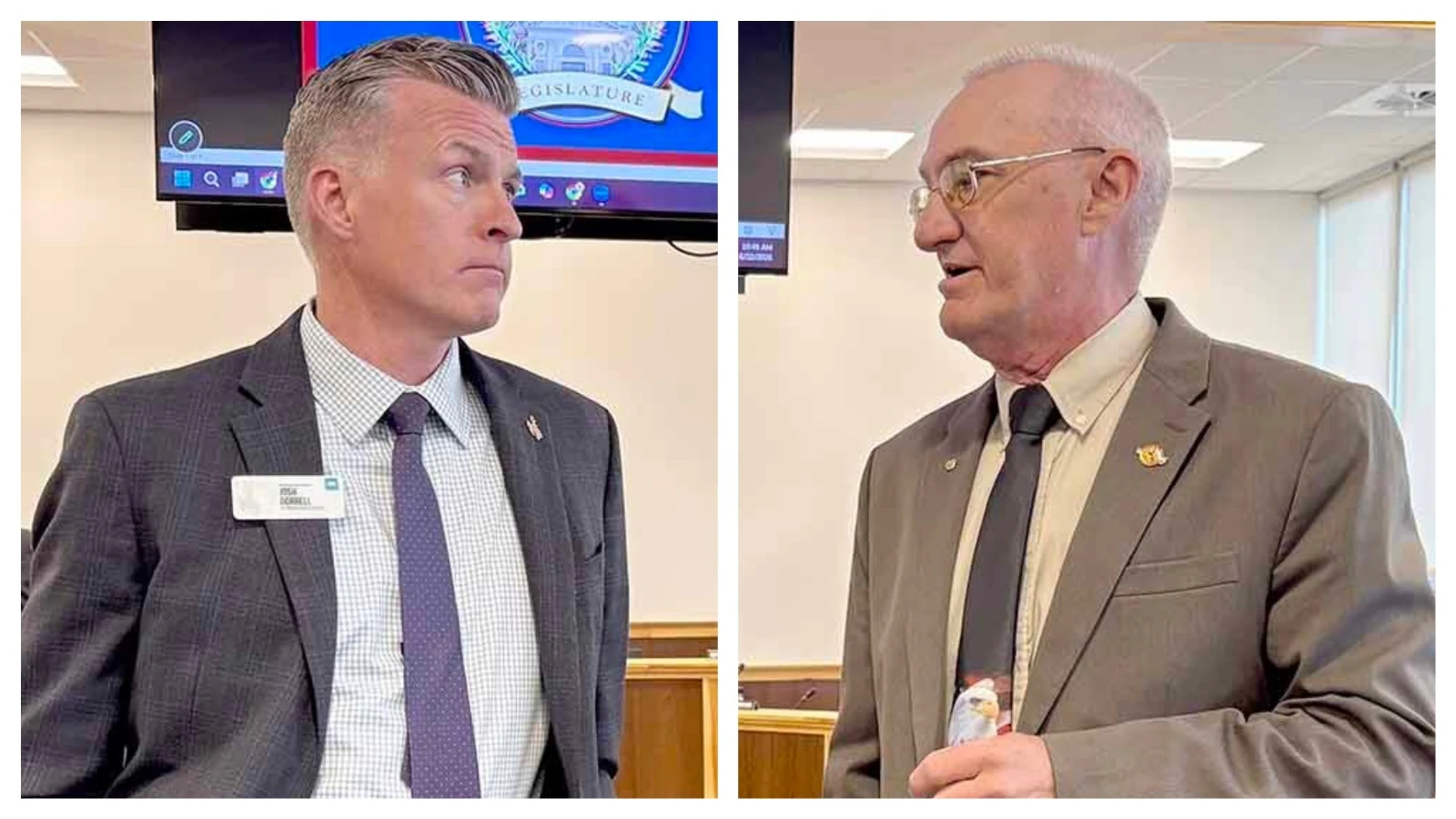
The Wyoming Business Council’s toughest critic in the Legislature says he was mostly relieved, though still fiercely curious, after the state Department of Audit released its report on the council late Wednesday.
Rep. Ken Pendergraft, R-Sheridan, made headlines in 2025 when he announced a goal to eliminate the WBC. That’s a government-funded entity that gives grants and loans to communities and businesses.
Pendergraft tried to fulfill his promise by spearheading the elimination effort in a January budget-planning session of the Joint Appropriations Committee, of which he’s the House side vice-chair.
The full Legislature rejected the proposition. But it cut down the WBC to one year of operational funding and specified that the Department of Audit should probe its finances and report back.
That was amid a larger, philosophical clash between lawmakers about whether the government should be involved in stimulating the economy and enticing business.
Now Pendergraft and other outright opponents of the WBC’s existence are shouldering the compromise the Legislature has placed upon them: investigating and reforming the council instead of killing it.
The Department of Audit describes accounting methods and issues across a nearly seven-year span, starting July 1, 2019, and ending in March of this year. Early in that period, WBC became a conduit for a large infusion of federal money related to the COVID pandemic.
“Based on that review, we found the WBC ultimately accounted for and expended funds in conformity with generally accepted accounting principles (GAAP), receiving unmodified audit opinions,” says the report. “However, these clean opinions were only achieved after private auditors identified material misstatements requiring significant audit adjustments.”
The report identifies some “material weaknesses,” corrections, and negligible levels of missing expenditure documentations.
On the one hand, Pendergraft told Cowboy State Daily on Thursday, he’s relieved. The report concludes that WBC doesn’t have unknown or private bank accounts.
“One of the reasons we brought (this audit) up was, in committee last year it was brought up there was a possibility they could have accounts we don’t even know about,” said Pendergraft. “It appears, from what we see here, that that is not the case. I’m relieved by that.”
On the other hand, he said, the issues the report details “did leave me with some questions.” He said he plans to question and study those issues.
Business Council CEO Josh Dorrell told Cowboy State Daily in his own Thursday interview that the WBC has answers.
The Answers
The report says independent audits for fiscal years 2024 and 2025 showed material weaknesses requiring multi-million-dollar corrections, including a $3.4 million expense over accrual, and a later $810,130 adjustment regarding reimbursement tracking.
It also says WBC had a $2.2 million adjustment to cover “improperly recognized revenue in the General Fund,” which is the state’s checking account.
A large broadband provider was working with WBC on a pay-as-you-go basis to install broadband infrastructure, Dorrell told Cowboy State Daily.
Instead of filing its expense documentation for timely reimbursement, the provider held onto that documentation for around six months then filed for reimbursement all at once, said Dorrell.
It’s like forgetting to bill one’s boss for a business expense until months later, he said, adding that the reimbursement issue was an “accounting issue.”
As for the second issue the report notes, the $2.2 million adjustment to cover revenue in the state’s checking account, that was a lapse exposed as WBC shifted from one accounting method to another, Dorrell said.
“For I think about 10 years, we’ve been recognizing revenue in a certain way. Our auditors recommended we recognize that revenue in another way,” he said.
The transition makes the numbers look sloppy, said Dorrell, “but again, no funds were misused or lost or anything like that. That change has been propagated as well.”
Does It Even Matter?
Pendergraft didn’t set out to reform the agency. But as an appropriator working under this year’s interim priorities, that’s his duty now.
That’s fine, he said.
“I’ve said before, I’m also a pragmatist. OK, I didn’t get my way. I didn’t get to eliminate it. I still have some philosophical issues with it,” said Pendergraft, adding that it’s “absolutely reprehensible” that WBC gives grants to certain businesses. That’s not the proper function of government and taxpayers’ money, especially when some businesses might benefit over others, he added.
Still, Pendergraft said, it’s better to be included in the reform conversation than not.
“So it’s, you know, the C-word that everybody hates: compromise,” he said. “If I were to be excluded from that conversation, the final resting place would be a lot further to where they’re at now, than if there were any changes at all.”
The Appropriations Committee is considering a draft bill to eliminate around 13 WBC programs – many of those at the WBC’s suggestion, but at least two over its objections.
That’s a “small victory,” said Pendergraft.
The Missing Receipts
The report says one out of 222 total transactions examined – or half a percentage point – contained discrepancies in which the underlying invoices or documents didn’t match the entry WBC put in the Wyoming Online Financial System (WOLFS). That error totaled $316.32.
WBC countered in a Wednesday letter to Gov. Mark Gordon, the members of the Joint Appropriations Committee and the Joint Minerals, Business and Economic Development Committee.
Gordon is co-chair of WBC’s board, and the two legislative committees are working together this interim to reform WBC.
“The actual discrepancy between the WOLFS entry ($316.32) and the underlying documentation ($317.18) in the subject transaction was a miniscule $0.86,” says WBC’s letter, which WBC Board Co-Chairman Derek Smith signed. “Even so, we have directed staff to redouble efforts to match WOLFS entries and limit any potential for the WBC to approach the ‘estimated potential population misstatement'.”
Another audit test showed that nine out of the 222 transactions – or 4% - lacked the necessary invoice to substantiate them.
That error totals $520.61, says the audit report.
WBC’s letter says the documentation is available except where its expenditure policy doesn’t require them.
Two of the nine unsupported transactions were for $15, and WBC policy doesn’t require receipts for individual reimbursements of $15 or less, says Smith’s letter.
Those expenses bought car washes. Together they cost $30, the letter says.
Another two of the transactions were accidental personal charges on a WBC card. Those totaled $70.87, and the employees reimbursed those, the letter says.
One of the nine transactions was a partial expenditure ($170.25) relating to a subscription, where the subscription period crossed multiple fiscal years, says the letter.
Four of the nine transactions (totaling $249.49) have documentation but “could have used additional context and explanation of the specified business purpose,” Smith’s letter concedes.
“Going forward,” it says, “WBC will review purchasing policy best practices with staff.”
Eleven of the 222 total transactions – or 5% - were travel expenses without an out-of-state travel request, the report indicates.
WBC management is reviewing the travel policy and crafting a solution, the letter says.
Just less than 2% of a specific, 120-transaction sample contained mathematical inaccuracies, the report says.
One expense report was $76.65 short of the calculated reimbursement total, and another invoice showed an unexplained $11.70 discrepancy, the audit report says.
The WBC says it will keep monitoring the grant reimbursement process and “explore technological solutions” to monitor documentation compliance.
A Market Expansion Grant showed a $333.74 reimbursement for a cooler that lacked a vendor invoice in the paper trail, says the report.
This was a lapse in available terminology in different systems, says Smith’s letter.
The WOLFS description included the word “cooler” but the invoice from the supplier, Wyldgear, didn’t contain that word.
Not Too Shabby, Says Council
A Wednesday WBC statement quotes Smith.
“We hold the Business Council to high standards of fiscal responsibility and accountability, and we welcome independent oversight. This audit affirms that the agency is operating responsibly while identifying a limited number of opportunities to further strengthen our documentation practices," he said.
"We recognize that some may try to use this audit to advance a political narrative or cast the Business Council in a negative light,” Smith continued. “The findings simply don't support that.”
He noted that the Department of Audit didn’t find improper spending or violations of law, “only a small number of minor documentation-related findings.”
“As a board,” Smith concluded. “We'll continue to ensure the agency implements the recommendations and maintains the high level of accountability Wyoming taxpayers expect."
Clair McFarland can be reached at clair@cowboystatedaily.com.


