Wyoming lawmakers meeting Thursday in Lander promised a crowded room repeatedly that they would fix a $3.9 million decrease in public school sports and activities funding that shocked parents and schools this spring.
The Legislature passed its new $2-billion-per year school funding model in March. A mix of hated and beloved changes have roiled the school districts. For example, teachers are on track for a roughly 12.8% raise, while other needs and wants have taken a hit.
The package’s architects voiced surprise in May, when the Wyoming High School Activities Association dispatched a plan for dealing with the $3.9 million activities shortfall that involved cutting sports, reducing travel and other reductions.
“I can tell you quite frankly that parents in Lander, myself included, are really aggravated about this,” said one parent, Randy Weisz, at the Thursday meeting of the Wyoming Legislature’s Select Committee on School Finance Recalibration, held in Lander’s school district central building.
“Lander’s taken a hit, but I had no idea what all these other schools were getting hit with. My son said, ‘They should be really mad,’ and I completely agree with that.”
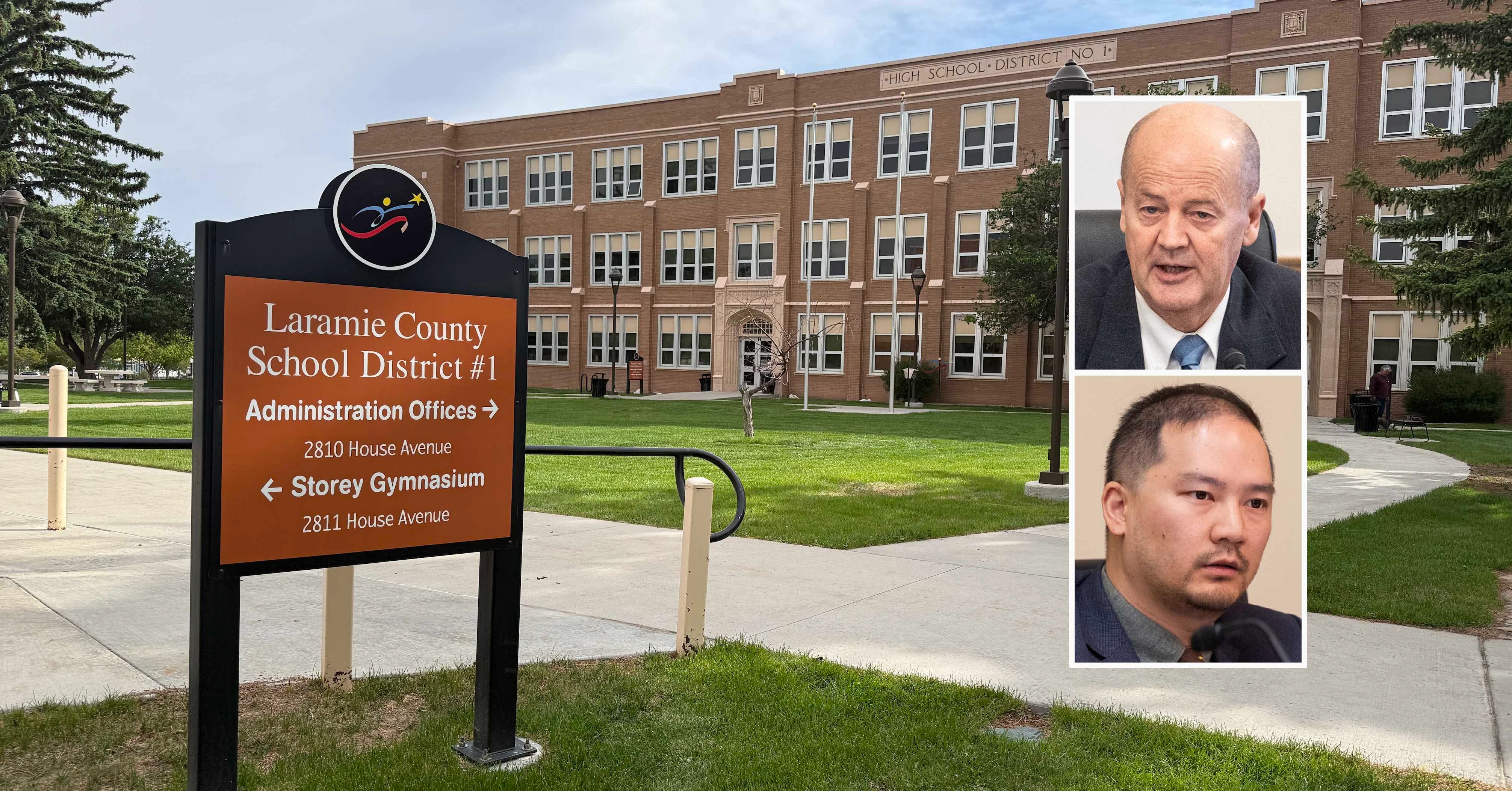
Committee Co-Chair Rep. Scott Heiner, R-Green River, reassured meeting attendees repeatedly that the committee seeks to fix the issue.
“In my mind and I think in the mind of most of the committee members here, activities are an extension of the classroom,” said Heiner. “It provides benefit for our students and we don’t want to stop that. We don’t want to deemphasize how important activities are for our students.”
Committee members and staffers floated multiple different strategies for fixing the problem.
Those range from putting activities costs into the rigid but well-funded “silo” of money the Legislature has reserved for classroom teaching costs, reverting to the old activities funding model but adding a 5% increase, or letting school districts choose the more generous of the old activities model and the new one.
The committee didn’t adopt one method Thursday. It meets again Aug. 25 in Cheyenne.
Now For The Numbers
Laramie County School District 1 – the state’s largest – is on track to lose more than $600,000 for activities. Lincoln County School District 2, based in the Star Valley region, is on track to lose $400,000.
Not all districts are losing money: 26 are slated for increases and 22 for decreases.
That’s because the new funding model doles out money for activities based on district population, not schools.
Anticipating that smaller schools have less economy of scale for propping up activities programs, the model historically has given more money for smaller schools and less for larger ones, on a per-student basis, according to a presentation by Legislative Service Office fiscal deputy administrator Matt Willmarth.
But now the Legislature gives money based on the whole district’s population, not each school’s population.
So if a larger district contains a far-flung, tiny high school of 45 students, apart from its bigger high school of 1,000 students, the little high school still gets less per-student allocation for activities because it sits within a populous district.
That’s what happened to Cokeville’s high school within Lincoln County School District No. 2, multiple people testified Thursday.
“This legislation created a $130,000 hole in Cokeville that would have killed all activities in Cokeville within a single year,” said school principal Kenneth Dietz, who appeared via virtual link.
Dietz and other school administrators who addressed the committee over the two-day meeting thanked lawmakers for giving classroom instructors such substantial raises.
But they also lamented – resoundingly and on both days – that they can’t pull money from the instructional silo to fund other areas that may be suffering shortfalls.
Dietz voiced the same thoughts. He said the teachers at Cokeville have been willing to see money go toward activities that they knew were helping kids.
Other administrators cast it as tension-inducing, that their classroom educators are slated for big raises while other staffers aren’t.
This One’s An Oldie
The teacher silo is the culmination of an old struggle between the Legislature and the education sector.
Lawmakers hear that teachers need more money, or that schools need more money to hire teachers. So they furnish more money to the districts.
In multiple cases, the money goes “sideways” – as House Speaker Chip Neiman would say – into other areas of education.
To be fair, Sen. Chris Rothfuss, D-Laramie, has told Cowboy State Daily in the past, those other areas have seen shortfalls as well.
Johnson County School District No. 1 Board Chair Travis Pearson echoed that Thursday.
“The same year we got the 8.5% raise to the teacher based (salaries), utilities got bumped 11%,” Pearson said.
Some committee members voiced reluctance to abandon the classroom silo. It's been a great compromise that carried the new funding package, committee Co-Chair Sen. Tim Salazar, R-Riverton, told the public Wednesday.
"If I had to do a recalibration over again, I'd do it again," Salazar said. "Those salary increases had to occur. And if you monitor the state legislative process on recalibration, it was not at all certain (they would have)."
Administrators gave varying answers on the extent to which the raises in the teacher silo would have reached the teachers without that restriction.
Heiner, Rothfuss and other legislators told Cowboy State Daily in May that they didn't foresee the activities shortfall.
Willmarth said that this new method was known in January while they were sculpting the new spending package, but schools didn't voice outrage over it because the teacher silo - locking funds that could cover the shortfall - wasn't yet cemented into the legislation.
Mike Yin’s Idea
House Minority Floor Leader Mike Yin, D-Jackson, offered the idea of letting districts use whichever model was more generous: the old one that funded activities based on the school’s population, or the new one funding them based on the full district’s population.
Most of Wyoming’s high schools suffer under the new model, and high school activities are slated for a $5.9 million reduction statewide.
Middle schools gain $1.69 million and elementary schools gain $340,845, however, which is why the total decrease for activities shakes out to $3.87 million.
Smaller districts with fewer schools benefit from the new model.
Niobrara School District No. 1, based in Lusk, is set for a nearly 30% increase to activities funding.
Goshen County School District No. 1 is set for the biggest decrease, percentage-wise, at 30% less for activities. Lincoln County School District No. 2 is next, at about a 28% drop.
Brian Farmer, executive director of the Wyoming School Boards Association, told lawmakers that even with Yin’s proposition, schools might still fall short.
That’s because schools have pulled from other budget categories to fund activities above what the model allocates and recommends.
In school year 2024-25, the districts spent $4.3 million more on activities than the Legislature envisioned and allocated.
So right now with the $3.9 million reduction and the freezing of “siloed” instructional money that once helped cover the districts’ $4.3 million boost, the activities bracket is falling closer to $7 million shy of the school system’s past provision, said Farmer.
Courts
Wyoming’s courts require the Legislature to adopt a cost-based funding model for public K-12 schools due largely to the state Constitution’s promise of a complete and uniform education system.
Rothfuss urged school administrators to communicate with lawmakers about shortfalls and excesses.
“You’re telling us we don’t provide enough funding: where? Let’s see the details of the expenditures versus the funding model spreadsheet you’re generating,” he said. “Get us that data so we can start to understand where we’ve fallen short in these categories.”
Rothfuss in February advanced significant changes to the new funding model so that it provided more money for electives and other offerings, but so that some areas – like insurance costs – anchored more directly to each district’s demands.
Senate President Bo Biteman, R-Ranchester, worried aloud that Yin’s proposition strayed from the court-mandated mission of the Legislature.
“Not to throw cold water on it,” Biteman said. “You know I just want to make sure we’re evidence-based and cost-based here, not just going on what feels good.”
Clair McFarland can be reached at clair@cowboystatedaily.com.