The Joint Appropriations Committee majority tried in January to defund the Wyoming Business Council, an agency that gives grants and loans to businesses and communities.
The state Senate, which ran more fiscally moderate this year than the House, rejected the effort overwhelmingly in February. But then in March, the Legislature passed a budget that funds the Wyoming Business Council’s operations for one year instead of the traditional two-year budget allocation.
The Joint Appropriations Committee is now delving into a monthslong research project into how it can trim the business council, tether it to legislative oversight and refocus it onto what the supermajority Republican Legislature deems proper uses of government.
The committee spent around five-and-a-half hours on that topic while meeting Monday in Lander.
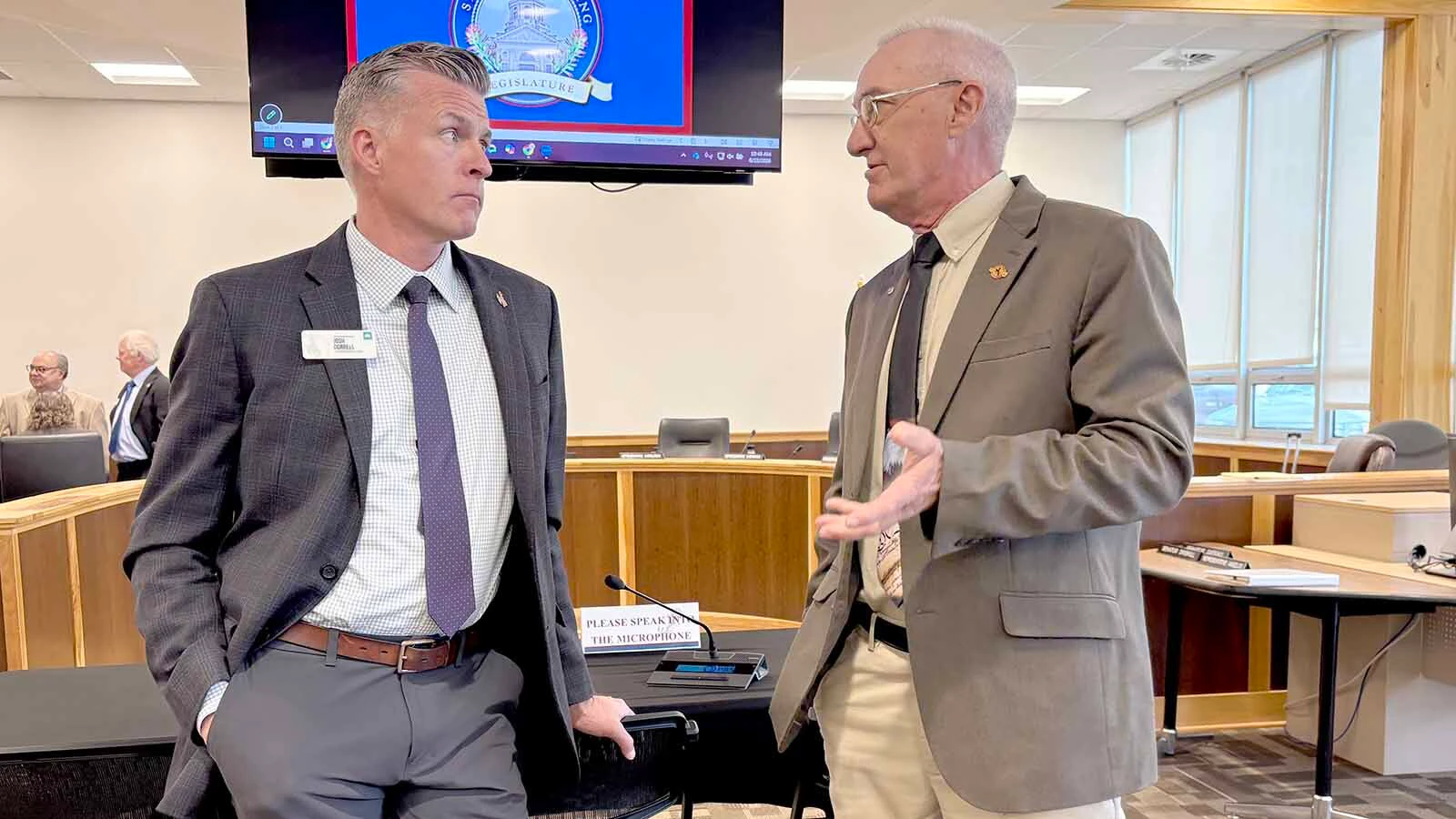
Its members weighed three proposed bills. They also engaged in a spicy back-and-forth with Wyoming Business Council CEO Josh Dorrell.
‘Give Me A Number'
“Mr. Dorrell, what do you anticipate will be your ask for the Wyoming Business Council for the supplemental budget? And No. 2, how much do you need to succeed?” asked Senate Appropriations Chair Tim Salazar, R-Riverton.
Dorrell said the WBC’s figures are still in flux, and he expected it to give its final budget request submission to Gov. Mark Gordon in August. But becoming “whole,” or receiving the rest of its two-year budget, would be the priority, he added.
As of now, the agency’s budget ends June 30, 2027, unless the Legislature acts to restore its second-year money.
Salazar later voiced dissatisfaction with that answer, pressing Dorrell on it again.
“Give me a number. Tell me where that fits into the supplemental budget,” said Salazar.
“I’m not going to give you a number,” responded Dorrell. “I don’t mean to be obtuse, but I want to work it through the proper channels first.”
Besides having its funding cut to one year of operations, the WBC is slated for a potential makeover.
Both the Appropriations Committee and the Joint Minerals Business and Economic Development Committee are reviewing the WBC’s programs and underpinning laws.
Dorrell said he’s looking for information on which programs the Legislature wants to cut.
He also indicated that lawmakers don’t fully understand the agency yet.
“I don’t think it’s appropriate for us to really discuss the exact in-and-out if you don’t understand the things that we do,” said Dorrell, adding that WBC has presented program data to lawmakers in recent months.
“I’d advocate to at least stay whole, as a minimum, (but also) we should look at investing in our communities, and the state agency that unlocks those,” he said.
Humble Ask This Time
Rep. Ken Pendergraft, R-Sheridan, also parried with Dorrell.
“Honestly, I’m not trying to be confrontational, but I’m frustrated,” said Pendergraft. “You were asked what does it cost to be successful — no answer. No answer, no money.”
Dorrell reiterated that he’d know the answer in August.
Salazar’s line of questioning is an echo of one he launched in December, but which Dorrell then handled very differently.
At that time during the committee’s budget-planning marathon, Salazar asked how much money WBC needs to fix the economic problems facing the state.
Dorrell answered $1.7 billion.
“Thank you for giving us the courtesy of the truth,” said Salazar at the time.
Around seven weeks later, the committee advanced two pieces of legislation — both of which later failed — that had sought to defund the agency and strip it from state law.
Ahead of next year’s January lawmaking session, the two committees are working on a plan to refocus the Wyoming Business Council and reevaluate its many programs.
Neither committee has adopted any WBC makeover bills yet.
But the Joint Appropriations Committee on Monday discussed four in this vein.
The Bill About Federal Money
One of the bills would authorize lawmakers to review and appropriate federal funds seeking to pass through the WBC for capital and investment projects.
Dorrell cast that one as peculiar.
Congress authorizes federal money for governmental investments, the U.S. Treasury allocates those investments and enforces their terms, and the executive branch of Wyoming runs the program.
“And then all of a sudden, somehow the state Legislature is inserting itself into this process,” said Dorrell. “And while I am happy to report, I’m happy to bounce ideas off of, it feels like gumming up the system … is exactly what this is going to do. It doesn’t help us act at the speed of business. I’m open to understanding why.”
House Appropriations Chair John Bear, R-Gillette, said lawmakers would consider that concern carefully so they don’t create undue burden.
Of the 11 companies involved in this system, he said he hopes “the preponderance of them” have been traditional energy companies.
Bear referenced allegations Wyoming continues to wage in federal court litigation with other red states that large investors colluded to kill coal and other fossil fuels by banding together in green-energy compacts.
“Even though these are federal funds, they’re still taxpayer funds,” said Bear, who went on to ask about the WBC’s administration of its investment projects.
Dorrell said WBC’s investment committee can meet spontaneously to consider and authorize those projects, and that he has arranged for a full-time employee to serve as investments analyst.
The Bill To Stop Feeding Airports
The Wyoming Business Council’s Business Ready Community program generally involves WBC sending a grant or loan to a community entity, which then works on economic development and business infrastructure projects.
But WBC doesn’t call it that anymore. The agency rebranded the controversial program this year as the Building Resilient Communities program.
The Appropriations Committee is considering a bill that would ban airports from benefitting from the program, as well as recreational and convention facilities, and infrastructure projects of the WBC’s choosing.
That would leave the program free to fund or invest in land, buildings, facilities, telecommunications infrastructure, rights of way, sewer and water projects, roads and landscaping.
The bill also seeks to add a requirement that the WBC can’t grant or loan money for assets that the applicant owns or will own.
A lawsuit between Gunwerks and the Cody-based economic development group that secured funding for it has been waging for years over the allegedly dismal state of a building Gunwerks doesn’t own, but which the economic development group arranged to be built for the company with WBC money.
The bill pertaining to the BRC program would also require WBC to send grant and loan plans to two lawmakers — one state House representative and one senator — for review and comment before sending them to the executive branch for final approval.
The Big One
The biggest bill the committee considered would eliminate 13 Wyoming Business Council programs, some of which are obsolete.
Others Dorrell hopes to keep, he indicated to Rep. Jeremy Haroldson, R-Wheatland.
He asked why the Wyoming Partnership Challenge Loan program is on the chopping block. That’s a loan program in which WBC partners with banks to secure loans for businesses.
Dorrell insisted the WBC is not competing with banks, but is helping businesses get loans on components on which banks aren’t authorized to lend, like the more speculative success prospects called “blue sky.”
Disaster loans are “a challenge,” but outside disaster loans, the program is at industry-standard or higher rates of success, Dorrell said.
Pendergraft raised an ideological roadblock.
“My problem with this is ideological. Essentially, it sounds to me like you’re not in competition with the banks,” said Pendergraft. “But if a business goes to a bank and the bank turns them down — presumably because of risk — why is it justifiable to take public moneys and … risk public funds, which to me should be, probably, more cautiously invested?”
Dorrell said banks have to refuse certain investments due to other reasons besides risk.
Pendergraft countered again, asking why the government should be involved in the fate of businesses that don’t provide essential public services.
Sen. Mike Gierau, D-Jackson, rebutted Pendergraft’s logic.
On the Select Water Committee, he said, lawmakers are willing to “dole out” significant money for agricultural water projects.
“You want to talk about blue sky?” asked Gierau. “Oh my Lord. And we do it. And we do it because it’s right.”
Haroldson said he’d be happy to put a “question mark” next to this program, and he emphasized that this is only a draft bill set for more contemplation later this year.
Here Bear answered Gierau’s rebuke.
“As you’re forming that ideology in your mind as to how you’ll approach this, I hope you’ll also not compare water infrastructure to helping mom and pop shops have a successful program,” said Bear.
Small business success is “quite different from water infrastructure,” he added.
Water infrastructure serves small family farms, which are businesses, said Gierau.
“Water infrastructure,” countered Bear, “would be much similar to the road in front of the small mom and pop shop. ... It’s got a common usage.”
The County Infrastructure Bill
One of the bills contemplates a revival of the old budget appropriation called the County Consensus Funding program by which counties, if at least half of the governing boards of the local governments within them agree, could receive construction and infrastructure grants through the State Loans and Investment Board.
The Wyoming County Commissioners’ Association has asked the Legislature to send $75 million per year into that program. The draft bill says “XX” where the appropriation would go.
Three-quarters of the allocations to counties would hinge on population, and one-quarter on how poor their property values are.
Clair McFarland can be reached at clair@cowboystatedaily.com.