

When Iranian forces brought down a U.S. Army helicopter Monday off the coast of Oman, Dillon Jackson’s reaction wasn't shock so much as recognition.
“The first thing I wondered is what happened, what were they doing?” he said. “What did they see, or not see?”
It’s the reflex of someone who has spent years training for moments just like that.
Jackson, a Wyoming native, spent 22 years in the U.S. Navy flying helicopters over some of the world’s most volatile waterways, including the Persian Gulf and the Strait of Hormuz.
He retired just one week before the incident off Oman, but incidents like this still pull him back into the same calculus of how things unfold and how quickly they can go wrong.
“There’s a lot of ways that could have gone differently,” he said. “A lot of Navy helicopters go into the water, and one or more of the crew members don’t make it out.”

When Iranian forces brought down a U.S. Army helicopter Monday, Dillon Jackson’s reaction wasn't shock so much as recognition. “There’s a lot of ways that could have gone differently,” said the Kemmerer native, who spent 22 years flying Navy helicopters. (Courtesy Dillon Jackson) 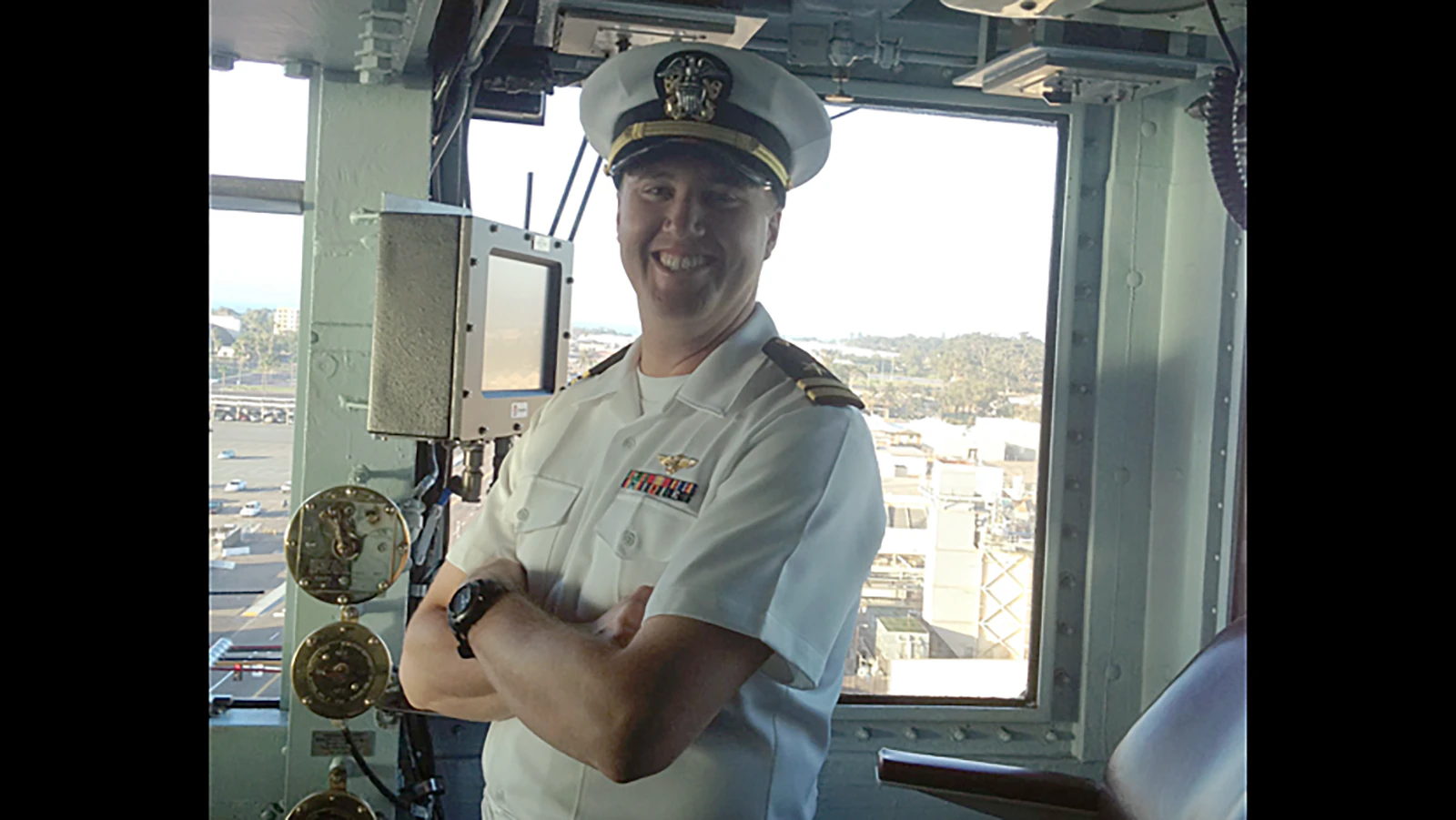
When Iranian forces brought down a U.S. Army helicopter Monday, Dillon Jackson’s reaction wasn't shock so much as recognition. “There’s a lot of ways that could have gone differently,” said the Kemmerer native, who spent 22 years flying Navy helicopters. (Courtesy Dillon Jackson) 
When Iranian forces brought down a U.S. Army helicopter Monday, Dillon Jackson’s reaction wasn't shock so much as recognition. “There’s a lot of ways that could have gone differently,” said the Kemmerer native, who spent 22 years flying Navy helicopters. (Courtesy Dillon Jackson)
What People Don’t Understand About Hormuz
For many Americans, a phrase like “naval presence” or “blockade” conjures a simple image of ships lined up on the water like net buoys of a fishing boat.
Jackson said the reality is much more complicated.
Across the Persian Gulf, and even through the narrow Strait of Hormuz, there are thousands of miles of water and hundreds of vessels to account for at any given time. Tracking them requires constant surveillance, meticulous coordination, and patience.
“One of our missions in the helicopter community was to fly up and run radar in order to track all the ships out there,” he said, explaining that it gets tough when vessels use radar-avoidance tactics.
“It’s a lot harder when they start turning broadcasting systems off,” he said. “Now you’re trying to find people who don’t want to be found.”
Even an area as confined as the Strait of Hormuz is difficult to manage amid shifting national interests.
“The thing most people don’t understand is just how narrow it is. You can see land on the right side of the ship and land on the left at the same time. These aren’t wide-open places,” he said, adding how in that environment, the margin for error narrows too.
“In some ways, it’s like if Wyoming went to war with Idaho. The countries (in the Persian Gulf) are about that size and the distances aren’t that great,” he said.
Though he deployed in conflict zones around the world, the strain Jackson felt most wasn’t physical.
The lessons that stand out most from those years aren’t about tactics or preparedness, but about the way life in the Navy can reshape relationships with the people waiting at home.

Cost That Doesn’t Show Up on a Map
As his deployments accumulated in places as far flung as South Korea and the Middle East, physical separation resulted in emotional distance too.
He met his wife while stationed in Pensacola, Florida, where they bonded over a shared love of horses and imagined eventually settling into a quieter life with a few horses of their own.
Neither anticipated how difficult it would be to build that life around constant movement between different duty stations and long deployments.
It was an emotional balancing act, said Jackson. At points, something as simple as a call home could feel like a tripwire.
“I might try to make light of things —tell her I saw whales or a rainbow — and it might be the only good thing that’s happened all month,” he said. “Back home, she’s had a hard day, and it can sound like I’m just out there having fun on some cruise.”
The situation required compartmentalizing, but Jackson needed to be careful not to separate himself too much.
Life “underway” could swing from long stretches of routine to moments of sudden intensity, and the same mental compartmentalization that helped him manage on duty carried over into life at home.
“That compartmentalization helps you function in stressful situations, but if you’re not careful, it can also become a way of keeping parts of yourself walled off, and that’ll show up when you come home,” he said.
The balancing act became additionally hard with the arrival of their two children.

Miles Between Family
That tension came into sharp focus during a nearly 11‑month deployment in 2020.
He was stationed in the Persian Gulf on the USS Reagan, meanwhile his wife was back in Washington state, parenting their two young children by herself and juggling the pandemic stresses of school disruption and social isolation.
When he called home, his kids didn’t always want to talk to him. When they did, every mile between them was felt.
“The longer that tour goes on, the harder and harder and harder it becomes, because how do you talk to a 5-year-old kid once every few weeks for five minutes on the phone and stay engaged when you've been gone for months,” he said.
“Sometimes after the call, everybody’s just sadder. My last six years in the Navy, it feels like I really haven't been around (my family) much at all,” he said. “There’s a reason divorce rates are so high in the military.”
That strain is common among service members.
The crew of the USS Gerald R. Ford was in the news this year after their deployment stretched to a record 326 days for an aircraft carrier. It struck a familiar chord with Jackson.
“There’s a part of you that has to ask: What is happening in the world that justifies keeping the 5,000 sailors on board that ship out there that long, and who’s making that decision, because that is a huge cost to all of those families,” Jackson said.
These experiences have reframed how Jackson understands his own story, particularly where it began. Now, stepping away from the Navy, he’s looking back at that beginning with a different perspective.

Escape Velocity
Growing up in Kemmerer, most people Jackson knew either worked in an open‑pit coal mine, a nearby power plant, or on the surrounding ranches.
His dad was a miner and cowboy; his mom worked at the local school.
Like a lot of kids in small towns, Jackson said he craved to see the world beyond it.
“I used to tell people small towns have their own gravity,” he said. “I called it escape velocity — I spent 18 years trying to build up enough speed so that when I left for college, I wouldn’t get pulled back.”
He made his first break by heading to the University of Wyoming, and after college he took a job as a residence director at Fort Lewis College in Durango, Colorado.
He’d always wanted to be a pilot, figuring it the easiest way to see the world.
To the friends he grew up with, and who knew him as a long‑haired guitar player, Jackson would have been more likely to join the Peace Corp than the military.
That changed in September 2001, when he woke one morning to his clock radio and heard news of planes flying into buildings.
The next week, he walked into a recruiting office, setting him on a path that would take him into the Navy and, eventually, around the world.
Shark Week
In Japan, he befriended the owners of a small counter bar near his apartment. In Thailand, he once ordered a simple “chicken and rice” dish and got a curry so strong the memory of it still makes him sweat.
From Singapore to the Persian Gulf, one of his favorite parts of the job was simply interacting with people different from him.
He also came to see the Navy itself as a kind of compressed version of the country.
In a destroyer’s ward room or a carrier’s flight deck, Jackson worked with Americans from all 50 states.
To him, it was the closest thing to a working model of the country: a handful of people from everywhere learning each other’s quirks, arguing, ribbing — and watching Shark Week.
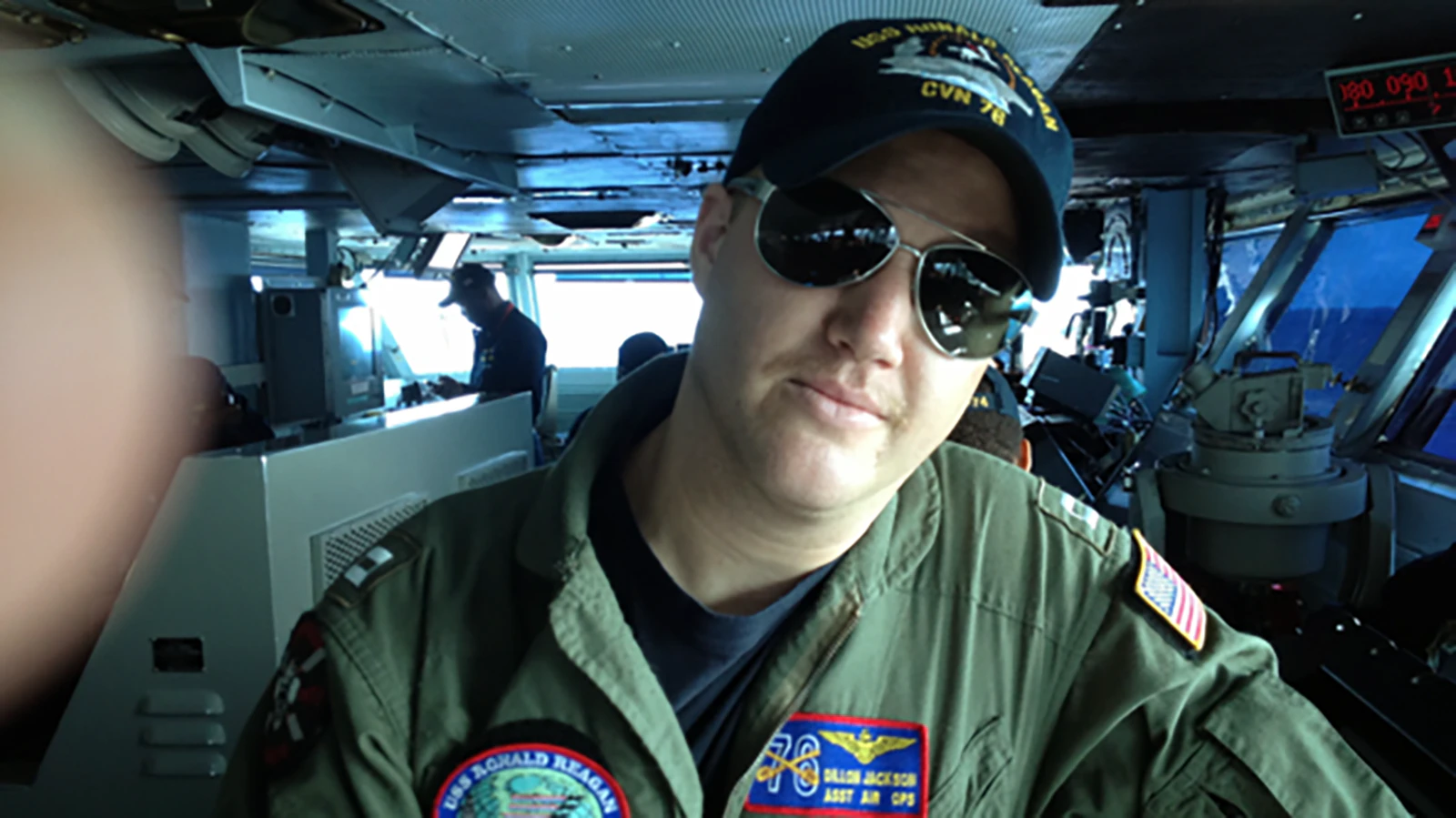
“The captain of the ship would come into the ward room to get coffee, and finally one time he says, ‘'Man, what is it with you pilots and watching Shark Week?’” said Jackson. “Without skipping a beat, I turned to him and said, 'That's our motivation to stay airborne.'”
As he steps away from a 20-year career, Jackson is thinking deeper now about the institution of the military as a whole.
During that time, he’s said he’s seen a cultural shift that’s made it harder to separate the institution from the political conversations surrounding it.
“We get to look at history with a clear lens. You don’t get that with the present,” he said. "I’ve got a lot of confidence in leadership to figure out what the Navy needs to look like for the next 20 or 50 years.
“What I wonder about more is whether the United States knows what it wants its role in the world to be.”
Jackson is asking a smaller version of that question of himself.
He knows he wants a civilian job that lends itself to a stable family life, but he’s already running into something he hasn’t faced in a quarter‑century in uniform: job rejection.
While he figures out what comes next, he’s throwing himself into the mission he no longer wants to leave.
In the mornings, he’s in the kitchen making breakfast. He walks his daughter to the bus stop, then meets his son in the yard to throw a baseball. In the evenings, he’s at his daughter's volleyball games or reading to his son aloud from "Encyclopedia Brown" paperbacks.
Some changes will take time. His wife has to remind him not to “XO” every household problem, shorthand for his Executive Officer rank.
Other adjustments are coming easily.
“My daughter is 12, and she is at the stage where I’m getting a lot more eye rolls,” he said, laughing. “I’m doing my best to be an embarrassing father. It’s a role I’m trying to lean into.”
Zakary Sonntag can be reached at zakary@cowboystatedaily.com.