
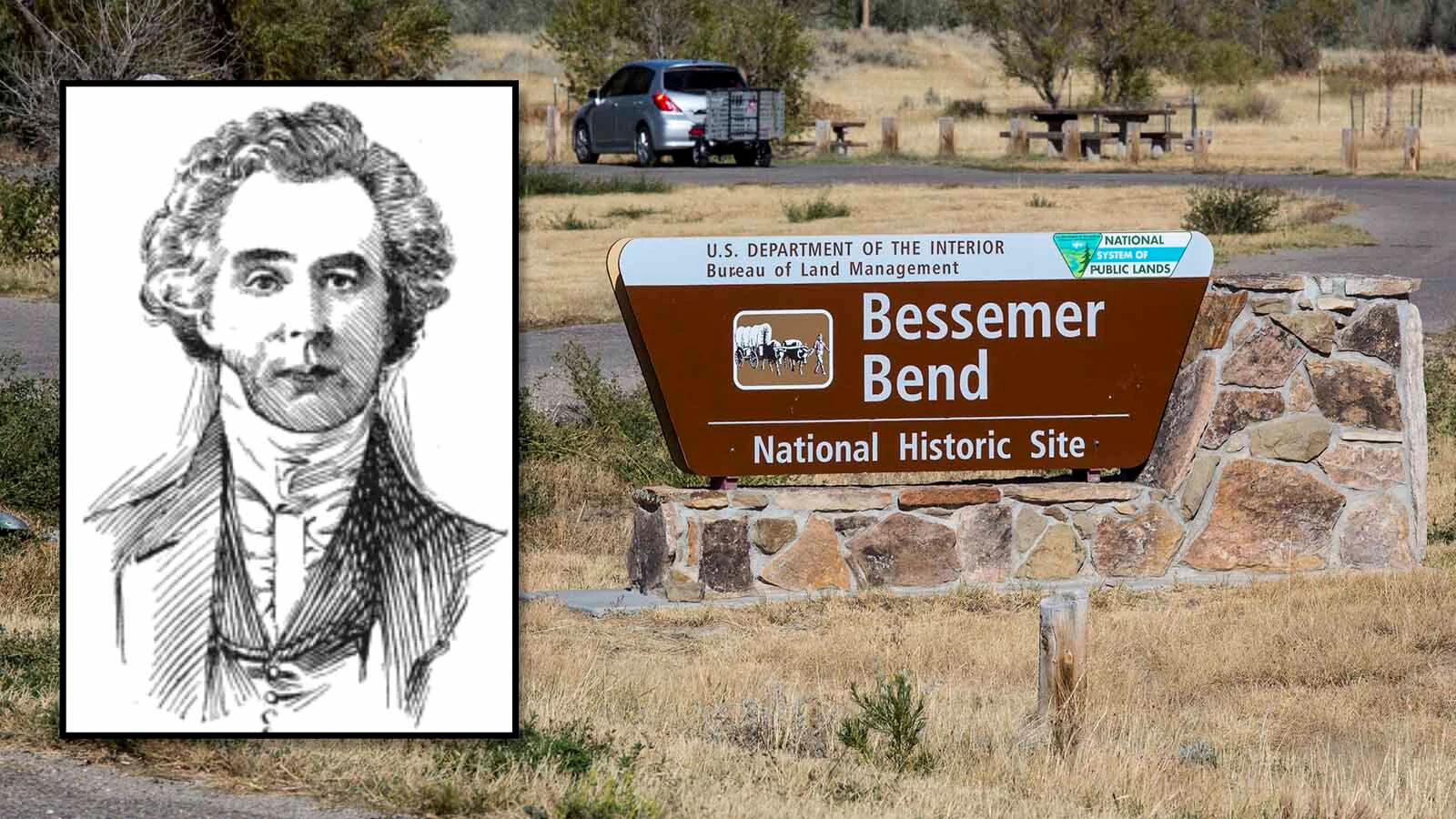
Bessemer Bend, a true Wyoming ghost town, has been claimed back by nature and alfalfa fields.
Before its demise, Bessemer was where Wyoming’s oldest cabin was built by desperate fur traders with the Pacific Fur Co.
Decades later, Bessemer became part of the Oregon, California, Mormon, Pony Express, and Overland trails that all crossed at Red Buttes/Bessemer Bend.
Later, the famous Goose Egg was built on the spot. This extravagant stone mansion is said by some say to have inspired scenes in Owen Wister’s “The Virginian.”
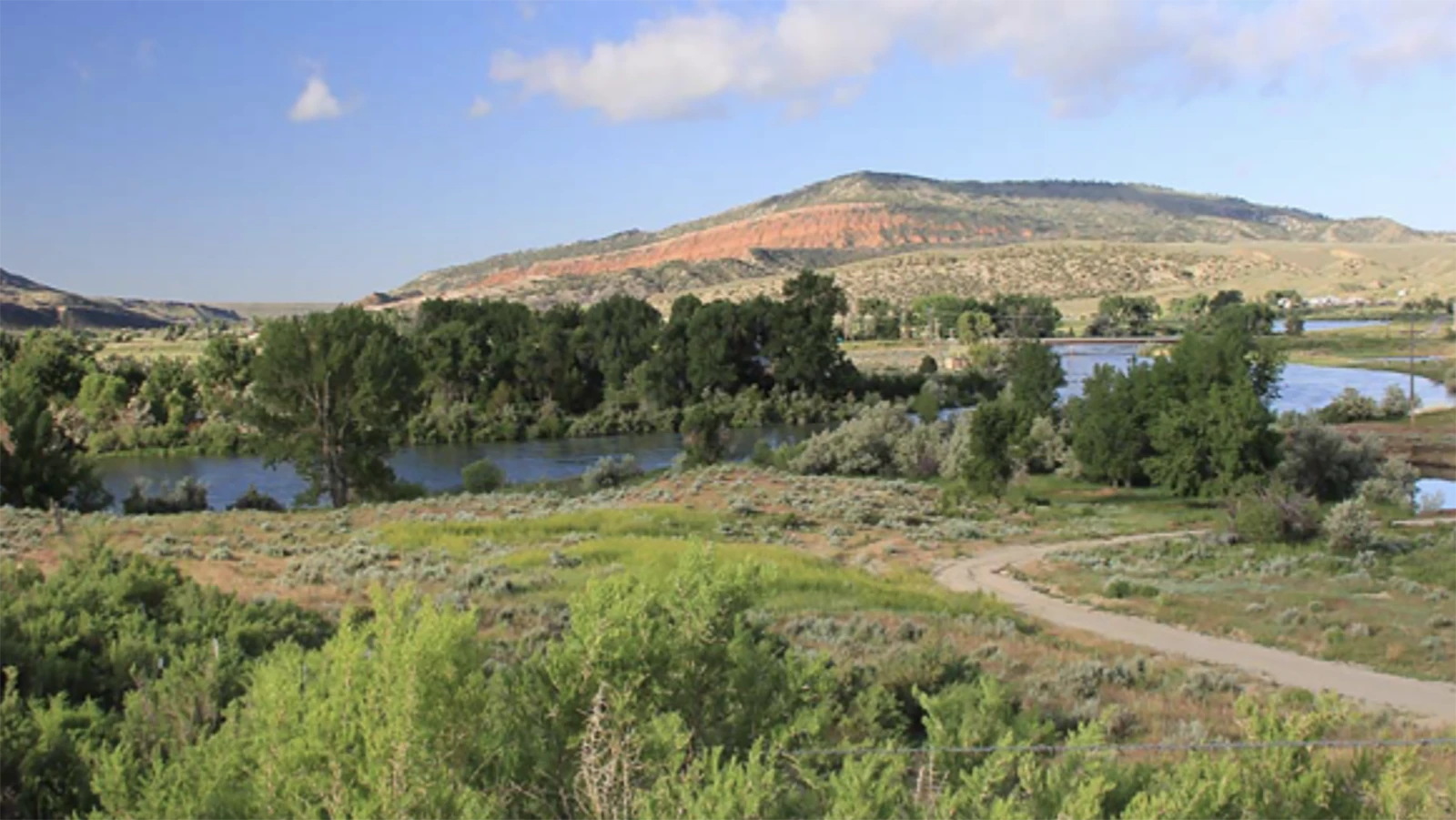
Today, Bessemer Bend is a broad loop of the North Platte River southwest of Casper that shows no signs of the failed city.
The landscape is dominated by irrigated fields, ranchland, cottonwoods along the river, and the red hills and buttes that explorers and Oregon Trail emigrants knew as Red Buttes.
The town of Bessemer, now long gone, had gained a reputation as the “Queen City of the Plains.” Her founders believed that their city would one day be the grandest in Wyoming.
Their hopes were dashed by a rigged election and the railroad.
Ultimately, Casper “stole” the honor from them when it became the seat of Natrona County instead and, one by one, the residents of Bessemer hauled their homes over to Casper.
The Fur Traders
Bessemer first appeared in written record in the 1812 diary of fur trader Robert Stuart.
Stuart had been hired in 1810 by John Jacob Astor to work for the Pacific Fur Co. and was on the company ship, the Tonquin, when he became marooned at Fort Astoria.
The crew had sailed first to the Falkland Islands and then around Cape Horn and up the western coast of North America, reaching what is now Astoria, Oregon in May 1811. There, they established Fort Astoria.
When the crew sailed farther north, to Vancouver Island, an interaction with Native Americans resulted in many deaths and the destruction of the ship.
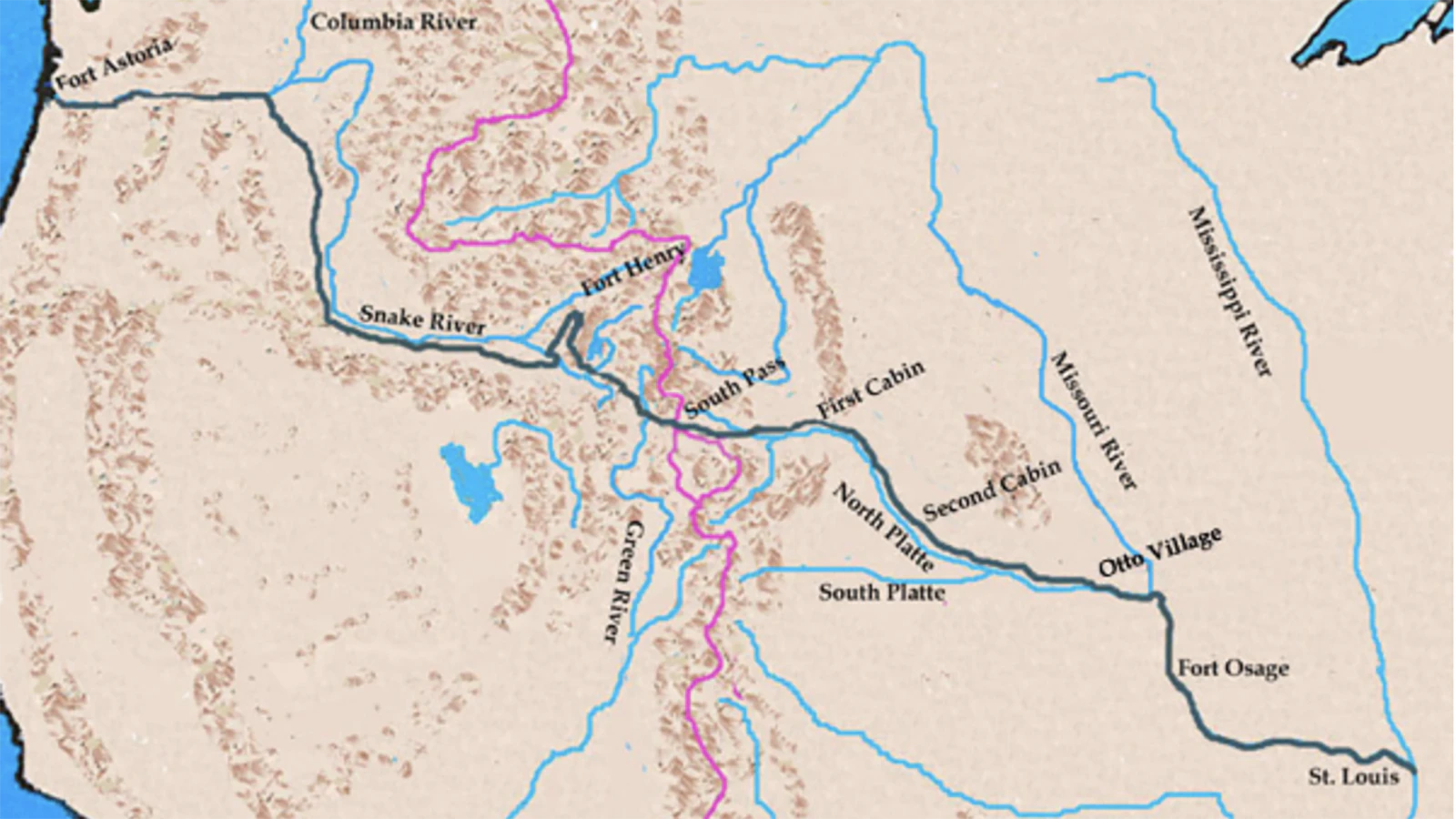
It was left to Stuart and a small group of men to return eastward overland. The party left Astoria on June 29, 1812, bound for St. Louis. With Stuart were Ramsay Crooks, John Day, Benjamin Jones, François LeClerc, Robert McClellan, and André Vallé.
They started up the Columbia River in canoes. Before they were out many days, John Day became “demented" and was sent back to Astoria in the care of some friendly Indians.
In a few days, they came across some men who had been separated from another party and gave them provisions.
A man named Miller joined Stuart in Day's place according to Molker.
The group headed east, through what is now Washington, Oregon, Idaho, and Wyoming, traveling on what would later become the Oregon Trail.
Highlights of their journey that Stuart detailed in his diary included paddling down the Snake River, crossing Teton Pass and seeing Jackson Hole, and discovering the South Pass.
By the time they reached Bessemer, the seven men were starving and weak, desperate to rest.
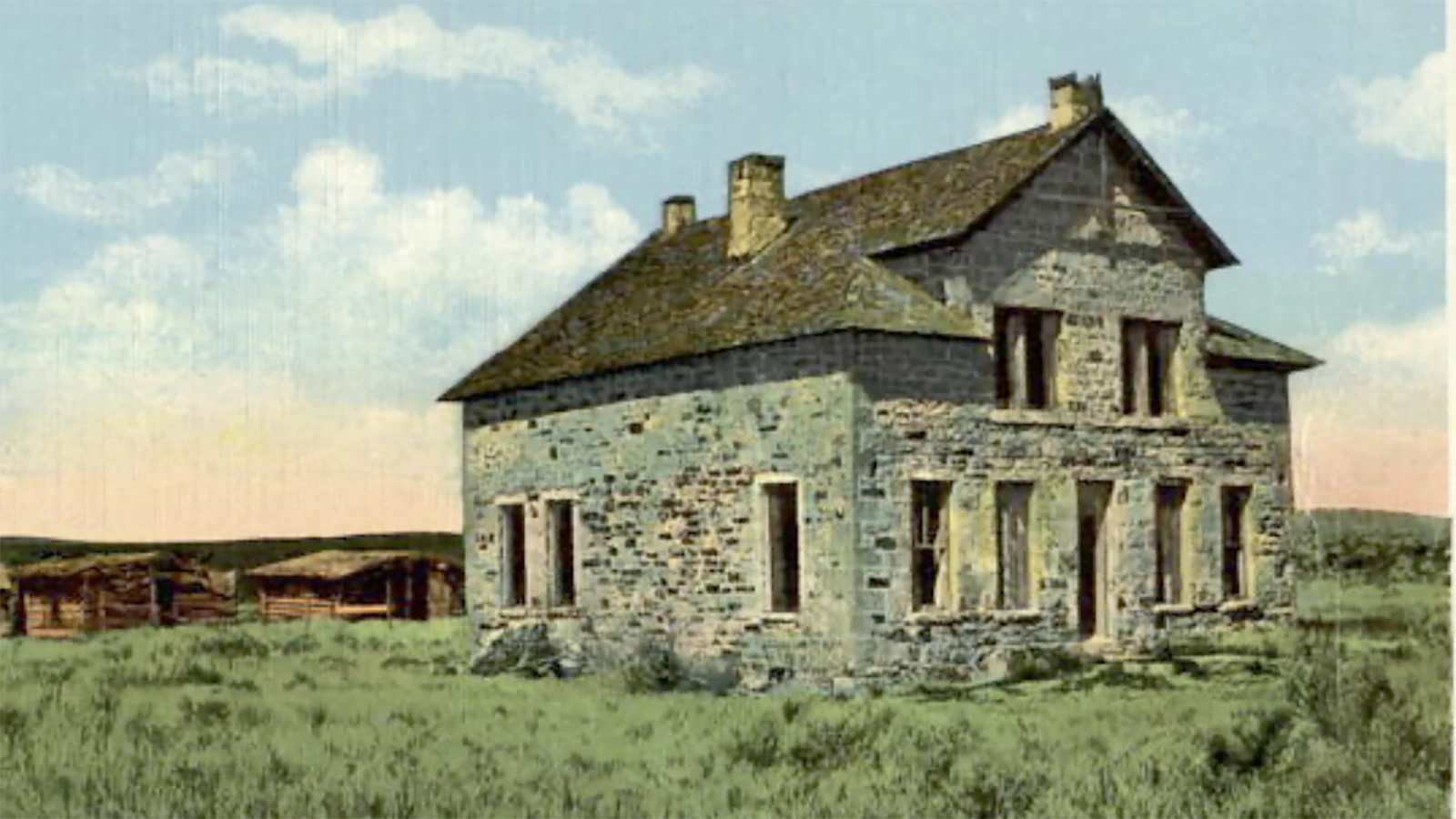
The Goose Egg was a stone mansion that was built on Bessemer Bend and visited by Owen Wister. It was torn down in the 1950s but the memories of Bessemer’s colorful past remain. Near the mansion, the first cabin was built in 1812 and then the Oregon Trail and others used the area as safe passage. 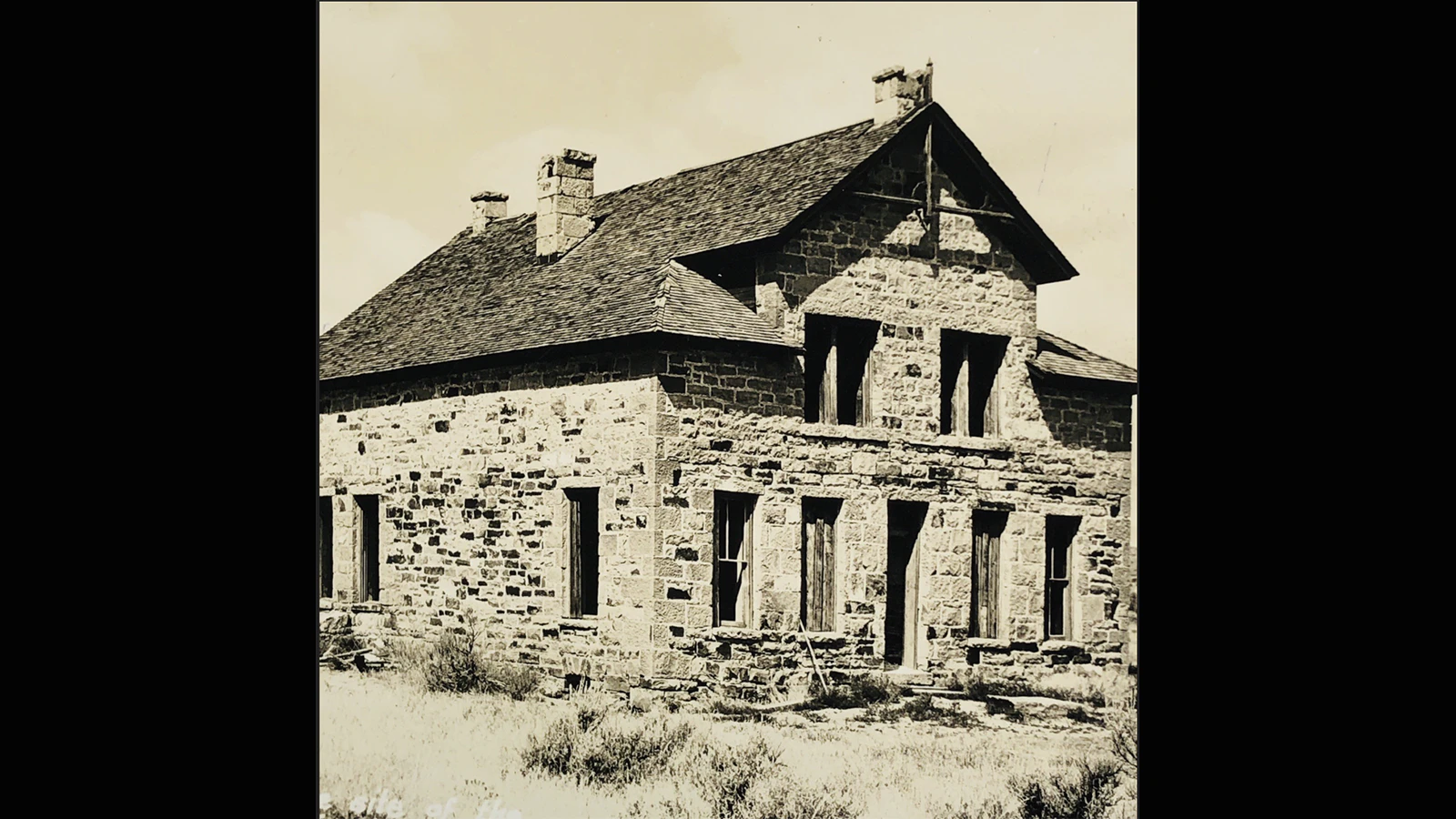
The Goose Egg was a stone mansion that was built on Bessemer Bend and visited by Owen Wister. It was torn down in the 1950s but the memories of Bessemer’s colorful past remain. Near the mansion, the first cabin was built in 1812 and then the Oregon Trail and others used the area as safe passage.
A Refuge
Described as “footsore, hungry, and utterly weary,” fur trader Robert Stuart wrote in his diary that he and his six companions had been following a river (the North Platte) for two days but had to find a place to stop and recuperate.
The cabin they were soon to build would become the oldest recorded cabin in Wyoming.
It was November 1812 when Stuart described how they had found a low point of land on a bend in the river and had selected it for their winter camp.
There were cottonwoods and willows there for building materials and firewood and the area had plenty of wildlife to sustain them.
The men had already seen the Grand Canyon and discovered the passage through South Pass. They had their horses stolen by the Crow and were on foot.
Weakened by their trek, they had started missing shots and were starving when they had finally succeeded on killing an injured bull buffalo.
Though tempted to eat the meat raw, Stuart had fed the men broth to regain their strength.
Stuart describes their cabin at Bessemer as eight feet wide and 18 feet long. The walls were six feet high and the whole was covered with buffalo skins.
The fireplace was in the center and the smoke found its way out through a hole in the roof.
“As the slaughter of so many buffaloes had provided the party with beef for the winter, in case they met with no further supply, they now set to work, heart and hand, to build a comfortable wigwam,” Stuart wrote. “In a little while, the woody promontory rang with the unwonted sound of the axe.”
He said that by the second evening, the cabin was complete.
They rested and recuperated from the exertion and hunger they had suffered. They had been in their little cabin for five weeks when a small band of Arapahoe Indians visited them for a few days. Although the Arapahos did not harm them, Stuart was concerned that they might return in “another mood.”
He packed up his men and some provisions and moved on toward the east, leaving behind their home on Bessemer Bend. When Stuart’s party arrived at Saint Louis they had shortened the route of Lewis and Clark, had discovered the Sweetwater and North Platte rivers and had discovered the most important gateway through the Rockies, South Pass.
Mary Lou Pence and Lola Homsher in their book, “The Ghost Towns of Wyoming,” said that some pioneers claimed the cabin stood for many years while others said the Indians immediately swooped down and burned it.
Whichever the case, the cabin has long been gone when the Oregon Trail followed part of the same route first made by the small party of fur traders.
The Queen City Of The Plains
The Goose Egg, or the Searight House, was built on Bessemer Bend and by 1888, a town had been planned, adopting the name of Bessemer.
The founders had high hopes of being a metropolis. A sawmill and brick plant were brought in and homes and businesses sprung up quickly.
When a brewery and liquor house were brought in by Max Jaensch, the residents of Bessemer saw a bright future.
“For as one citizen put it,” Pence and Homsher wrote. “Here the consumption of distilled waters was far above the average in American communities.”
In 1888 to 1889, the town promoters laid out 49 blocks and reserved land for what they hoped would become Wyoming's future capitol building. Bessemer grew quickly and attracted settlers, ranchers, and businesses.
As Wyoming was preparing for statehood, Bessemer entered the race to become the county seat of the proposed Natrona County.
However, it was not to be.
According to Pence and Homsher, just as Bessemerites were sitting back “gloating” over the meager 304 pollings cast in Casper as compared to their 667 count, it was announced that some “skullduggery” had been perpetrated.
The investigators ruled that Bessemer had cheated and had more votes than residents. Their count was thrown out and Casper became the county seat in 1890.
Residents of Bessemer were still angry when they spoke to historians Pence and Homsher in the 1950s.
“They say we cheated and voted every man, woman and kid,” one old-timer told Pence and Homsher. “Well, I know one of their men who voted three times. But they don’t tell about that!”
The following year, the printing press for the Bessemer Journal was seized and moved to Casper to become the Natrona Tribune.
The railroad selected Casper as the regional rail terminal and the end of Bessemer was official.
Many of the buildings were moved to Casper until only the Goose Egg and a few others remained. Eventually, even the stone mansion was torn down and Bessemer quietly faded into the past.
“When they said the Goose Egg was no more, you could hear that awesome hush,” Pence and Homsher wrote. “You could almost see Chalkeye and Fingers and Honey Wiggin and Baldy and Missou wipe away a tear.”
Bessemer is now returned to pasture and agricultural land. However, the memory of the ghost town and the first cabin from 1812 remain.
“You can rip a house to pieces, ’til it ain’t no more, but you can’t tear up the things that happened there,” an old-timer told Pence and Homsher in remembrance of his beloved Bessemer and the people that once lived there.
Jackie Dorothy can be reached at jackie@cowboystatedaily.com.


