
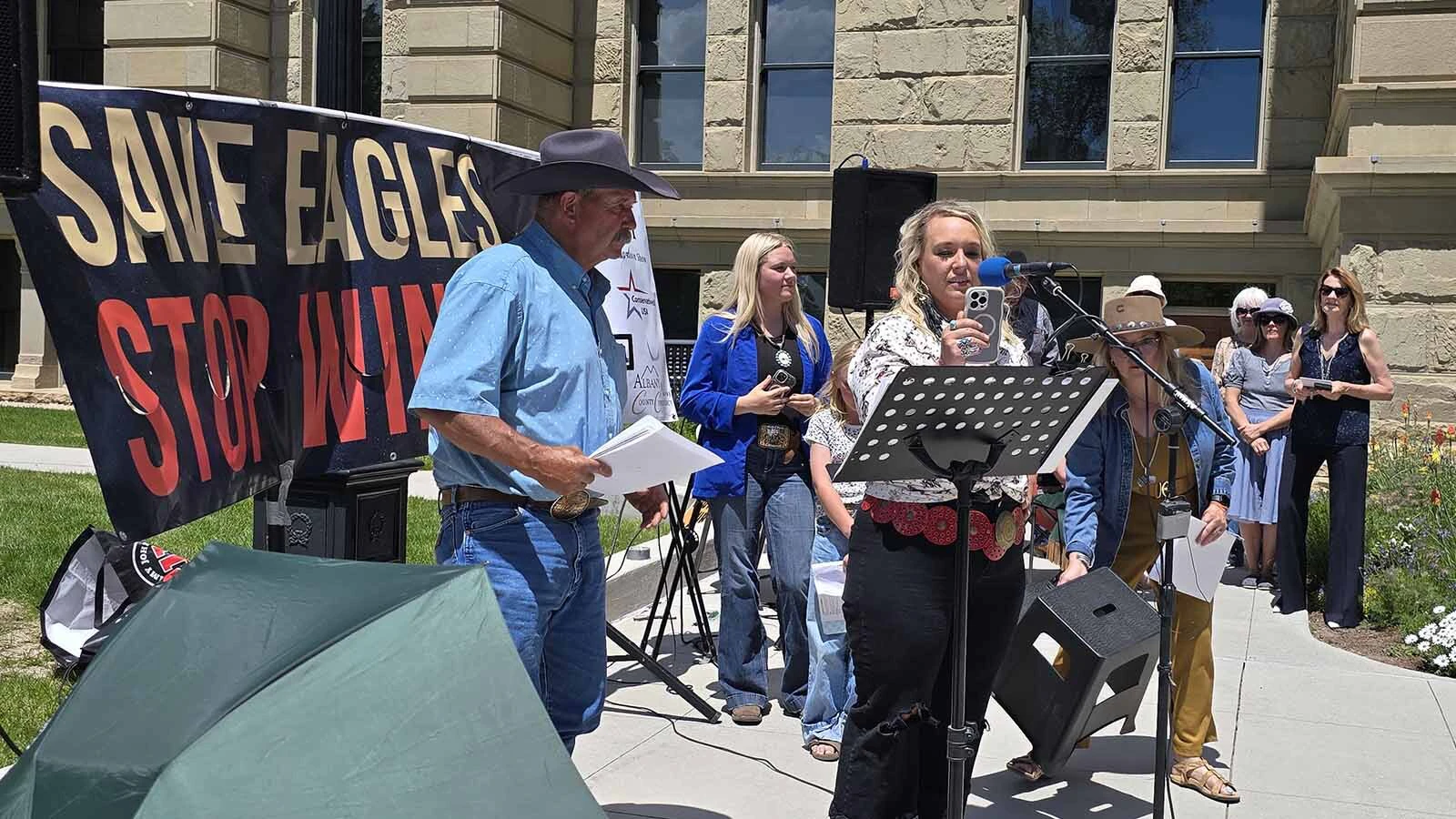
CHEYENNE — Protests and rallies are something fourth-generation rancher Mike Stephens of Converse County rarely attends.
In fact, Thursday marked a first for him.
Stephens, whose family has what he describes as a “modest” cow-calf operation south of Glenrock that’s been there since 1910, said he’s spent most of his life avoiding microphones and politics.
But as wind projects have encircled his part of the county, he felt he could no longer afford not to get involved.
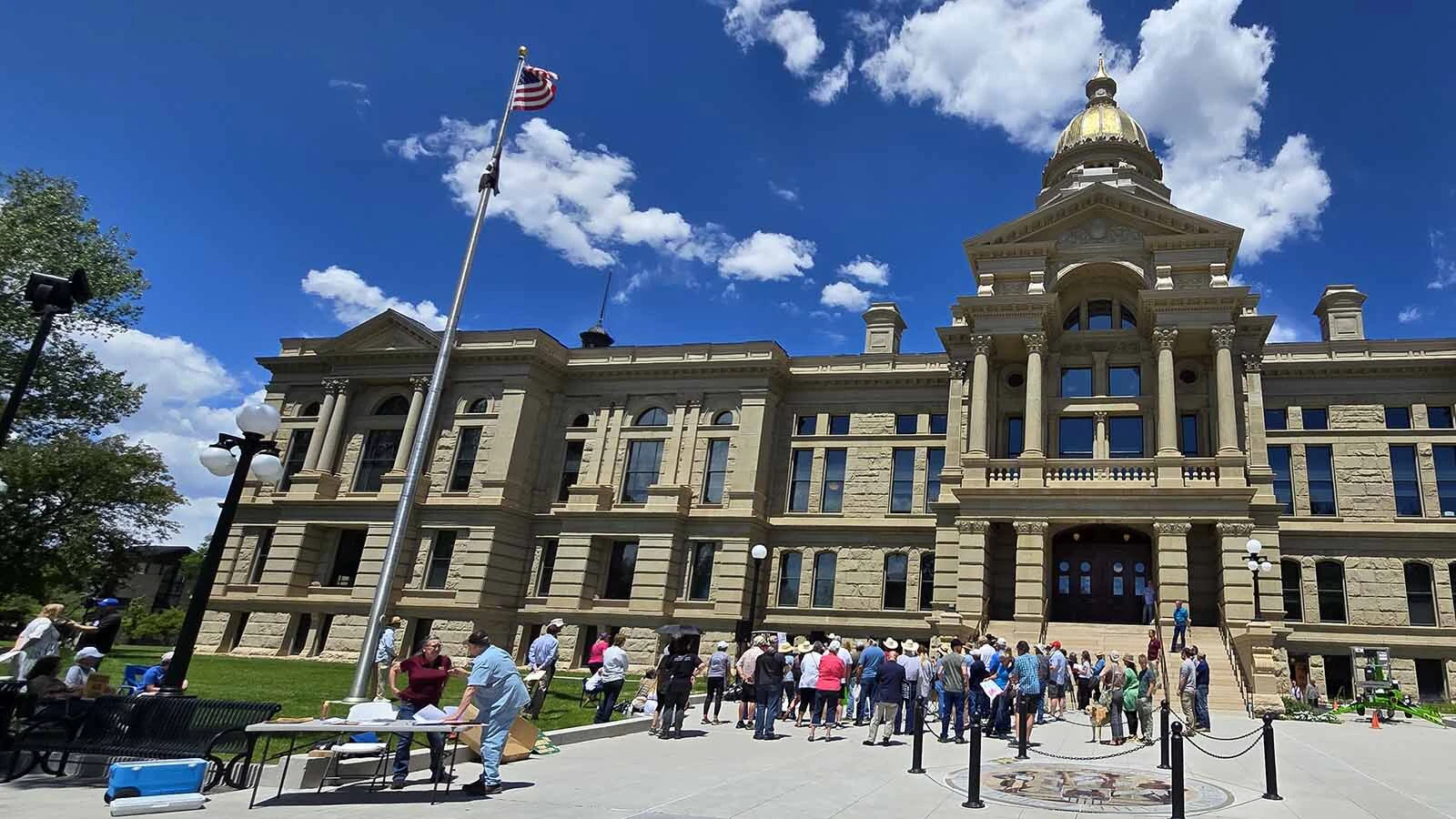
“We’ve got surrounded by wind farms,” he told a crowd gathered Thursday at the Wyoming Capitol in Cheyenne to call for more study of a wind wall that’s sprung up across a 200-mile swath of southeast Wyoming.
“If you look at Converse County right now, between the farms that are there and the ones that are proposed, it’s 200,000 acres,” he said. "That’s a lot. And then this Pronghorn (wind and solar project) showed up. Half of it’s going to be on state land. That was enough for me.”
When he started talking to neighbors, Stephens learned how widespread wind farms had become. That made him feel uneasy.
So, he decided to come and be part of what was his first-ever rally, even though it meant his family’s ranch would be short-handed that day.
“I have talked to ranchers all around,” he said. “I’ve talked to 68 ranchers, and there’s 50-some against it, three who won’t say, and six who are for it,” he said. “And this is the ranchers all the way around me. And they don’t have to save the ranch. They’ll go to work and do whatever they need to do to make it.”
At a State Board of Land Commissioners meeting in Douglas that Stephens helped arrange, he saw 200-some people in the crowd, with another 100 or so on Zoom, all against more wind in Wyoming.
More Than 3,500 Signatures On Petition So Far
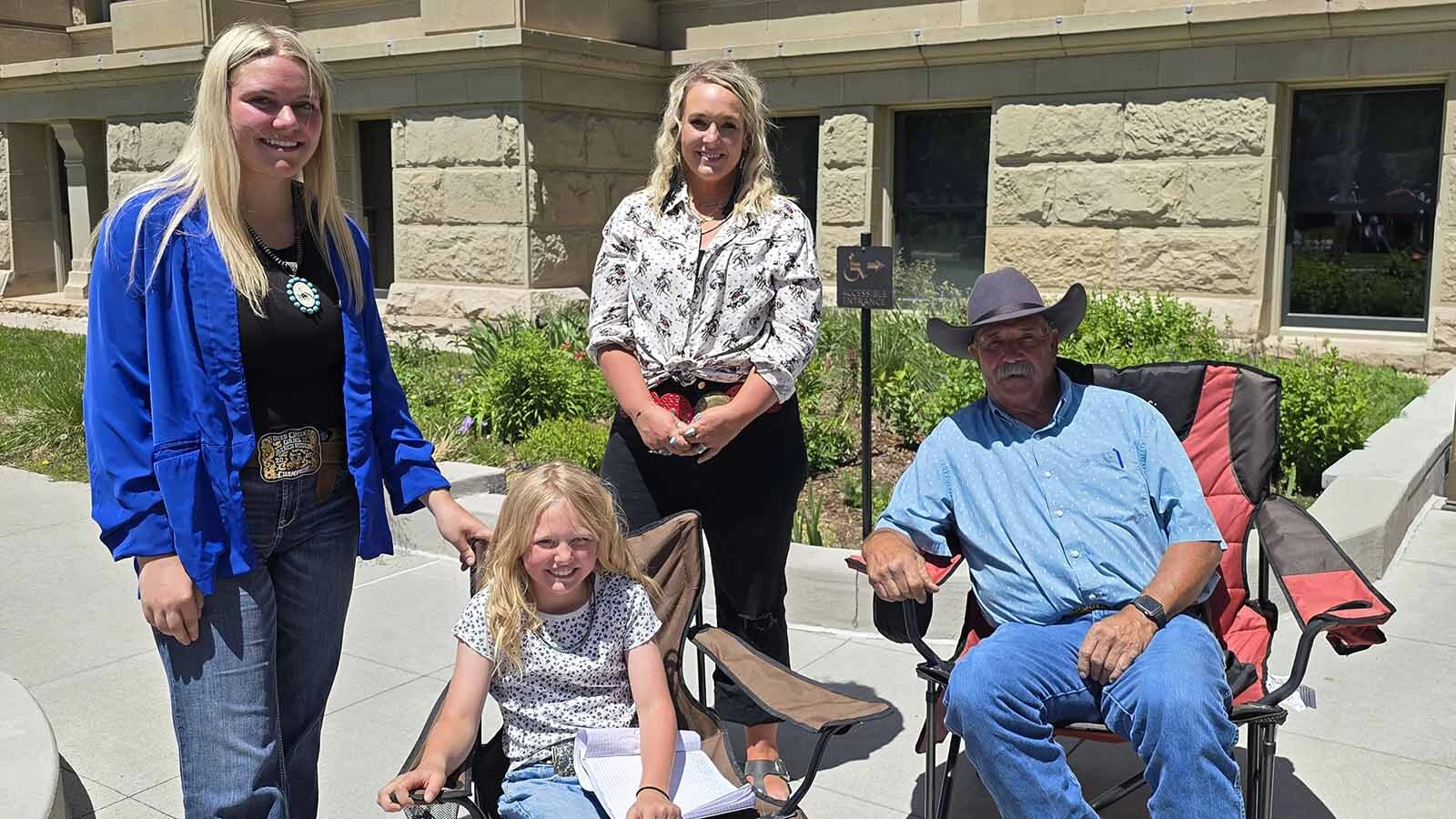
For the rally on Thursday, Stephens brought his daughter-in-law Kelsey and two grandchildren, Emory and Acelynn, to Cheyenne.
“My husband and I built our home with our own two hands alongside family and friends,” Kelsey told the crowd. “We chose this place intentionally for the land, the view, and the life it allows us to live.
"Picture a summer evening on our front porch — crickets and frogs singing, the smell of freshly cut hay in the air, and the red hills glowing as the sun sets. That’s a view that will take your breath away.”
And it’s exactly where a new wind farm plans to locate.
A petition the family has helped circulate has so far gathered 1,778 signatures from Converse County residents alone, Emory told the crowd, with another 500 from Douglas and another 1,241 coming from Glenrock and nearby areas. That’s more than 3,500 signatures so far.
About 98% of those are from Wyoming residents, Emory added.
“Based on the most recent available data, Converse County generates approximately 43% of Wyoming wind power and electricity, but only receives 12% of the wind generation tax revenue,” she said. “That’s a small fraction of the benefits compared to what it produces for many residents.”
For her, the point of the rally in Cheyenne was all about making sure Wyoming people, including ranchers, have a say in the decisions that are affecting them.
Seeing A Wind Wall For The First Time
On a map taped to her kitchen table, Cheyenne Realtor and Dereemer Ranch family member Wendy Volk has plotted an informal picture of what Wyoming’s wind tower surge looks like on the land.
She started the map a little more than a year ago after receiving a letter notifying her that one or more neighbors planned to rezone their land from agricultural to industrial. The map she received with the notice was all but incomprehensible.
There was a dot for Cheyenne in the right-hand corner of the page and another dot in the lefthand corner for Laramie. Chugwater floated near the top of the page.
“Smack dab in the middle of that was this postage-size stamp, depicting this project,” she said. “And I’m a real estate agent, but I couldn’t make heads or tail of that map.”
A different page offered an enlargement of the postage stamp, a 56,000-acre tract dotted with 189 wind turbines, crisscrossed with access roads and transmission lines, as well as symbols for substations.
But it was still impossible to tell where her family’s property was in relation to all of that.
She reached out to the company for a better map, and that wasn’t as straightforward as she had expected.
“I kept being very tenacious, asking questions, and then the gentleman said I have to go through legal,” she said. “He eventually sent me a better map, which he thought didn’t show that we were even touching.”
With the improved map, though, Volk finally verified that the project was about 1,000 feet off of her property line, as well as some of her neighbors. That’s when she started looking for a bigger picture.
She hadn’t set out to become an expert on Wyoming’s industrial siting laws or federal permits. She just wanted to see a master map of all the projects to understand their overall footprint on the land.
She’d noticed, now that her own property was directly affected, that there were an awful lot of wind projects popping up all over the place. She figured someone, somewhere would already have created such a map at the state level.
Nope. And further, there had been no state-level look at the cumulative effects of all these many wind projects.
So she decided to make her own.
“I started putting pink sticky notes on a Wyoming map anytime someone mentioned a wind or solar project,” she said. “All of a sudden, the sticky notes were like connecting dots. And that’s when I thought, ‘Oh my gosh, this is an entire wall of wind projects that will stretch easily from Casper to Cheyenne and from Cheyenne to Rawlins. It’s just going to fill in and create a triangle.'”
It will be a massive “wind wall” that industrializes well over 200 miles of southeastern Wyoming rangeland and migration corridors, she said.
In Volk’s mind, the problem with that isn’t just any one wind farm in particular. It’s that no one at the state level is looking at the whole picture.
Ranchers Are ‘Not Protest People’
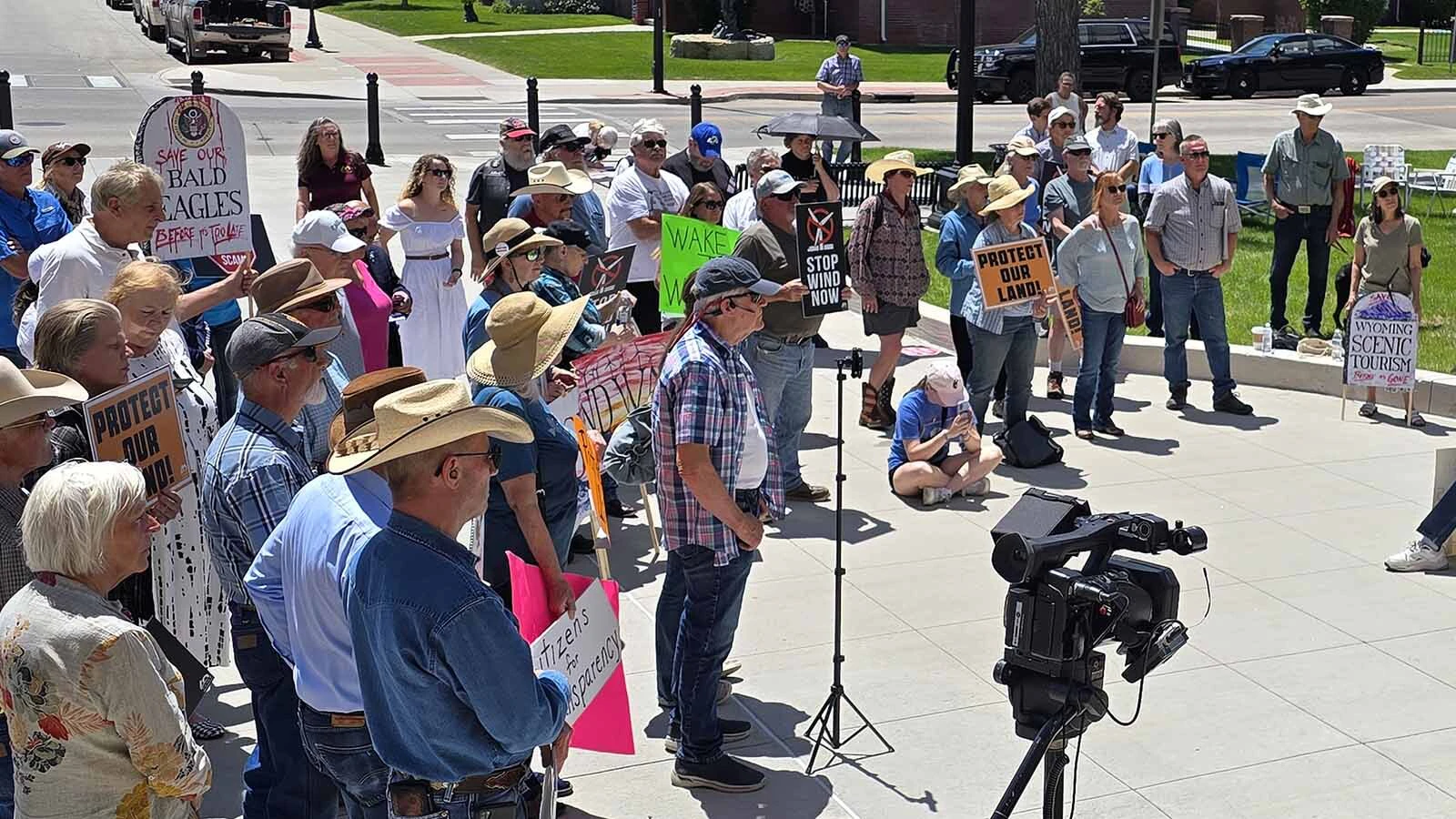
Across southeast Wyoming, ranchers like Volk and her family rarely show up at hearings in their own communities, much less drive hours to Cheyenne to attend Industrial Siting Council meetings or stand on the Capitol steps for something like a rally.
Making time to be in Cheyenne means leaving their families shorthanded for tasks involving animals and fields.
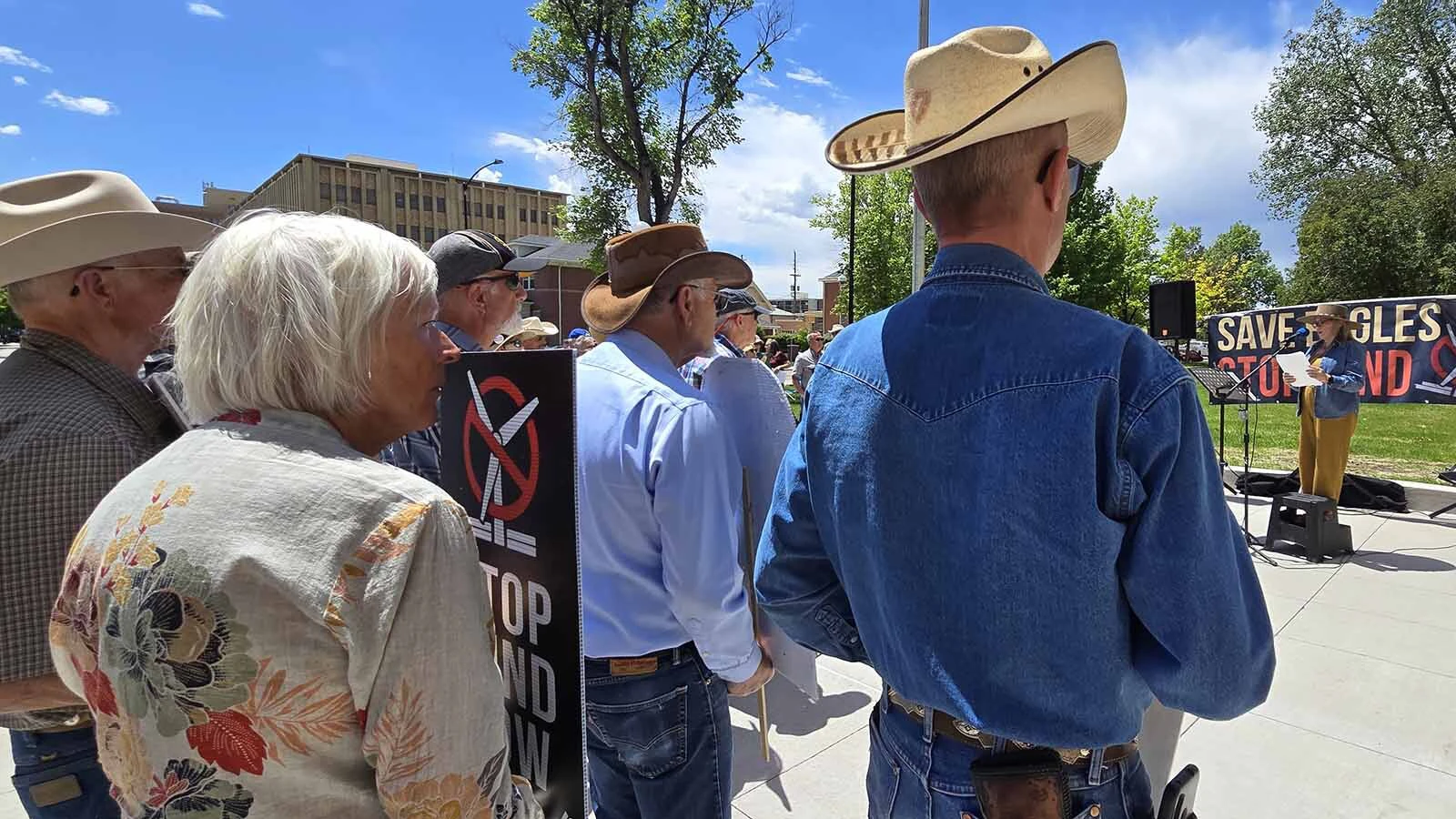
But Thursday, Stephens and Volk were there with other ranching families to help make a statement about what they feel is unprecedented and unconstrained growth of wind towers in Wyoming.
“These are not protest kind of people,” fourth-generation Wyomingite and Albany County Conservancy founder Anne Brande told Cowboy State Daily. “But they are calling me from Niobrara County, from Chugwater, from Wheatland, from Casper, from Goshen.
"People are just tired of these (wind turbines) in these rural communities. They want to have a state conversation about it.”
Brande’s group isn’t asking to stop every wind turbine, but they want tougher siting scrutiny, as well as a cumulative impact review that looks at how so many wind turbines showing up all at once will affect wildlife, migration corridors, viewsheds, agricultural land, and rural communities across Wyoming.
Wind turbines have already killed a number of golden eagles, Brande said.
“We’ve been trying to place a golden eagle nest cam,” she said. “We think that’d be a fun project, but we’re having a hard time locating a viable nest, a viable golden eagle nest, and that’s a very different narrative than what we had even two, three years ago.”
Golden Eagles In The Crosshairs
Federal policy analyst David Wojick has spent the past two years digging into what wind development is doing to golden eagles across the American West.
He says the Eagle Protection Act is misnamed and is actually a license to kill a certain number of golden eagles every time a project gets a permit. That’s because each permit allows a certain amount of eagle “take” or deaths.
“There’s supposedly a program whereby every eagle that’s killed by a wind turbine, 1.2 golden eagles are saved from electrocution, because the wind people pay to have power poles somewhere in the country fixed,” he said. “As far as I’m concerned, that’s all false, by the way. And that’s the thing that I’m the most focused on.”
Wojick has been involved in broad environmental impact assessments of offshore wind on whales for the last six or so years, and said that’s what he believes Wyoming needs to do about its wind wall.
“We’ve got this huge number of projects, some of which are built, some of which are under construction, and a whole bunch of which have been applied for in various processes,” he said. “And they’re being treated individually. The cumulative effect is obvious, and could be devastating.”
Wojick sees an “ecological death trap” phenomenon with such a widespread swath of land being taken up by wind towers.
“Somebody’s got to be looking at that,” he said. “The feds should be looking at it. I don’t know if there’s some provision in Wyoming wildlife law for this, but if there isn’t, then the governor should just like convene a task force or committee to look at this.”
Wojick has seen studies showing the number of golden eagles killed by wind turbines has doubled in the Rocky Mountain West.
He’s also heard ornithologist and bird biologist Bryan Bedrosian’s say that Wyoming’s golden eagle population has dropped by 30% over the last 20 years. Bedrosian is founder of Sporting Lead-Free, as well as conservation director at Teton Raptors Center.
“When you’ve got around 1,500 turbines at this point and with another 1,500 coming, I mean you could wipe (golden eagles) out, quite literally,” Wojick said. “You need to have a moratorium until somebody decides how many eagles you’re prepared to kill.”
What’s The Legacy For Future Generations?
For ranchers like Stephens and Volk, the wind wall isn’t theoretical. It’s either become the view from their front porches, or will be soon.
They’re not asking to turn back the clock on every wind turbine in the state. They just want a thoughtful look at the big picture, instead of a piecemeal approach.
“Governor Gordon’s recent executive order just yesterday regarding data center development recognizes many of these same concerns,” Volk said. “It acknowledges the importance of stewardship, water resources, wildlife, local communities and the entire region.
"If Wyoming recognizes the need to evaluate cumulative impacts associated with large-scale data center development, then we should be willing to examine the cumulative impacts of industrial corridors forming across southeastern Wyoming.”
The rally, she added, is not about protesting energy development.
“It’s about making sure Wyoming residents have a voice and the cumulative effects of these projects are honestly evaluated before our landscapes are permanently changed,” she said. “Today, I respectfully ask our city council members, our county commissioners, our state legislators, our state agencies, governing boards to consider the bigger picture, because southeastern Wyoming is not an empty space on a map.
"It is ranch land, it is wildlife habitat, it is open space, and it is our heritage.”
Wyoming has a responsibility, she added. to be good stewards of that land, and to consider carefully the legacy that will be left to future generations, a legacy she’s sketched out in pink sticky notes that paint what she feels will be a disquieting story.
Renée Jean can be reached at renee@cowboystatedaily.com.


