
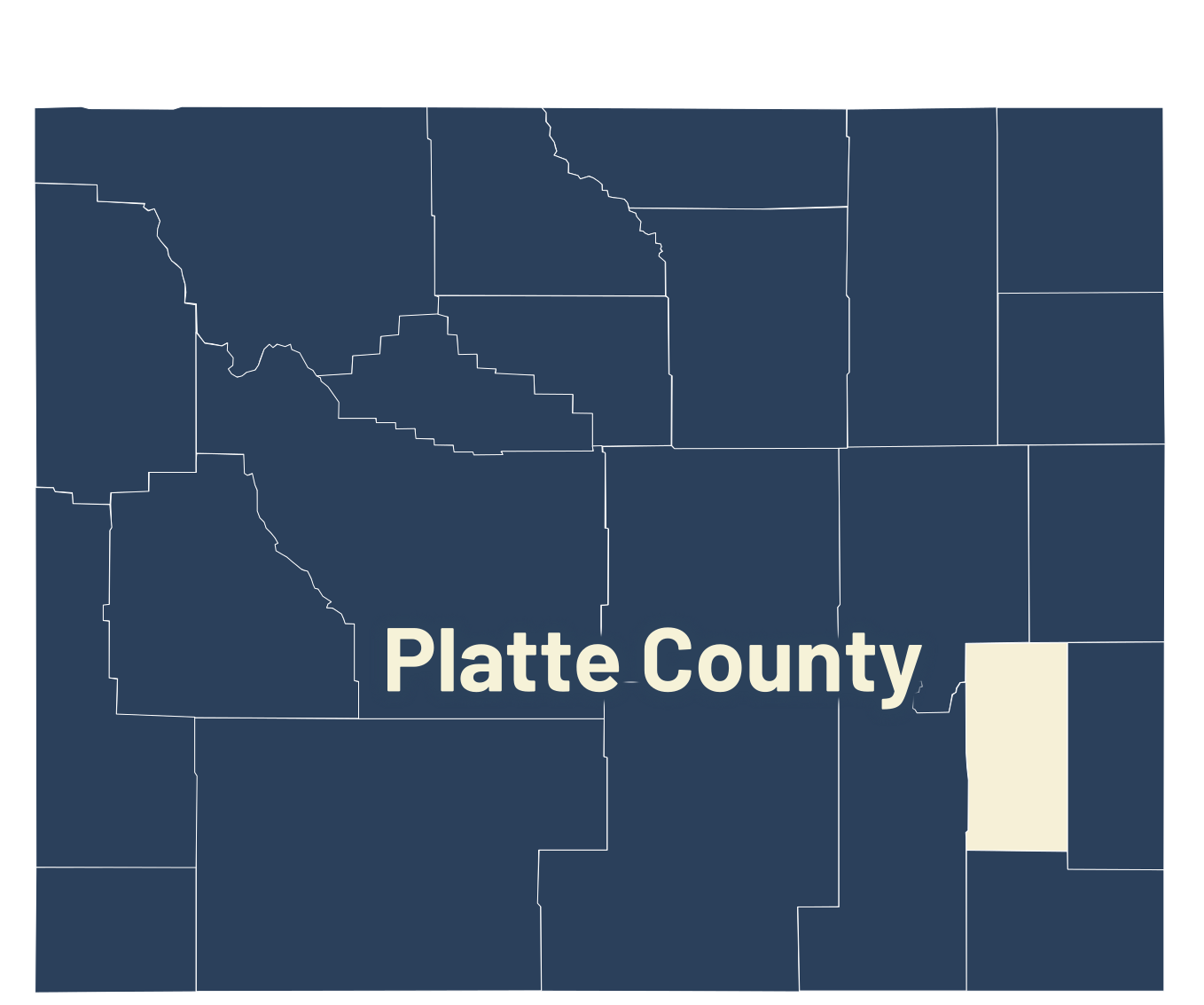
A massive wind and solar project spanning 49,500 acres in Platte County got a unanimous green light Wednesday from the Platte County Planning and Zoning Commission.
NextEra Energy Resources' Chugwater Energy Project is expected to generate about 300 megawatts of wind energy, 150 megawatts of solar energy and includes a 150-megawatt battery energy storage system.
The project will include up to 150 wind turbine generators, and the construction phase will create up to 300 jobs, with eight to 12 full-time positions for ongoing operations.
Planning commissioners faced a room full of county and town residents, including farmers and ranchers at a public hearing for about two hours of public comment prior to voting unanimously to approve moving forward with the project.
Their votes, which came about with three motions, took less than 30 minutes. The unanimous vote will go to the Platte County Commission as the group's recommendation. Any final decisions on county approval for the project will be made by the commission.
To Start With …
“Please try to stay open-minded and level-headed,” said Planning and Zoning Commission Chairman Marty Shepard.
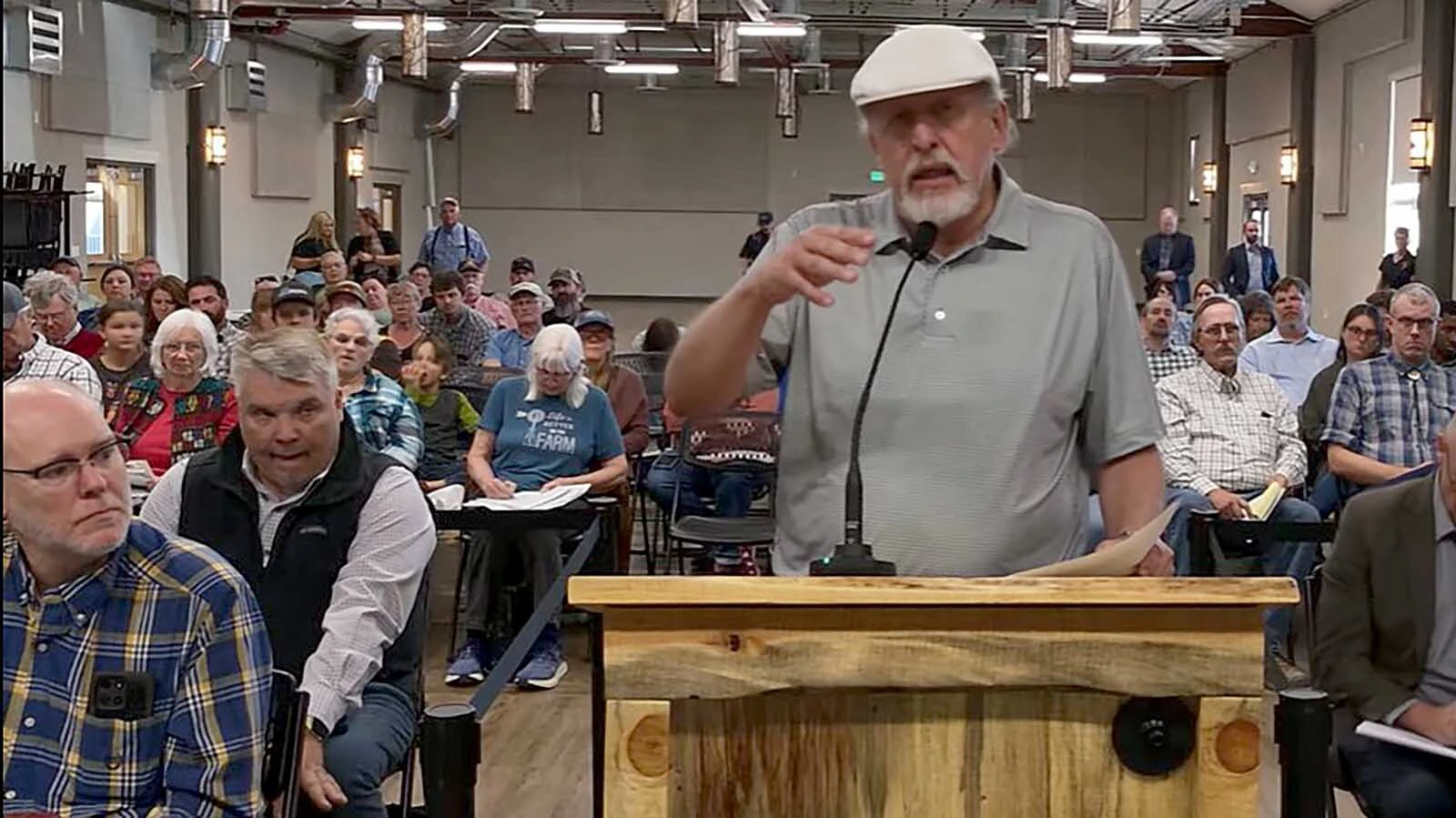
Prior to approving the public hearing rules, Platte County resident Jill Caufmann requested removing the restriction of a time limit on public comment and removing a clause condemning derogatory comments.
“If I understand you correctly you would like to have removed from the rules of the meeting that people act dignified and second of all you object to the five-minute rule,” said Platte County Attorney Rex Johnson.
He said the board has the authority to conduct meetings in an orderly fashion, adding that if they didn’t put a time limit on the public comments, “We’d be here until Christmas.”
Developer Anthony Bianchini, a senior project manager with NextEra Energy, introduced the project, saying, “Today we want to be clear about what we are proposing, why this project makes sense, how this project has been designed and why it meets Platte County’s requirements.”
A slide show he presented covered aspects of the proposed projects including environmental and community impacts, transmission line siting considerations, noise regulations, battery storage statistics.
The project would include construction, maintenance, operation, decommissioning and land reclamation.
“The county has some of the best wind potential anywhere in the nation,” Bianchini said.
Chris Brown, executive director of Powering Up Wyoming, remarked that three proposed Wyoming energy projects — the Rail Tie, Laramie Range and Chugwater — comprise less than 2% of the overall landmass of southeast Wyoming, which he classified as Albany, Laramie, Platte and Goshen counties.
He also said the economic benefits from the Chugwater project were important to consider, given property tax reductions that local communities are facing due to recent legislation.
“We think this is a good project,” Brown said. “We stand in favor of it moving forward.”
Landowners React
A number of Chugwater-area ranchers and farmers attended the hearing, many speaking in favor of the proposed project because of how it would support their operations.
Dan Kirkbride operates a 102-year-old ranch outside of Chugwater. The project would largely increase his family’s annual income, he said.
He added that it would contribute to the county’s coffers at a time of declining property tax revenue.
“If the Chugwater community picks up even a few of the workers as permanent residents that’s good news,” he said. “Every family is important to our little town and school.”
Kirkbride was sympathetic to those who oppose the project.
“We realize it’s a hard situation for folks who feel they are captive to it,” he said.
But, said Kirkbride, we live in a world of development. These developments “all contribute to the conveniences that sustain our everyday life.
“The council has hard decisions ahead of you,” he said.
Robert Moxley spoke to the commissioners about a wind co-op he helped establish two decades ago where area landowners pooled up to 10,000 acres of land to offer to wind developers.
“We were hoping to make our farms productive in a climate where agriculture has become impossible,” said Moxley, who is a lifelong Chugwater resident and owns land that will be impacted by the project. “I want to see this project go through.”
Moxley said he worked 60 hours a week for years, trying to turn a profit on his family’s wheat farm.
“It’s not worth anything as a wheat farm,” he said. “It’s got grass growing on it. I want to be able to earn some money off my land.”
Cole Borchardt, who graduated from Chugwater High School in 2004, spoke in favor of the project for the growth it could mean for his hometown.
He told commissioners he left the area after high school because he didn’t see many opportunities at home. After a stint working in oil fields and construction, he returned to his family’s ranch.
He told the commissioners that six kids from his graduation class stayed in Chugwater to do business.
“Wyoming’s not growing much,” he said. “You either grow or you die. You have to change some if you want to grow some.”
Paul Norfleet, a sheep rancher who recently moved to Chugwater, spoke about the challenges of farming and said the project would allow revenue to come to his ranch.
That revenue, he said, would go toward regenerating the land.
Solar panels would be a boon to his sheep, he said, because the panels would allow the sheep to graze for several weeks longer than normal.
Norfleet said condensation collects on the solar panels and then drips onto the ground, providing strips of grass for grazing.
“It seems like a win-win situation,” he said.
Opposition
Holding back tears, John Burns, who serves on the Chugwater Town Council and owns land within 1 mile from a proposed power line, expressed concern over the project turning Chugwater into a ghost town.
“Nobody wants to live near a power line. That’s a simple fact,” Burns said. “If this goes forward as it is, Chugwater’s going to die.”
Earl Wright, a landowner who lives “right next door” to where proposed solar panels would be placed, voiced concern over how his property would be affected by solar panels.
He worried the heat generated from the panels would negatively affect his trees and the wildlife he enjoys seeing on his peoprty.
He also expressed concerns over increased traffic. The road to his house is already bumpy, he said, adding, “the road gets so rough I have to get my teeth fixed.”
“If they put those panels around my house, my property will become basically worthless,” he said.
Caufmann, who had challenged the rules of the public hearing prior to the public comment period, presumed that none of the energy generated from the project would be used in Wyoming.
Several landowners questioned the fire risk with a battery storage facility so close to their land.
Cowboy State Daily previously reported that Cheyenne will also likely be expected to aid the Chugwater Fire Department in emergency response to the construction site.
Mayor Patrick Collins said Cheyenne has one of the only teams in the area capable of performing emergency rescues in high places like the tops of wind turbines.
Viewshed Concerns
Eric Jones, representing the town of Chugwater, spoke to the importance of preserving the town’s viewshed.
“The town of Chugwater would like to preserve its views,” he told the planners.
Burns said the project’s proposed transmission line would be visible near town and go “right on top of the bluff and the billboards.
“The power line will kill Chugwater if it’s in sight of the town,” he said.
He continued, “We’re a town in dire straits. People move here for the bluffs and the access to state land. We need to protect that.”
Kate Meadows can be reached at kate@cowboystatedaily.com.


